The Development Logic of DAT
By the end of 2025, Digital Asset Treasury (DAT) will still be one of the most noteworthy corporate behaviors in the cryptocurrency industry. An increasing number of companies are choosing to incorporate digital assets into their balance sheets, a behavior that is no longer just passive participation in market trends but an attempt to transform digital assets into strategic resources that can be utilized long-term. As the market environment and regulatory expectations gradually change, the DAT industry is undergoing structural optimization and capability selection, with its core value shifting from mere asset holding to testing the strategic execution capability of enterprises.
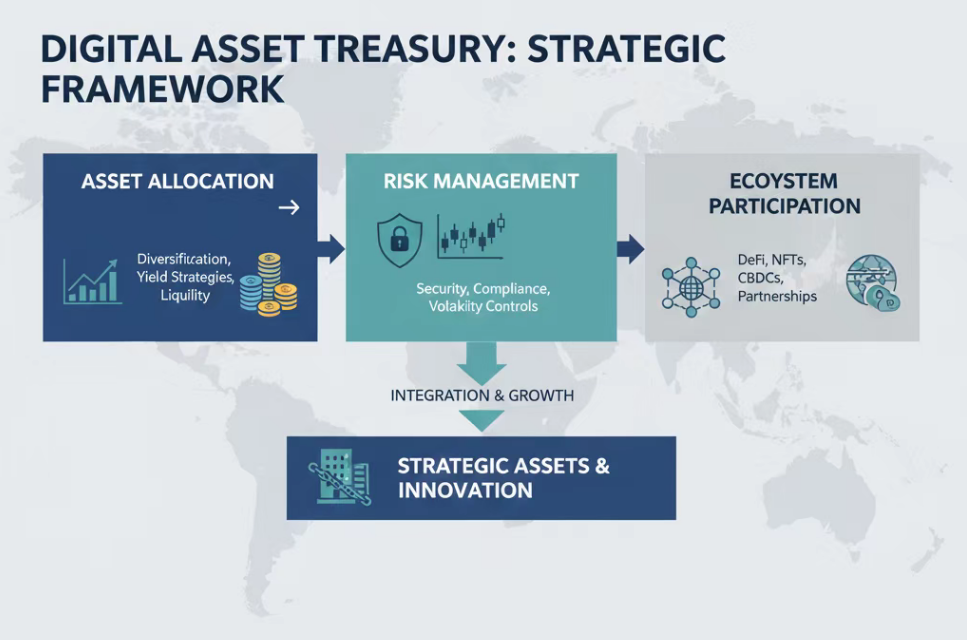
Typical DAT companies usually raise funds through stock financing, bond issuance, or private placements, and allocate them to mainstream digital assets such as Bitcoin and Ethereum. Compared to earlier strategies focused on "hoarding coins," companies today place greater emphasis on the rationality of asset allocation, risk control systems, and strategic linkage with the blockchain ecosystem. On one hand, digital assets provide companies with asset diversification and long-term value potential; on the other hand, companies must simultaneously establish cash flow management and risk constraint mechanisms to ensure operational continuity. Additionally, holding digital assets means that companies can participate in on-chain governance, staking, and lending, thereby gaining deeper participation rights and influence at the ecosystem level. This change indicates that DAT has gradually become part of the corporate strategic management system, rather than just a line item on the balance sheet.
Market Structure and Corporate Performance
From recent industry performance, DAT companies are entering a clear phase of structural adjustment. Some companies stabilize market expectations and improve shareholder structures through share buybacks and asset portfolio optimization; others are gradually returning to a more robust operational path through strategic contraction or asset adjustments. Meanwhile, index organizations like MSCI are beginning to reassess the inclusion criteria for DAT-related companies, significantly increasing their focus on corporate information disclosure, governance structures, and operational stability. This means that the market is weakening its reliance on asset scale and short-term price performance, instead evaluating companies' operational capabilities and risk management levels in complex environments.
Notably, some companies with a core allocation in Ethereum-related assets have shown relative resilience during recent market adjustments. This is not merely a reflection of the advantages of a single asset but more so highlights the important role of asset diversification, business synergy, and governance capabilities in a company's long-term performance. Overall, the changes in market structure are driving the DAT industry from an "asset-driven" approach to a "capability-driven" one.
Corporate Behavior and Strategic Choices
Starting from specific corporate behaviors, we can more clearly understand the strategic logic behind DAT.
At the asset level, companies no longer view digital assets as isolated investment targets but incorporate them into a long-term capital allocation framework to support future business expansion and ecosystem layout.
At the risk and stability level, companies balance market expectations and internal robustness through asset diversification, share buybacks, and operational structure optimization. The significance of these operations lies not in short-term market feedback but in securing greater strategic maneuvering space for the company.
At the ecosystem level, holding digital assets enables companies to participate in on-chain governance and ecosystem building, transforming financial behavior into actual influence and voice. This shift from "asset management" to "ecosystem participation" is becoming an important path for DAT companies to build long-term competitiveness.
In summary, DAT has evolved from simple coin-holding behavior to a comprehensive practice that integrates asset strategy, risk control, and ecosystem participation.
Industry Trends and Corporate Differentiation
From a longer-term perspective, the evaluation criteria for the DAT industry are undergoing substantial changes. Market focus is gradually shifting from asset scale and short-term price fluctuations to companies' operational capabilities, cash flow stability, and governance transparency. This change directly drives differentiation among companies: those with clear asset strategies, diversified allocations, and robust governance structures are more likely to establish advantages in long-term competition; while companies that heavily rely on a single asset or market sentiment face significant limitations in strategic flexibility and sustainability.
More importantly, some companies have begun to transform digital assets into sustainable strategic resources through business synergy, ecosystem participation, and asset management. This path does not depend on a single market phase but is built on long-term capability development, constituting the core direction for the future development of the DAT industry.
Conclusion
The true value of DAT companies lies not in how many digital assets they hold, but in whether they can incorporate these assets into a clear strategic framework, establish a robust operational system and governance structure, and form a continuous participation capability at the ecosystem level. By observing corporate behaviors and changes in industry structure, it is evident that the DAT industry is moving towards a competitive stage centered on strategic capability and long-term execution power.
Understanding DAT essentially involves understanding how digital assets transition from a financial tool to a key resource within a corporate strategic system. This transformation not only reshapes the way companies manage assets but also provides new judgment coordinates for investors and industry participants. In the future, companies that can form a positive synergy between asset strategy, risk management, and ecosystem participation are more likely to establish long-term, stable competitive advantages within the DAT framework.
免责声明:本文章仅代表作者个人观点,不代表本平台的立场和观点。本文章仅供信息分享,不构成对任何人的任何投资建议。用户与作者之间的任何争议,与本平台无关。如网页中刊载的文章或图片涉及侵权,请提供相关的权利证明和身份证明发送邮件到support@aicoin.com,本平台相关工作人员将会进行核查。


