
Original: hooeem
Translation: Yuliya, PANews
If you are tired of the 9-to-5 life but don’t know how to break free from this cycle, then this article is for you. This is not about cryptocurrency or get-rich-quick schemes, but a practical guide to financial freedom.
From how to turn your job into a springboard, to finding your passion, to navigating the attention economy, building communities, achieving diversified monetization, and smart investing, this article will provide you with a clear path to move from the ordinary to the extraordinary.
1. Work
Believe it or not, young people need money to maintain basic living, such as filling their stomachs and providing shelter. Work is not a constraint but a means to achieve financial freedom. If you cannot stick to a 9-to-5 job, then you may lack the motivation to achieve financial freedom, let alone accumulate enough income.
A 9-to-5 job is not just a means of making a living, but also creates more possibilities for the “5-9” time after work. Instead of being busy only to find out after retirement that your health is damaged and you cannot enjoy life, it is better to strive for personal goals while you are young, energetic, and have fewer responsibilities. Although the process is not easy, it is the hard work of the present that paves the way for a better life in the future.
2. Luck (Non-essential Accelerator)
If you are lucky enough to receive family support and live at a low cost when you are young, you will accumulate wealth faster.
- Make good use of advantages: This is not a necessary condition for success, but if you have this luck, it means you have better cards than others. Don’t feel guilty about it; use it without reservation.
- Turn adversity into motivation: If you don’t have this luck, then turn the “bad cards” you have into powerful fuel that motivates you to move forward.
3. Passion
What is your passion? What do you truly love and understand? This is the core of your career.
- Find your creative source: Think deeply about the topics you would be willing to create content about every day; it could be football, fashion, movies, cryptocurrency, economics, travel, food—anything.
- Find the intersection: If your passion is not clear, list all the things you like and look for their intersections. For example, someone may like AI, cryptocurrency, robotics, privacy, and finance; the intersection here is technology and market. This way, they will have a continuous stream of content to create.
4. Attention Economy
If you are reading this on your phone, laptop, or tablet and have an internet connection, then you already have the tools to connect to the world economy.
In today’s world, attention is money. The most successful companies now use attention to sell products, and you can sell anything that provides value to others.
- How to harness attention? By building a community.
- How to build a community? By providing value for free on social media.
In summary: You have a job, a passion, and tools to connect with the world. Now, the real challenge begins.
5. Building a Community from 0 to 1
Step 1: Start
Precise positioning: Choose a niche that you are familiar with and can produce content for a long time. If you have already clarified your interests, then your niche is basically determined.
Professional image: Choose a simple, recognizable username and nickname that is highly relevant to your content area. No one will follow a bland account. Your username should clearly convey who you are and what you do, maintaining professional consistency both visually and semantically. Additionally, use a striking and high-quality avatar to reinforce brand recognition. The avatar can be a real photo or a stylistically uniform AI image, but it must be clean, clear, and relevant to the content theme, ensuring it is easily recognizable in the information flow.
Value declaration: Write a clear, value-focused personal introduction that specifies what problems you can solve for others and what results you can create (avoid excessive personal details). People only care about what you can offer; they are not interested in your private life. Keep the homepage header image simple, professional, and highly relevant to your core positioning.
Step 2: Create a List
- Search for peers: Now, you need to do some “homework” in your field. Search for keywords related to your passion on social platforms (like X/Twitter). Find active accounts in that field (you may already be following them, which makes it easier), aiming for at least 100 active accounts.
- Layered management: Then, categorize these active accounts based on their follower count (e.g., 0-5k, 5k-10k, 10k-25k, 25k-100k, 100k+).
If you don’t understand why to do this, here’s the explanation:
- The first category is your initial social and cross-promotion targets. You are at a similar stage with similar interests, and when you frequently provide valuable replies to their content, they will follow you (don’t beg for attention), and you can grow together.
- The second and third categories follow the same logic. As you grow, you will be noticed by accounts with larger follower counts and can further cross-promote.
- The fourth and fifth categories are for instant replies to their high-quality posts. They have a large follower base and an audience that is highly relevant to you. If you don’t understand why this is important, please realize this: you will have the opportunity to showcase your account to hundreds of thousands of people. All you need to do is quickly reply to their content and provide high-quality, valuable insights. Don’t just reply with “nice,” as no one will visit your homepage for such replies; don’t use AI-generated replies, as they can be easily recognized. Be sincere, be yourself, and provide your experience and thoughtful value in a specific field, and then watch your account grow continuously.
Step 3: Grow Your Account
- From 0 to 5,000 followers: Post at least 15-20 updates daily, including 3-5 original content pieces, and make at least 10-15 high-value replies to the accounts on the list; the more, the better. Make the replies thoughtful and engaging, avoiding generic comments. Retweet your best-performing content for more exposure.
- From 5,000 to 10,000+ followers: Continue to maintain 10-15 replies daily (or even more); increase original content to 7-10 pieces daily; start using automation tools to schedule posts while you sleep, keeping the account active.
Step 4: Create Quality Content
- Use short, easy-to-browse text (avoid long paragraphs).
- Use lists, line breaks, and keywords to make content more eye-catching in the timeline.
- Retweet high-performing content for secondary exposure.
- Present list-style content in threads/long posts.
- Write articles to provide in-depth, engaging content.
Step 5: Avoid Pitfalls
- Don’t rely on “follow-for-follow” strategies.
- Avoid overusing hashtags and abusing @mentions.
- Don’t plagiarize; keep it original and add value to your field.
Step 6: Scale Up
- Drive traffic to yourself through valuable replies;
- Increase follower conversion through a clear homepage introduction and strong pinned content; people will check your account because of your value;
- Gain quality followers and further dissemination by interacting with high-quality accounts;
- Use automation tools and newly established networks to further develop; this is a cross-promotion strategy.
Case Study: Drizz

Some may question whether this approach is effective; you can look at a case application.
- Starting point: Drizz had only 24 followers at the time.
- Action: Created content around macroeconomics. Published an article related to FOMC as it approached.
- Result: Followers grew from 24 to 157.
- Follow-up: Later, the account reached 527, but due to insufficient frequency of posts and replies, growth did not reach a potentially higher level.
Since then, the account has admitted that it sometimes wanted to give up and did not maintain the necessary persistence. That’s okay; this path is not suitable for everyone. But to truly stand out, you must treat this as your “5-9” endeavor, not just a “hobby.”
6. Commercial Monetization
If you cannot monetize, then all the efforts made in building a community are meaningless. It must be clear: building a community is very difficult; it is not impossible, but it is extremely time-consuming. This means that after finishing your 9-to-5 job every day, instead of lying down and binge-watching shows, you should continue to write content around your passion, break down problems, and continuously provide value.
Fortunately, you can use AI to help brainstorm, but AI cannot replace your writing. People can easily see through AI-generated content, and you will not be able to establish the connections necessary for scaling and success within the community.
Of course, you may receive some ad revenue from platforms, earning a little pocket money. But our goal is financial freedom, right? Here are several compliant and long-term effective monetization methods.
Path 1: Platform Ad Revenue (“Money from Musk”)
Once you establish your account, you will be able to earn ad revenue from the platform. The core of X platform’s profit model is to attract high-quality users, not merely to pursue follower count or superficial data. The platform is more inclined to reward users who truly create value rather than those who complain about the algorithm. The platform only cares about one thing: convertible attention. The goal of the X platform is to attract users with purchasing power, whom advertisers are interested in and willing to invest in the platform, such as subscribers of the Premium blue check. The platform algorithm is not targeted at individuals but is more inclined to promote attractive and conversion-potential content.
Key factor for monetization: Your income depends on the quality of your audience, not the quantity.
- Geographic location: Followers from the US and EU can bring in more ad revenue.
- Paid users: Followers with premium membership are worth ten times that of regular followers.
- Content type: Some topics generate little income, while others are lucrative. You need to enter fields where advertisers are willing to spend money to get attention, such as finance and cryptocurrency.
- Consistency: Stable output is more important than viral hits.
How to truly get paid? Besides audience quality, you should also focus on:
- Replies, retweets, and quotes that reflect genuine interaction.
- Time spent: This silent metric determines the fate of your content.
- Long-form content that attracts attention, such as articles and videos over two minutes long.
- Online Q&A events (AMA Spaces) that enhance community cohesion.
Mastering these will turn the platform from a mystery into a predictable machine. To get paid, you need to meet basic requirements: be at least 18 years old, enable two-factor authentication, verify your email, have 500 followers, achieve 5 million impressions in the past 90 days, and activate a Premium subscription. Once you connect Stripe, you can start earning passive income.
Path 2: Sell "Skills"
People are willing to pay for the following:
- Methodologies
- Breakdown and review
- Research systems
- Templates
- Workflows
Here’s a complete guide on how to do it:
- Choose skills that people are truly willing to pay for: You are not writing a diary; you are packaging a solution. First, ensure you have a deep understanding of the relevant field, while focusing on the pain points people face in that area and assessing the actual value of solving those problems. Additionally, observe whether there is a clear demand online. Whether it’s market analysis, design, writing, fitness, cryptocurrency, programming, or efficiency improvement, as long as there is demand and results can be created through knowledge, it could be a worthwhile direction to develop.
- Define the transformation: Every successful product accomplishes one thing: it takes the reader from point A to point B. Specifically, you need to answer two questions: What problem is the reader currently facing? And what goal will they be able to achieve after reading? If you cannot clearly articulate this transformation in one sentence, the product will be hard to sell.
- Build a clear framework: People do not simply buy raw information; they are more inclined to purchase structured content. Therefore, it is crucial to transform your skills into a clear process. An effective process can include several key steps: understanding the basics, setting up correctly, executing core skills, avoiding common mistakes, and expanding or optimizing results. Such a framework not only helps users quickly master skills but also enhances the product's practicality and value. It is important that users can implement the guide within the same day; if not, the product is unlikely to be considered high quality.
- Write an eBook/PDF: Use sharp language with no fluff. Employ simple language, short paragraphs, direct instructions, and screenshots to enhance clarity when necessary, providing examples only when needed. Tools like Canva or Google Docs can be used, ensuring a clean, readable layout with brand consistency. You don’t need a designer; clarity is key.
- Package the product: When promoting a product or service, the focus should be on the transformation users can achieve, not the specific content details. Users care more about whether they can save time, reduce uncertainty, avoid mistakes, receive clear guidance, and have a validated plan. Therefore, when introducing the product, emphasize what goals it can help users achieve rather than stressing the number of pages or modules it contains.
- Establish authority through content: Content is the core driving force behind product sales. Posting high-quality content daily helps establish authority and attract user attention. You can provide clear and valuable information through sharing insights, lessons learned, how-to guides, case studies, screenshots, framework analyses, and quick solutions. By continuously delivering high-quality and practical content, users will feel that the free content is already very helpful, making them naturally willing to purchase more in-depth paid resources, such as PDFs.
- Build a sales infrastructure: Setting up a sales infrastructure requires just a few key tools, including Gumroad, LemonSqueezy, or Payhip. Pair this with a landing page, a purchase button, and a clear call to action.
- Publish correctly: When releasing content, avoid simply throwing out links; instead, create anticipation: you can first introduce a problem, then showcase part of the content in the guide, explain who the target audience is, and share some user testimonials or early feedback. Additionally, pinning the main content post helps increase visibility. People are more likely to be attracted to content that is energetic, confident, and clearly expressed, so be sure to convey these traits when publishing.
- Iterate and upgrade: Continuously optimize the product through customer feedback to enhance user experience. Adding clear examples, templates, checklists, extra pages, and updated strategies can make the product more attractive and practical. These improvements not only help users better understand and use the product but also keep it competitive in the long run, making it a timeless choice.
- Build an ecosystem: When creating an ecosystem, a single guide is just one product, while three guides can constitute a business. To achieve this, it is advisable to create complementary assets, including beginner versions, advanced versions, niche-specific versions, as well as toolkits, cheat sheets, and templates. This is not just about making a PDF file but about building sustainable intellectual property.
- Repeat the cycle: Every time you master a skill, you can turn it into a product; every product is a stream of income; every buyer may become a repeat customer. The path is: learn, package, sell, optimize, expand, and cycle. Simple, efficient, and highly leveraged.
Path 3: Sell "Convenience"
- Understand what convenience is: Convenience is about removing obstacles, helping people achieve results faster, skipping painful processes, reducing choice costs, saving time, and avoiding confusion. If a product eliminates the "right friction," it transforms from valuable to indispensable.
- Identify tasks people hate doing: Convenience stems from frustration. Look for tasks that people avoid due to boredom, repetition, time consumption, technical complexity, or emotional fatigue.
- Package solutions into effortless products: Convenience must feel instant. It can be packaged as templates, checklists, automation scripts, AI prompts, plug-and-play systems, etc. If users can pick it up and use it within 60 seconds, it is often easier to sell.
- How to achieve quick results: The primary concern for users when choosing convenience products is "how to get results quickly." To meet this demand, developers need to focus on enhancing product efficiency, removing redundant content, and optimizing the usage process. Specific measures include providing clear operational instructions, clarifying how to execute each step, and adding screenshots when necessary to assist explanations. Additionally, break tasks down into small, repeatable actions and provide a simplified one-page operational guide to meet quick usage needs. Importantly, product design should avoid theoretical teaching and focus on providing direct and effective shortcuts to help users quickly achieve their goals.
- Make the offer irresistible: Users purchase convenience not because of low prices but because it significantly enhances their time efficiency. The appeal of products and services lies in whether they can help users save hours each week, simplify complex learning processes, reduce stress, provide clear solutions, offer competitive advantages, or deliver ready-made solutions. By showcasing saved time, reduced effort, and avoided frustrations, you can effectively convey the value of the product or service, thereby better appealing to users.
- Sell through demonstration, not persuasion: Show before-and-after comparisons, demonstrating how your method saves steps and time. If people "feel the ease," the product will sell itself.
- Build authority by solving small problems daily: Every piece of content you create should convey, "I make your life easier."
- Repeat this cycle: Identify obstacles -> eliminate obstacles -> package solutions -> sell results. Convenience is almost a legal "cheat" in the digital economy.
Path 4: Sell "Premium Communities"
People are willing to pay for the following:
- Access to unique resources
- Mentorship guidance
- Clear goals
- Enhanced accountability
- Direction
- Motivation to take action
- Being with like-minded individuals
A true premium community has its own culture: values, tone, language, standards, and a shared mission. People pay for a sense of belonging.
- Provide clear value: Clearly state what members will gain by joining and how their lives will improve. For example: daily analyses, workflow guides, live Q&A sessions, opportunities to interact directly with you, as well as practical tools, templates, and shortcuts.
- Offer transformation, not content: What truly makes members feel valued is their own growth and change. Every member should feel, "I am not the same person I was last month." Achieving this transformation requires clear direction, structured clarity, effective accountability mechanisms, daily motivation, and a sense of continuous progress.
- Opportunities to connect with you are core: Your presence, guidance, and attention are what add premium value to the community.
- Establish structure to maintain engagement: There should be weekly themes, regular activities, challenges, milestones, etc., so that members always know what to do next when they log in.
- Create a quality environment: Set rules to eliminate noise, spam, and low-quality questions. A clean community with 30 loyal members is better than a server with 3,000 "zombie" accounts.
- Community optimization enhances brand strength: The community, as a living organism, improves overall performance through continuous experience enhancement. Optimization methods include streamlining channels, adding new tools, bringing in experts, launching new templates, hosting meetings, and updating systems. Additionally, focus on listening to member feedback; every improvement will create a cumulative effect, making the community operate more sensitively.
- Expand rhythmically: When scaling, don’t rush to chase numbers; focus on "density." Community growth comes from consistency, transformation, word-of-mouth, results, and member victories. When spontaneous recommendations arise saying "you must join here," a positive cycle will begin.
Other Monetization Methods
- Revenue-sharing tools: Earn commissions by promoting referral links for other digital products.
- One-on-one support and assistance: Similar to paid communities, offer personalized services.
- Merchandise: If the product is cool and fits your field, you can sell related merchandise.
Important reminder: Do not over-market. Maintain a balance between content and sales (recommended at least 5:1), or you will quickly lose the trust of your followers.
7. Balance and Savings
When income starts to improve, the most common risk is: living costs rise rapidly, leading to debt for a "more refined life," resulting in being tied to the system for longer.
What needs to be done is to save and clearly delineate cash flow:
- Use your 9-to-5 income to cover living expenses (what you could do before, you can do now);
- Use the extra income from your "5-9" time to save.
Of course, you can go on vacation and enjoy good food, but don’t be overly extravagant and squander all your income. You need this money to truly achieve financial freedom.
8. Investment
Do not trade, do not gamble; invest savings to appreciate assets and outpace inflation.
Depending on your location, find the best investment methods to reduce capital gains tax (e.g., ISA stocks and shares accounts in the U.S.).
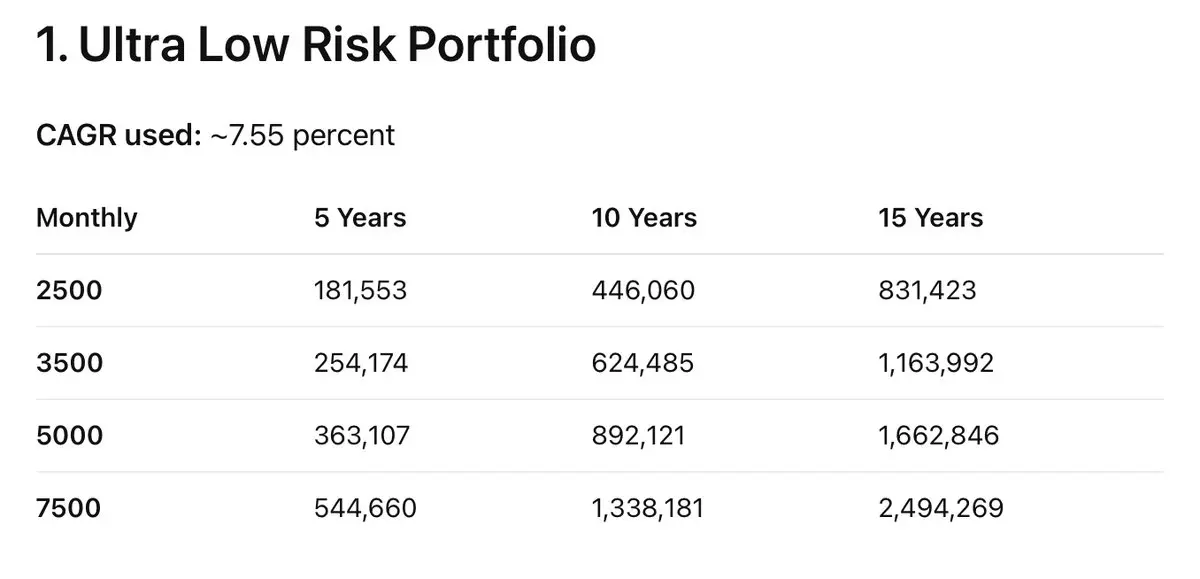
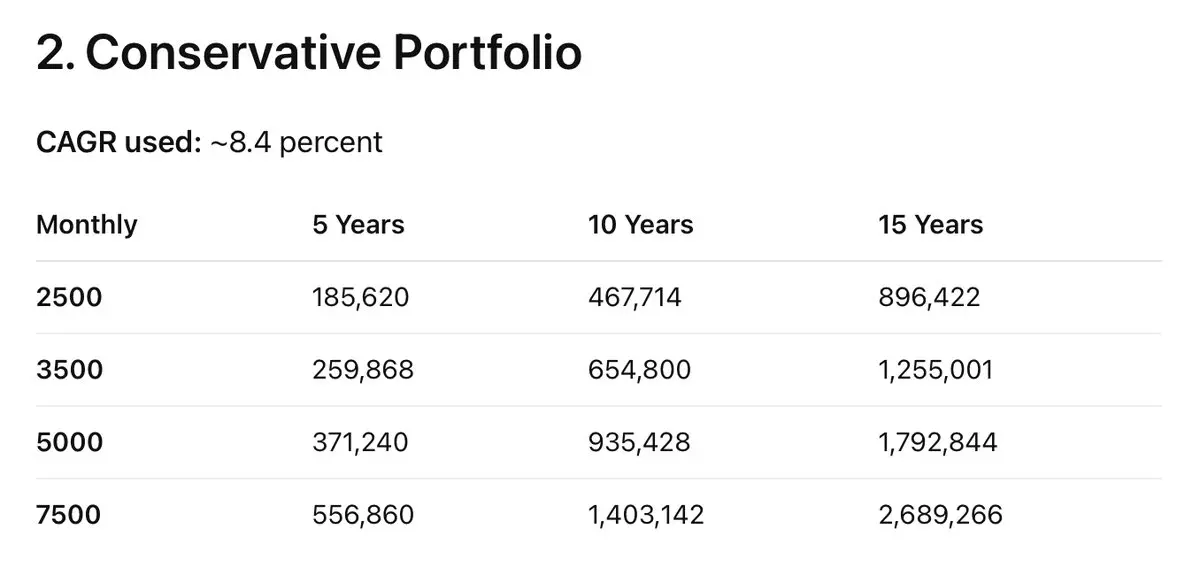
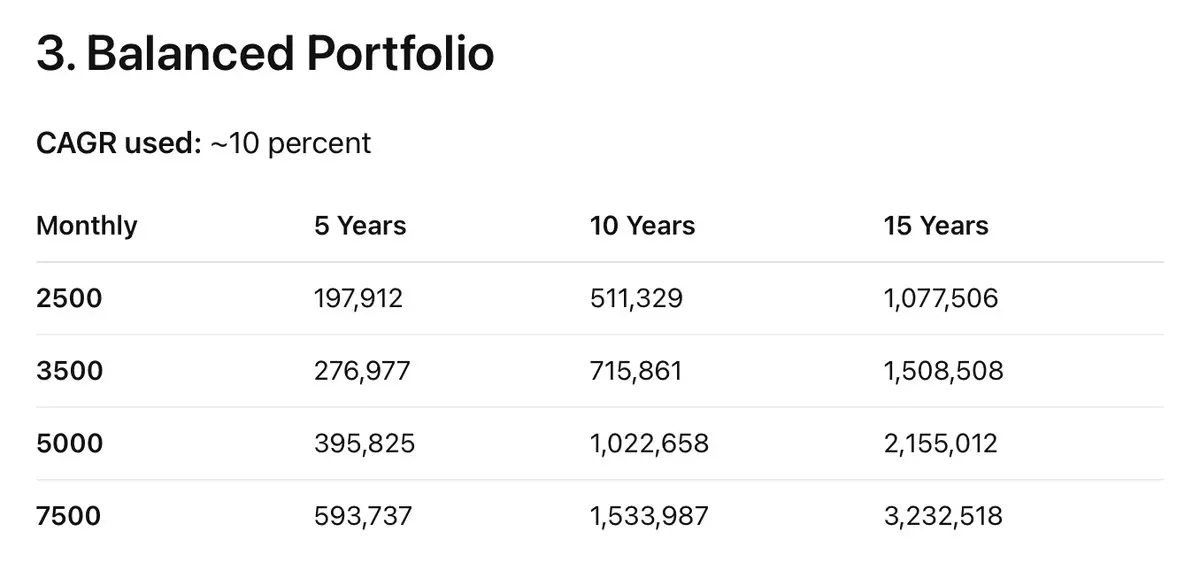
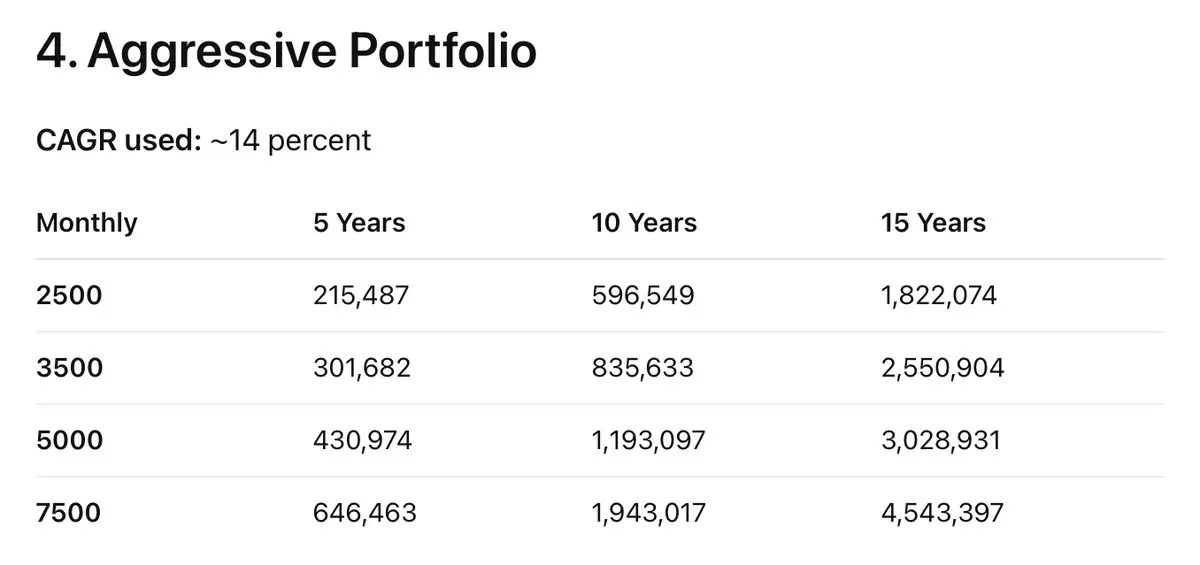
Here are five investment portfolios, along with their expected volatility and compound annual growth rate (CAGR), as well as expected returns after 5, 10, and 15 years.
*Note: NFA, DYOR.
1. Extremely Low-Risk Portfolio
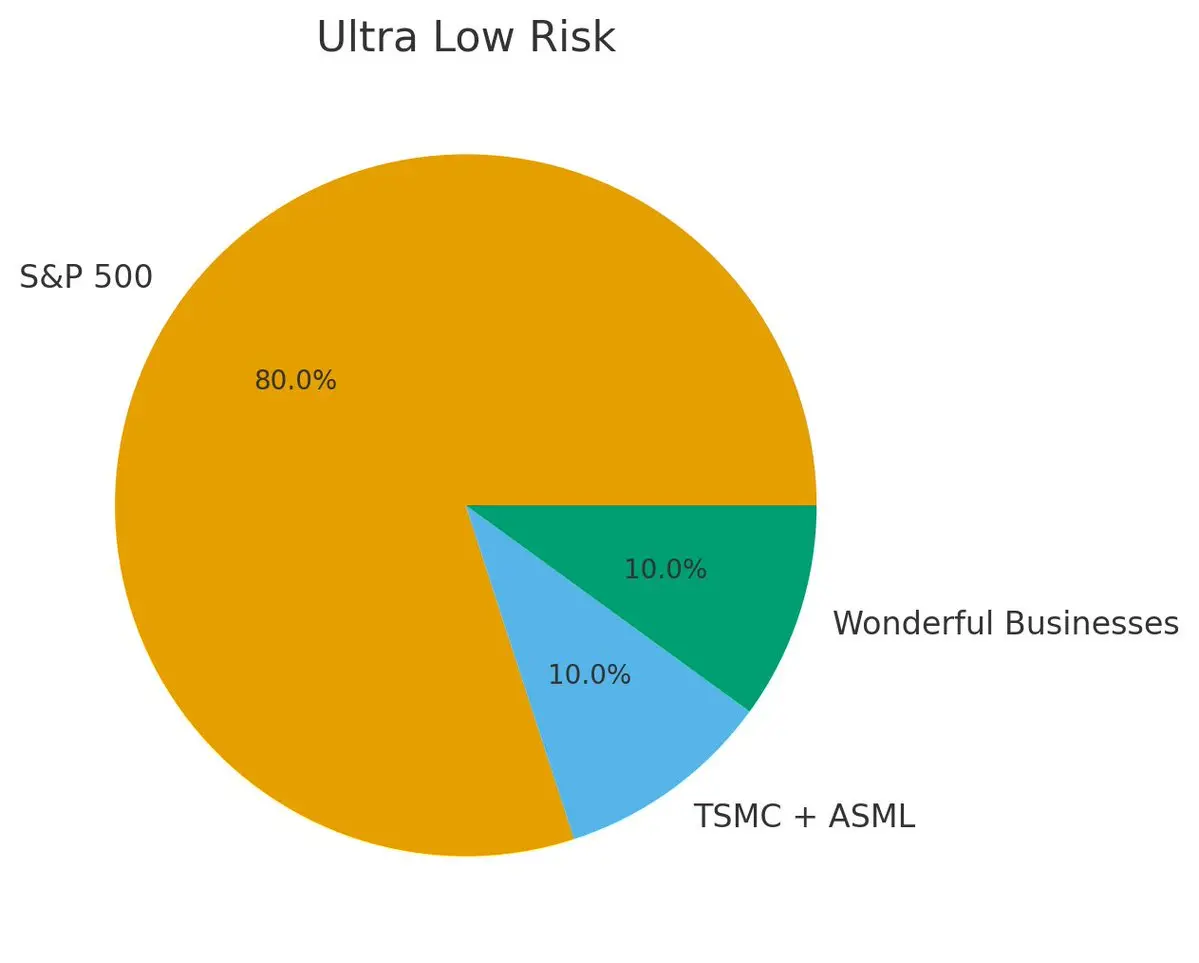
- 80% S&P 500 Index: Broadly and diversely invest in the U.S. stock market, providing stability, lower volatility, and long-term consistent performance.
- 10% TSMC and ASML: These two companies are at the core of global semiconductor and AI production, possessing deep moats and high demand.
- 10% "Quality" companies: Such as American Express (AXP), Visa (V), Mastercard (MA), Moody's (MCO), S&P Global (SPGI), Ferrari (RACE), Hermès (RMS), etc., which have lasting competitive advantages and predictable earnings.
- Portfolio metrics:
- Expected CAGR: 6.7% - 8.4%
- Volatility: 12% - 13%
2. Conservative Portfolio
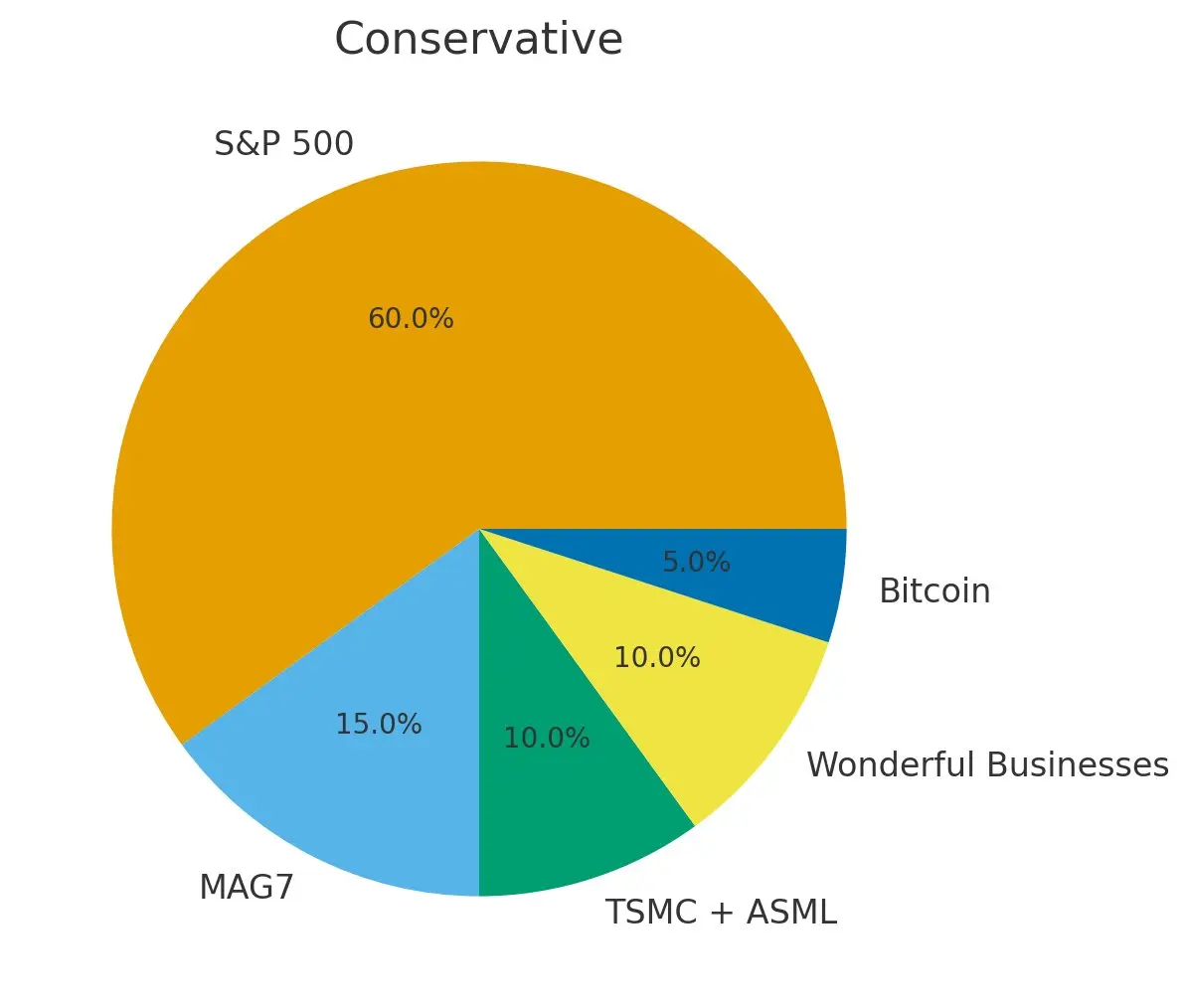
- 60% S&P 500 Index: The core defensive foundation.
- 15% MAG7 (Tech Giants): Invest in the world's strongest tech companies at a manageable scale.
- 10% TSMC and ASML: Key semiconductor infrastructure.
- 10% "Quality" companies: Reliable global compounding machines.
- 5% Bitcoin: Small position allocation to capture asymmetric upside potential without distorting overall volatility.
- Portfolio metrics:
- Expected CAGR: 7.5% - 9.3%
- Volatility: 14% - 17%
3. Balanced Portfolio
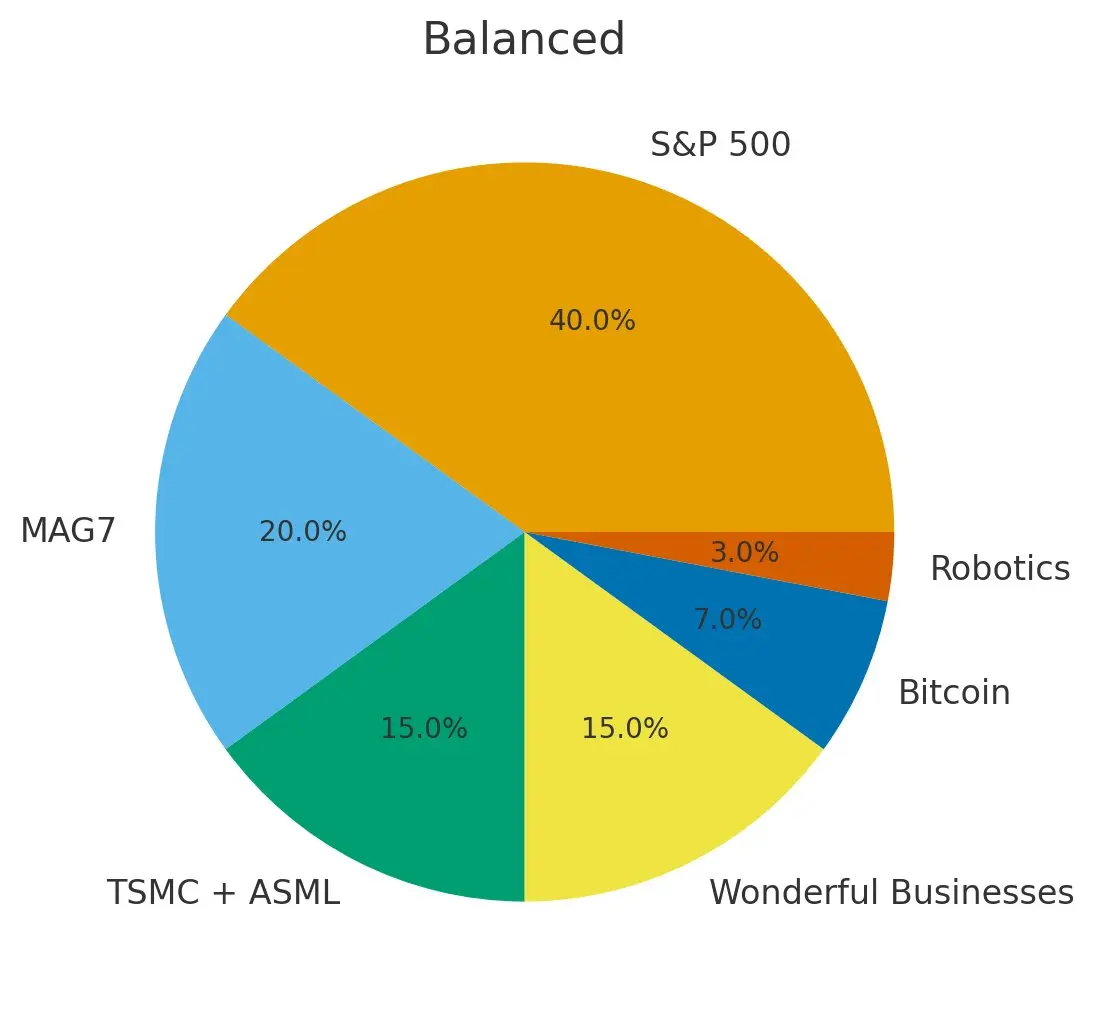
- 40% S&P 500 Index: A solid foundation to stabilize the overall portfolio.
- 20% MAG7: Key engine for long-term tech growth.
- 15% TSMC and ASML: Monopolists in the AI and semiconductor fields.
- 15% "Quality" companies: Balanced, predictable cash flow.
- 7% Bitcoin: Provides long-term convexity.
- 3% Robotics: Small position investment in emerging innovative fields without taking on excessive risk.
- Portfolio metrics:
- Expected CAGR: 9% - 11%
- Volatility: 17% - 20%
4. Aggressive Portfolio
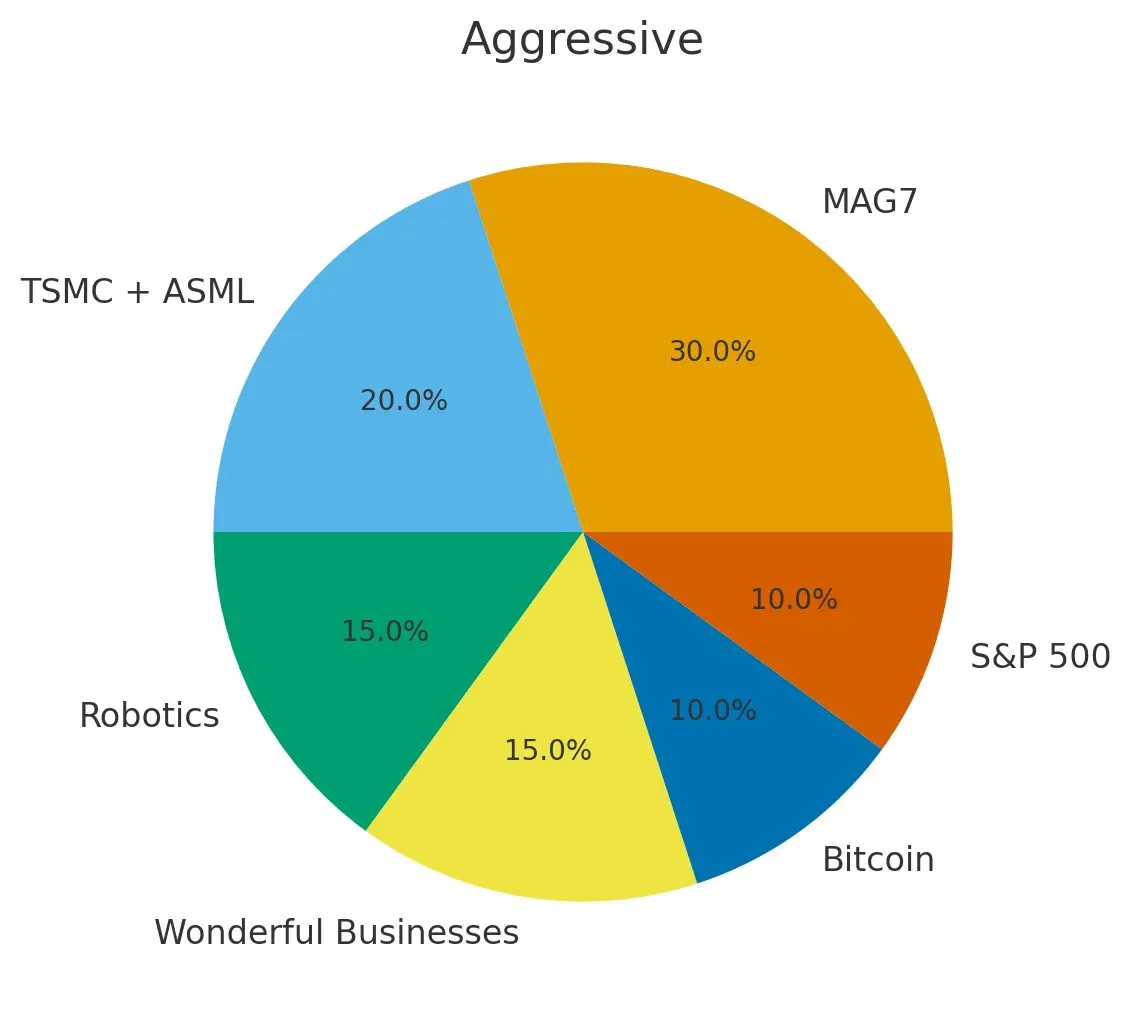
- 30% MAG7: The strongest tech platforms and AI leaders globally.
- 20% TSMC and ASML: Key AI infrastructure.
- 15% Robotics: Companies like UBTech, Xpeng, Unitree, which are highly innovative but also highly volatile.
- 15% "Quality" companies: Provide high-quality ballast during market downturns.
- 10% Bitcoin: Significant asymmetric upside potential.
- 10% S&P 500 Index: Marginally reduces volatility.
- Portfolio metrics:
- Expected CAGR: 12% - 16%
- Volatility: 25% - 32%
5. Extremely High-Risk Portfolio
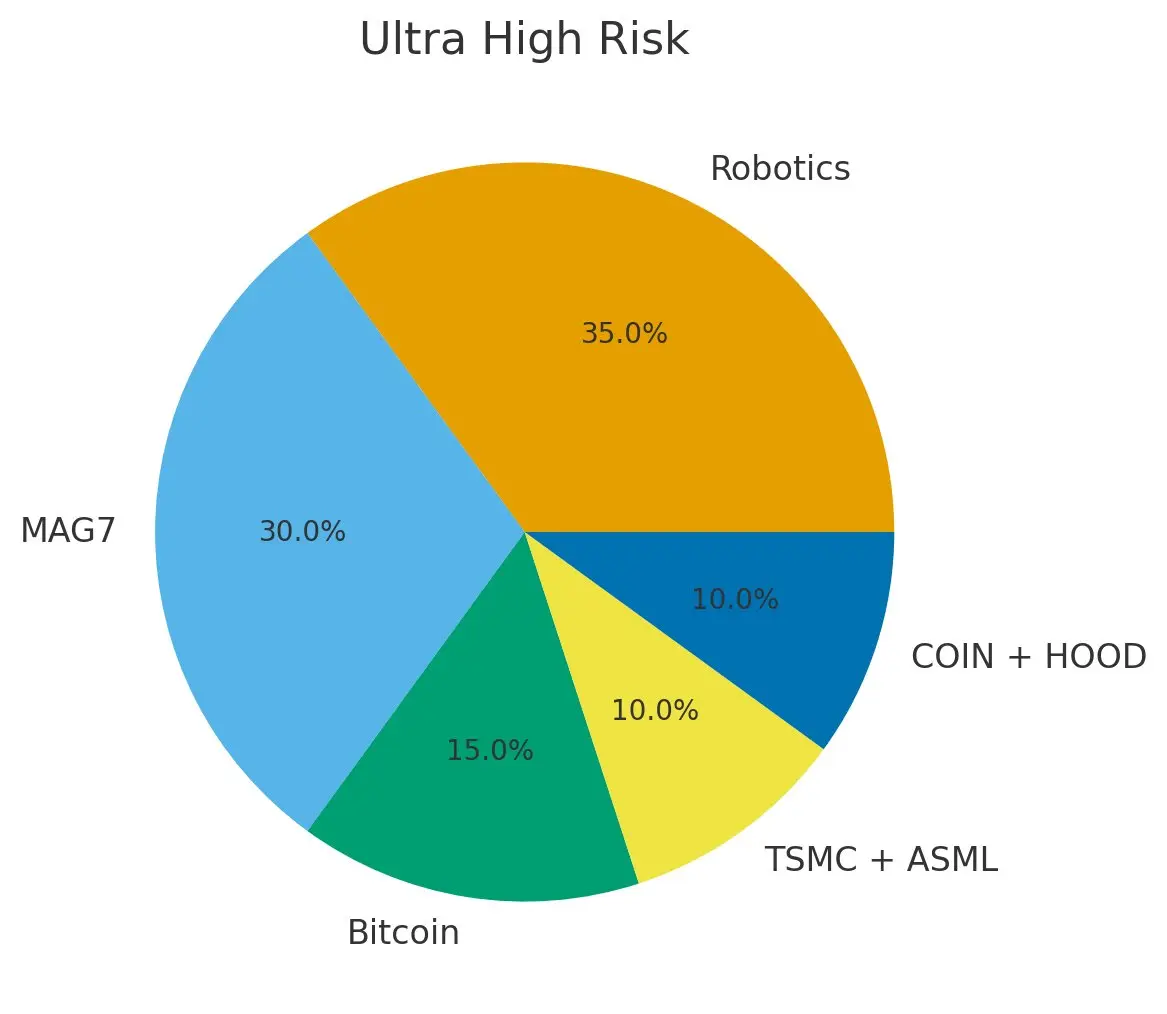
- 35% Robotics: Cutting-edge technology with high outcome dispersion. Companies like UBTech, Xpeng, Unitree.
- 30% MAG7: Sustained dominance in AI, cloud computing, software, and global digital infrastructure.
- 15% Bitcoin: A macro asset with a high beta value, possessing significant historical long-term appreciation.
- 10% TSMC and ASML: Provide structural tech exposure and strong moats.
- 10% Coinbase (COIN) and Robinhood (HOOD): High beta fintech stocks directly related to the next generation of investors and traders.
- Portfolio metrics:
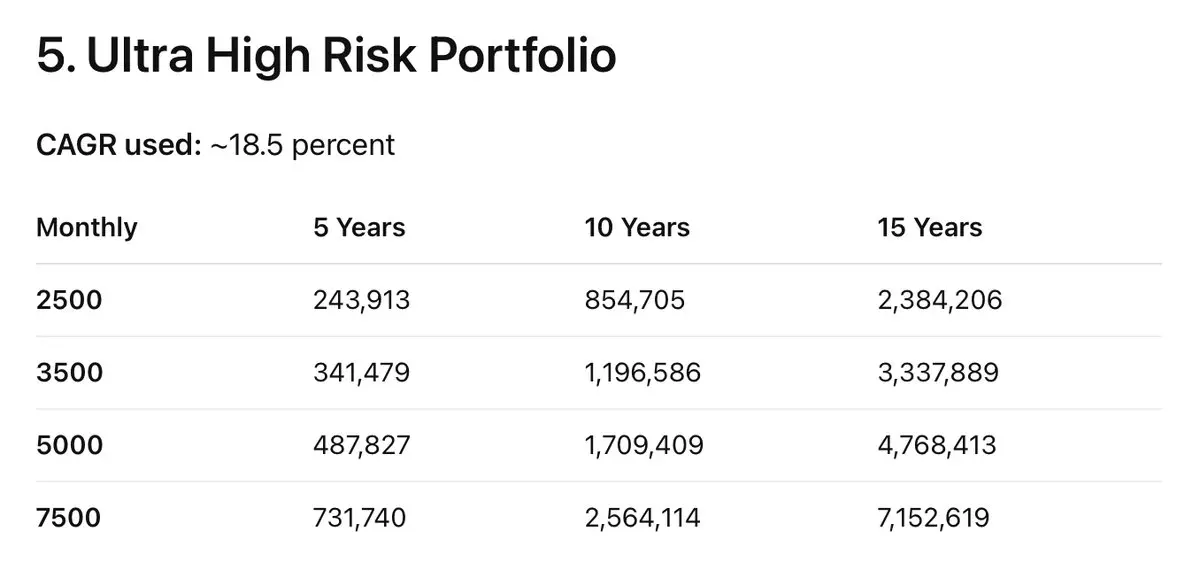
- Expected CAGR: 15% - 22%
- Volatility: 35% - 45%
About Risk: The less responsibility you take on, the more risk you can afford. It is advisable to start investing during extreme market panic (for example, when the Fear & Greed Index is very low, but asset prices are at historical highs; they will eventually crash at some point), at which time you can begin dollar-cost averaging (DCA). You can also choose to go all-in when others say Bitcoin is a failed experiment. There are many choices here. You need to invest to outpace inflation.
Simulation Projection: If you proceed with the process of "gaining attention → building a community → successfully monetizing," it may take up to 2 years; once successful, it should be able to generate at least $2,500 in "investable income" (not for daily living) each month. Based on the CAGR of the above investment portfolios, the expected returns after 5, 10, and 15 years will be substantial.
9. Financial Freedom
When the amount of personal investable funds reaches approximately $1.5 million to $4 million, financial freedom becomes within reach. At an annualized return of 3%, this translates to about $45,000 to $120,000 in passive income per year (equivalent to $3,750 to $10,000 per month). If you also add personal brand and long-term product income, this means an overall monthly cash flow of $10,000 to $30,000, with almost no pressure, no employees, and no complex operational processes. Moreover, this model is entirely online and can be operated from anywhere.
免责声明:本文章仅代表作者个人观点,不代表本平台的立场和观点。本文章仅供信息分享,不构成对任何人的任何投资建议。用户与作者之间的任何争议,与本平台无关。如网页中刊载的文章或图片涉及侵权,请提供相关的权利证明和身份证明发送邮件到support@aicoin.com,本平台相关工作人员将会进行核查。


