The Absolute Domain of Market Makers: Speed.
Author: Dave
"The Attack of MM 1: Market Maker Inventory Quoting System"
"The Attack of MM 2: Market Maker Order Book and Order Flow"
The first two episodes mentioned order flow and inventory quoting, which makes it seem like market makers can only adjust passively. But do they have proactive means? The answer is yes. Today, we will introduce statistical advantages and signal design, which are also the "micro alpha" pursued by market makers.
1. Market Maker's Alpha?
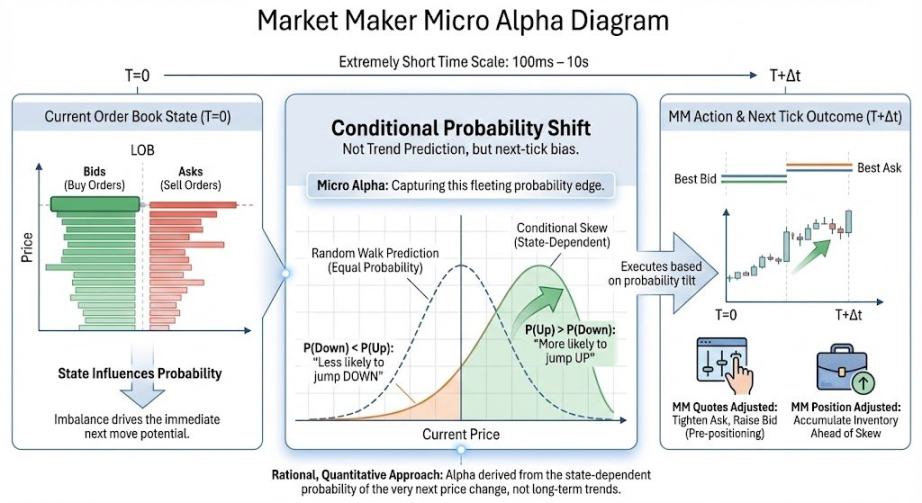
Micro alpha refers to the "conditional probability shift" regarding the direction of the next price movement / mid-price drift / asymmetry of transactions over an extremely short time scale (~100ms to ~10s). It is important to note that the alpha in the eyes of market makers is not about trend prediction or guessing price fluctuations; it only requires probability shifts, which is different from what we usually refer to as alpha. Let’s explain this in simpler terms:
The statistical advantage of market makers can be understood as whether the order book state within an extremely short time window "leans" towards allowing the price to move in a certain direction first. If a market maker can successfully calculate the probability of the price direction in the next millisecond using certain indicators, then they can: 1) be more willing to buy before a likely price increase. 2) withdraw buy orders more quickly before a likely price decrease. 3) reduce exposure during dangerous moments.
The financial basis for predicting the next price direction is that due to factors such as order flow, order volume, and order cancellation ratios (which will be discussed later), the market is not a "random walk" Brownian motion in a short moment but has direction. This statement is the financial translation of the mathematical concept of "conditional probability."
With these alphas, market makers can operate directionally on prices, finally earning money from price levels rather than just service fees like spreads.
2. Introduction to Classic Signals
2.1 Order Book Imbalance: OBI
OBI looks at which side has "more people standing" near the current price level; it is a standardized volume differential statistic.
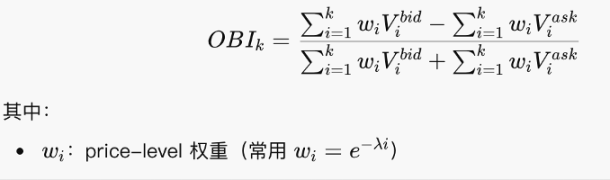
This formula is not difficult; it is just a logic of proportional summation. It checks whether there are more buy orders or sell orders. An OBI close to 1 indicates that there are almost all bid buy orders, with a thick layer below. An OBI close to -1 indicates thickness above. An OBI close to 0 indicates a relatively symmetrical buy-sell situation.
It is important to note that OBI is a "static snapshot," a classic indicator that is not effective on its own and should be used in conjunction with order cancellation ratios and order book slopes.
2.2 Order Flow Imbalance (OFI)
OFI looks at who is actively attacking in a recent short period. OFI is a first-order driving factor of price changes because prices are driven by taker orders, not by resting orders.
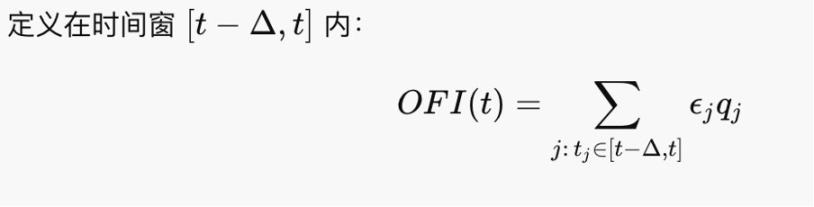
It has a feeling of net buying and selling volume. In the Kyle (1985) framework, ΔP≈λ⋅OFI, where λ is tick depth, so OBI is the factor that drives prices.
2.3 Queue Dynamics
Most exchanges now operate under continuous bidding rules, following the optimal price and first-come, first-served principles, so submitted orders will queue up to be filled. The queue reflects the state of resting orders, which determines the order book state. Abnormal order book states (along with order cancellations) imply directional price changes, which is micro alpha.
There are two situations to note regarding the queue:
1. Iceberg: Hidden Orders
For example, only 10 lots are displayed. But every time they are filled, another 10 lots are immediately replenished. The actual intention may be 1000 lots. The method I introduced in the first episode about how some market makers lower the cost price is essentially hand-crafting icebergs. In practice, some players want to conceal their true order volume and will also create icebergs.
2. Spoofing
Placing a very large order on one side to create a "pressure illusion," which is quickly withdrawn as the price approaches. Spoofing can pollute OBI and slope, making the queue appear falsely thick and increasing movement risk. At the same time, some large spoofing can intimidate the market and potentially manipulate prices. It seems that the London Stock Exchange caught someone manipulating foreign exchange through spoofing in 2015. However, in the crypto space, we can also handcraft spoofing to annoy market makers, but if it actually gets filled, your exposure becomes significant.
2.4 Order Cancellation Ratio (Cancel Ratio)
The cancellation ratio is an estimate of liquidity "disappearance rate":
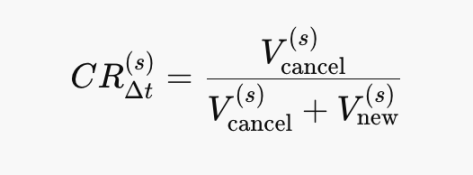
Cancel↑⇒Slope↓⇒λ↑⇒ΔP becomes more sensitive. It is a leading instability signal ahead of OFI. CR->1: almost pure cancellations. CR->0: almost pure replenishments. The mathematical formulas in this episode are quite simple; they can be interpreted visually.
CR↑⟹ the passive side believes future risks are rising, and CR will not be used alone; it is always used in conjunction with OFI and other factors.
The above may just be some old tricks in the order book game. The speed of market making evolution is still very fast, especially since after stocks are on-chain, these market makers may also need to engage in on-chain market making. However, these indicators are still very useful and inspiring.
3. The Absolute Domain of Market Makers: Speed
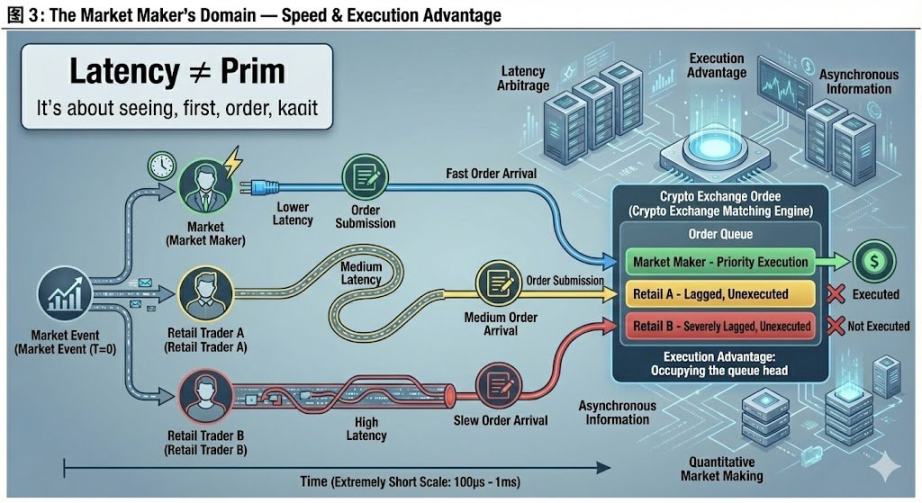
In movies, we often hear that a certain fund has a faster network speed, making it more impressive. Many market makers even move their server rooms closer to the exchange servers. Why is that? This article will discuss the advantages of physical equipment and the "transaction advantages" unique to crypto exchanges.
Latency arbitrage is not about predicting future prices but executing buy and sell orders at more favorable prices before others "react." In theoretical models: prices are continuous, and information is synchronized. However, in reality: the market is event-driven, information arrives asynchronously. Why does information arrive asynchronously? Because receiving price signals from the exchange and sending order instructions to the exchange both take time, which is a limitation of the physical world. Even in fully compliant markets: different exchanges, different data sources, different matching engines, and different geographical locations can all lead to delays. Therefore, market makers with more advanced equipment have the initiative.
This tests the market maker's own strength and has little to do with other players, so I believe it is their absolute domain.
To give a simple example, if you want to sell a position and you quote the best selling price in the market, theoretically, it can be executed. However, if I also want to sell and I see the price and quoting speed faster than you, I will eat the order first, and your inventory cannot be sold, leading to a continuous inability to restore a neutral position. The reality is much more complex.
Interestingly, due to the lack of regulatory laws, almost all exchanges in the crypto space can directly give designated accounts priority in transactions. This means granting certain designated accounts the right to jump the queue. This is especially common in smaller exchanges, indicating that becoming "one of their own" in the crypto space is as important as in scientific research. Whether one can safely execute transactions is a crucial step in transitioning alpha theory to practical application.
This episode attempts to write content from the perspective of market makers, but the actual operations are certainly more complex. For example, dynamic queues have many details to pay attention to in practice. Teachers are welcome to provide feedback.
Postscript: There is a regret in this article regarding the title "Expansion of Domains in Market Making." I originally wanted to use it to discuss dynamic hedging and options because I believe this is the most conceptually challenging area in market making, worthy of the title of domain expansion. However, after spending a whole day on it the day before yesterday and writing half of the article, I really didn't know how to systematically discuss this matter, so I changed it to talk about micro alpha. Teacher @agintender has an article that mentions many professional hedging concepts, encouraging everyone to take a look.
免责声明:本文章仅代表作者个人观点,不代表本平台的立场和观点。本文章仅供信息分享,不构成对任何人的任何投资建议。用户与作者之间的任何争议,与本平台无关。如网页中刊载的文章或图片涉及侵权,请提供相关的权利证明和身份证明发送邮件到support@aicoin.com,本平台相关工作人员将会进行核查。


