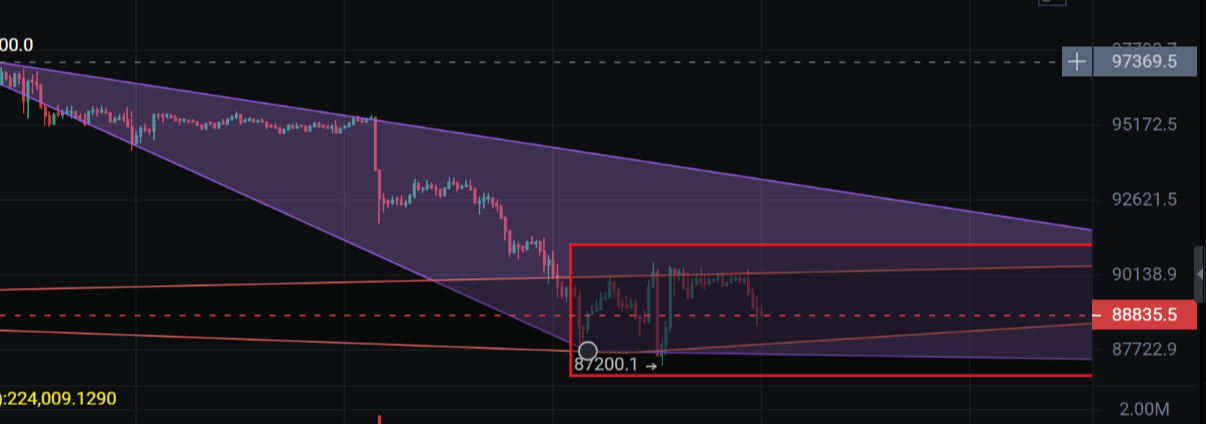
On January 22, 2026, a relevant on-chain address suspected to be affiliated with BlackRock or its ETF products transferred a total of 3,970 BTC and 82,813 ETH to Coinbase Prime, amounting to an estimated total value of approximately $603.8 million based on market capitalization at the time of monitoring. This data, cross-verified by multiple sources including Lookonchain, has been described by channels such as Jinse Finance as “the largest single institutional-level crypto asset transfer in 2026 so far,” making it particularly notable in the current relatively calm environment of large on-chain transfers. The market quickly split into two interpretative paths regarding this over $600 million reallocation: one side views it as a potential precursor to large-scale selling pressure, while the other believes it is more likely related to routine operations such as custody rotation, ETF-related asset management, or over-the-counter settlements. The expectations game triggered by this transfer is amplifying its marginal impact on sentiment.
Rare $603.8 Million Volume on Coinbase Prime
● Breakdown of Quantity and Valuation: On-chain data shows that the 3,970 BTC transferred to Coinbase Prime is estimated to be worth approximately $356.7 million at the monitored price, while the 82,813 ETH is about $247.1 million, totaling around $603.8 million. This data, monitored by Lookonchain and widely referenced after cross-verification from multiple sources, serves as the quantitative basis for current market discussions and provides an objective anchor for subsequent narratives regarding selling pressure, custody rotation, and more.
● Uniqueness Relative to Historical Scale: Looking at past publicly reported institutional-level reallocations, on-chain fund transfers involving both Bitcoin and Ethereum exceeding $600 million are rare, especially against the backdrop of the beginning of 2026, where overall large address activity on-chain has not significantly increased. Jinse Finance describes it as “the largest single institutional-level crypto asset transfer in 2026 so far,” making this transfer to Coinbase Prime stand out in terms of both timing and volume, indicating a signal density that exceeds typical daily reallocations.
● Role Differentiation of Coinbase Prime: Unlike regular exchange deposit addresses, Coinbase Prime is positioned as a professional custody and trading platform for institutions and high-net-worth clients, undertaking multiple functions such as market-making, over-the-counter settlements, compliant custody, and asset management. Transferring assets to Prime more often signifies entry into a comprehensive channel for over-the-counter matching, block trading, and custody management, rather than simply selling into an order book, which means that the linear logic of “transfer = immediate sell” needs to be approached with caution in institutional scenarios.
Prelude to Selling or Multiple Possibilities of Custody Rotation
● Inertia of “About to Sell” Interpretation: On-chain funds flowing from cold wallets or long-term holding addresses into trading platforms have long been viewed as potential selling pressure signals, a behavioral-price association that has developed over years in the crypto market. For retail addresses, there have been multiple historical instances of “deposits followed shortly by concentrated sell orders,” reinforcing this conditioned reflex. Therefore, when a suspected BlackRock-related address transfers large amounts of BTC and ETH to Coinbase Prime, the interpretation of “preparing to sell” quickly gains traction on the emotional level, even in the absence of a complete data chain regarding subsequent transactions and holding changes.
● Multiple Use Cases of Institutional Routine Operations: From the perspective of institutional asset management, the same on-chain action can correspond to entirely different funding uses, including liquidity management to meet ETF subscription and redemption needs, over-the-counter block settlements with counterparties, asset migration or risk diversification among custodians, or even preparing underlying assets for future derivatives hedging or market-making. These scenarios can all be implemented through compliant platforms like Coinbase Prime and do not necessarily imply short-term public market selling, but rather complete position structure optimization in a more refined manner in the background.
● Linkage Demand with ETF Product Structure: Considering that BlackRock has launched spot-related products, there needs to be sufficient scale and liquidity of BTC and ETH as supporting assets to facilitate market-making, custody, and redemption processes. Concentrating large assets through Coinbase Prime is beneficial for completing custody, over-the-counter counterpart matching, and reporting integration on the same compliant platform, reducing operational complexity and compliance costs. Therefore, this $603.8 million reallocation can also be viewed as a “technical concentration dispatch” under the demand for spot products and tokenized asset management, rather than being interpreted solely from a “selling” perspective.
Emotional Amplification Amidst Doubts About Address Ownership
● Indirectness of Label Sources: Currently, the basis for linking the relevant BTC and ETH addresses to BlackRock or its ETFs primarily comes from on-chain analysis institutions and community annotations, which are indirect inferences made through transaction patterns, counterparties, and historical association paths, rather than being results of official on-chain statements from BlackRock. Such labels have reference value in actual research, but from a strict compliance and information disclosure perspective, they should still be viewed as probabilistic judgments rather than established facts confirmed by regulatory documents or official publications.
● Market Risks of Address Label Misjudgment: Surrounding this reallocation, some on-chain analysts have explicitly pointed out the need to “verify whether the address ownership labels are accurate,” indicating that if the labels are incorrectly bound or partially deviated, the market may misinterpret fund movements that are originally unrelated to BlackRock as strategic adjustments from the world’s largest asset management institution. Such misjudgments can quickly spread on social media, amplifying emotional fluctuations and triggering chain reactions on price expectations, derivatives position adjustments, and even regulatory observations, highlighting the double-edged sword nature of on-chain intelligence when not officially confirmed.
● Cautious Attitude Towards “BlackRock Address” Narrative: In the absence of direct disclosures from BlackRock or supporting regulatory filings, terms like “BlackRock address” or “ETF custody wallet” are better labeled as pending verification labels, rather than being treated as confirmed information sources. For investors, the key is to distinguish between the boundary of “high-probability inference” and “official fact,” avoiding the over-amplification of a single institution's dominant role in the narrative when assessing the impact of this $603.8 million reallocation.
Emotional Contrast Between Tokenization Discourse and Large Reallocation
● Boundaries of CEO Tokenization Statements: In the discourse surrounding BlackRock's layout in crypto and on-chain assets, the market has widely circulated recent public statements by BlackRock's CEO regarding asset tokenization, interpreting them as a positive attitude towards mapping traditional assets onto the blockchain in the future. It is important to emphasize that this statement currently mainly comes from a single source report and still needs to be cross-verified with BlackRock's official materials and regulatory documents to more accurately define its true weight in the company's long-term strategy and product planning.
● Contrast Between Positive Statements and Transfer Platform: On an emotional level, one side is optimistic about the prospects of tokenization, while the other side sees large amounts of BTC and ETH being transferred to trading platforms. This apparent combination of “bullish rhetoric + potential selling pressure actions” can easily be interpreted as institutions “verbally bullish, but actually reducing positions.” However, from an operational logic perspective, tokenization deployment, spot ETF operations, and daily asset management inherently require frequent use of compliant platforms to complete custody rotation, position hedging, and market-making supplements; the two are not inherently opposed but are different links in the same asset management chain.
● Necessity of Frequent Reallocations in Tokenization and Compliance Channels: As traditional financial institutions advance in tokenization, spot products, and on-chain asset management, their reliance on compliant custody and market-making channels will continue to increase. Whether providing underlying collateral for tokenized assets or maintaining secondary market liquidity for products like ETFs, institutions need to frequently reallocate large positions between platforms like Coinbase Prime. This $603.8 million transfer is more a slice of this structural trend being amplified on-chain, rather than a denial or reversal of the tokenization route itself.
Macroeconomic Echoes of Overseas Taxation and Derivatives Adjustments
● Netherlands' Unimplemented Unrealized Gains Tax Discussion: In a broader policy context, it has been reported that the Netherlands is proposing to tax unrealized gains on crypto, although this information also comes from a single source and is still in the policy discussion stage, with significant uncertainty remaining before legislation is enacted. Nevertheless, such discussions regarding paper profits have marginally deepened European institutions' considerations regarding holding cycles and asset location choices, prompting some funds to migrate and reallocate more frequently between different jurisdictions and custodians.
● Impact on Institutions' Profit Realization and Turnover Rhythm: If unrealized gains taxation gradually advances in Europe, institutions will face new constraints and games regarding when to lock in profits and how to adjust positions before and after reporting periods. To balance compliance costs and yield, some institutions may prefer to accelerate the conversion rhythm of paper profits into realized profits through over-the-counter settlements and asset rotations between compliant custody platforms, which indirectly reinforces the pivotal role of platforms like Coinbase Prime in the global capital flow chain.
● Emotional Mapping of Derivatives Funding Rate Adjustments: Meanwhile, Binance's adjustment of funding rates for XAU and XAG perpetual contracts, although technically complex in details and terms, may be interpreted by some traders as a rebalancing signal regarding safe-haven assets and risk preference structures. Changes in funding rates for metal contracts do not correspond one-to-one with crypto assets, but in the context of major asset allocation, the relative attractiveness changes between traditional safe-haven assets like gold and silver and high-volatility assets like BTC and ETH may indirectly influence how institutions maneuver leverage and allocate weights between different assets.
Observational Coordinates After the $603.8 Million Reallocation
● Dual Characteristics of Scale and Information Gap: Overall, the suspected BlackRock-related address transferring approximately $603.8 million of BTC and ETH to Coinbase Prime has set a new high for single institutional reallocations in 2026 in terms of scale, while being positioned during a transitional period of heightened global regulatory and tax discussions and slight adjustments in derivatives structures, yet lacking sufficient official explanations and complete on-chain flow diagrams, forming a “massive volume - unclear intent” typical high-attention event. This high uncertainty itself is a significant source driving market emotional fluctuations.
● Selling Pressure Judgment Remains a Hypothesis Rather Than a Conclusion: Currently, there has been no formal response from BlackRock regarding this transfer in publicly available information, nor is there a complete on-chain fund flow diagram covering all relevant addresses before and after the transfer. In this context, simply categorizing this reallocation as “bearish selling” or “bearish signal” is more an emotional inference based on past experiences rather than a conclusion supported by sufficient evidence. Similarly, interpreting it as “bullish accumulation” or “pure custody rotation” also lacks complete data support, and all market participants need to acknowledge the current incompleteness of information.
● Data-Driven Risk Management and Tracking Pathways: For traders and institutions, a more prudent approach is to construct an observational framework centered on data: on one hand, continuously track the on-chain movements of the relevant addresses after the transfer to Coinbase Prime, paying attention to whether there is a significant outflow, internal transfers, or rotations with other custodians; on the other hand, monitor subsequent disclosures from BlackRock and its ETF products in official materials and regulatory filings, rather than amplifying a single on-chain event into a trend signal. In the absence of further evidence, viewing it as an important but not yet fully “decoded” institutional reallocation event may be more helpful in controlling emotional fluctuations and position risks.
Join our community to discuss and grow stronger together!
Official Telegram community: https://t.me/aicoincn
AiCoin Chinese Twitter: https://x.com/AiCoinzh
OKX Welfare Group: https://aicoin.com/link/chat?cid=l61eM4owQ
Binance Welfare Group: https://aicoin.com/link/chat?cid=ynr7d1P6Z
免责声明:本文章仅代表作者个人观点,不代表本平台的立场和观点。本文章仅供信息分享,不构成对任何人的任何投资建议。用户与作者之间的任何争议,与本平台无关。如网页中刊载的文章或图片涉及侵权,请提供相关的权利证明和身份证明发送邮件到support@aicoin.com,本平台相关工作人员将会进行核查。