The gold market is witnessing a battle between old and new capital, with central banks and private whales joining forces to drive up gold prices, while Bitcoin is quietly changing the future landscape of safe-haven assets under the banner of "digital gold."
When Goldman Sachs raised its gold price target to $5,400 per ounce, this prediction was not just a shift in numbers but revealed a deep-seated anxiety among global capital seeking a safe haven.

1. Gold Prices Soar: From Historical Highs to Higher Expectations
● The gold market at the beginning of 2025 has already made history, with spot gold prices firmly above $4,900 per ounce. This figure alone is enough to shock traditional gold investors, but Goldman Sachs analysts see further ahead.
● In their latest forecast, by December 2026, gold prices are expected to reach $5,400/ounce, an increase of about 17% from the average price in January 2025.
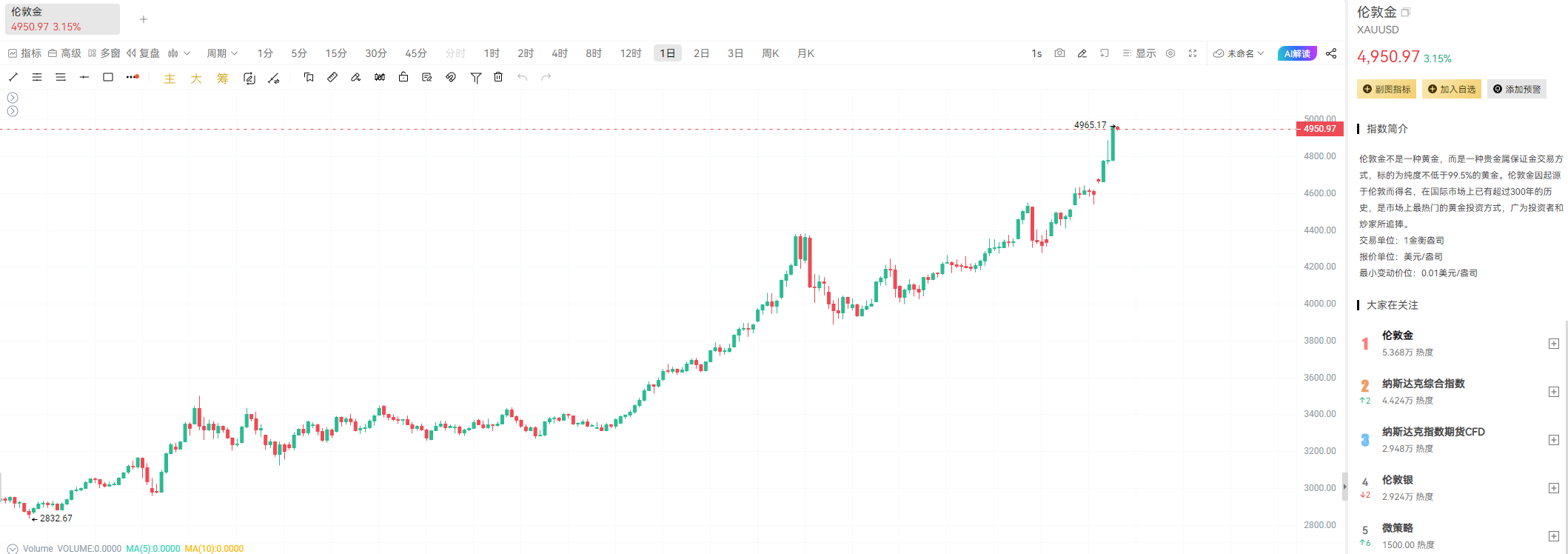
● The backdrop of this prediction is that gold has been rising for several consecutive years: approximately 15% in 2023, about 18% in 2024, and the momentum has significantly accelerated since 2025. The forces driving this historic trend are undergoing a structural change.
Over the past three years, the gold market has shifted from a steady rise led by central banks to a phase where central banks and private investors are competing for limited physical gold bars. This "cumulative effect" is creating an unprecedented demand pattern in the gold market.
2. Central Bank Gold Purchases: A Silent Currency Revolution in Emerging Markets
● The freezing of Russia's central bank foreign exchange reserves after the Russia-Ukraine conflict became a turning point for global central banks to rethink the safety of reserve assets. Goldman Sachs' report points out that this event has prompted many central banks (especially in emerging markets) to reassess the "neutrality and availability of reserve assets," leading to a systematic increase in the allocation of gold.
● Data shows that global central banks have maintained strong net gold purchases for several consecutive years, with total gold purchases in 2023 reaching about 1,037 tons, just slightly below the historical high in 2022.
● This trend has not weakened in 2025; instead, there are signs of acceleration. Goldman Sachs predicts that the average monthly gold purchases by central banks will remain at about 60 tons in 2026, nearly three times the average level before 2022.
● The People's Bank of China has increased its gold reserves for 13 consecutive months, and Russia's gold reserves have reached the highest level since 1995. This structural and sustained gold purchasing behavior provides a solid "ballast" for the gold market.
3. Whales: New Power Players Hidden in the Market
If central bank gold purchases are the "visible stream" of the gold market, then the entry of the private sector is the "underwater current."
● Goldman Sachs' report explicitly states that the demand from the private sector to allocate gold as a hedge against "global macro policy tail risks" has begun to become apparent. This purchasing behavior has a key characteristic: "stickiness."
● Unlike hedges based on specific events (such as election results or short-term geopolitical conflicts), the private sector is now buying gold more to hedge against macro policy uncertainties such as fiscal sustainability, monetary discipline, and long-term inflation risks.
● These risks are difficult to be "resolved" in the short term, so the related hedge positions are more likely to remain in the market for the long term, substantially raising the baseline for gold price movements.
● These "private whales" include the physical gold purchasing and storage needs of high-net-worth families, as well as investors using "harder-to-statistics hedge tools" like buying call options. Their entry marks a complete change in the rules of the gold market.
4. Rule Reconstruction: Traditional Gold Logic Has Failed
● Goldman Sachs clearly states in the report that the gold market "old pricing rules are no longer applicable." In general commodity markets, "high prices cure high prices"—price increases suppress demand or stimulate supply increases, leading to price declines. But gold is not like that.
● The supply of gold is extremely rigid. The annual output of global gold mines accounts for only about 1% of the total gold stock above ground, and even if prices soar, supply cannot respond quickly. On the other hand, the "sticky demand" from central banks and the private sector is relatively insensitive to price changes.
● The report emphasizes that price reversals in gold typically do not come from increased supply but from weakened demand. Therefore, Goldman Sachs is more inclined to use a higher elasticity parameter to characterize the "demand-price" linkage, reflecting that the current market's price elasticity for gold has significantly decreased.
5. Digital Gold: Bitcoin's Scarcity Challenge
As the traditional gold market continues to heat up, Bitcoin, hailed as "digital gold," is attracting another group of investors with its unique scarcity logic.
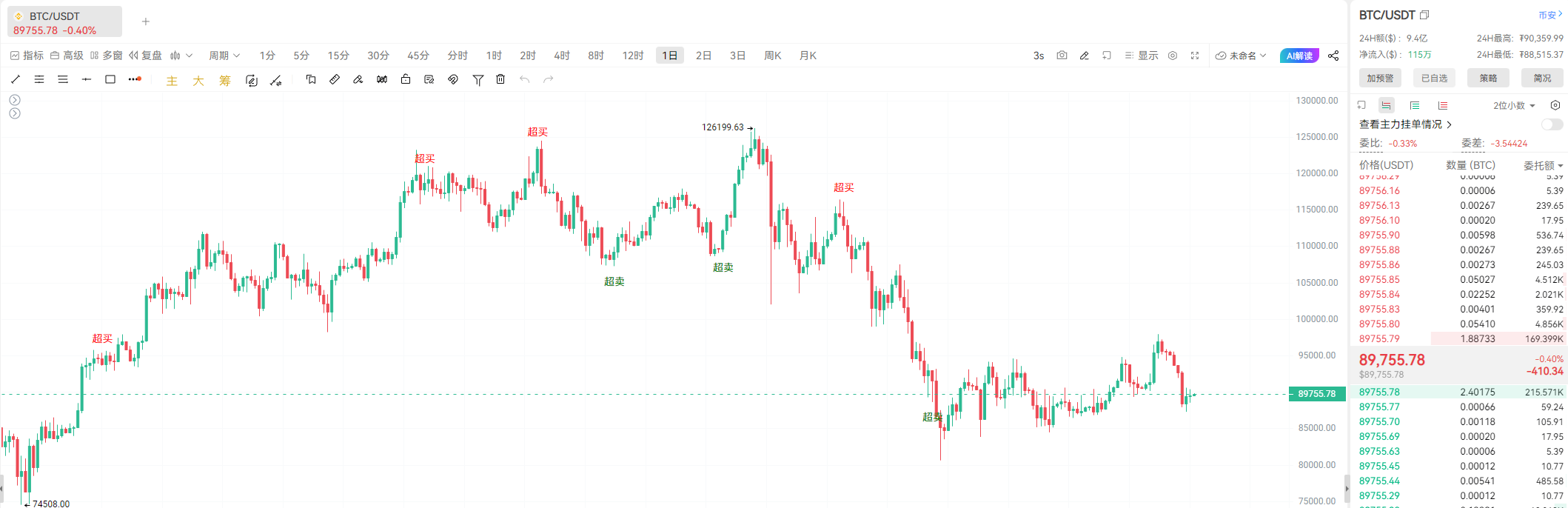
● Cathie Wood, founder of ARK Invest, has repeatedly emphasized that Bitcoin has a structural scarcity advantage over gold. The supply of gold expands with rising prices (through increased mining), while the issuance of Bitcoin is entirely algorithmically determined, with a hard cap of 21 million coins.
● This programmed scarcity makes it a "purer" means of value storage. It is estimated that Bitcoin's annual supply growth rate will drop to about 0.82% by 2026 and approach 0.4% in the latter part of this decade.
● The market value ratio of gold to Bitcoin has significantly narrowed from about 60 times in 2020. Although the total market value of gold still far exceeds that of Bitcoin, the gap is rapidly closing, reflecting a shift in market perception of the two assets.
6. Future Showdown: Redrawing the Map of Safe-Haven Assets
The relationship between gold and Bitcoin is evolving from a simple comparison to a more complex asset allocation pattern.
● Gold carries thousands of years of historical trust, and its physical attributes and stability are highly attractive during turbulent times. Bitcoin, on the other hand, represents a new paradigm of value storage—completely digital, globally accessible, censorship-resistant, and with predictable supply.
● A report from JPMorgan points out that Bitcoin has a very low correlation with gold, bonds, and stocks, giving it unique allocation value in diversified investment portfolios.
● From a market performance perspective, the two are not simply substitutes. At certain times, gold and Bitcoin prices show a positive correlation (both being safe-haven assets), while at other times they show a negative correlation (reflecting different market logics).
In the future, as the wealth of the digital native generation grows and traditional investors become more accepting of digital assets, Bitcoin may siphon off some funds from the gold market, especially from those seeking higher growth potential and technological innovation capital.
Behind the historic breakthrough in gold prices: Central banks continue to buy at a rate of 60 tons per month, while private whales view gold as a "long-term insurance" against global policy uncertainties, with both forces shaping a new normal for the gold market.
Traditional rules have completely failed: Supply cannot respond to price signals, and the classic economic principle of "high prices suppress demand" has lost its explanatory power in the gold market, replaced by a solid price foundation built on "sticky demand."
Digital gold is quietly rising: Bitcoin is challenging the physical scarcity of gold with algorithmic scarcity, and a historic competition for dominance in safe-haven assets is unfolding in the global capital market, where the ultimate winner may be a diversified investment strategy that embraces both.
Join our community to discuss and grow stronger together!
Official Telegram community: https://t.me/aicoincn
AiCoin Chinese Twitter: https://x.com/AiCoinzh
OKX benefits group: https://aicoin.com/link/chat?cid=l61eM4owQ
Binance benefits group: https://aicoin.com/link/chat?cid=ynr7d1P6Z
免责声明:本文章仅代表作者个人观点,不代表本平台的立场和观点。本文章仅供信息分享,不构成对任何人的任何投资建议。用户与作者之间的任何争议,与本平台无关。如网页中刊载的文章或图片涉及侵权,请提供相关的权利证明和身份证明发送邮件到support@aicoin.com,本平台相关工作人员将会进行核查。


