Original|Odaily Planet Daily (@OdailyChina)
After submitting applications for stock tokenization trading to Nasdaq and the New York Stock Exchange, Binance, the largest cryptocurrency exchange, recently sounded the "counterattack horn from CeFi to TradFi."
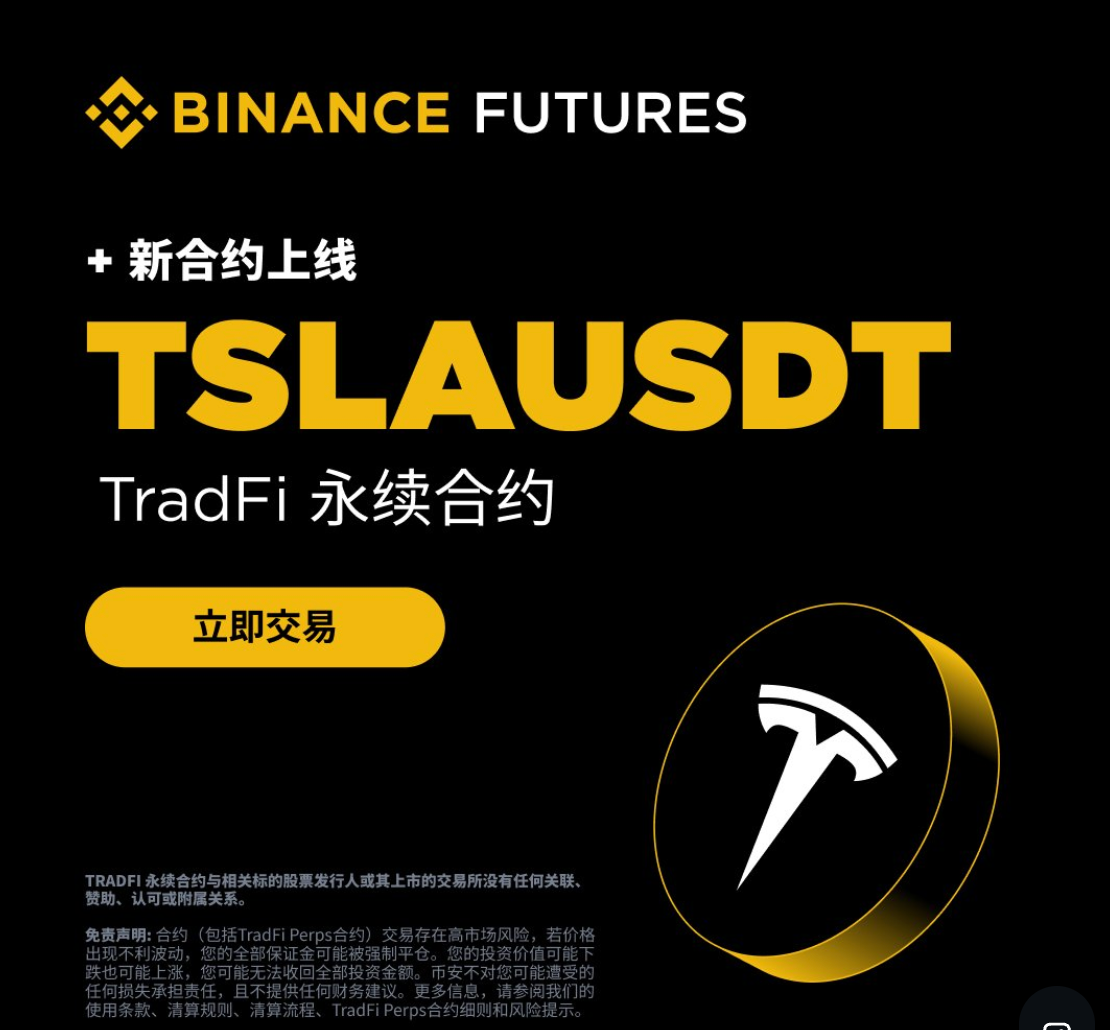
On January 24, a Binance spokesperson stated that they are "exploring the relaunch of stock tokens"; two days later, Binance officially announced that "it will launch perpetual contracts for Tesla (TSLA) stock on January 28, with a maximum leverage of 5 times."
It is worth mentioning that this is Binance's bold attempt after halting support for stock tokens in July 2021, marking a significant change after five years. The market regulatory environment and infrastructure have undergone tremendous changes since then.
Binance's move may signify that the "liquidity battle" between CEX and traditional securities exchanges has begun. Odaily Planet Daily will provide a brief analysis of this matter for readers' reference.
Tesla Becomes Binance's Stock Tokenization Trading Experiment Field
The short-lived "stock token experiment" in 2021 left Binance not only with the pressure of facing regulatory compliance but also with the defeat of CeFi's power against the TradFi forces in the traditional financial market.
Now, five years later, Binance's relaunch of stock token contract trading hides greater ambitions. The reasons lie in the following three significant changes:
First, the "crypto-friendly attitude" of U.S. government regulators. After the Biden administration, the Trump administration sparked a "crypto storm" in the U.S. and globally, creating a "new crypto regulatory environment" through personnel appointments, organizational cuts, and the establishment of legal provisions, clearing the atmosphere of the U.S. crypto market;
Second, the rapid development of stock tokenization trading. According to information from rwa.xyz, the overall market capitalization of the stock tokenization market is currently reported at $1.096 billion, with a trading volume exceeding $1.86 billion in the past 30 days, over 107,700 active addresses, and more than 170,000 holders. Compared to a market cap of less than $500 million in December 2024, this milestone of doubling has been achieved in about a year. With Nasdaq and the New York Stock Exchange's related applications likely to be approved by the SEC this year, the stock tokenization market is expected to experience explosive growth;
Third, the improvement of infrastructure such as stablecoins, oracle systems, and on-chain and off-chain settlement systems. Following the signing and passage of the GENIUS Act (Stablecoin Genius Act) in 2025, oracle projects like Chainlink and Pyth Network were selected as official partners of the U.S. Department of Commerce, along with the opening of applications for crypto banking licenses, a series of events have eliminated technical bottlenecks in the development, launch, settlement, and leverage of stock tokens compared to 2021.
Based on these conditions, after integrating the stock tokenization trading platform ONDO Global Market, Binance has reopened the door to "stock contract trading." The deeper meaning of this move by Binance may lie in the following two aspects:
First, seeking "new user growth." According to Binance's official website, its total user count has risen to 306 million, accounting for a significant portion of the global crypto population of about 600 million. Undoubtedly, Binance has entered a "user growth bottleneck period," which is one of the main reasons it has begun to promote through traditional internet user acquisition methods. Compared to the hundreds of millions or even billions of stock investors and investment institutions globally, the crypto population is merely a "niche group." To continue expanding and sustaining growth, Binance's exploration of new TradFi products is both coincidental and inevitable.
Second, seeking "new business growth." In 2025, Binance's total trading volume reached $34 trillion, even surpassing the annual trading volume of stablecoins in 2025 (which is $33 trillion), making it truly the "world's largest centralized exchange." However, data details show that Binance's spot trading volume is about $7.1 trillion, accounting for only 1/5 of the total trading volume; in other words, the bulk of Binance's trading volume still comes from derivatives trading such as contracts and options. This is determined by Binance's CEX business model and reflects the significant role of derivative products in stimulating trading volume and earning platform fees. The stock market, with its scale of tens of trillions, is the "next cake" that Binance covets.
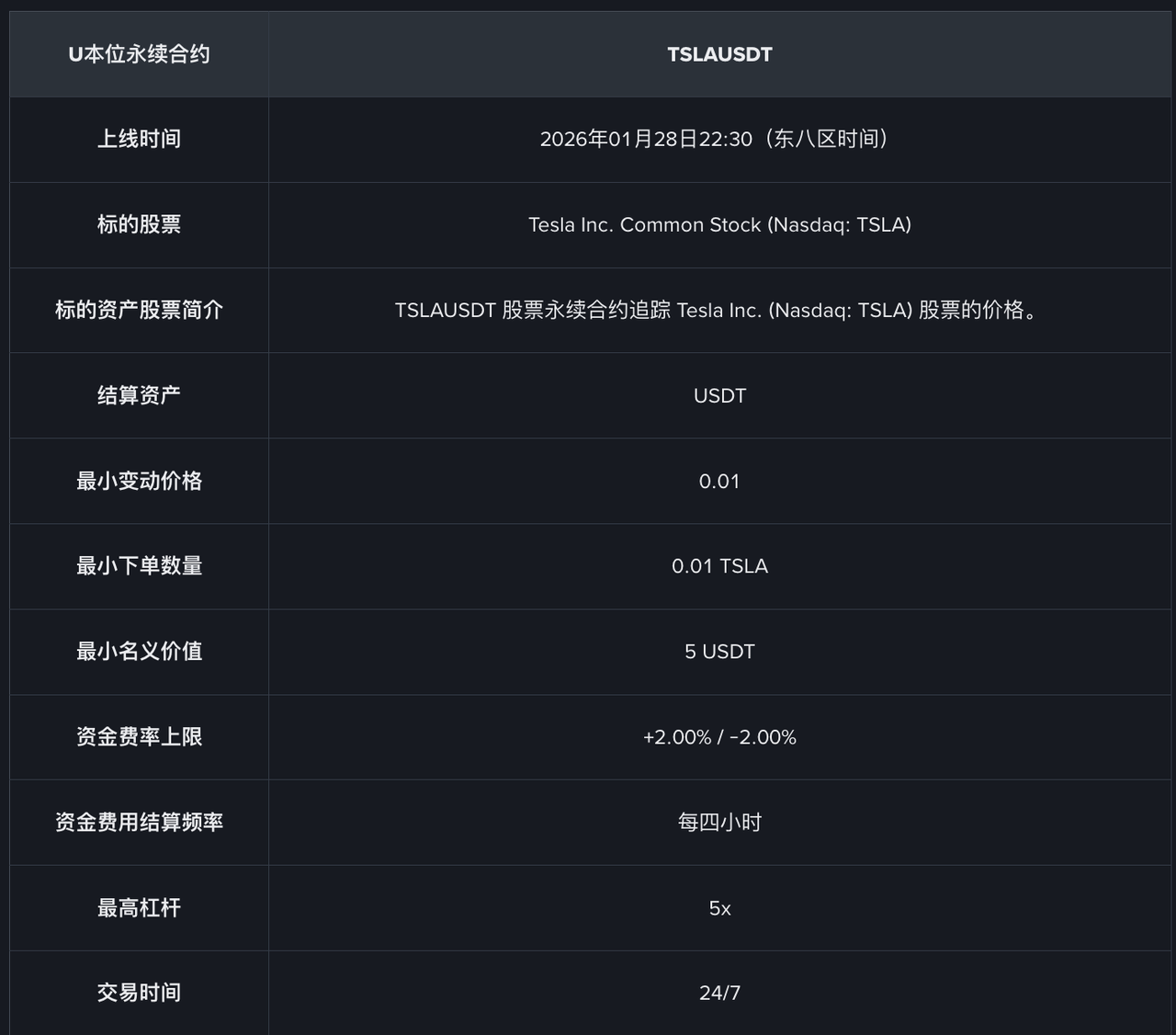
With the right timing and conditions, Binance naturally reopened stock contract trading. Choosing Tesla (TSLA) contracts as the first target seems to carry the meaning of getting back up where one fell. As the most growth-potential U.S. stock under Musk, the launch of Tesla contracts can also help boost discussions around Binance's relaunch of stock contract trading.
On the other hand, the substantial trading volumes of many competing CEXs may have also instilled a sense of urgency in Binance.
Data shows that Bitget's U.S. stock contract segment has accumulated a trading volume exceeding $15 billion, with the top three popular trading assets being Tesla (TSLA), Meta Platforms (META), and Apple (AAPL), with total transaction amounts of $5.4 billion, $3 billion, and $1.7 billion, respectively; as of January 5, Gate's stock token section has accumulated a trading volume exceeding $13.5 billion, with nearly 80 trading pairs launched.
Conclusion: A Liquidity Tug-of-War Between Binance and Nasdaq, NYSE
In conclusion, I boldly predict that there will be a fierce battle between crypto CEXs like Binance and traditional financial securities exchanges like Nasdaq and the NYSE. Of course, this war has not fully erupted yet, but what is at stake is not just a battle for user numbers, but a war for platform liquidity between funds and fees.
Although compared to the annual trading volume of hundreds of trillions at Nasdaq and the NYSE, the trading volume and market scale of crypto CEXs like Binance lag behind by more than one order of magnitude, from brand awareness, market scale, and trading volume, this is a thoroughly "small versus big" war; however, in terms of user experience, product iteration, and regulatory adaptability, CEXs like Binance undoubtedly possess better flexibility.
Of course, the premise of victory is that regulatory forces do not "favor one side," and this liquidity battle may be a protracted one—it's not just about short-term wealth creation effects, but also the ability to connect deeply with the long-term global economic situation. As for who the ultimate winner will be and who can become the rule-maker of the new game, let us wait and see.
Recommended Reading:
The NYSE Plans to Launch 24/7 Tokenized Stock Trading, Leaving Competitors Stunned
免责声明:本文章仅代表作者个人观点,不代表本平台的立场和观点。本文章仅供信息分享,不构成对任何人的任何投资建议。用户与作者之间的任何争议,与本平台无关。如网页中刊载的文章或图片涉及侵权,请提供相关的权利证明和身份证明发送邮件到support@aicoin.com,本平台相关工作人员将会进行核查。


