Author: Kevin He, Co-founder of Bitlayer
1. A Programmer's 15 Years with "Recruitment"
I am Kevin, an AI × Crypto entrepreneur, co-founder of Bitlayer, previously at Huobi, and a graduate of Peking University.
From programmer to technical management, and then to entrepreneur, I have switched industries several times over the past 15 years, always passionately engaged in recruitment-related work.
In these 15 years, I have helped over 600 people successfully find jobs. Some were formal recruitments, but more often I helped friends—finding jobs and introducing employees.
There are two stories I always remember.
The first is helping a brother over 35 find a job. He has two children and is under a lot of pressure. When he told me he got the offer, I was even more excited than he was.
The second is helping a startup team quickly build a research and development team. From zero to being operational, it took less than two months. Watching the product go live, I felt like I was part of that creation.
This is why I love this work: achieving resource matching and truly helping people.
But recently, I started to rethink the premise of this work.
2. COCO 1.0: From Passion to Doubt
In June 2025, with support from various parties, I formed a small team to launch the incubation of COCO AI.
The original intention was simple: to use AI to realize career consulting and recruitment. To make recruitment more efficient and help more people find good jobs.
The product went through several iterations: resume optimization → AI job matching → AI corporate recruitment.
We developed two products:
Job seeker side: job.coco.xyz
Corporate side: company.coco.xyz
We invested significantly in technology, and the product was developed.
But the go-to-market (GTM) strategy was not as smooth as expected.
I began to reflect and discovered several realities:
The company's recruitment needs are decreasing: Due to the economic environment and improved organizational efficiency, many companies are no longer hiring on a large scale as they used to.
There is a gap between job seekers' skills and company requirements: AI can help with matching, but the gap itself does not disappear.
Job seekers' skills need updating: Many people's abilities have fallen behind in a rapidly changing market.
I began to doubt myself.
Is it a product issue? A market issue? Or—does the direction itself have a problem?
At that time, I had no answers.
3. The Great Changes in the External World
In the second half of 2025, the external world changed.
Claude Code began to be widely applied across various industries. Not just for coding, but truly capable of completing complex tasks. More and more people around me were discussing a term: digital employees.
In December, we internally built a system called zylos, attempting to let AI handle daily work.
Tasks included:
Daily data reports
Social media management
Code writing and testing
Data processing
And more
The results shocked me.
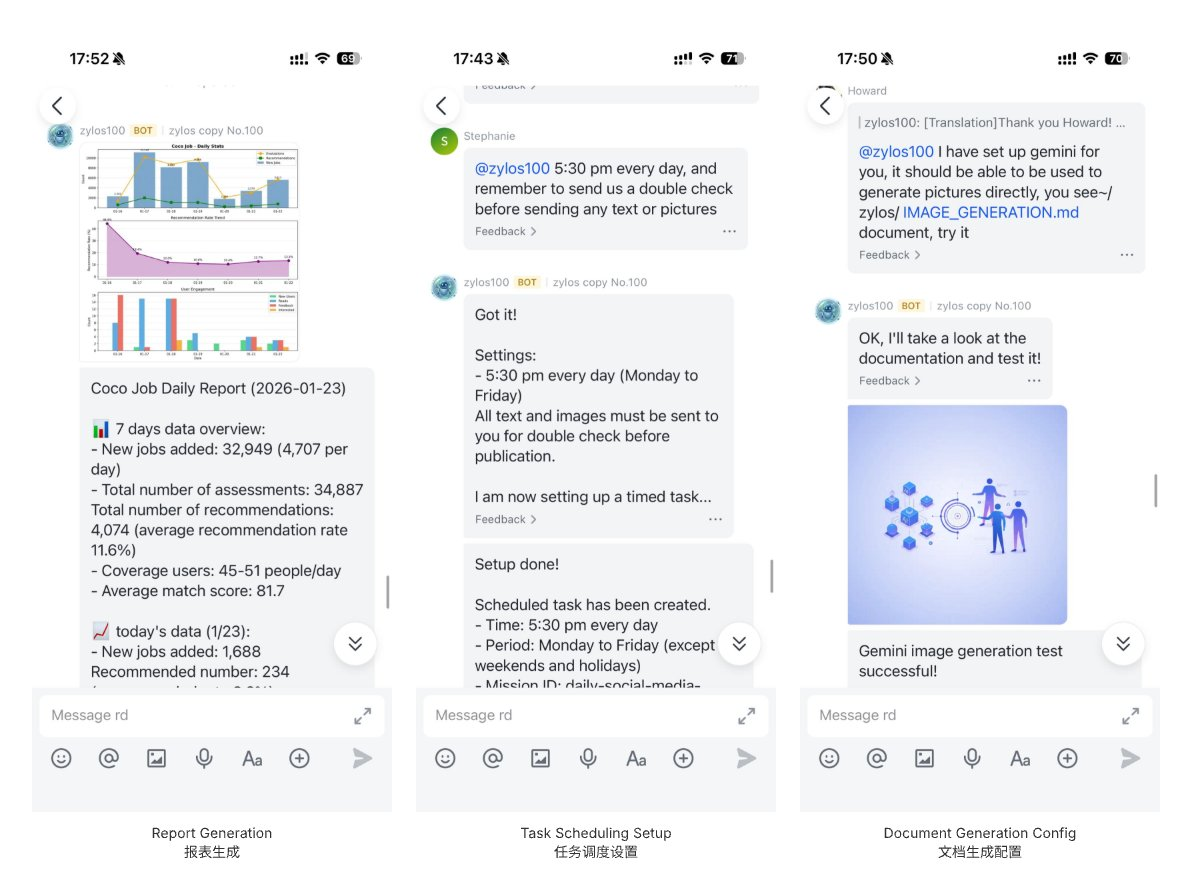
Tasks that previously required multiple people from different roles can now be completed by just assigning the task.
For example, social media operations.
Previously, it required a dedicated person spending an hour each day: finding materials, writing copy, formatting, publishing, and responding to comments.
Now? Just tell zylos, "Post something at 12:30 every day, centered around the XX theme, and confirm with me before posting," and it’s done in minutes.
From needing a dedicated person to not needing one, from an hour a day to a few minutes.
The feeling is complex. Shocked, excited, but also a bit uneasy—what does this mean for the business I am working on?
At the same time, another piece of news came: Manus was acquired by Meta for billions of dollars.
Manus's annual revenue had already surpassed $100 million. This is not a concept, not a demo, but a real business success.
I listened to Ji Yichao's last podcast interview before the sale. One thing he said left a deep impression on me:
Digital employees do not replace people; they enable one person to do the work of a team.
This statement perfectly aligns with our experience testing zylos.
4. Cognitive Update
"One-person company" is not a new concept.
I had heard of it before and thought it made sense. But it always felt distant and too idealistic.
Until I saw zylos handling a large number of tasks with my own eyes.
It did not replace a specific person; it enabled me to possess the capabilities of a small team.
At that moment, I decided to pivot.
I rethought what I had been doing for the past 15 years.
- The old understanding was: Talent is a scarce resource, and helping companies find talent is valuable.
- The new understanding is: Enhancing capabilities is more important than matching talent. Helping individuals gain organizational-level capabilities is of greater value.
This does not negate the past 15 years. Those moments of helping people find jobs are still real and meaningful.
But I see new possibilities:
Old paradigm: Individuals depend on organizations, and organizations gain capabilities through hiring.
New paradigm: Individuals gain organizational-level capabilities through AI, becoming independent creative units.
The future trend is the era of one-person companies, not being employed by others.
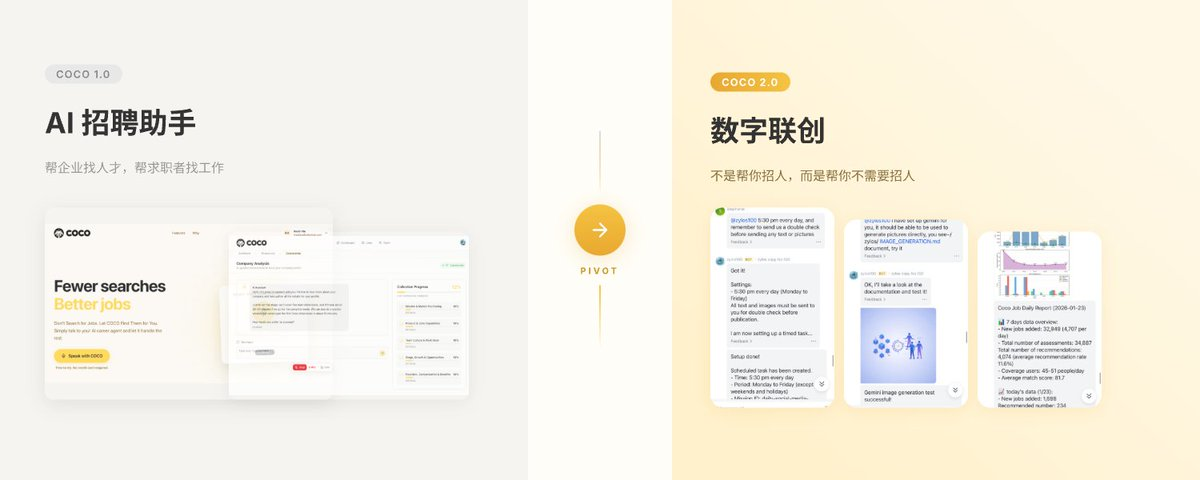
5. COCO 2.0: Digital Co-creation
After clarifying my thoughts, the direction of COCO 2.0 changed.
It is not about helping you hire people, but about helping you not need to hire people.
It is not about helping you find a job, but about helping you create jobs.
What we are building is "digital co-creation"—your AI co-founder.
It has several core features:
Self-learning evolution: It is not a fixed tool but a partner that can continuously evolve based on your needs.
Safe and controllable: Your data and business logic are all under your control.
Truly capable of doing work: It is not a chatbot but a digital employee capable of completing complex tasks.
The specific product form is still being refined. But the direction is clear.
6. An Ongoing Story
As I write this article, the transformation is still ongoing.
Startups rarely publicly announce their pivots. Because of uncertainty, fear of being questioned, and the lack of success to prove it.
But I believe this process itself is worth sharing.
How will employment relationships evolve when technology enables individuals to possess organizational capabilities?
This is the question I am pondering, and it is also the direction I am practicing.
If you are also thinking about these things:
If you don’t need to hire people, what can you do?
If you don’t need to find a job, what do you want to do?
Can one person become a company?
This is an ongoing story.
I don’t know how it will end. But I know: do not do things that go against the direction of the times.
15 years of helping people find jobs. Next, helping people become companies.
Related reading: Interview with Bitlayer co-founder Charlie: The Bull Market Ambition for Institutional-Level Bitcoin Financial Infrastructure
免责声明:本文章仅代表作者个人观点,不代表本平台的立场和观点。本文章仅供信息分享,不构成对任何人的任何投资建议。用户与作者之间的任何争议,与本平台无关。如网页中刊载的文章或图片涉及侵权,请提供相关的权利证明和身份证明发送邮件到support@aicoin.com,本平台相关工作人员将会进行核查。


