In the past year, the most genuine "votes" in the crypto industry have increasingly occurred not in governance forums, but in deployment scripts, migration plans, and budgets. Project teams no longer express their positions through slogans, but rather choose their ecosystems through actions: where to migrate the mainnet, which tool stack to prioritize for the next phase of products, and where to bet liquidity and partnerships in markets with stronger network effects.
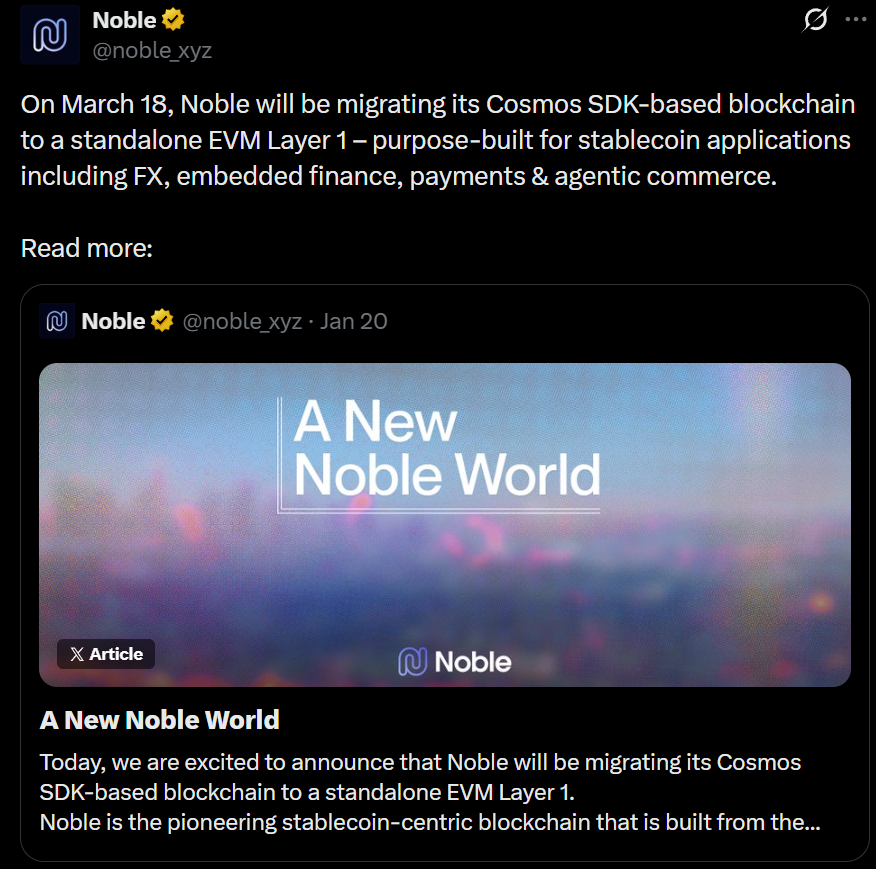
Noble's pivot is a typical case. As one of the most successful stablecoin infrastructures in the Cosmos ecosystem, it once undertook the issuance and cross-chain distribution of native USDC and connected numerous chains and stablecoin settlement scenarios through IBC. However, when it announced its migration to an independent EVM L1 and deeply bound its stablecoin product to the network's value capture mechanism, the signal became clear: the main battleground for stablecoins, settlement, and application distribution still lies within EVM. The market share of stablecoins is highly concentrated in EVM, where developer tools and wallet/dApp ecosystems are more mature. But this does not mean that "going EVM" equates to "squeezing into a generic chain" and everything will be fine. On the contrary, more and more teams, while moving towards EVM, are beginning to redefine a question: are we choosing a chain, or are we choosing a way to grow?
Why is "having one's own EVM chain" becoming more common?
First, the advantages of EVM remain clear: stablecoins and asset volumes are larger, integration targets are more comprehensive, and developer tools are more mature. This determines that many applications still hope to achieve growth and distribution within EVM. On the other hand, on generic chains, applications often have to accept a series of external constraints: fee fluctuations, congestion, shared ordering environments, unified upgrade rhythms, and the uncontrollable user experience that comes with them. The appeal of application chains/rollups lies in "internalizing" these constraints—teams can choose more suitable block times, execution models, RPC, and infrastructure configurations based on business characteristics, and closely bind transaction revenue and incentive design to their own network and product growth.
In other words, the industry is shifting from "choosing a chain and adapting to it" to "choosing an architecture and shaping it." When the costs of this path are significantly reduced, "having one's own EVM chain" becomes more like a replicable product strategy rather than a gamble.
Rollup as a Service is turning "self-built chains" from heavy assets into standard actions
The barrier to the application chain model is not "value clarity," but rather "construction and operation costs are too high." From building the chain, security, operation, monitoring, to cross-chain, bridging, messaging, and user deposit paths, each aspect entails high labor and time costs. For most teams, even if they recognize "the chain is the product," they may be deterred by engineering complexity. This is also the backdrop for Rollup as a Service (RaaS) coming to the forefront: it productizes deployment, hosting, maintenance, and some security engineering, allowing teams to refocus their energy on the application itself—functionality, ecosystem collaboration, growth, and commercialization.
Taking Caldera as an example, its core narrative and roadmap are quite typical: initially lowering the deployment threshold for rollups through the Rollup Engine; and after the rapid growth of rollups, further focusing on "how to smooth out fragmentation." In Caldera, this layer is referred to as Metalayer: it aims to ensure that new chains have more complete interconnectivity capabilities from the outset, including fast bridging, aggregation, and developer SDKs, reducing the integration costs and time that teams would otherwise incur by connecting with multiple vendors separately. Behind this is a very realistic judgment: the true bottleneck of the application chain model is not "can we build a chain," but rather "does having our own chain impact user experience." If user deposits, cross-chain interactions, and paths are smooth enough, the sovereignty and controllable experience of application chains/rollups will be more attractive; conversely, fragmentation in interoperability and liquidity will offset the benefits of "lower gas and higher performance."
After the distribution logic changes, "interconnectivity" becomes the foundation of growth infrastructure
When the threshold for "self-built chains" is lowered by RaaS, new problems become more prominent: chains can be created more easily, but users and funds may not find it easier to enter. For most applications, real growth loss often occurs before usage—how many steps to deposit, how long to wait for cross-chain, whether fees are transparent, and what to do if it fails. Funds are scattered across the Ethereum mainnet, various L2s, exchanges, and other ecosystems, with user entry points coming from wallets, aggregators, centralized channels, or dApp redirects; in this distribution pattern, cross-chain and deposit paths are essentially part of the conversion funnel, and the greater the friction, the more likely new users will be consumed "before reaching the product."
Because interconnectivity begins to affect conversion and retention, the competitive point of RaaS is shifting from "can we deploy a chain with one click" to "can we prevent the chain from becoming an island." Some infrastructure teams are also extending their focus from deployment capabilities to the productization of the interconnectivity layer: for example, Caldera not only provides rollup deployment and operation capabilities but also introduces Metalayer as one of its core directions, hoping to preemptively and standardize the integration of cross-chain, bridging, and related toolchains, so that new chains can have smoother asset entry and cross-network flow paths upon launch, rather than piecing them together after going live. For project teams, this means fewer vendor assemblies, shorter integration cycles, and a more controllable user experience; for users, it means fewer "choices" and less operational friction. Once interconnectivity friction decreases, the sovereignty and controllable experience of application chains/rollups will not be offset by cross-chain complexity, making it easier to replicate on a larger scale.
The next generation standard is not "where to migrate," but "taking growth into our own hands"
As more and more projects gravitate towards EVM, the decision-making focus of the industry is also changing: from "which chain to align with" to "choosing more effective growth and delivery methods." The advantages of EVM as a distribution market still hold, but if business is placed on generic chains for the long term, key experiences will become more reliant on external environments: fee fluctuations caused by congestion, queuing and failure rates due to shared execution, and upgrade and parameter constraints under a unified rhythm. In the early stages, these uncertainties may be acceptable; once entering a scaling phase, they will directly impact conversion and commercialization, making growth feel more like "eating based on market conditions."
The reason "having one's own EVM chain/rollup" is increasingly seen as a standard is not that project teams all want to build infrastructure, but because it makes growth variables more controllable: costs and performance are more stable, confirmation and execution environments are more aligned with business needs, upgrade rhythms can follow product development, and it is easier to form a closed loop between chain-level revenue, incentives, and resource investment with product operations. More importantly, RaaS reduces the costs of building and operating chains, while interconnectivity layers like Metalayer reduce cross-chain and integration friction, making "having one's own execution environment" no longer equate to "sacrificing distribution and liquidity." When both types of costs decrease simultaneously, self-owned EVM chains/rollups transition from a few customized options for top projects to a standard solution that more applications can replicate during their scaling phase.
免责声明:本文章仅代表作者个人观点,不代表本平台的立场和观点。本文章仅供信息分享,不构成对任何人的任何投资建议。用户与作者之间的任何争议,与本平台无关。如网页中刊载的文章或图片涉及侵权,请提供相关的权利证明和身份证明发送邮件到support@aicoin.com,本平台相关工作人员将会进行核查。