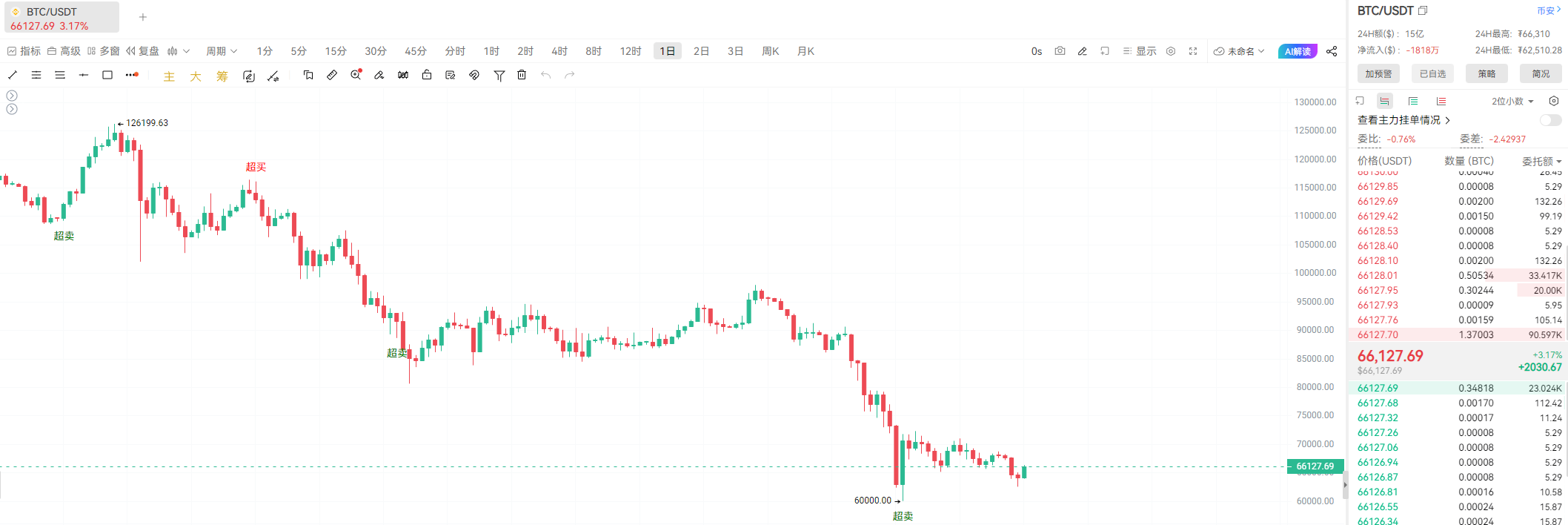
In the past 48 hours, the cryptocurrency market has undergone a brutal "de-leveraging" ordeal. Bitcoin has continuously breached multiple key levels, with its lowest approaching $62,700, over 130,000 investors have suffered liquidation in a short period. Behind this cascading drop, it was not a single bearish factor that dominated the market, but rather a liquidity crisis triggered by the chain reaction of leveraged long positions being "taken out." This article will outline the causes of this crash and dissect the bullish and bearish implications of the $60,000 key support level.

1. A Bloody Weekend: Over $400 Million Disappeared
● Although weekends are typically a period of relative calm in the cryptocurrency market, the past weekend has become a "battlefield" for leveraged longs.
● Bitcoin attempted to rally near $68,600 on Saturday, but the optimism was short-lived, and with increasing selling pressure, the price quickly turned downward, breaching the $64,000 threshold early Monday. According to Coinglass data, this sharp decline resulted in over $467 million in futures contracts being forcibly liquidated across the entire network, with long positions accounting for as much as 93%, approximately $434 million.
● Notably, on the HTX exchange, there was a single-sided liquidation of BTC-USDT worth as much as $61.5 million, which the market generally believes was not the action of ordinary retail investors, but rather a long position from a "whale" or a fund that was "hit." Such a large position being liquidated instantaneously further exacerbated the market's downward spiral.
2. Who is Selling? Triple Pressure Accumulated
Regarding this downturn, Min Jung, an associate researcher at Presto Research, pointed out that this is not solely due to a single deterioration in fundamentals, but rather a result of a resonance between macro risk aversion sentiment and the inherent structural weaknesses in the cryptocurrency market.
● Firstly, the "tariff big stick" at the macro level is swinging again. Former U.S. President Trump announced a temporary increase of the import tariff to 15%, higher than the previous 10% baseline, which directly weakened the market's risk appetite. At the same time, geopolitical tensions have escalated, with funds withdrawing from risk assets like Bitcoin and flocking to traditional safe-haven assets like gold.
● Secondly, the temporary "absence" of institutional demand. Data shows that the Coinbase premium index, which measures institutional demand in the U.S., has been negative for most of the time since 2026, indicating that U.S. investors are mainly engaged in distribution rather than accumulation.
○ More intuitively, the U.S. spot Bitcoin ETF has seen an outflow of about $2.81 billion in funds over the past two months, with $1.21 billion having flowed out since February alone. This substantial outflow has directly removed the support for buying in the market.
● Finally, and most critically, the de-leveraging cycle within the cryptocurrency market. Andri Fauzan Adziima, research director at Bitrue, analyzed that the market is experiencing large-scale long position liquidations, with funding rates consistently negative and open interest sharply declining.
○ Data from Glassnode also corroborates this: the seven-day moving average net realized loss of buyers remains near $500 million per day, indicating that after the first liquidation in early February, short-term holders attempting to catch the bottom are still experiencing losses.
3. $60,000: The Last Defense Line for Bulls
As prices retreat, the $60,000 threshold has become the focus for all traders. Coinbase Institutional's analysis on social media points out that the data from the BTC options market shows that the most concentrated support cluster is near $60,000, which is the key support to prevent accelerated declines.
Analyst Andri Fauzan Adziima further dissects the significance of the core area between $60,000 and $63,000:
● If it holds (bullish scenario): If the price stabilizes above $60,000, the currently persistent negative funding rates will be unfavorable for shorts. Once shorts need to cover their positions, it could easily trigger a "short squeeze," creating conditions for a rebound. If subsequent macro sentiment improves or ETF funds flow back in, it may drive price recovery.
● If it fails (bearish scenario): If it breaks below the psychological barrier of $60,000 with increased volume, it may open up further downside. In the worst-case scenario, as the macro backdrop worsens and cascades of liquidations accelerate, the price could drop to the mid-$55,000 range, and in extreme cases, it may even test $47,000.
From a technical analysis perspective, some traders pointed out that while prices are currently testing below $65,000, more buying might be waiting around $60,000; if it effectively breaks below $60,000, the next key defensive level will be around the 200-week moving average at $58,500.
4. Market Sentiment Plummeted to Freezing Point
In this crash, the market's panic sentiment is even more glaring than the price itself.
● The "Cryptocurrency Fear and Greed Index," which measures market sentiment, has plummeted to 5 points, entering the "extreme fear" zone. This level has only occurred three times since 2018, corresponding to previous drops in August 2019, June 2022, and earlier this month.
● Interestingly, the reflexivity of sentiment has been validated. Google Trends data shows that the search popularity of keywords like "Bitcoin is dead" and "Bitcoin will go to zero" has reached an all-time high this month, with the index hitting a perfect score of 100. Historical experience indicates that such extreme pessimistic sentiment peaks often coincide with short-term price bottoms, and although this does not represent an accurate bottom signal, it at least signifies that the weak hands in the market are being rapidly flushed out.
● Under such extreme sentiment, the behavior of market participants has begun to diverge. While overall institutional funds continue to flow out, there are also "contrarians" who are quietly accumulating. MicroStrategy (now renamed Strategy) completed its 100th Bitcoin purchase on February 23, adding 592 BTC at an average price of about $67,286. On-chain HODL signals also indicate that during the process of strategically reducing risk, some long-term believers are quietly accumulating chips.
5. Future Outlook: Darkness Before the Dawn?
● As of the time of writing, Bitcoin has seen a slight rebound, regaining above $65,000. However, there remains a significant divergence among institutions regarding the market outlook.
● The bears, such as Ned Davis Research strategists, warn that if this bear market evolves into a full-fledged "crypto winter," Bitcoin's price could even be halved to $31,000. Meanwhile, the bulls argue that the combination of extreme panic readings, massive realized losses, and large-scale liquidations often serves as a signal that the market is searching for a bottom.
● Regardless of the future market direction, one thing is certain: in this round of declines dominated by liquidation, the market has completed an initial "detox." In the short term, $60,000 is not only a critical technical level but also a psychological battleground for both bulls and bears. For investors, maintaining a sense of calm amidst market fear may be more important than blindly catching the bottom or cutting losses.
免责声明:本文章仅代表作者个人观点,不代表本平台的立场和观点。本文章仅供信息分享,不构成对任何人的任何投资建议。用户与作者之间的任何争议,与本平台无关。如网页中刊载的文章或图片涉及侵权,请提供相关的权利证明和身份证明发送邮件到support@aicoin.com,本平台相关工作人员将会进行核查。


