Mark Karpelès, former CEO of the now-defunct Mt Gox, has published a proposal calling for a Bitcoin hard fork that would allow approximately 79,956 BTC tied to the exchange’s 2011 hack to be recovered and distributed to creditors.
The proposal, titled “Consensus: Allow recovery of Mt Gox stolen funds (79,956 BTC),” outlines a narrowly scoped consensus rule change that would permit the unspent outputs locked to address 1FeexV6bAHb8ybZjqQMjJrcCrHGW9sb6uF to be spent using a signature from a designated Mt Gox recovery address.
According to the document, the funds — moved during a June 2011 system compromise — have remained untouched for more than 15 years. The private key to the address is believed to be controlled by the original attacker, not by the exchange or its creditors. The coins are among the most closely watched dormant holdings in Bitcoin’s history.
The proposal argues that the Japanese court-supervised rehabilitation process already exists and is actively distributing recovered assets to verified creditors. In theory, if the coins could be accessed, a legal framework is in place to allocate them.
Technically, the change would introduce a new script verification flag that substitutes the theft address’s public key hash with that of a recovery address at a specified activation height. The activation parameter is currently set to INT_MAX, meaning the rule remains inactive unless a future consensus decision alters that setting.
Crucially, the document openly acknowledges that the change constitutes a hard fork, requiring every node to upgrade prior to activation. This is not framed as a soft tweak or backward-compatible update — it would make previously invalid transactions valid, a significant step in Bitcoin governance terms.
Arguments in favor center on restitution, the prolonged dormancy of the coins, and the limited scope of the change. Opponents, however, raise concerns about precedent, the sanctity of immutability, coordination risks, and moral hazard. In short: If the network bends once, where does it stop?
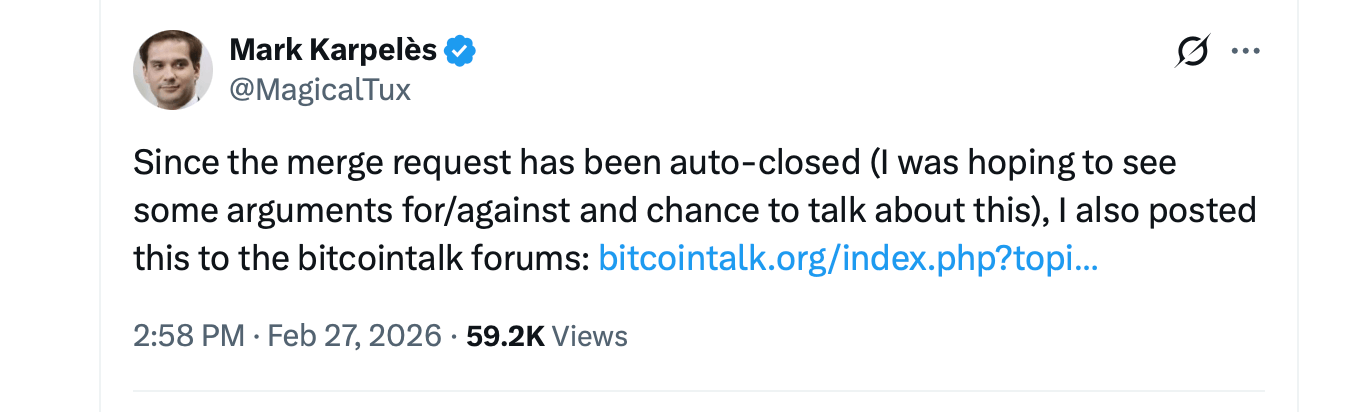
The proposal did not enjoy a prolonged public airing on Github. It was auto-closed within hours by Drahtbot as spam and subsequently locked, preventing further discussion on the Bitcoin Core repository. The abrupt shutdown added procedural drama to an already sensitive subject.
Pieter Wuille, one of Bitcoin’s Core contributors, directed Karpelès to what he believes is the appropriate venue for such consensus-level discussions. “If you’re actually serious about this, the Bitcoin development list is the appropriate place for discussing changes to Bitcoin’s consensus rules: https://groups.google.com/g/bitcoindev,” Wuille wrote.
The episode highlights an enduring tension within Bitcoin’s governance: balancing immutability with extraordinary cases. The Mt Gox collapse remains one of the most consequential events in Bitcoin’s early history. Whether the network would ever entertain a targeted hard fork to address it is another matter entirely — and for now, that debate appears headed to the mailing list and bitcointalk.org, rather than Github.
- What is Mark Karpelès proposing?
He is suggesting a Bitcoin hard fork that would allow 79,956 BTC tied to the 2011 Mt. Gox hack to be spent by a designated recovery address. - Was the proposal adopted?
No, it was auto-closed as spam on the Bitcoin Core GitHub and locked before extended discussion. - Why is this considered controversial?
The change would alter consensus rules to redirect a specific set of coins, raising concerns about immutability and precedent. - Where will the discussion continue?
Bitcoin Core contributor Pieter Wuille directed the proposal to the Bitcoin development mailing list for further debate.
免责声明:本文章仅代表作者个人观点,不代表本平台的立场和观点。本文章仅供信息分享,不构成对任何人的任何投资建议。用户与作者之间的任何争议,与本平台无关。如网页中刊载的文章或图片涉及侵权,请提供相关的权利证明和身份证明发送邮件到support@aicoin.com,本平台相关工作人员将会进行核查。


