Author: Frank, PANews
In the early hours of February 28, 2026, the global geopolitical landscape experienced a tremor as the conflict between the United States and Iran reignited. This black swan event, which changed the geopolitical structure, triggered severe chain reactions in the physical world and similarly caused a chaotic vortex of capital in the digital realm.
On the decentralized prediction market Polymarket, a contract titled "Will Khamenei resign as Iran's Supreme Leader before February 28?" attracted a total trading volume of 81.63 million dollars. As the death of Khamenei was gradually confirmed in the physical world, the smart contract settlement for this massive position became severely paralyzed and contentious. Two proposals for a 'Yes' resolution were rejected, forcing the market into the final review phase of the UMA oracle. This controversy once again sparked thoughts on the judgments of prediction markets, while multiple addresses suspected of insider trading surfaced, allegedly profiting over a million dollars.
PANews conducted in-depth tracking and multidimensional analysis of the on-chain transaction data for this market and discovered 521 suspiciously profitable addresses aggressively building positions during a specific vacuum period. Among them, 62 addresses only made one bet relating to the Iranian situation on the entire platform, with some wallets turning a mere 300 dollars into profits exceeding tens of thousands.
Outside the battlefront, while some argued endlessly, others were making a fortune.
The Deadly Time Zone Black Hole and the 81.6 Million Dollar Settlement Deadlock
To understand the insider suspicions behind the data, it is crucial to clarify the deadly contradictions in this battle over rules.
According to the official rule document of Polymarket, the conditions for the market to settle as 'Yes' are Khamenei's resignation, detention, loss of position, or being prevented from carrying out his duties.
After sorting through the information, PANews found several reasons why this contract prompted disputes over judgments twice.
1. Dispute over timing errors:
The first point of contention lies in the serious misalignment of the timeline. The cutoff deadline set by the smart contract is 11:59 PM Eastern Time on February 28. U.S. President Trump announced the news of Khamenei's death on social media at 6:12 PM that day, completely within the cutoff period. However, due to stability concerns, Iranian officials initially vehemently denied it, only formally announcing the obituary on national television in the early morning of March 1, after the contract's deadline. This led to disputes between the YES and NO camps regarding whether the timing fell within the cutoff date.
2. Dispute regarding semantic interpretation:
Aside from the timing controversy, there was also a dispute stemming from unclear contract interpretation. The contract rules state that the market settles as 'Yes' when Khamenei resigns, is detained, loses his position, or is prevented from performing his duties. Perhaps to avoid legal pressure, the rules deliberately avoided terminology related to death or assassination, and it is this textual compromise that sows the seeds of trouble. The NO camp believes that by expressly excluding the term 'death,' the contract text implies that death does not automatically equate to resignation unless the power transition process is officially initiated.
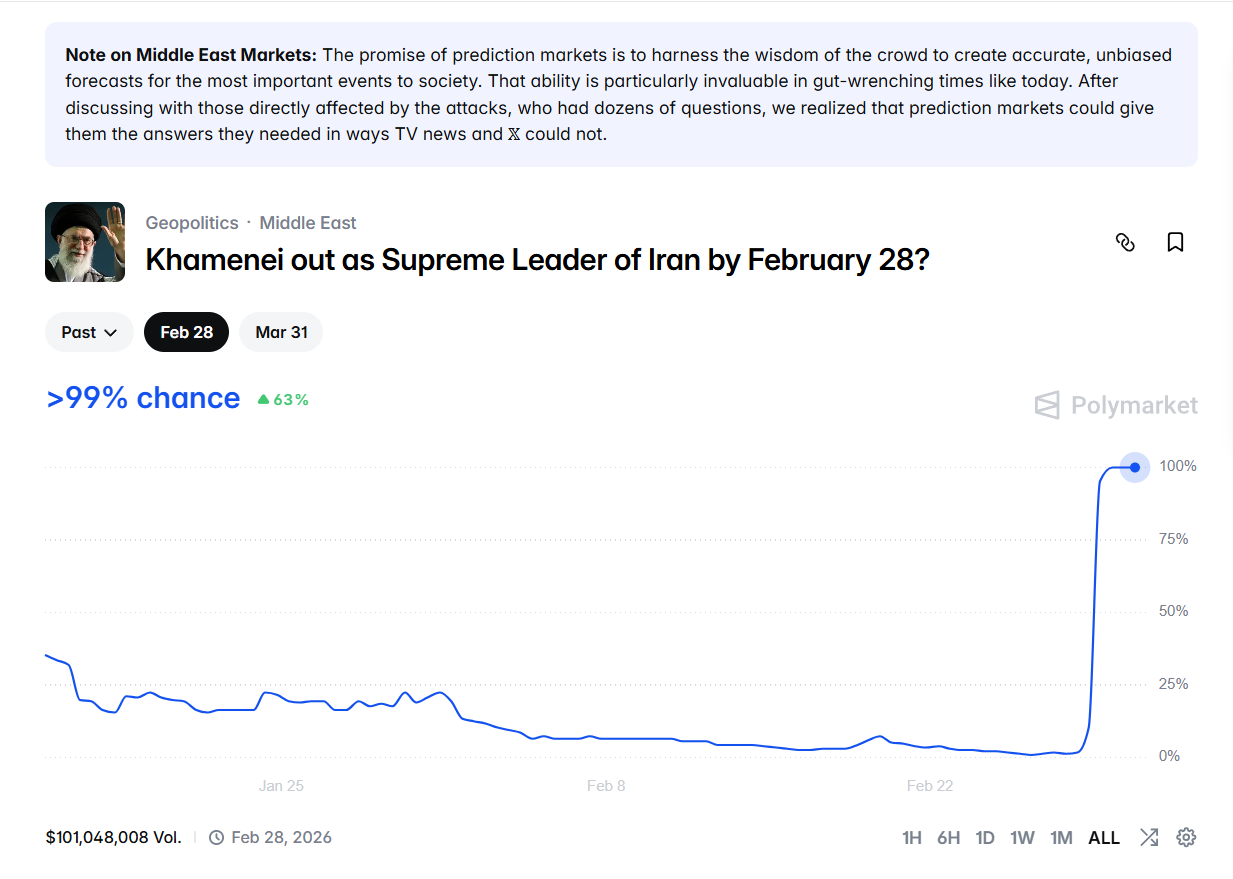
Faced with the enormous capital surge, Polymarket officials unusually intervened centrally, urgently adding a vague statement to the page indicating that the market might remain open until consensus was reached. This action was immediately criticized fiercely by the community, being seen as a violation of the core tenet of smart contract integrity.
Currently, the fate of this market has been handed over to the underlying UMA decentralized oracle for final review. If the result is ultimately determined to be NO, it will create the largest erroneous judgment in prediction market history.
521 Ghost Accounts: 100% Winning "Prophets" and Position Building During the Vacuum Period
Amid the controversy, a group of insider addresses began to quietly lay out their plans again.
By scraping the complete on-chain transaction data from Polymarket, PANews set eight dimensions of suspicious scoring criteria for all profitable addresses, including early buyers, trading only on winning sides, precise targeting, concentrated trading times, large holdings until settlement, high investment return rates, very short active periods, and significant absolute profits.
After systematic screening, PANews analysis revealed that 521 addresses exhibited highly suspicious trading behaviors. Further digging showed that 62 addresses had no other category of participation records throughout the entire Polymarket lifecycle, exclusively trading related to Iran and Khamenei. Additionally, there were 95 addresses whose trades related to Iran made up more than half of their activity.
After integrating various unusual trading conditions, PANews discovered that the top 15 ranked addresses collectively earned total profits of 900,000 dollars from this market.
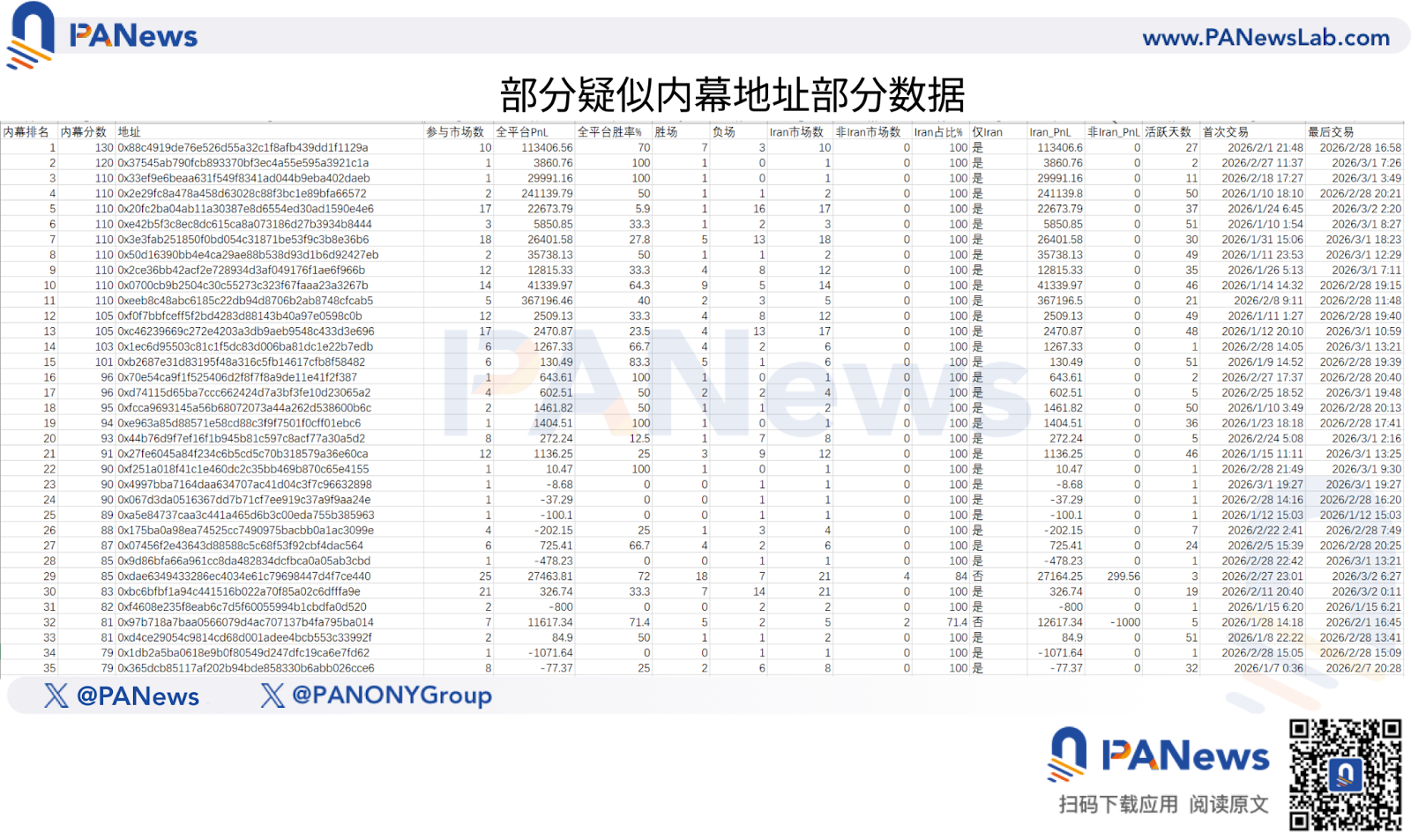
From a timeline perspective, these trading behaviors exhibited strikingly prescient judgment.
The first abnormal window appeared between January 14 and 17, during the initial creation phase of the market. At that time, a large number of high-suspicion addresses bought YES shares at ice-bottom prices of 0.03 to 0.05 dollars, seemingly setting the stage for the upheaval two months later. Notably, the second abnormal window concentrated on February 27 and 28, just hours before the settlement date and the first round of explosive news. Dozens of "one-time wallets," which existed for less than a day or two, surged in like phantoms, executing drastic buying and redemption operations; some even completed the entire asset exchange within the same block in less than a few minutes.
300 Turning into 40,000 Dollars: On-chain Data Restores the Path of the Whales' Harvest
Data aggregation is just the outline of this puzzle; as we zoom in, the on-chain operational methods of these whales and "prophets" become even more stark.
PANews selected a representative address with a suspicious score of 130 out of 130, 0x88c4919d. This address only participated in 10 markets across the entire platform, all related to the Iranian situation. It completed all fifteen trades in the Khamenei market in just an hour and a half, exclusively buying in the YES direction. Interestingly, its largest profits did not come from the contentious market but rather from the market regarding "Will the U.S. strike Iran before the end of March?" where it aggressively amassed 266,000 dollars. This operational pattern indicates that this is not an ordinary retail investor, but rather a highly specialized institutional player focused on Iranian political intelligence.
Looking at another more typical "one-time wallet" sample, the address starting with 0x37545ab7 was just opened on February 27 and conducted only two transactions on the entire platform. It used merely 51 dollars to buy YES and redeemed a total of 3,911 dollars just two days later, achieving a return of 7569%. Opening an account, entering the market, withdrawing, and disappearing — the actions were clean and efficient, resembling a predatory harvest that had been planned in advance.
Hiding in the second position on the profit leaderboard, 0x2e29fc8a, is an address that rolled away with a total profit of 241,000 dollars. Throughout its entire platform career, it only interacted with two related markets, earning over 100,000 dollars within two short days on an initial capital of 6,202 dollars. However, this address also lost 40,000 dollars in the earlier Khamenei market that closed in January, validating that such decision-makers relying on intelligence are not always victorious.
A Systematic Hunt Dominated by a Small Number of Entities
Moreover, PANews found through cross-comparisons on the dimensions of the common markets, directional consistency, and time overlap that a large number of these trading accounts are likely just a chip network controlled by a few giants.
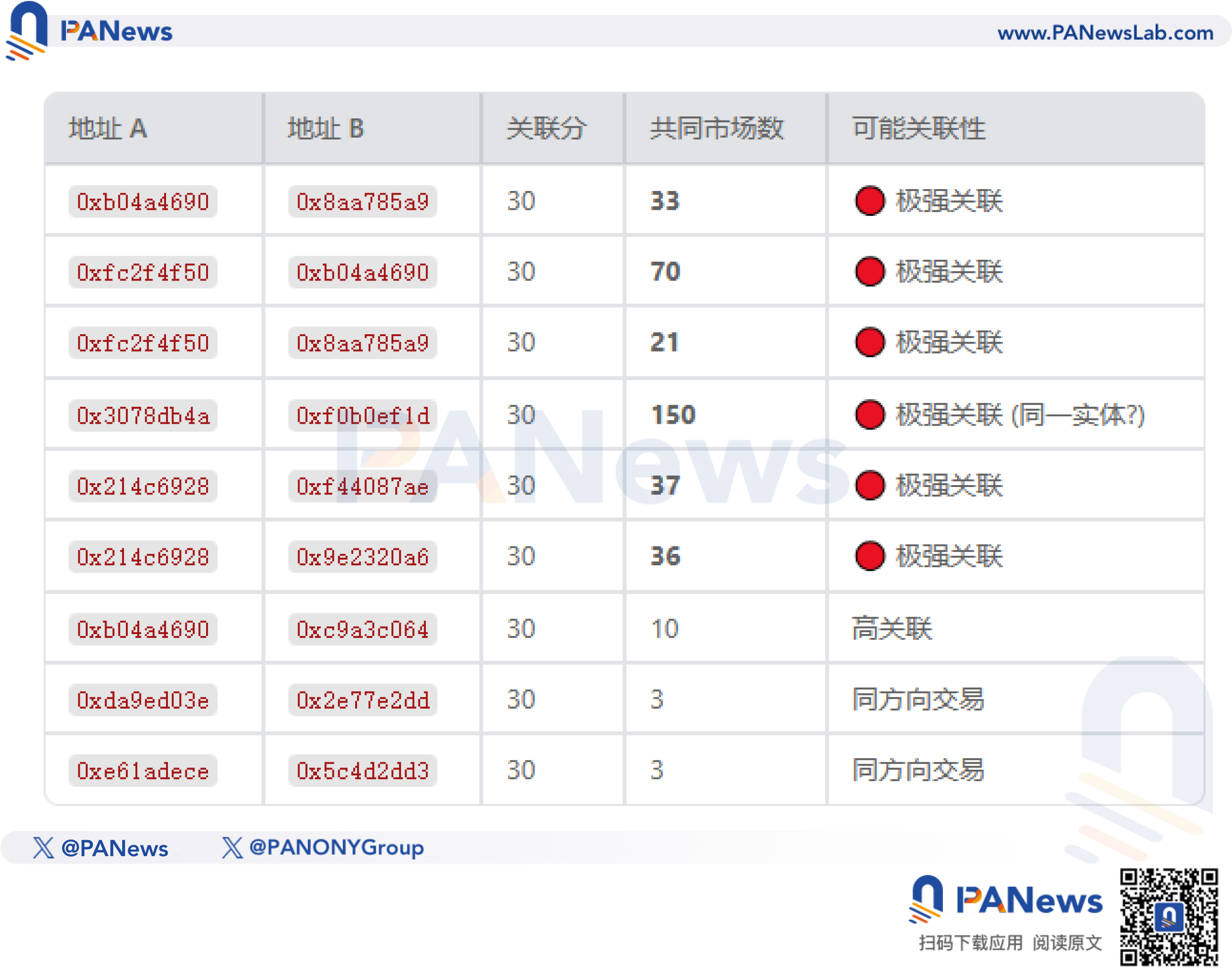
Among these over five hundred suspicious sources, at least three clusters of highly correlated addresses engaging in coordinated operations can be clearly identified.
Taking one particularly active address cluster as an example, it includes four frequently linked addresses. They entered and exited together across 20 to 70 common markets, cross-referencing each other, displaying remarkably synchronized movements. In another identified group of clustered operations, two addresses not only shared the same trading direction but also synchronized betting across as many as 150 identical derivative markets. Given the extreme overlap at this scale, we can highly confirm that behind these two addresses is a single entity with one program.
To obscure the trajectory of funds and disperse risk control, some entities have also deliberately constructed a decentralized network composed of dozens of small bets of a few dollars. This means that the insider control team actually hiding behind these 521 addresses may ultimately be under the control of just a few entities.
In a report released a week ago, only six suspicious wallets were accused of stealing over a million dollars. However, when PANews extended its focus to scan this network of over 500 address maps covering the entire web, it became clear that this is no longer the speculative play of a few lucky individuals, but a systematic hunt led by insider information, targeting average liquidity providers.
When 332 dollars can instantaneously swell to 40,000 dollars within a few blocks, when 62 wallets uniquely focused only on Tehran's skies among thousands of categorized platforms, the on-chain data does not lie. These suspicious addresses demonstrated thousands of times in returns that when anonymity and geopolitical secrets converge, the so-called collective wisdom is merely a cover for a few monopolists to reap retail investors. Respect the market, honor the trends, maintain independent thinking and cautious judgment — perhaps this is the only rule for survival for everyone in the decentralized carnival.
免责声明:本文章仅代表作者个人观点,不代表本平台的立场和观点。本文章仅供信息分享,不构成对任何人的任何投资建议。用户与作者之间的任何争议,与本平台无关。如网页中刊载的文章或图片涉及侵权,请提供相关的权利证明和身份证明发送邮件到support@aicoin.com,本平台相关工作人员将会进行核查。


