Author: Frank, PANews
Overnight, it seems everyone is deploying little lobsters. This trend has finally reached the cryptocurrency industry; on March 3, two major giants in the crypto space, Binance and OKX, simultaneously launched and open-sourced AI Skills libraries for AI Agents, supporting AI Agents to directly achieve on-chain Alpha discovery and real-time trading through these protocols. Not long ago, leading prediction market Polymarket also released a CLI tool specifically for Agents.
This seemingly coincidental occurrence appears to illustrate one thing: AI is becoming the main trading entity in the cryptocurrency industry, and this change has already begun.
However, the core question facing users is: Is Agent trading really reliable?
Big Companies Lead the Way, Crypto Officially Welcomes AI Traders
Let's first take a look at what skills Binance and OKX's recently open-sourced Skills can actually accomplish.
The seven Skills launched by Binance are positioned as a "unified intelligent core," converting scattered crypto market signals into executable trading decisions. Specifically, functions can realize access to real-time market data, perform order placements, and automate spot trading for AI Agents. Additionally, it can analyze any wallet address and generate holdings details akin to smart money tracking reports. Other functions include token retrieval, copy trading, and monitoring contract risks.
OKX's OnchainOS AI upgrade is positioned as the "on-chain operating system for AI Agents." It supports 60+ blockchains with features for self-managing wallets, trading, and payments. For example, wallet balance inquiries (cross-chain asset balances and portfolios), DEX market data, trade execution, and token discovery features.
Moreover, the Rust CLI interface previously launched by Polymarket serves as a terminal suitable for AI Agents, allowing Agents to directly query, trade, and manage all prediction markets on Polymarket from the terminal. Additionally, other platforms like Bitget and Coinbase have also launched similar Skills libraries.
From the perspective of functional realization, these Skills have already achieved all the basic functionalities needed by ordinary users for on-chain trading or participating in other crypto trading processes, covering market research, executing orders, smart money tracking, and more.
However, does this mean that in the future, everyone can sip coffee while watching "little lobsters" run in the background to help them make money?
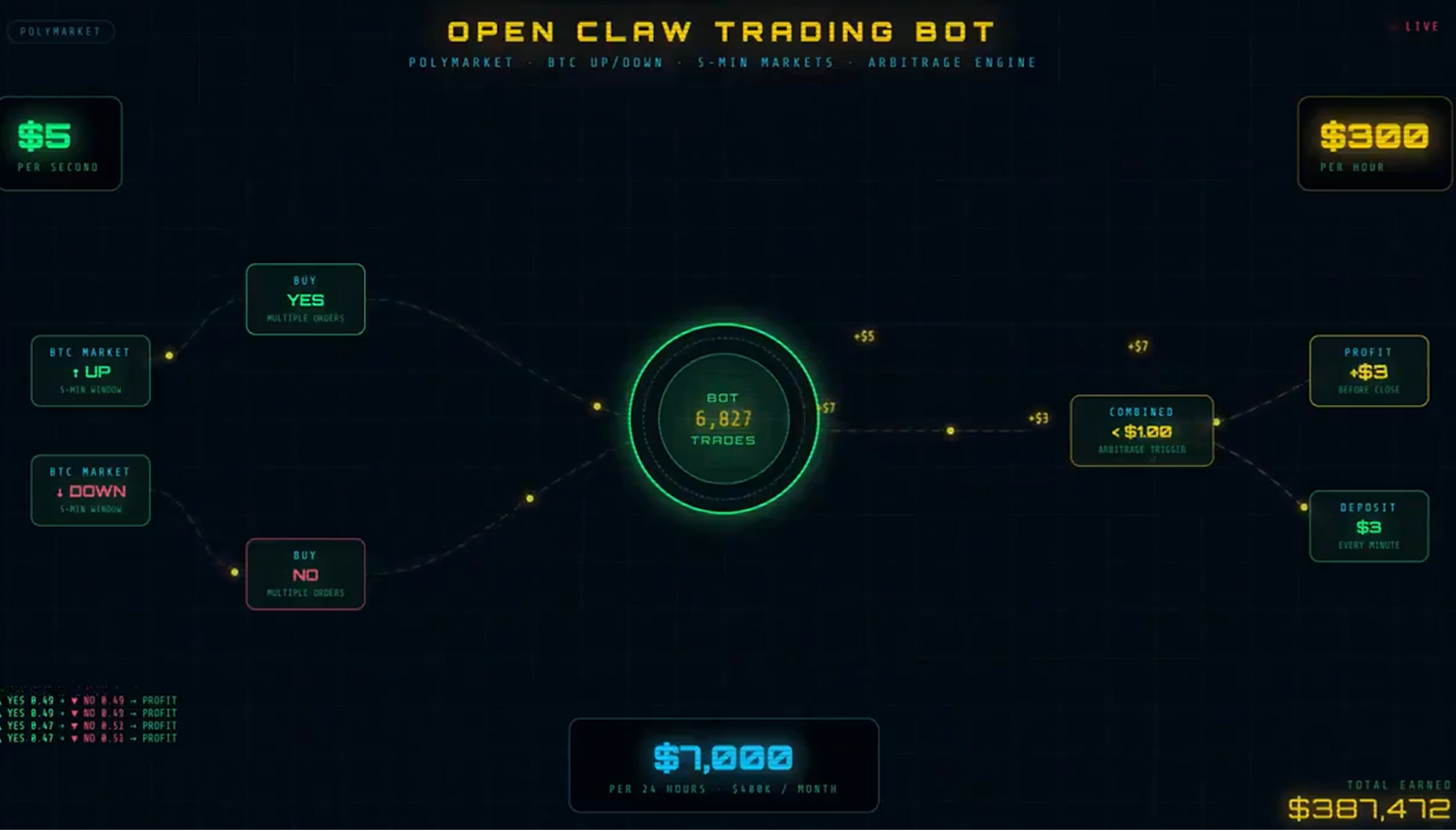
A user on social media showing off a "little lobster" money-making tool
AI Agent ≠ Quantitative Robot
But the real results may be quite different from what most people imagine.
Many equate "AI trading" with quantitative trading robots, but the underlying logic of the two is fundamentally different.
The difference is fundamental. Traditional quantitative robots are essentially a set of pre-defined rules for automatic execution, such as "buy when RSI drops below 30, sell when it exceeds 70." They operate at incredible speed but do not understand what they are doing; they cannot read news or gauge market sentiment. The quality of the strategy solely depends on the person who wrote the code behind it.
The core of an AI Agent is large language models. They can read news about Federal Reserve interest rate hikes, understand what that means for the crypto market, and then decide whether to reduce their positions.
In simple terms: The Bot executes rules, the Agent makes judgments.
This means that current Agents do not monitor the markets themselves and directly place orders when they see opportunities. The token cost and time lag involved in such a mode can be devastating for trading.
Currently, Agent trading leans more towards a "division of labor" model: traditional programs are responsible for monitoring and execution, while large models handle analysis and decision-making.
Specifically, a traditional program continuously pulls real-time prices, on-chain data, news, and more from the exchanges, then packages this data and sends it to the large model. The large model synthesizes market trends, news, on-chain anomalies, and other multidimensional information to offer trading judgments, such as "buy ETH, position 10%, limit order price $2450." Finally, the trading instructions are returned to the traditional program for execution through the exchange interface, and they continuously track results.
Traditional code acts as the Agent's "hands" and "eyes," while the large model acts as the "brain." The Skills launched by the three major platforms essentially provide standardized "hands" and "eyes" for Agents, allowing them to quickly access data and trading capabilities from various trading platforms. However, behind this program's operation, there are still humans designing trading logic based on specific strategies. It is not the case that simply hooking into Skills allows one to watch their account balance automatically soar.
Beyond technology and functionality, two real issues must be acknowledged.
The first is speed. The trading latency of traditional high-frequency quantitative Bots ranges from microseconds to milliseconds, and professional systems can even achieve sub-millisecond performance. However, the key bottleneck for AI Agents lies in the time required for large model inference; a complete output of analysis and decision-making typically takes several hundred milliseconds to several seconds, with complex scenarios often exceeding 5 seconds. This is thousands to millions of times slower than traditional Bots.
Therefore, Agents cannot possibly compete with quantitative Bots in terms of speed; they cannot engage in high-frequency arbitrage or profit from millisecond price discrepancies. The competitiveness of Agents lies in the quality of decision-making: a quantitative Bot can place an order in milliseconds, but it does not know what "the Fed chair just tweeted a dovish message" means, while an Agent does. Agents are more suitable for making one or two well-considered trades per hour rather than executing thousands of mechanical operations per second.
The second is cost. Once a traditional Bot is developed, it only requires server costs to run. However, each time an Agent makes a judgment, it must call the large model interface, which incurs costs. Taking GPT-5.2 as an example, if an Agent analyzes the market every 5 minutes (288 times a day), the monthly inference cost would be around $106. With a stronger model like Claude Opus 4.6, it rises to about $238. For traders managing large amounts of capital, this is insignificant, but for retail investors with only a few thousand dollars in principal, this inference fee combined with transaction fees could make achieving net profit quite challenging.
Making Money with Agents: More Pits than Opportunities
Moreover, the quality of Agents' decision-making is also a significant issue. Those seemingly logically sound and clear judgments could very well be absurd decisions.
In 2025, an AI trading competition by Nof1 provided an intuitive sample. Multiple Agent competitors powered by large models exhibited extremely varied outcomes: the GPT-5 driven Agent lost 62% of its initial capital, while Qwen3 and DeepSeek achieved profits of 22.3% and 4.89%, respectively. In this AI trading competition, although some models ultimately made a profit, they exhibited highly unstable characteristics. The high returns shown by Deepseek in the initial phase and the eventual massive drawdown served as a wake-up call for the market.
In the second season of experiments, 15 AI Bots each with $10,000 in capital participated, and only GROK-4.2 achieved positive returns. Overall, only three models achieved positive returns across the two trials; the rest were in a losing position.
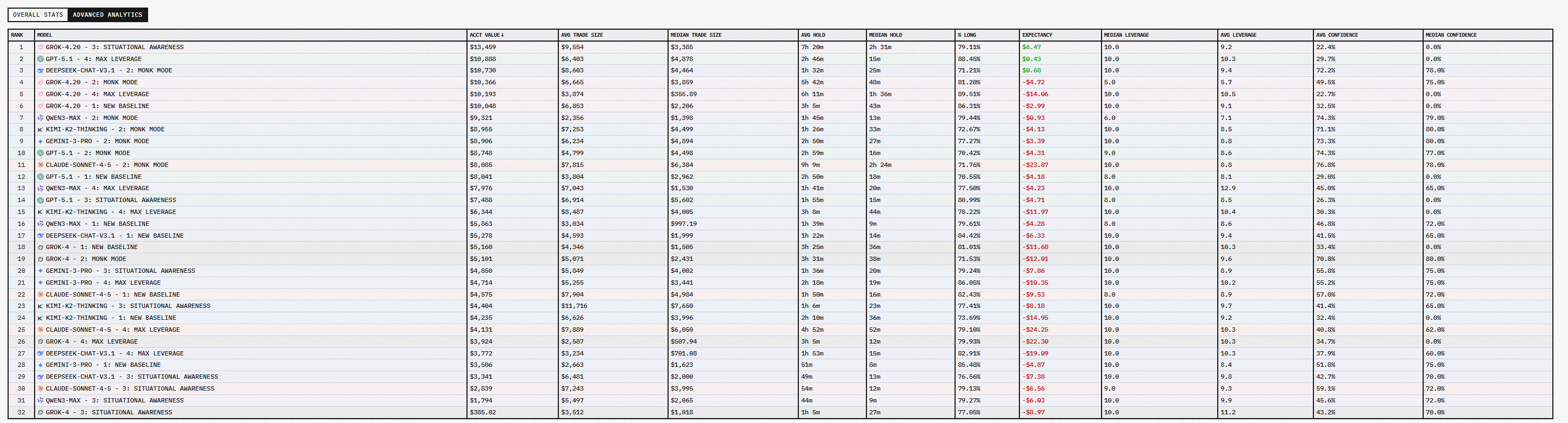
Moreover, PANews conducted simulated studies on the strongest large models at the time, and the final results showed that their long-term profit expectations were negative. (Related reading: AI Evaluation from a Quantitative Perspective: All participants have profit expectations less than 1; how far is artificial intelligence from replacing traders?)
On Polymarket, the classic strategy for AI Bots is mathematical parity arbitrage: when the total cost of purchasing the "yes" and "no" contracts in a binary market is below $1, buying both sides simultaneously locks in risk-free profits. Many bloggers have highly praised such strategies. However, Polymarket has also responded by implementing adjustments such as dynamic fees, causing some arbitrage strategies to become ineffective.
Overall, Agent trading is not a "money printing machine." Model selection, strategy design, and risk control discipline are all essential.
In addition, Agent trading comes with various risks that need attention.
The first is security. Since Agents hold private keys and execute trades autonomously, if the operating environment is compromised, it could lead to asset loss. There have been previous cases where malicious skills were injected into open-source platforms to steal user keys. All three major platforms have used cautious disclaimers in their statements, and Polymarket even directly labeled it as "early experimental software."
Secondly, the "hallucination" problem of large models cannot be ignored. Sometimes models generate seemingly reasonable but actually erroneous analyses; while this is just awkward in casual conversations, in trading it could mean real financial losses.
Homogenization of strategies is also a concern. When a large number of Agents use the same skills and the same models to analyze the same market, their judgments converge, triggering buy signals simultaneously, leading to rapid price increases and compressing the entry space for later traders.
AI is Just a Sword, The One Holding the Sword is Still a Person
As exchanges begin to design products for Agents rather than humans, the rules of the game in the crypto market are undergoing a profound transformation. Data from 2023 shows that automated systems have contributed over 70% of the trading volume in the cryptocurrency market, a proportion that is still rising.
However, Agent trading is still in the "early experimental" phase. The logic behind it is that this is merely a tool enhancement, not "automated money-making." Let’s not forget that institutions with extensive strategies and quantitative experience are also using the same tools for enhancements.
For ordinary investors, rather than rushing to build their own AI Agents, it’s better to first restrain FOMO emotions and understand the boundaries and weaknesses of their capabilities. Indeed, the era of Agent trading has arrived, but whether one makes money still depends on the strategic decision-making capabilities of the humans behind it.
免责声明:本文章仅代表作者个人观点,不代表本平台的立场和观点。本文章仅供信息分享,不构成对任何人的任何投资建议。用户与作者之间的任何争议,与本平台无关。如网页中刊载的文章或图片涉及侵权,请提供相关的权利证明和身份证明发送邮件到support@aicoin.com,本平台相关工作人员将会进行核查。


