Written by: Bitget Wallet
Wars show the world ruins, but capital only cares about prices.
As the fires reignite in the Middle East, colleagues far away in Dubai report bombings and air defense alarms; missiles cutting through the sky represent humanity waiting for an unknown fate.
Meanwhile, on another invisible timeline, global financial markets have begun recalculating: How high should oil prices go? Will gold continue to soar? When will the stock market bottom out and rebound?
Capital does not empathize, nor does it rage. It simply does one thing calmly—pricing uncertainty. For most people, it is invisible and unfathomable; its logic is ruthless, and its rhythm is merciless.
But in turbulent times, understanding the logic of capital operation and risk pricing may be the last line of defense between ordinary people and the historical tide. Looking back at human geopolitical conflicts and financial history, you will find a pattern that has almost never changed: In the face of war, the capital market always repeats the same script, and over the past 36 years, this script has been fully played out four times.
What capital fears most is not conflict, but "waiting"
From the Gulf War in 1991, the Iraq War in 2003, to the Russo-Ukrainian conflict in 2022, the script is always the same. These three globally influential geopolitical crises have illustrated the pricing rules of the capital market during the "brewing period—explosion period—clarification period."
The financial market is essentially a machine for discounting expectations. During the brewing period of conflict, fear of unknown supply interruptions drives oil and gold prices to sky-high levels, causing global stock markets to plunge. However, Wall Street has a bloody iron law: "Buy to the sound of cannons."
Once the first cannon sounds (or the situation clarifies), the greatest uncertainty is cleared away. Safe-haven assets often peak and fall quickly, while the stock market may complete a deep V-shaped reversal at the desperate bottom. The war may continue, but the panic in capital has ended.
The following is a deep analysis of the changes in capital markets during these three historical events:
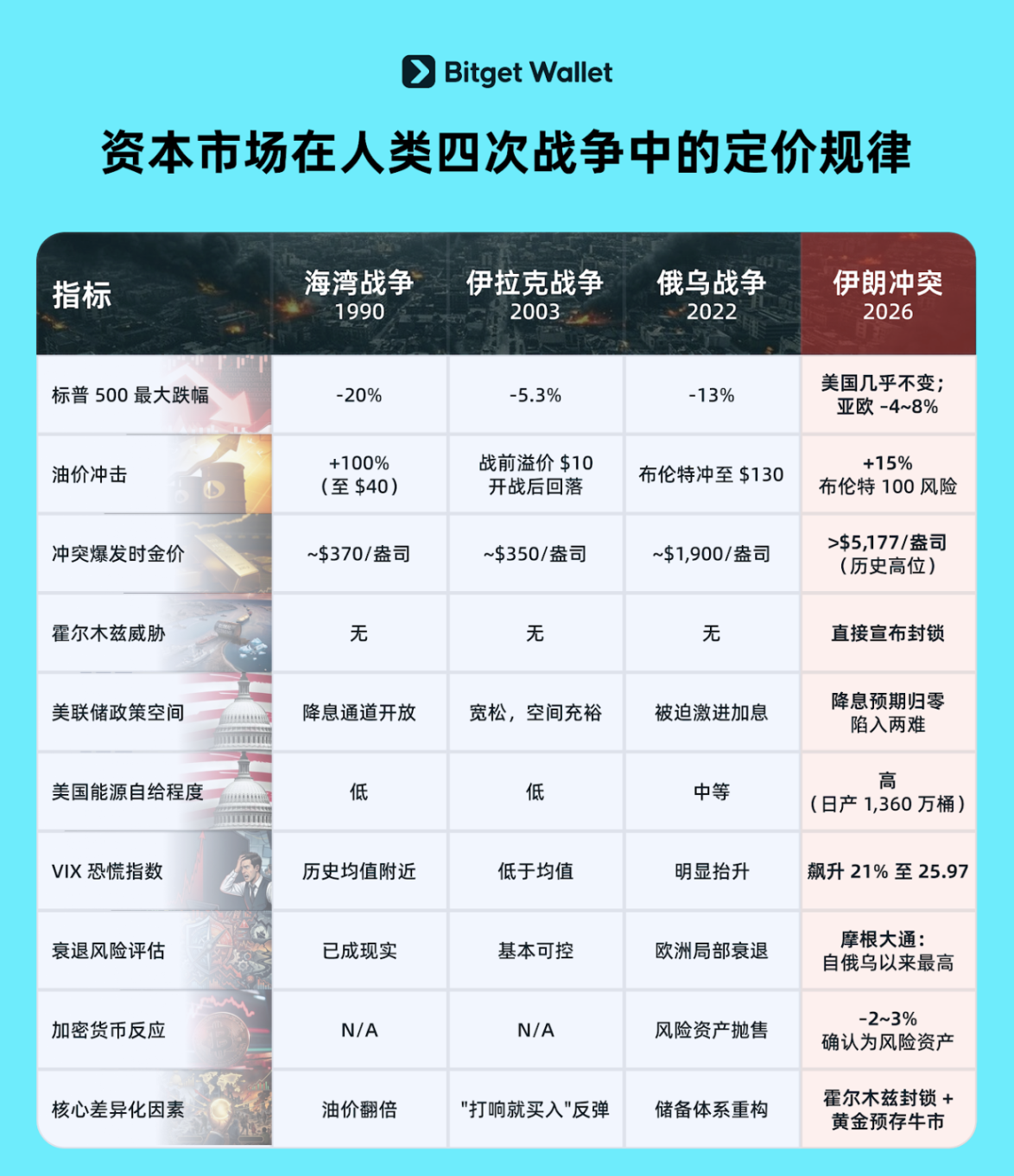
1. Gulf War 1990-1991: Classic "V-shaped reversal" and oil shock
This war is a textbook case for studying geopolitical shocks in modern financial history, perfectly illustrating "buy on expectation, sell on facts."
Crisis brewing period (August 1990 - January 1991): Panic and hedging
- Oil price skyrocketed: Following Iraq's invasion of Kuwait, the market panicked over potential interruptions of Middle Eastern oil supply. In just two months, international oil prices soared from around $20 per barrel to over $40, an increase of more than 100%.
- Stock market crash: Influenced by skyrocketing oil prices and the shadow of war, the S&P 500 Index plummeted nearly 20% from July to October 1990.
The shoe drops (January 17, 1991): Counterintuitive market upheaval
- On the first day of the U.S.-led "Operation Desert Storm," the market experienced a highly counterintuitive trend: due to the overwhelming nature of the war's progress, "uncertainty" was instantly eliminated.
- Oil price plummeted: Oil prices recorded one of the largest single-day drops in history on the day of combat (falling over 30%).
- Stock market euphoria: The S&P 500 Index surged on that day, subsequently initiating a fierce V-shaped reversal, recovering all losses within six months and reaching an all-time high.
2. Iraq War 2003: Relief after a long decline
The 2003 Iraq War accrued the aftermath of the dot-com bubble burst and the security anxiety following 9/11, with market reactions more reflective of the notion "long pain is worse than short pain."
Crisis brewing period (late 2002 - March 2003): Dull knife cutting meat
- During months of diplomatic tug-of-war and war preparations, capital markets were like startled birds. The S&P 500 Index continued its downward slide as global capital surged into gold and U.S. Treasury bonds out of a sense of risk aversion.
- Oil prices slowly rose from $25 to nearly $40 due to war expectations and strikes in Venezuela.
The shoe drops (March 20, 2003): Bad news exhausted becomes good news
- Dramatically, the absolute bottom of the U.S. stock market appeared about a week before the war began (around March 11, 2003).
- When missiles actually hit Baghdad, the market interpreted it as "bad news exhausted." The stock market then skyrocketed, opening a bull market that lasted four years. Gold and other safe-haven assets rapidly cooled as the war progressed smoothly.
3. Russo-Ukrainian conflict 2022: "Super stagflation" triggered by supply chain breakdown
Unlike the previous two Middle Eastern wars (where the U.S. achieved overwhelming victories without causing long-term substantive damage to the global supply chain), the Russo-Ukrainian conflict has had a deeper and heavier impact on capital markets, altering the underlying logic of the macroeconomy.
Crisis outbreak (February 2022): An epic storm in commodities
- Russia is a global energy and industrial metal giant, while Ukraine is the "breadbasket of Europe." Following the outbreak of conflict, Brent crude oil briefly surpassed $130 per barrel; European natural gas prices surged several times; and wheat, nickel, and other commodity prices reached historic highs.
Ongoing impacts: "Double whammy" of inflation rebound and monetary tightening
- Stock and bond markets both declined: The most deadly market impact of the Russo-Ukrainian conflict was its complete destruction of the fragile global supply chain post-pandemic, directly triggering the worst inflation in 40 years in Europe and America.
- To combat this "imported inflation" caused by geopolitical war, the Federal Reserve was forced to initiate the most aggressive interest rate hike cycle in history. This resulted in an unprecedented "double whammy" in 2022 (stocks fell, and bonds also fell), with the Nasdaq index plummeting over 30% that year.
The deadly illusion: Never try to profit from "war money"
Let us pull the timeline back to reality.
The sudden tension in the current Middle Eastern situation has once again pushed the global capital market into a phase of uncertain "stress testing."
From the perspective of the macroeconomic transmission chain, the core threat of the Middle Eastern conflict to capital markets lies in "physical supply chain blockage → energy price surge → global inflation rebound → central bank forced to maintain tightening → risk assets plummet."
Analysis of the chain reaction in capital markets
International crude oil: The absolute center of the storm
Chain reaction: The Middle East controls the lifeblood of global crude oil (especially critical shipping lanes like the Strait of Hormuz). If conflict expands or poses risks to major oil-producing countries, the market will immediately factor in a "geopolitical risk premium." This will result in a short-term spike in Brent and WTI crude oil prices.
Deep impact: Crude oil is the mother of all industries. The surge in oil prices not only raises the costs for aviation, logistics, and chemical industries but also directly threatens the recently stabilized price index (CPI) in the form of "imported inflation."
Precious metals (gold/silver): The traditional ultimate safe haven
Chain reaction: When faced with war, geopolitical turmoil, and potential vicious inflation, funds instinctively flow toward gold. Gold prices usually gap up before and during the early stages of a conflict, setting stage highs or even historical highs; silver tends to have greater volatility due to its industrial properties.
Deep impact: It is important to note that the surge in gold prices is often driven by emotion. Once the situation becomes clearer (even if conflict is still ongoing), the safe-haven sentiment may wane, and gold prices can easily experience high and then fall back, returning to a pricing logic driven by real rates of the dollar.
U.S. stock market: The specter of inflation and "valuation slashing"
Chain reaction: Wars are generally bearish for the overall U.S. stock market. The fear index (VIX) will soar quickly, causing funds to withdraw from overvalued technology stocks (like AI sector, semiconductors) and move into defensive sectors such as military, traditional energy, and utilities.
Deep impact: The U.S. stock market's greatest fear is not the shells from the Middle East, but the rebound of inflation triggered by those shells. If rising oil prices keep U.S. CPI elevated, the Federal Reserve will be forced to postpone interest rate cuts or even raise rates again. This tightening of macro liquidity will severely impact valuations for technology stocks represented by the Nasdaq.
Crypto market: Liquidity drain of high-risk assets
Chain reaction: Although Bitcoin has consistently been labeled as "digital gold," during past geopolitical crises (like the early outbreak of the Russo-Ukrainian conflict and escalating Middle Eastern tensions), the actual performance of the crypto market resembled the "super-elastic Nasdaq index" more closely.
Deep impact: In the face of war panic, Wall Street institutions prioritize selling the most liquid and highest-risk assets to cash out, with the crypto market often being the first to suffer dips. Meanwhile, altcoins face liquidity exhaustion. However, when conflicts trigger local fiat currency collapses or traditional banking systems are obstructed, the "resistance to censorship and borderless transfer" attributes of crypto assets may attract some risk-averse funds.
Comparing the three historical geopolitical conflicts allows us to distill core rules for ordinary people to respond to geopolitical crises:
- "Uncertainty" is the biggest killer: The most severe stock market declines almost always occur during the brewing and game-playing periods before the war breaks out. Once the war actually starts (especially when the situation becomes predictable), the stock market often rebounds. This confirms the Wall Street adage: "Buy in the sound of cannons."
- Commodity "takeover traps": Before and at the outset of a conflict, crude oil and gold often soar to incredible highs due to panic sentiment. However, unless the flames of war substantively and long-term cut off physical supply (as in the Gulf and Iraq wars), prices may quickly plummet by half after fighting commences. Blindly chasing higher prices for commodities can easily make one a "takeover pawn" for institutions.
- Differentiate between "emotional shocks" and "fundamental destruction": If the war is merely an emotional shock (like localized conflicts with significant disparities in strength), the stock market tends to rebound quickly after dropping. But if the war leads to a long-term break in core supply chains (like the energy/food crisis triggered by the Russo-Ukrainian conflict), it will change the global pricing anchor of capital through "inflation and interest rate hikes," making the market's period of pain very prolonged.
History does not simply repeat itself, but it always carries the same rhyme. In observing the current capital movements, we need to assess calmly: is the conflict before us merely temporary emotional panic, or does it represent a true black swan event that could reshape the global inflation and interest rate cycles?
Geopolitical games are utterly unpredictable; a ceasefire announcement in the dead of night can cause highly leveraged positions to vanish into thin air. In times of crisis, the foremost principle is always to protect one’s principal.
Defense formation in turbulent times: How should ordinary people position themselves?
Amidst the dual shadows of war and inflation, ordinary investors' core objective must shift from "pursuing high returns" to "preserving principal, defending against inflation, and hedging tail risks." It is recommended to restructure assets according to the following "defensive counterattack" formation:
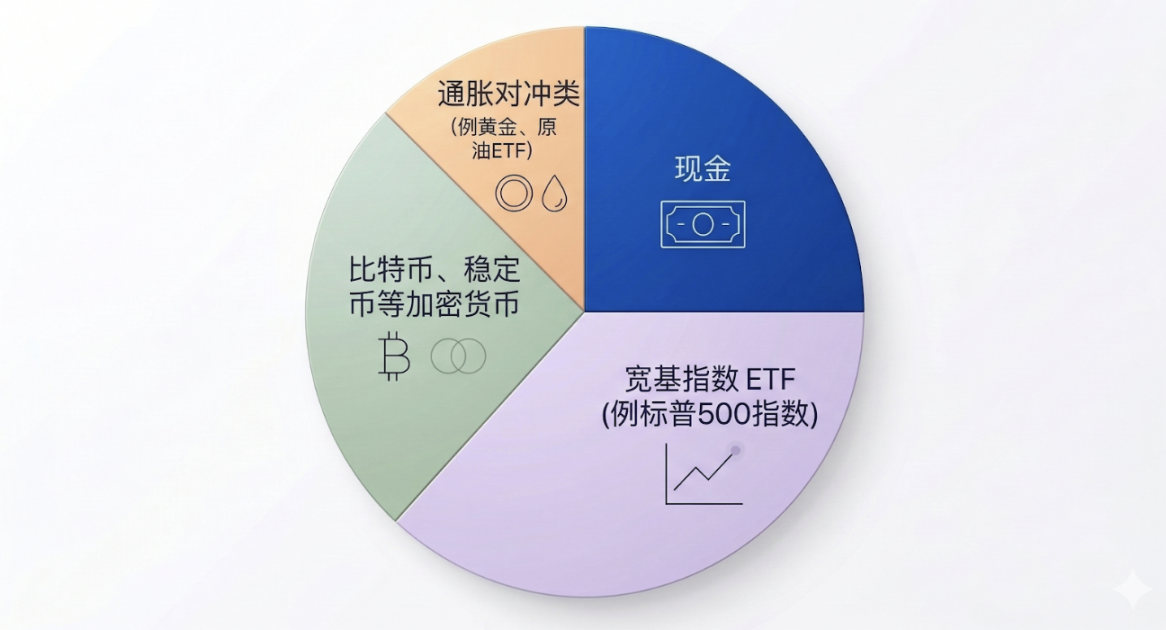
Strategy 1: Build a high cash moat (20%-30% allocation)
Implementation: Increase cash and cash equivalents (like high-yield USD deposits, short-term Treasury bonds, money market funds).
Logic: In times of crisis, liquidity is a lifeline. Holding ample cash not only ensures the family's quality of life remains unaffected by soaring prices but also allows you to have "bullets" ready to buy quality assets after significant plunges.
Strategy 2: Buy "insurance policies" against inflation (10%-15% allocation)
Implementation: Appropriately allocate to gold ETFs, physical gold, or a small amount of broad-based energy ETFs.
Logic: The mission of this part of the capital is not to earn large profits but to hedge. If war leads to oil supply interruptions and soaring prices, the increased living costs can be offset by the rise in the gold and energy sectors. Remember: do not go all in on these investments when the headlines are overwhelming.
Strategy 3: Shrink the front line, firmly defend core equities (30%-40% allocation)
Implementation: Sell off highly indebted, unprofitable marginal stocks, concentrating funds in broad-index ETFs (like the S&P 500) or companies with strong cash flows.
Logic: Individual stocks face enormous black swan risks during wartime (like sudden supply chain ruptures leading to bankruptcy). Embracing broad-index ETFs is to use the resilience of the country and the entire economy to hedge the vulnerability of individual enterprises. As long as you maintain consistent investments and disregard short-term losses, crises often create long-term "golden pits."
Strategy 4: "De-risking" of crypto assets (for Web3 users)
Implementation: Appropriately reduce positions in highly volatile altcoins and meme coins; consolidate funds into Bitcoin (BTC) as a long-term base, or convert into stablecoins (USDC/USDT) to earn flexible returns on leading compliant platforms. Once geopolitical risks are deemed controllable and market liquidity returns, allocate 10%-30% of funds for investing in meme coins to seize alpha opportunities based on your risk appetite.
Logic: The liquidity crisis triggered by war has a greater impact on smaller cryptocurrencies. Stablecoins can hedge against risks during crises while providing more flexible liquidity reserves than traditional banks.
Absolute untouchable red lines
- Absolutely prohibited leverage: Geopolitics is incredibly volatile; a ceasefire statement can cause oil prices to drop 10%. In leveraged trading, you may miss out on long-term victories and end up liquidated during short-term tremors.
- Abandon the mentality of profiting from "war wealth": The information asymmetry in capital markets is extremely harsh. When you decide to go long on certain assets due to escalating tensions, Wall Street's quantitative institutions have often already prepared to "take profits, sell facts."
In the face of macro tremors, an ordinary person's most powerful weapon is not precise predictions, but common sense, patience, and a healthy balance sheet.
The flames of war will eventually extinguish, and order will always be rebuilt from the ruins.
At the peak of extreme panic, the most anti-human action is to remain rational, and the most dangerous move is to panic sell. Please remember the oldest adage in investing: never bet on the end of the world—because even if you win, no one will redeem it for you.
And our greatest wish is, ultimately, for the conflict to subside, families that have been forced apart to reunite, and for world peace.
免责声明:本文章仅代表作者个人观点,不代表本平台的立场和观点。本文章仅供信息分享,不构成对任何人的任何投资建议。用户与作者之间的任何争议,与本平台无关。如网页中刊载的文章或图片涉及侵权,请提供相关的权利证明和身份证明发送邮件到support@aicoin.com,本平台相关工作人员将会进行核查。


