This article comes from: Kyle Soska
Compiled by|Odaily Planet Daily (@OdailyChina); Translator|Azuma (@azuma_eth)
Editor's note: The market continues to fluctuate at low levels, but what will the future direction be, up or down? Kyle Soska, Chief Investment Officer of Ramiel Capital, analyzes the long-short structure of the perpetual contract market in his latest article and attempts to provide answers by observing changes in market risk preferences.
Kyle's analytical approach shines by introducing data from Ethena, excluding basis positions and hedging positions that have certain noise effects on market direction, and only focusing on net longs and net shorts that can more directly determine market trends. His final conclusion is that the current market's net long vs net short structure is in a historically rare state, and this may not change into a new normal, but when observing other asset markets, this trend is generally very difficult to maintain in the long term. In other words, a turning point may be imminent.
The following is the original content by Kyle Soska, translated by Odaily Planet Daily.

The cryptocurrency market has been in a risk-off state for several months. I have been sorting through various forms of market data in hopes of finding signs of a possible market turning point. This article will analyze the market structure of perpetual futures in depth and explore changes in market risk preferences based on data from the Ethena transparency dashboard.
Ethena's currently deployed capital has fallen to its lowest level in years, only 71% of the lowest point in 2025. This is not a denial of Ethena but a reflection of the current market state. Directional shorts have almost reached parity with directional longs—this is an extremely rare structure in the crypto market and historically difficult to maintain long term.
The longstanding characteristic of the cryptocurrency market is extremely high asset volatility along with traders' widespread use of high leverage. Since the era of BitMEX, perpetual contracts have become the most traded products, with trading volumes typically 5 to 20 times larger than the spot market. As a core hub providing leverage to retail investors in the market, observing the perpetual contract market can effectively reflect the overall risk preferences of the crypto market.
Ethena provides us with a unique window to observe the crypto derivatives market. As shown in the figure below, Ethena's strategy essentially executes a carry trade of cryptocurrencies, and its logic is very simple—when a trader goes long on a crypto asset, Ethena will short as the counterparty. At the same time, Ethena will buy an equal amount of assets in the spot market to hedge its short position.
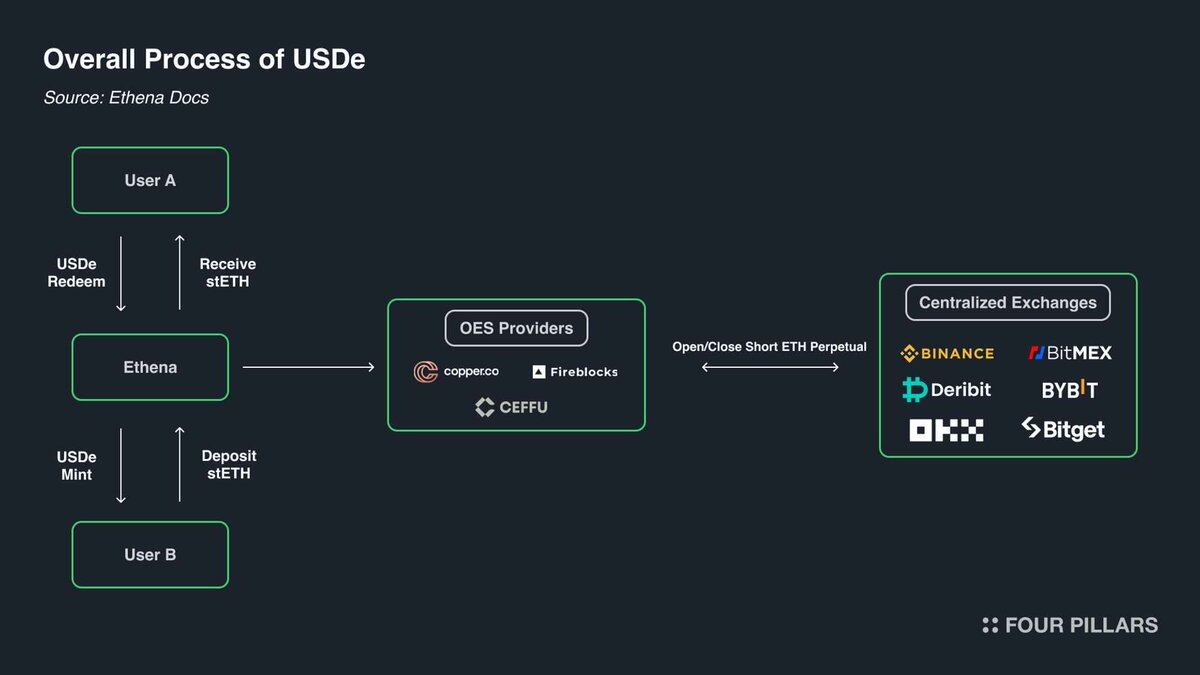
In a sense, Ethena offers "leverage as a service":
- Traders want exposure to the upside of crypto assets but lack sufficient capital;
- Ethena has capital but lower risk appetite;
- Thus traders borrow capital from Ethena through perpetual contracts, with their cost being "basis" + "perpetual funding rate."
According to the structure of perpetual futures, each long corresponds to a short, and they are always matched 1:1. Each open interest represents a cash flow agreement between two parties. The role of the exchange is to match these contracts, ensuring that each contract always has a sufficiently funded long and short holder. The matrix below illustrates the four possible outcomes that may occur when the exchange matches contracts.
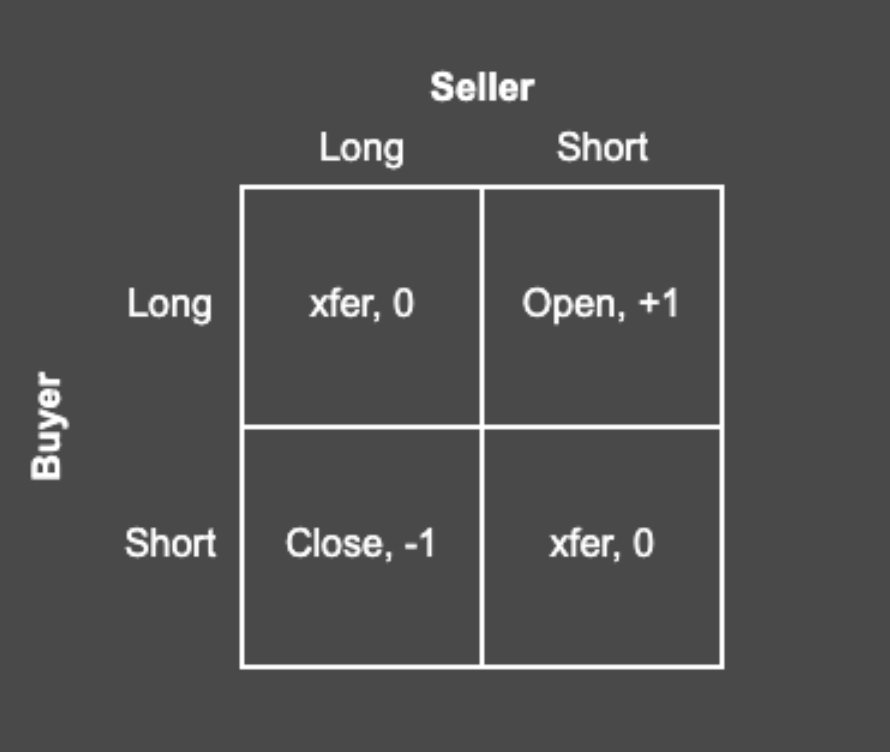
Each transaction has a buyer and a seller. When both the buyer and seller of a contract are longs or both are shorts, the exchange only needs to transfer the contract ownership between both parties. This transfer does not create or destroy any contract. When the buyer is a long and the seller is a short, a new contract must be created, with the buyer acquiring a long position and the seller acquiring a short position, thus increasing open interest by 1. Conversely, if the seller is a long and the buyer is a short, the exchange can disband the binding between both parties and remove that contract, thus decreasing open interest by 1.
So who holds these contracts in a typical market? Essentially, there are four types of contract holders in the market:
- Directional longs want exposure to rising prices. They are risk-seeking participants whose risk appetite depends on the strength of the market's risk preference.
- Directional shorts consist of two types of participants: one type seeks exposure to asset declines, while the other seeks to hedge their holdings of assets in a more tax-efficient manner. For example, VCs and those employees paid in tokens often want to hedge tokens that will unlock in the future to lock in current prices. For many altcoins, their market liquidity is often too thin to support effective direct hedging, or even to have a related market. In this case, firms like Cumberland, Wintermute, FalconX, Flowdesk, and Amber can construct a dynamically managed synthetic position: by shorting several high-liquidity and highly correlated assets (like Bitcoin and Ethereum), they can hedge an exposure to a less liquid asset (like Monad). This category also includes projects like Neutrl that treat this hedging structure as a yield strategy.
- Basis traders are opportunistic shorts. They do not care about price direction but voluntarily match the excess demand of directional longs whenever there is a market imbalance. In most market conditions, demand from longs often exceeds that of shorts, and their role is to fill that gap. Their scale is typically very elastic, capable of expanding or contracting rapidly.
- Perp-Perp arbitrageurs hold long and short positions in perpetual futures simultaneously. Their role is to connect prices between different perpetual futures markets and eliminate any minor price discrepancies after deducting transaction fees. Their longs and shorts are completely matched at all times.
According to the structure of perpetual futures, each contract must have a 1:1 long-short match, thus we know that "directional longs + arbitrage longs = directional shorts + basis shorts + arbitrage shorts"; moreover, due to the nature of arbitrage structure, we also know that "arbitrage longs = arbitrage shorts"; by canceling this relationship from the first equation, we can get "directional longs = directional shorts + basis shorts."
Ethena provides us with a proxy indicator for all basis shorts, which helps us observe the structural comparison between directional longs and directional shorts.
The figure below shows the balance sheet disclosed by Ethena, classifying assets into cash and deployed capital, with a time range from December 27, 2024, to March 7, 2026.
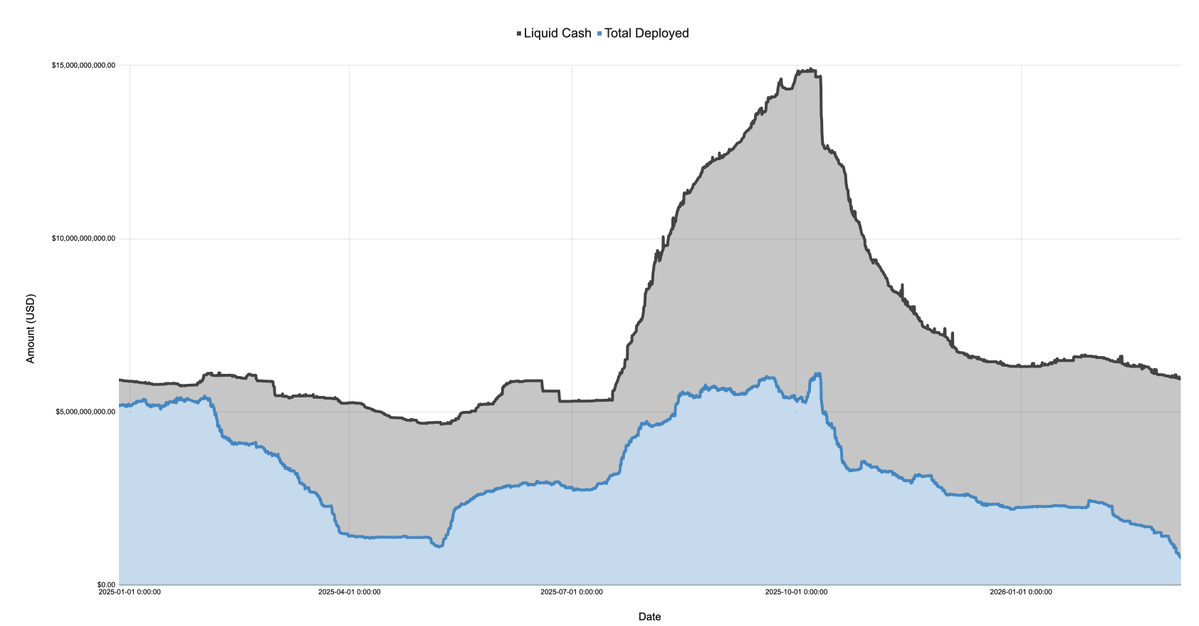
In 2025, after the launch of the TRUMP token in January, the market quickly entered a risk-off state, continuing to decline during the initial tariff discussions and the “Liberation Day” event in April. During this period, Ethena's deployed capital plummeted from over $5 billion to about $1.1 billion, a drop of over 75%.
Remember, Ethena's deployed capital can be seen as a proxy indicator of excess long demand in the market. Although Ethena is not the only institution executing such trades, its scale is substantial (at times accounting for about 25% of the total size of Binance and Bybit). As long as Ethena still has excess cash, it theoretically will expand its position to fill unmet long demand in the market. This means that while overall long demand may not have decreased by 75%, the excess long demand that has not been absorbed by directional shorts has indeed decreased by that much.
The figure below shows the changes in Ethena's deployed capital relative to total size, the lowest value in 2025, and the highest value in 2025.
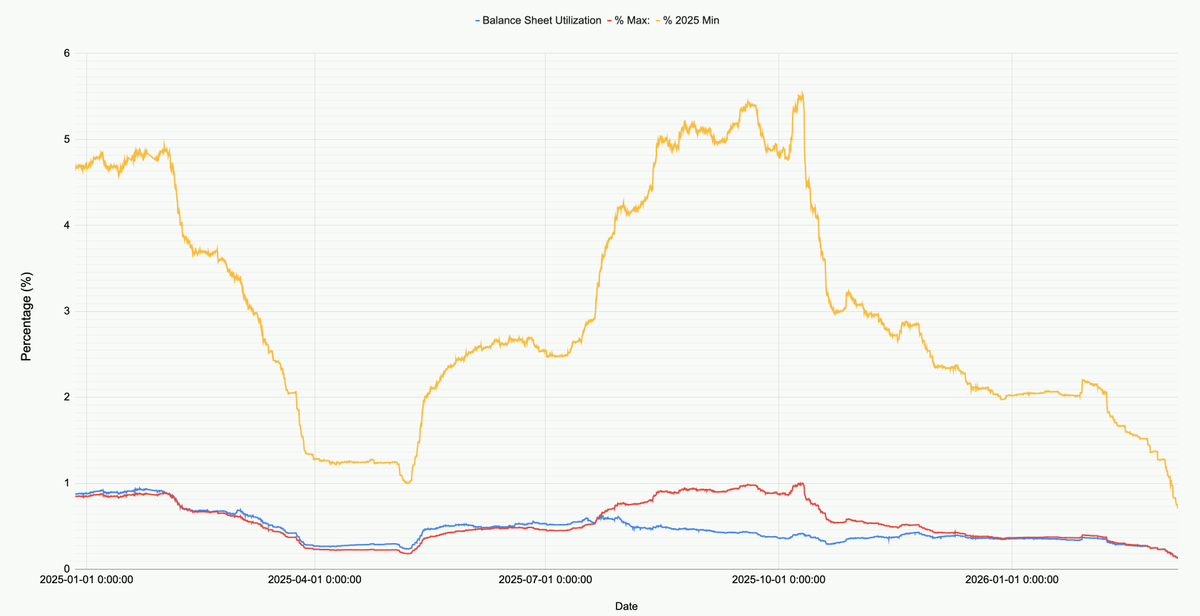
Observing the current market, Ethena's deployed capital across all markets (BTC, ETH, SOL, BNB, XRP, HYPE) is $790 million. This figure is only 71% of the lowest point in 2025 and 12.9% of the highest point before October 10. This number is not a denial of Ethena, but a reflection of the overall state of the market—current net long demand is at a historical low.
It is noteworthy that during the market crash when Bitcoin fell to $60,000, Ethena still deployed over $2 billion in capital. However, just one month later, after February 8, 2026, the deployed capital plummeted by 60%.
The figure below magnifies the changes in Ethena's deployed capital and Bitcoin price trends since January of this year.
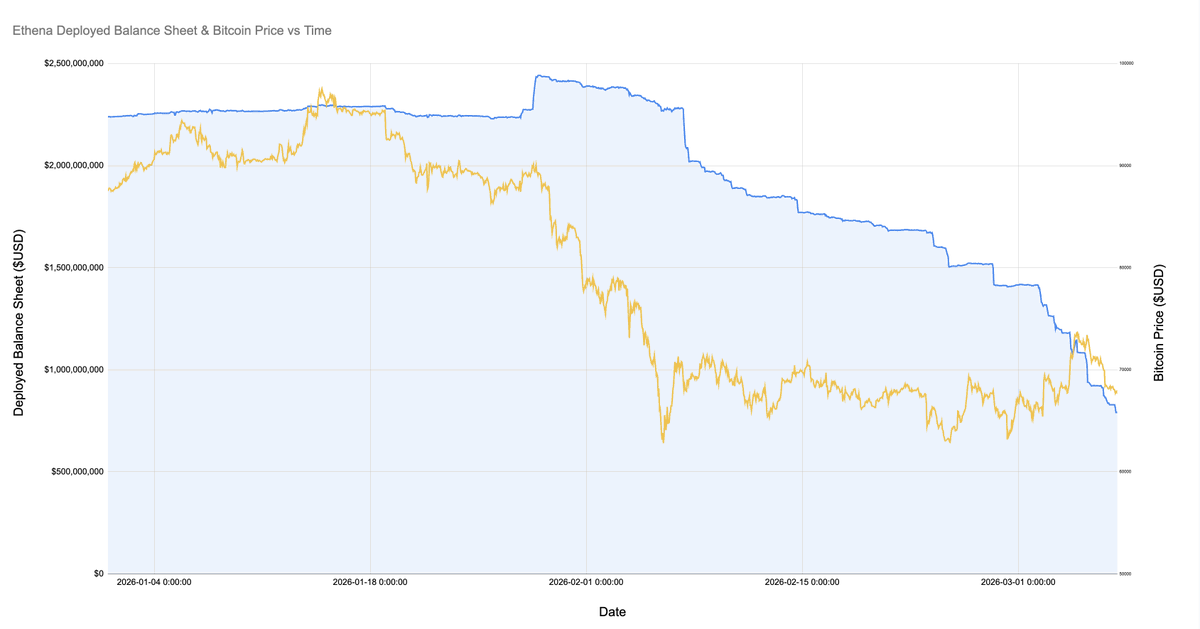
Since Bitcoin fell to $60,000, Ethena's basis position has shrunk from over $2 billion to less than $800 million. This change is quite intriguing as the overall market prices remained relatively stable during this period. Three possible explanations exist for this situation:
- Basis trades from the February crash are gradually being closed out. Although these trades are profitable, they are not sustainable (the basis has become more negative, but the funding rate is also negative);
- An increase in demand for directional shorts and hedging has squeezed the space of opportunistic basis traders;
- A lack of demand for leveraged long exposure.
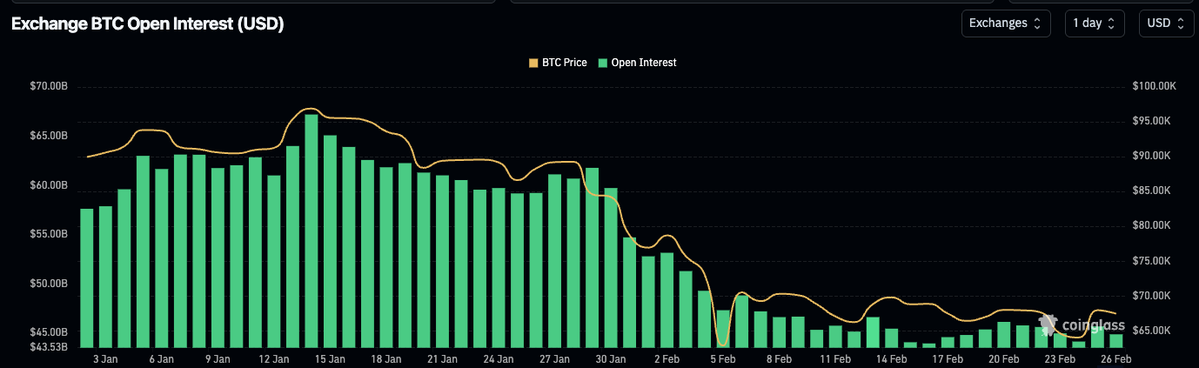
In my opinion, the real situation is primarily a combination of the first two possibilities, while the impact of the third possibility is relatively minor. As illustrated in the figure above, during the period when Ethena was gradually closing positions, the open interest of Bitcoin and other mainstream assets remained stable overall. Meanwhile, funding rates remained negative for a considerable time, and assets like SOL exhibited negative cumulative funding rates across multiple exchanges. This indicates that the market demand for directional shorting or hedging exposure is rising.
If I had to speculate, I believe many small and medium-sized crypto companies and VCs are experiencing a crisis. Think of those small market cap projects (like Eigen, Grass, Monad, etc.). Such tokens could number in the hundreds, with each project behind multiple VCs, a project team, a company treasury, and a significant number of employees. VCs need to limit losses and lock in profits to meet fund investment requirements, while project companies need to protect their operating capital reserves and workforce. This creates a situation where all participants must extract as much profit as possible from limited resources, and the solution is often a type of "crowded trade," i.e., shorting a basket of related assets through actively managed structured products.
We can see some signs of these structured products in some sudden surges in ETH, as these increases often trigger short covering and drive many small and medium market cap crypto assets to rise in unison. Another piece of evidence is that opportunistic basis trades (like Ethena) have been noticeably squeezed out of the market.
No matter the reason, what we can confirm is that for almost the first time in the history of the crypto market, directional longs and directional shorts have nearly reached complete parity.
Theoretically, there is no reason to suggest that this state cannot become a new normal, nor that this structure must change. But if we observe the markets of other asset classes, we find that it is extremely rare for this trend to be maintained long-term.
免责声明:本文章仅代表作者个人观点,不代表本平台的立场和观点。本文章仅供信息分享,不构成对任何人的任何投资建议。用户与作者之间的任何争议,与本平台无关。如网页中刊载的文章或图片涉及侵权,请提供相关的权利证明和身份证明发送邮件到support@aicoin.com,本平台相关工作人员将会进行核查。


