Author: CryptoSlate
Translation: Shenchao TechFlow
Shenchao Introduction: Currently, BTC is about $67K, miners' electricity costs barely break even, but operational costs and depreciation leave the overall operation in a loss. This article constructs a three-layer cost model using Riot Platforms' real financial data, thoroughly breaking down the heavily simplified figure of "mining cost"—it has direct reference value for understanding miner stock valuation and BTC price pressure points.
Buying Bitcoin is currently cheaper than mining Bitcoin, unless your electricity price is below $0.07 per kilowatt-hour.
The full text is as follows:
Riot Case Reveals the Three-Layer Profit and Loss Structure of US Miners
The cost of Bitcoin mining is often simplified to a single number: "the cost of mining one BTC." In reality, this number depends on the level at which you measure the business.
Electricity costs determine whether to turn on the machines today, operational expenses determine whether the mining facility can support the entire company, and accounting costs determine whether this business ultimately reports a profit.
To analyze these three layers more clearly, CryptoSlate constructed a Bitcoin mining cost model that starts from basic principles, calculating mining economics based on network difficulty, block rewards, fees, ASIC energy efficiency, and electricity prices.
This model then incorporates company-level cost data from Riot Platforms' public financial documents to showcase the actual economic situation.
Under current network conditions, the model shows that miners can cover electricity costs, but still cannot cover broader operational and accounting expenses.
Riot's operations in Texas reveal that even after the BTC price rebounds, there is still a significant gap between the electricity break-even point, the operational break-even point, and the full accounting profit point.
Riot Mining Economics Reveal Three-Layer Profit and Loss Structure
At the current BTC price of $67,200, Riot crossed one break-even point but failed to cross the latter two.
The model is based on the following current network conditions: Bitcoin difficulty 145,042,165,424,850, block reward 3.125 BTC, modern ASIC energy efficiency of about 17-19 J/TH, and Texas industrial electricity price of about $0.0667 per kilowatt-hour. Due to the current average fee of about 0.02 BTC/block, this model ignores block fees.
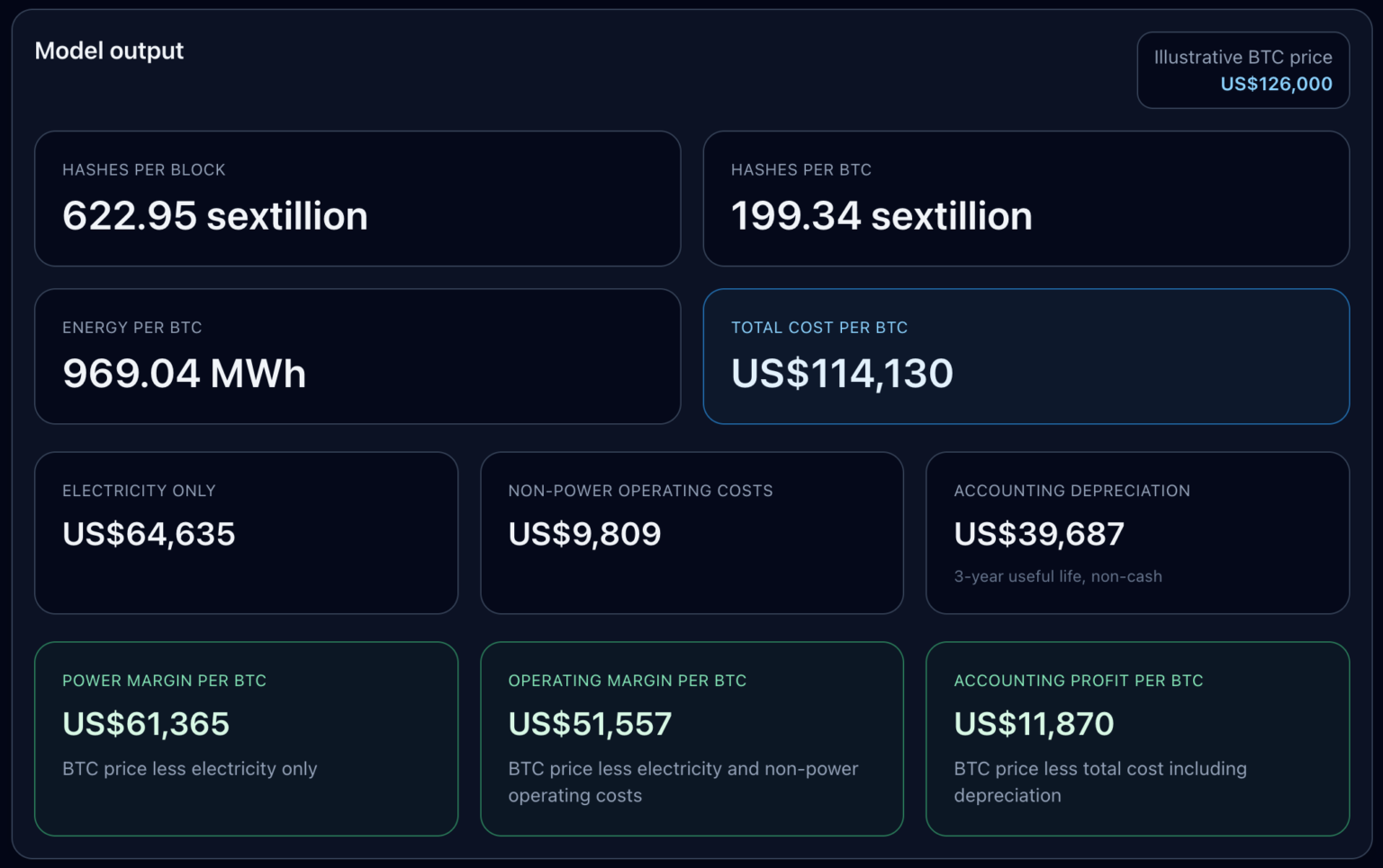
The above parameters result in the following: total network hash power of 622.95 quintillion hashes per second, hash power required per BTC of 199.34 quintillion hashes per second, and energy consumption per BTC of 969.04 megawatt-hours.
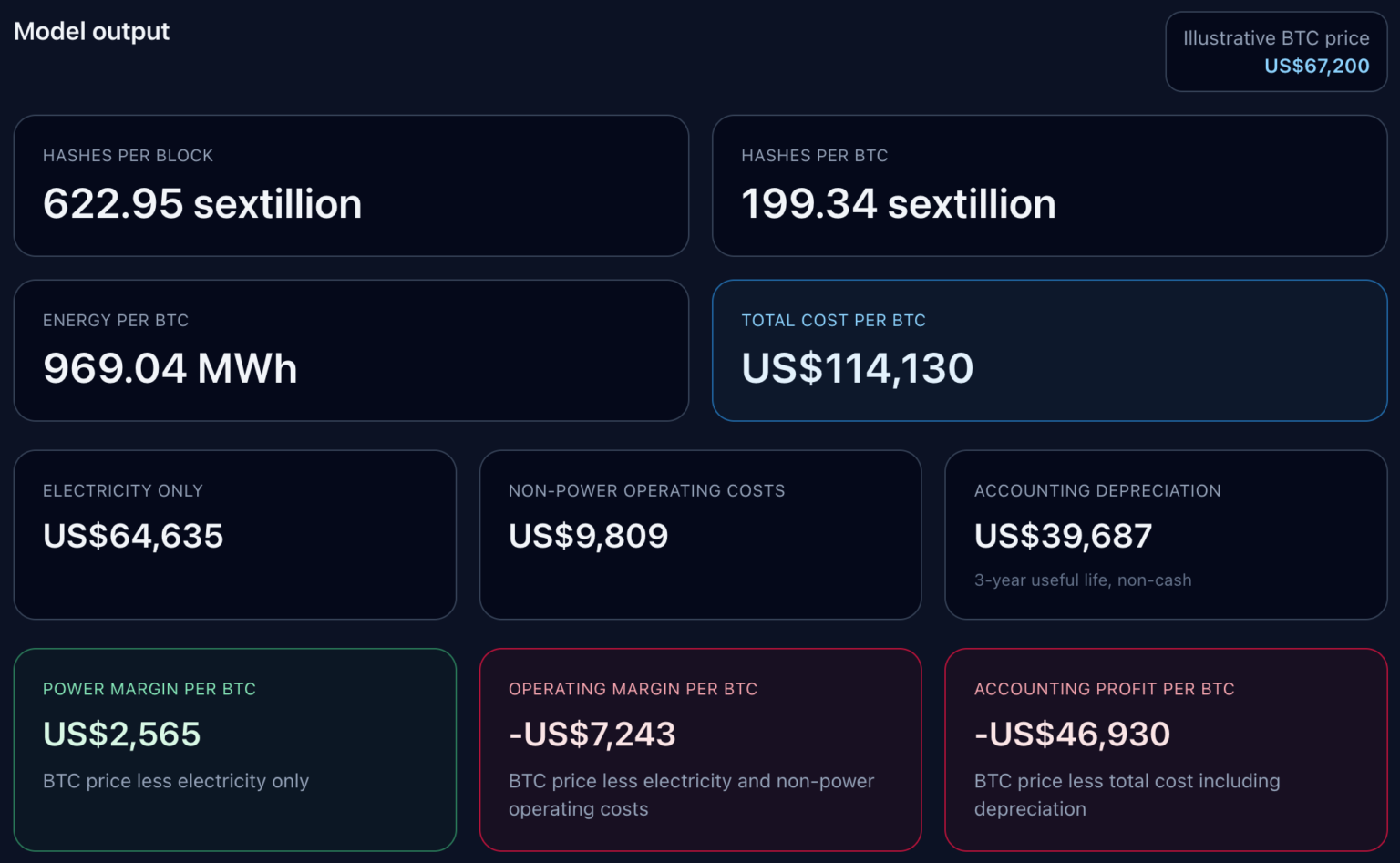
Accordingly, the electricity cost to mine one BTC at current prices is $64,635, with an electricity profit of $2,565/BTC.
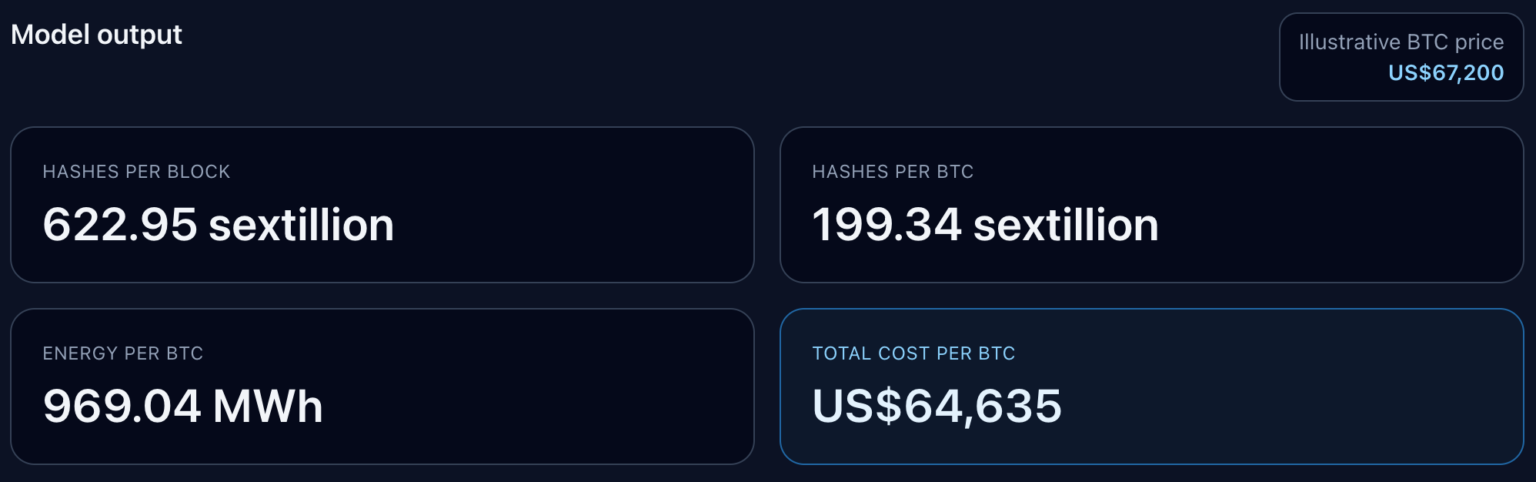
With the addition of Riot's approximately $9,809/BTC non-electric operational costs, operational profit turns negative to -$7,243, and total costs rise accordingly. Including approximately $39,687/BTC in non-cash depreciation, accounting profit drops to -$46,930.
This clearly shows that for large American miners, the "cost of mining one BTC" does not have a single number.
First layer: electricity cost, which determines whether it is worth turning on the machines in the short term.
Second layer: adding broader operational costs, determines whether self-mining can cover overall business.
Third layer: adding depreciation, determines whether reported profit can synchronize with cash profit.
The model displays these three layers side by side, revealing how large the gap remains between them after the market rebounds.
The Break-even Ladder Defines the Entire Operational Picture
The break-even ladder provided by the model is more illustrative than any single overall cost figure.
The break-even point based solely on electricity costs: $64,635/BTC.
After adding Riot's non-electric operational costs, the break-even point rises to approximately $74,444.
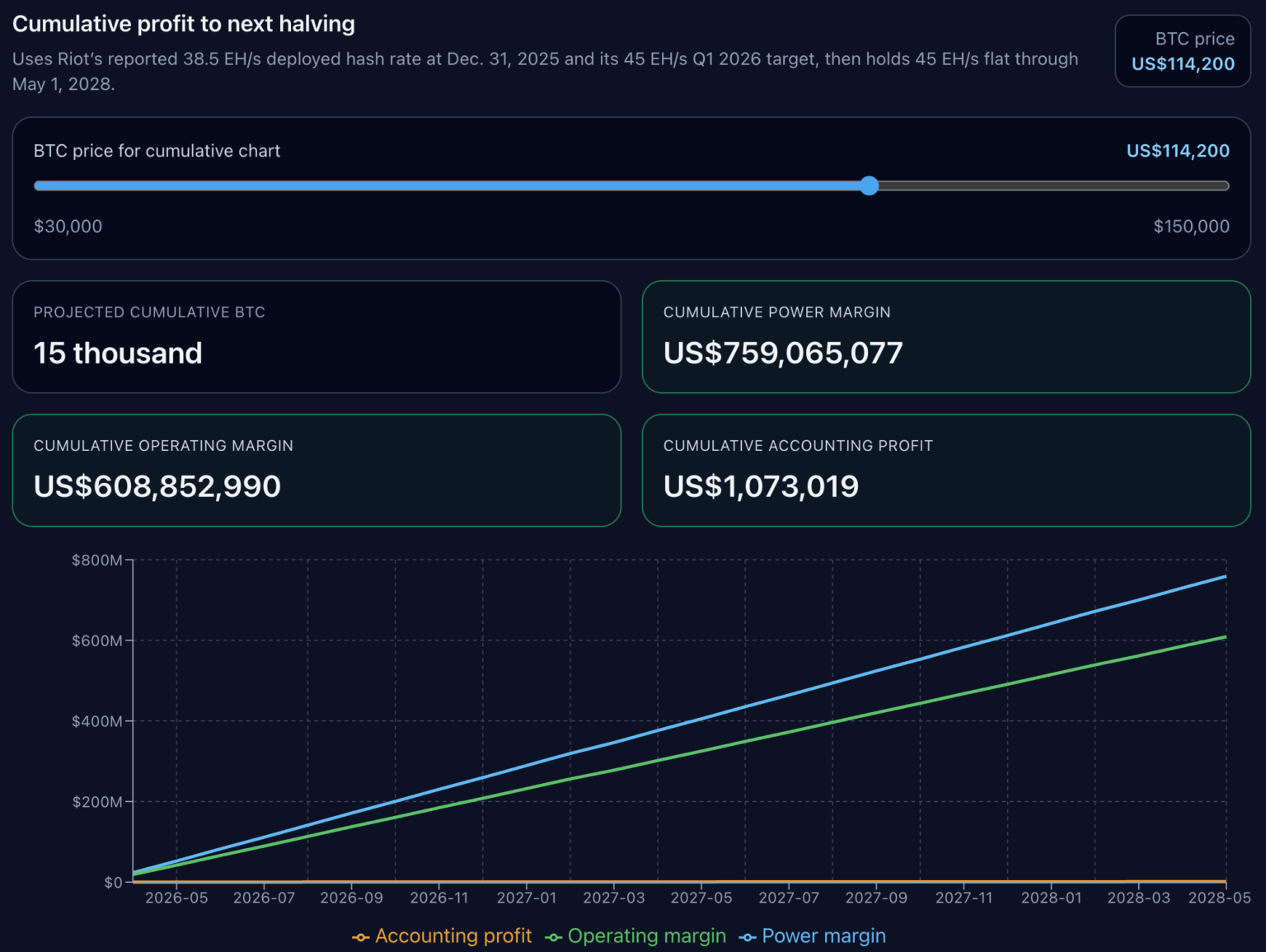
After adding accounting depreciation, the full accounting break-even point rises to $114,130.
Thus, miners can report positive earnings on the electricity layer while still being in a loss at the operational or accounting level.

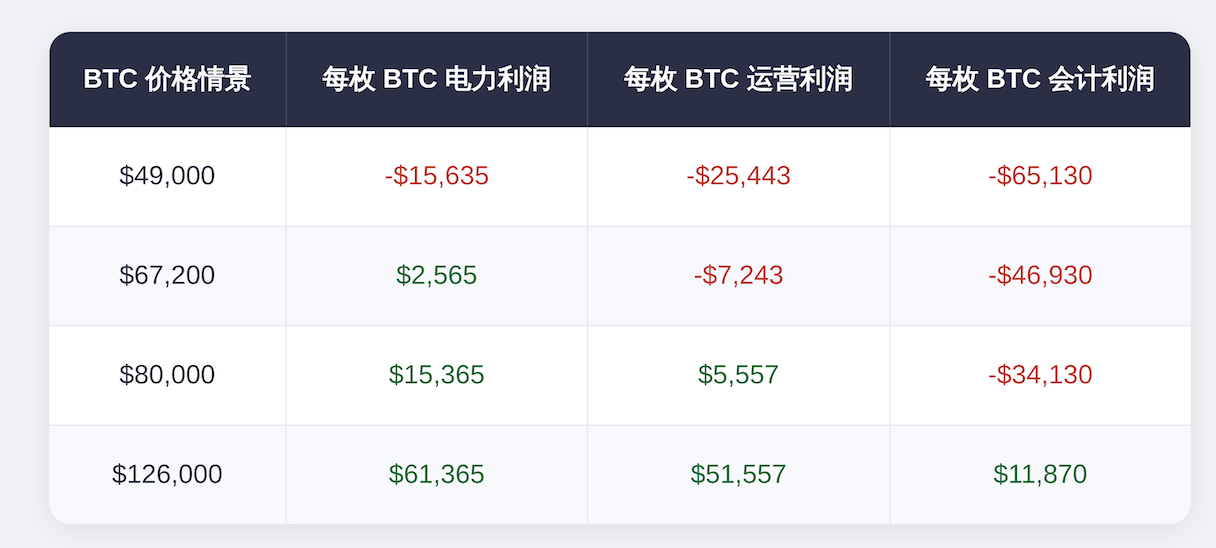
I established four price scenarios to illustrate how this ladder operates in practice.
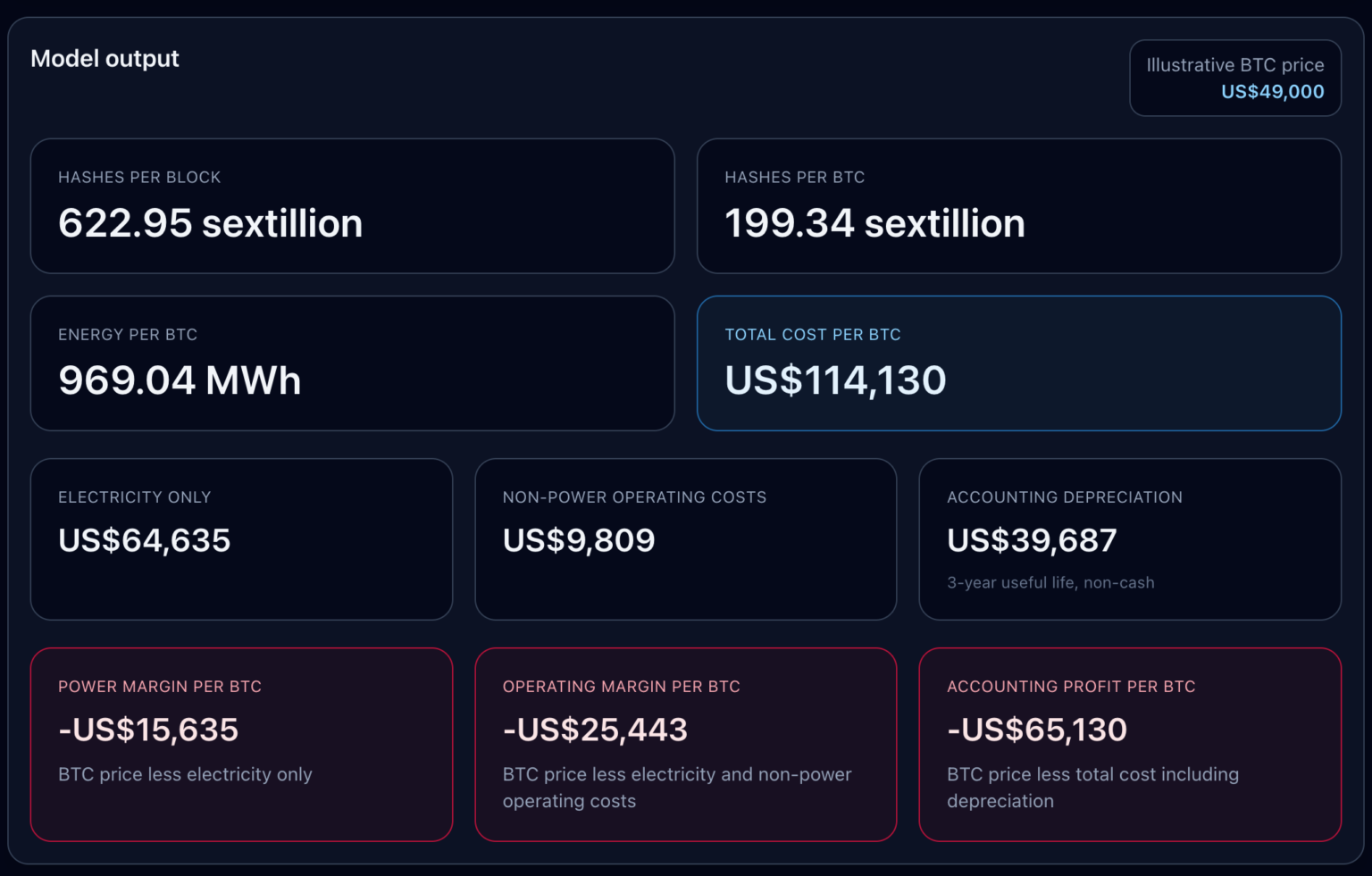
In the $49,000 bear market scenario, Riot is negative at all levels: electricity profit -$15,635/BTC, operational profit -$25,443/BTC, accounting profit -$65,130/BTC.
In the current price scenario of $67,200, Riot just crossed the electricity break-even point, slightly above the critical value. Electricity profit turns positive, but operational and accounting perspectives still show negative values.
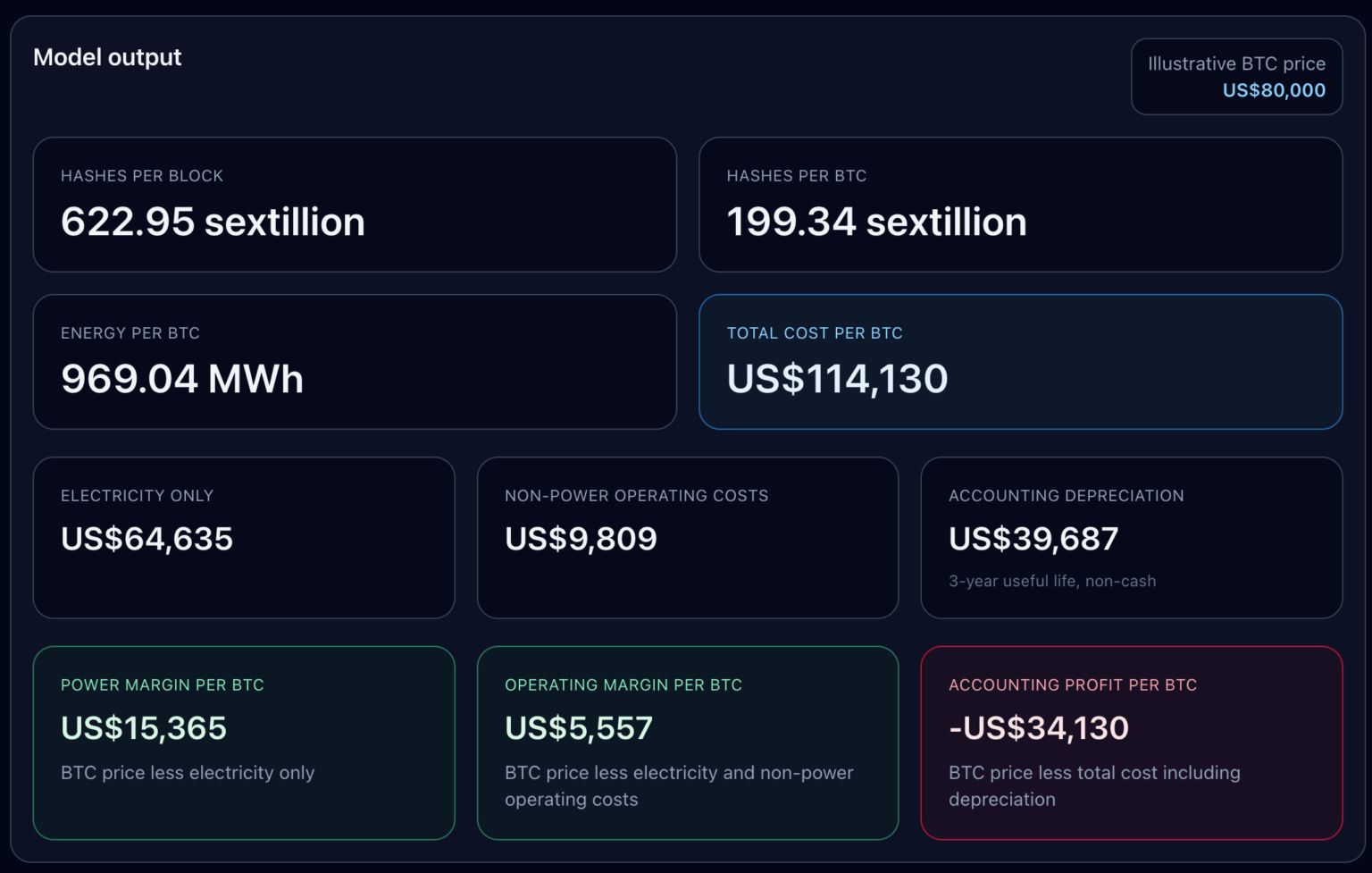
In the $80,000 rebound scenario, Riot crosses the operational break-even point with an operational profit of $5,557/BTC, but the accounting level still shows a loss of $34,130.
For all three layers to turn positive, BTC must return to its historical high of $126,000, at which point the accounting profit would be $11,870/BTC.
This distinction is of substantial significance. Riot's depreciation layer is clearly defined as a non-cash expense, calculated based on a three-year lifespan, which is an accounting allocation rather than a short-term avoidable cash outflow.
However, it still belongs to this picture, because publicly traded miners cannot survive solely on electricity profits—they must report on the income statement, replace machines, and bear operational costs.
Therefore, the truly valuable question is: which profit line are investors, analysts, and management actually looking at when assessing miner profitability?
Riot Price Pressure Test Before Next Halving
We subsequently extended the cost model to the next halving in 2028.
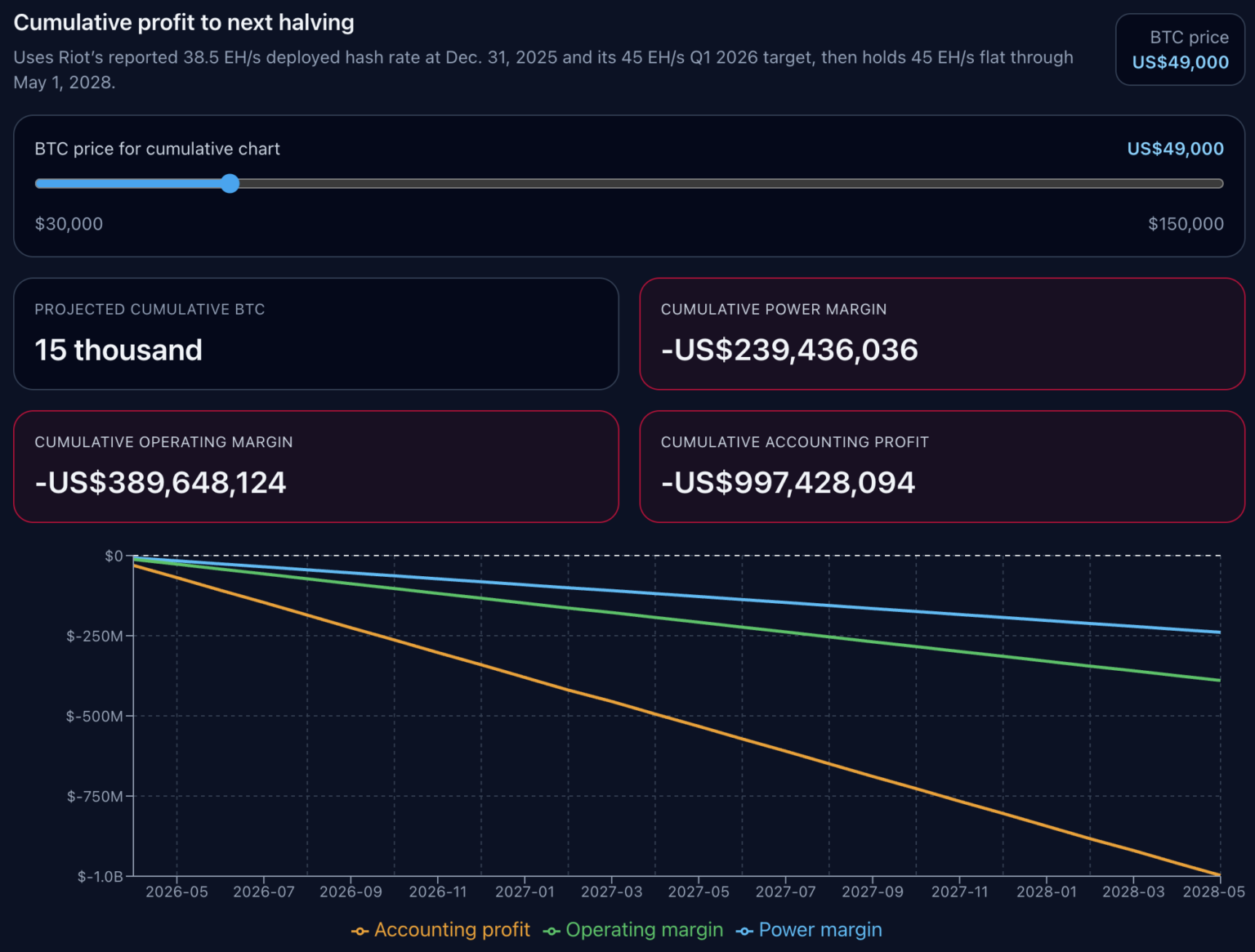
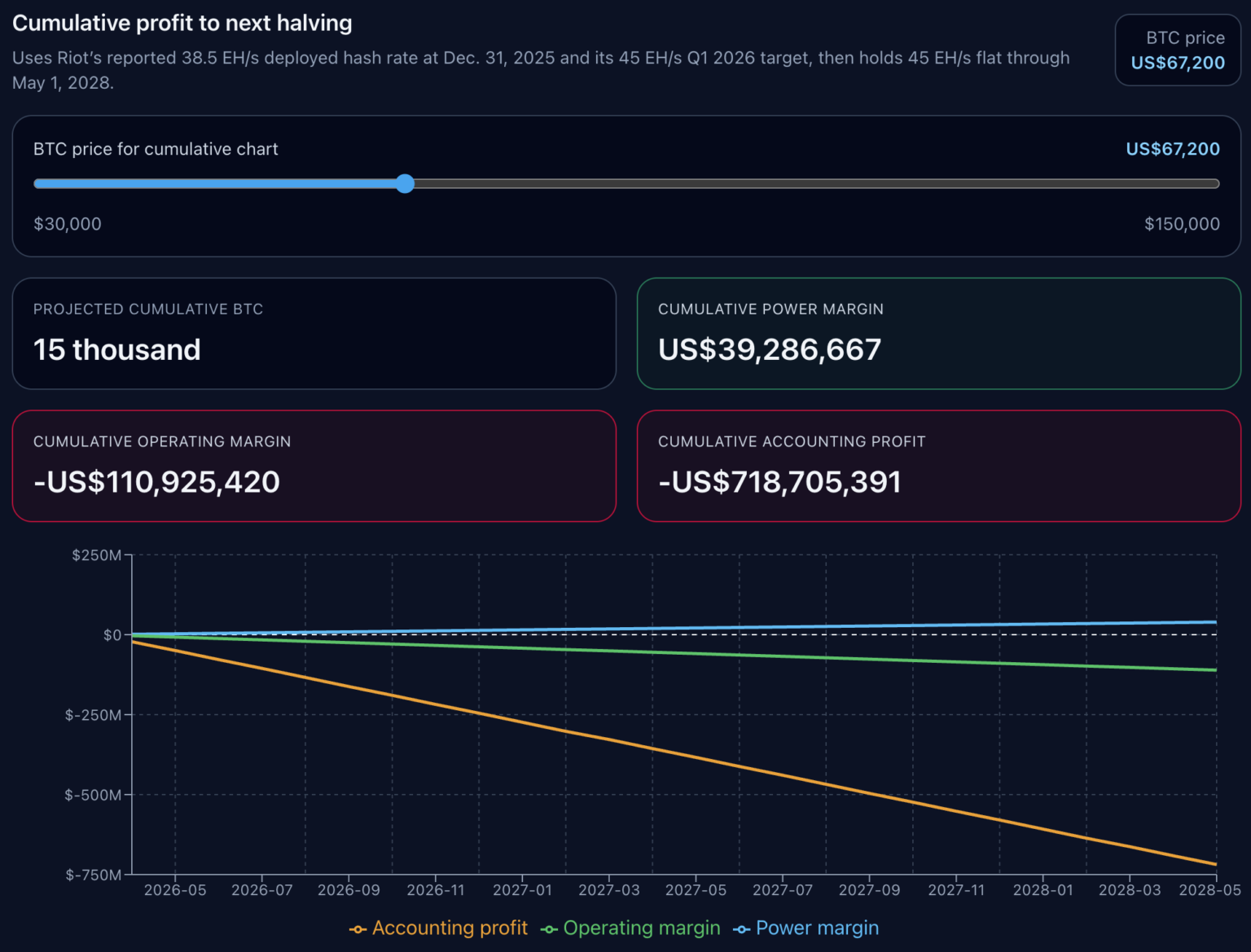
Based on Riot's latest public documents, assuming current hash power of 38.5 EH/s, expected to rise to 45 EH/s before March 31, 2026, and maintain that level until the next halving window.
This model does not aim to reconstruct the entire market but keeps current economics per BTC unchanged while projecting based on Riot's reported and planned self-mining hash power path.
This is a scenario analysis focusing on operational leverage, with clear price sensitivity visible.
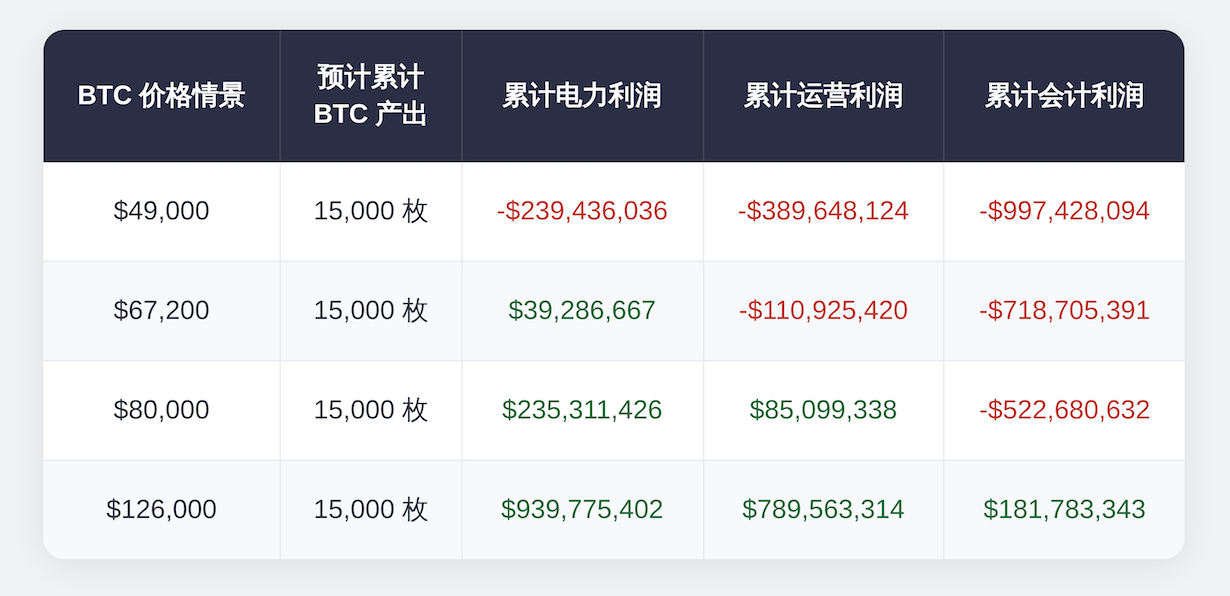
In all four scenarios, the expected cumulative amount of mined BTC is 15,000 coins, differing only in profit structure.
In the $49,000 scenario, Riot's cumulative electricity profit is -$239,436,036, cumulative operational profit -$389,648,124, and cumulative accounting profit -$997,428,094.
In the $67,200 scenario, cumulative electricity profit turns positive to $39,286,667, but cumulative operational profit remains at -$110,925,420, and cumulative accounting profit is -$718,705,391.
In the $80,000 scenario, cumulative operational profit turns positive to $85,099,338, but cumulative accounting profit is still -$522,680,632.
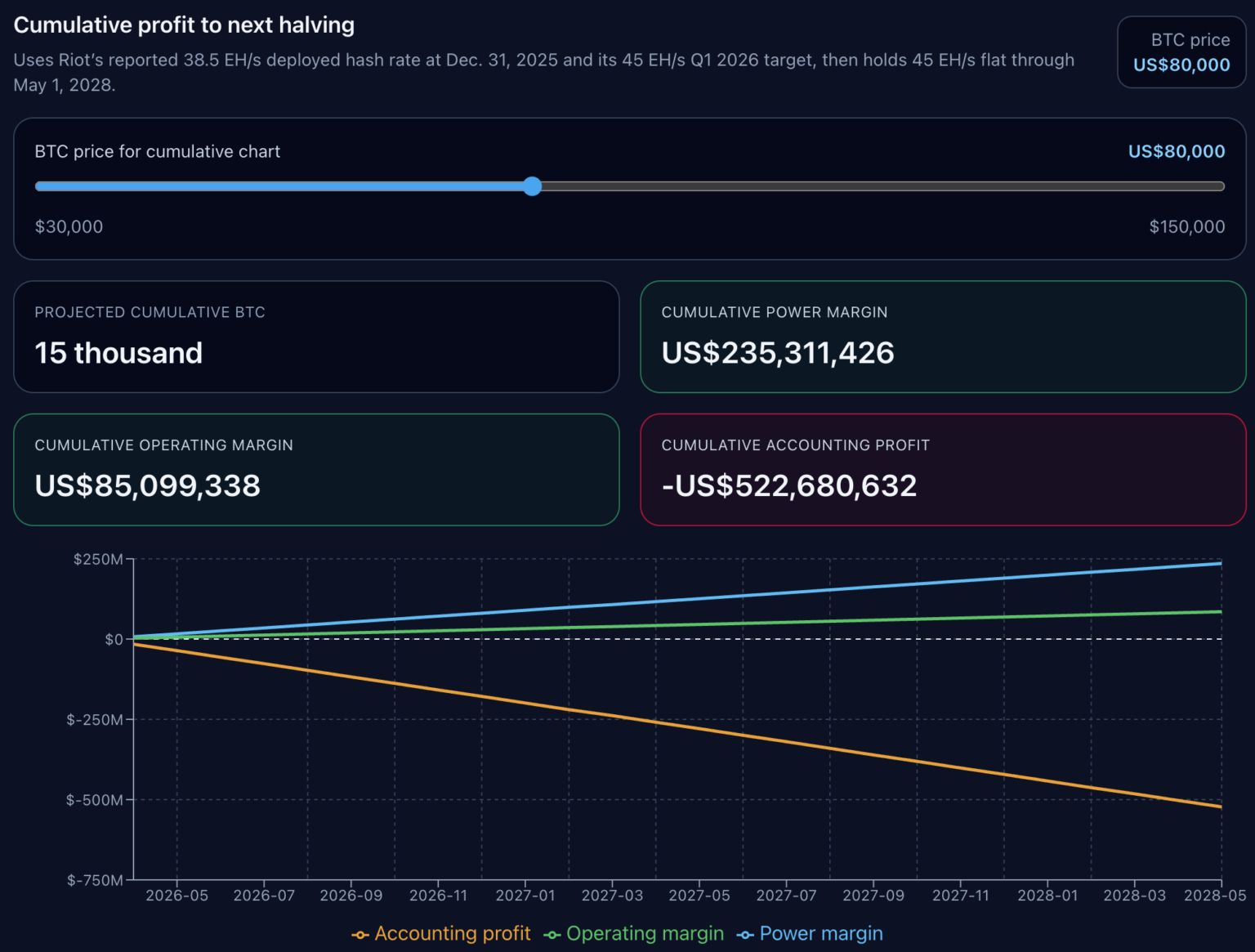
Only in the $126,000 scenario do all three lines turn positive, with cumulative accounting profit of $181,783,343.
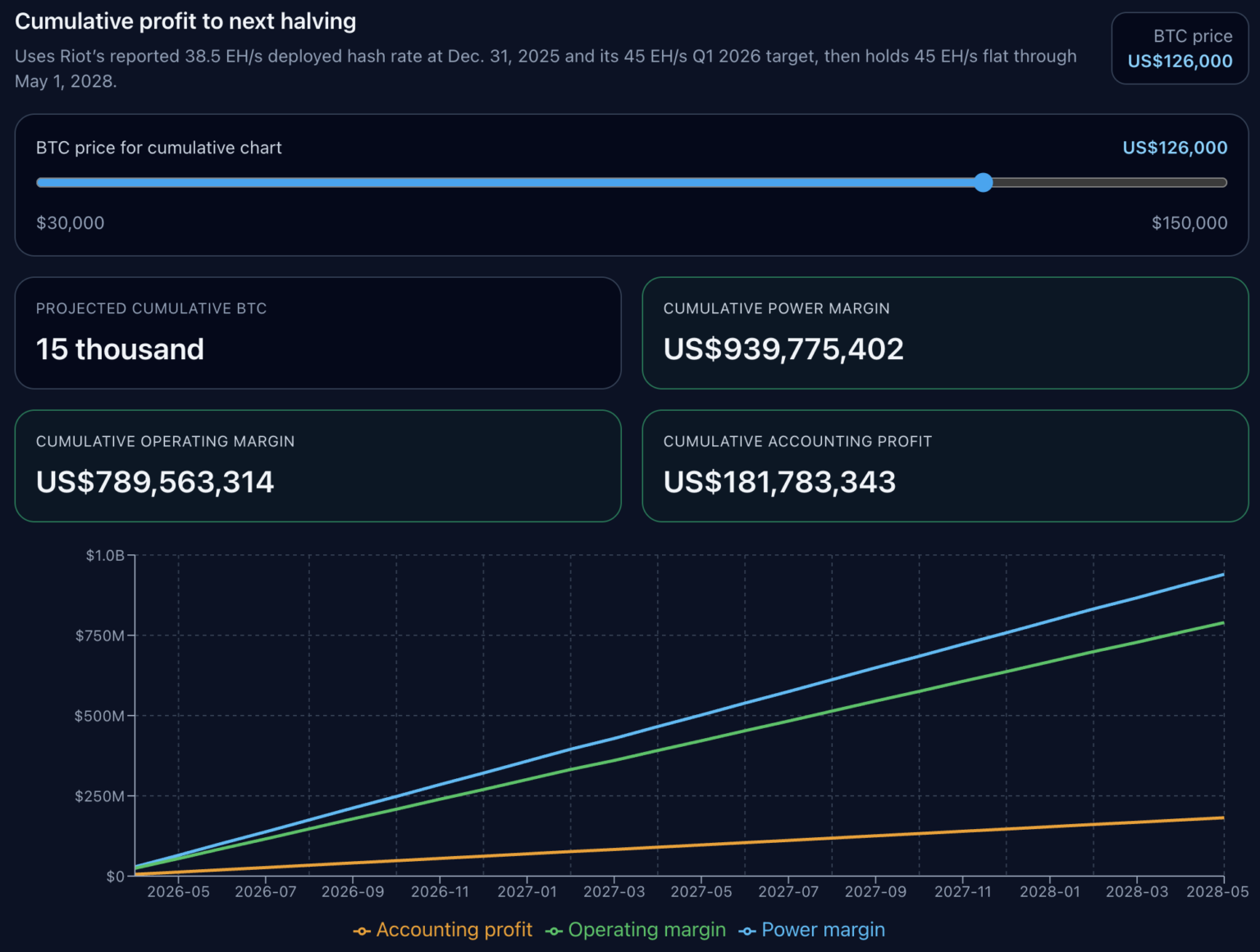
Miners can maintain positive earnings on electricity for a long time yet still fail to cover broader operational costs; they may also achieve operational profit while being far from accounting profit. The Riot case demonstrates that the gap between these two states is substantial.
In the model, the difference between the electricity break-even point and the complete accounting break-even point is about $49,495/BTC. This profit margin helps explain why miners may appear healthy at the hash power scheduling level but seem stressed at the reporting profit level.
Our cumulative charts do not project future difficulty, fees, downtime, peak-load revenue, financing, or new capital expenditures, merely assuming current per BTC economics remain unchanged and projecting based on Riot's planned hash power path.
This limitation does not affect the core signal delivered by the model: under the premise of unchanged other economics, fixing these parameters means the discussion before the next halving will largely depend on BTC price.
For Riot, the model achieves cumulative accounting profit only in the $126,000 scenario, but in absolute terms, this critical point is $114,200.
Riot Case Insights for the Entire US Mining Sector
For American miners, the broader insight is direct: operational issues cannot be solved solely by price; machine efficiency and electricity price remain the first hurdles.
In terms of cost sensitivity, we compared three ASIC presets: Bitmain S21 (17.5 J/TH), MicroBT M60S (18.5 J/TH), and Antminer S19 Pro (29.5 J/TH), all using Texas industrial reference electricity prices.
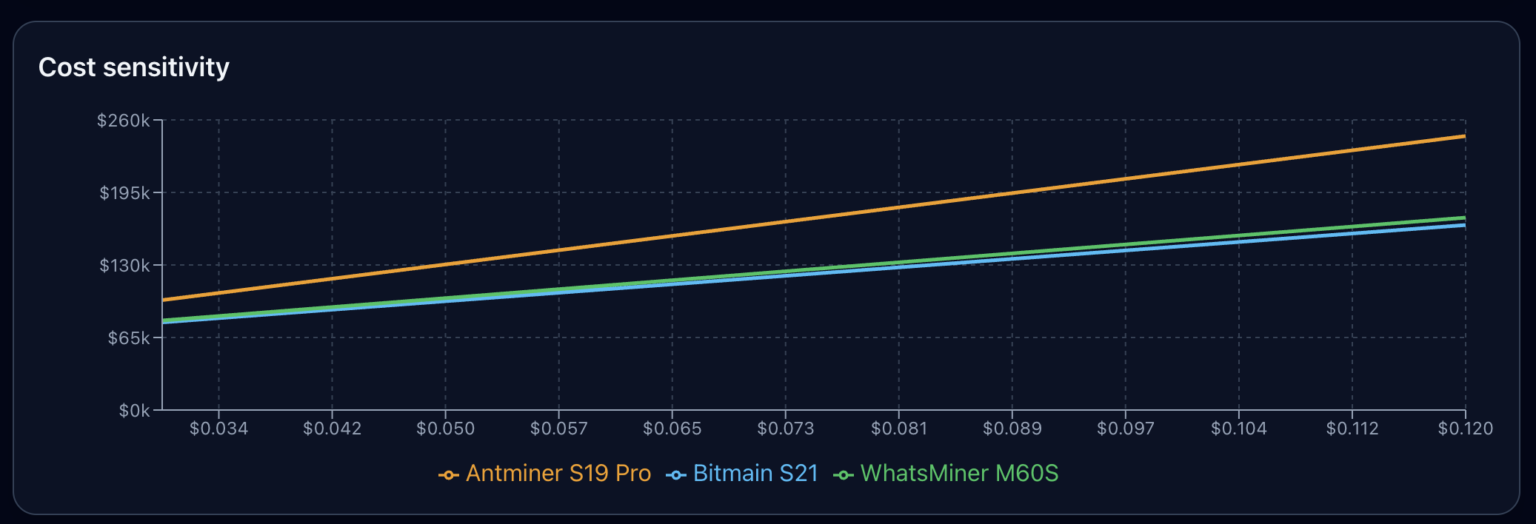
Within this electricity price range, the S19 Pro consistently has a higher cost per BTC than the new models. The two new models have costs that are close, while the less efficient miner maintains noticeably higher cost lines throughout the entire chart.
This conclusion is not limited to Riot. Riot's non-electric cost layer and depreciation assumptions are unique to the company; other miners may have different indirect costs, different lifespan assumptions, different peak-load revenue structures, or different actual electricity mixes. However, the applicability of the three-layer analysis framework itself is not affected.
First layer: electricity cost. Second layer: operational cost. Third layer: accounting cost.
Companies that can survive in low-price cycles often easily surpass the first layer. Companies that can compound growth within a cycle…
免责声明:本文章仅代表作者个人观点,不代表本平台的立场和观点。本文章仅供信息分享,不构成对任何人的任何投资建议。用户与作者之间的任何争议,与本平台无关。如网页中刊载的文章或图片涉及侵权,请提供相关的权利证明和身份证明发送邮件到support@aicoin.com,本平台相关工作人员将会进行核查。


