Written by: Zhao Xuan, Rao Weitong
In 2026, localized debt enters a challenging phase; the traditional method of "borrowing new to repay old" is becoming increasingly untenable, and the high costs of non-standard financing put immense pressure on local state-owned enterprises.
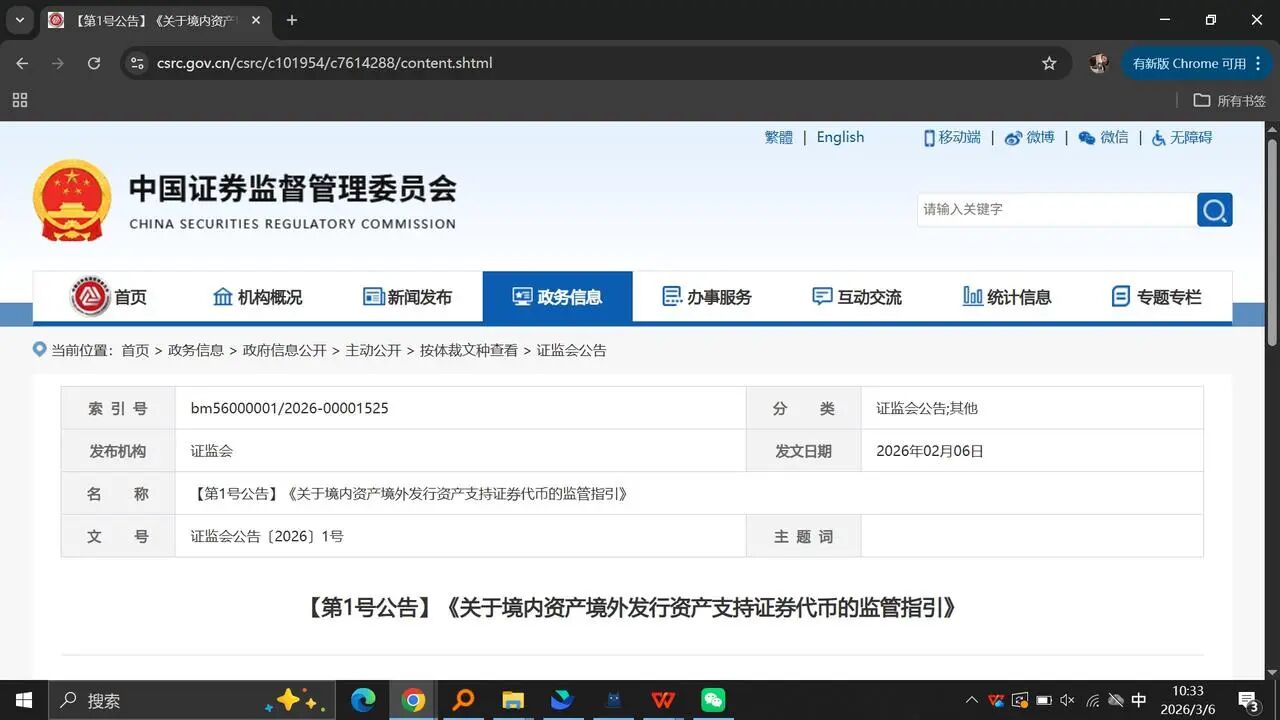
Fortunately, in February 2026, eight ministries and the China Securities Regulatory Commission issued new regulations, which for the first time opened a compliant channel for domestic assets to issue RWA (Real World Assets digital issuance) overseas.
This not only signifies a breakthrough for fintech in the asset securitization field but is also viewed by the market as a strategic tool customized by the state to revitalize local existing assets and connect them with overseas low-cost funds.
This article will specifically analyze from the perspectives of business logic and legal compliance how to legally and compliantly transform the fixed assets within the municipal investment system into circulable funds in the Hong Kong capital market.
The "Triple Barrier" Facing Municipal Investment Debt
Although the national level has issued implicit debt replacement quotas, the real hard nut to crack for municipal investment transformation is the massive scale of "operational debt" resolution.
Currently, municipal investment platforms are generally troubled by the "triple barrier":
The first barrier is the cost issue—interest rates are eating into profits. In order to maintain an unbroken funding chain, many platforms have to rely on high-cost non-standard financing at annualized rates of 8%—12%. The result is that the profits from real projects can't even cover the financing interest, leading to an ever-growing debt snowball.
The second barrier is the channel issue—there are assets in hand, but they can't be monetized. Municipal investments do not lack quality assets, such as water plants, toll bridges, and industrial parks. However, the problem is that these assets either have incomplete historical rights confirmation processes or have not had independent operating entities for a long time, making them "dead assets" in the eyes of traditional banks, unable to be mortgaged.
The third barrier is the threshold issue—though public REITs are good, they cannot solve immediate problems. The threshold for issuing public REITs is too high: underlying assets typically need to exceed 1 billion, compliance reviews are comparable to A-share listings, and the entire process can take one or two years, failing to address the urgent funding needs proactively.
In the face of these three dilemmas, municipal investment must break out of traditional indirect financing thinking and, leveraging the latest policy window from the state, shift focus to more flexible mechanisms in the cross-border capital market to locate genuinely effective incremental funding.
Policy Breakthrough—What is RWA? Why is this the Best Window Period?
1. Penetrating the technical veneer: The business and legal essence of RWA
Setting aside the intricate technical jargon, RWA is simply a "mini foreign version of REITs," or "cross-border asset securitization based on digital certificates."
Its operational logic is actually straightforward: take the underlying assets held by municipal investment that generate stable cash flows—such as a certain water plant's collection rights over the next five years—and legally separate them. Then, discount and package these future earnings to generate compliant digital certificates, and finally issue them to global professional investors on Hong Kong's strictly regulated exchange.
2. The clear dividends released by the dual-track supervision
For local decision-makers, engaging in financial innovation requires compliance to always be the top priority.
On February 6, 2026, regulators issued two documents on the same day, clarifying the path:
On one side is "closing the back door." The central bank and eight ministries issued the "Notice on Further Preventing and Addressing Risks Related to Virtual Currency" (Yin Fa [2026] No. 42), cracking down on illegal speculation in virtual currencies domestically, with a clear stance—there's no way to escape the real to the virtual.
On the other side is "opening the front door." The China Securities Regulatory Commission simultaneously released the "Regulatory Guidelines for the Issuance of Asset-Backed Securities Tokens by Domestic Assets Overseas" (Zheng Jian Gui Hui [2026] No. 1), officially permitting compliant businesses to proceed.
This tight and loose regulation sends a clear signal: speculation in the virtual realm is firmly opposed, while encouragement is extended to real financing. As long as the domestic quality physical assets complete preliminary record-keeping with the China Securities Regulatory Commission, they can go to Hong Kong for cross-border financing through digitization.
Calculating the Economic Account—Why is RWA a "Miracle Cure" for Debt Resolution?
Ultimately, the core driving force for municipal investment to pursue RWA in Hong Kong is simply this: to use cheaper money to replace more expensive debt. Let's take a look at three sets of comparative data to clarify:
First, look at the cost:
Domestic non-standard financing typically has an annual interest rate of 8%—12%, with terrifyingly high interest; why can the RWA issuance in Hong Kong reach 4%—6%? Because it accesses the global funding pool, making money cheaper and directly halving financial costs.
Next, look at the threshold:
For domestic bond issuance or REITs, the underlying assets routinely need to exceed 1 billion and must have complete and unblemished documentation; RWA is much more flexible, starting from 300—500 million, showing some tolerance for historical rights confirmation issues—this means the "medium-sized" assets municipal investments hold finally have the chance to be revitalized.
Finally, look at the speed:
Traditional domestic financing can take one or two years to get approval, which hardly solves immediate problems; on the RWA side, as long as materials are prepared, it can theoretically complete filing within 20 working days— this tempo is entirely "emergency relief" level for municipal investments requiring fast capital flow.
For a practical example:
Assuming a municipal investment platform raises 500 million in equivalent foreign currency through RWA in Hong Kong and then directly replaces the domestic high-interest non-standard debt at an annual rate of 10%.
How much can the enterprise save each year with this exchange? 20 million to 25 million.
This isn't merely an accounting profit, but a real financial expense saved, directly reflected in that year's profit sheet—this is the "cash flow antidote" most needed for municipal investments currently under great pressure.
Professional Risk Control Bottom Line—How to Build an Absolutely Safe Compliance Firewall?
In cross-border financing, the safety of state-owned assets and data compliance are two red lines that cannot be crossed. As professional advisors, we preset three "firewalls" in this model to ensure that operations remain within safe confines:
The first line: Separation of ownership and income rights to prevent "loss of state assets"
What we sell isn't the assets themselves, but the rights to future earnings from those assets for a specific period. In other words, the road is your road, the land is your land, and you still dictate day-to-day operations—overseas capital only collects "money" and cannot touch your "foundation." The control right over state assets remains 100% intact.
The second line: "Privacy computing" checks to keep the "data outflow" bottom line
Financing requires disclosing operational conditions to investors, but the privacy data of the public must never leak. We will comply strictly with the "Data Security Law," using "privacy computing" technology to "de-sensitize" data, allowing overseas access only to encrypted summary reports (e.g., total cash flow) without personal details. A law firm will also produce a specific "Data Outflow Assessment Report," ensuring compliance in writing.
The third line: Penetrative closed-loop supervision for full-process "transparency"
The entire process is transparent:
Domestic side: Only select self-sustaining good assets, absolutely avoiding hidden debts. Prior to project initiation, complete filing with the China Securities Regulatory Commission.
Overseas side: Only collaborate with properly licensed institutions by the Hong Kong Securities and Futures Commission (SFC), ensuring strict Anti-Money Laundering (AML) checks, and products are sold solely to compliant institutional investors.
Funding side: Foreign currency raised is exchanged through the State Administration of Foreign Exchange's designated account, operated in a closed-loop, with every penny used exclusively to replace high-interest old debts.
Only with these three lines tightly drawn can we genuinely mobilize "dead assets" into "low-cost liquid money."
Operational Roadmap—Guide to Implementing "Five Steps"
To translate macro policies into actionable plans, we have outlined a standardized implementation path:
Step one: Asset selection.
Opt for mid-sized assets with stable cash flows and relatively clear ownership (e.g., water service rights, public parking lots, rental income of industrial parks), with a scale starting at 300-500 million RMB.
Step two: Structural reorganization.
Establish a special purpose vehicle (SPV) to isolate underlying assets from the municipal investment parent company; introduce provincial-level guarantee groups for credit enhancement wherever necessary, further reducing issuance interest rates.
Step three: Compliance filing.
Obtain a legal opinion from a professional law firm, submit the filing application to the China Securities Regulatory Commission using "Document No. 1," and obtain cross-border issuance permission within approximately 20 working days if everything proceeds smoothly.
Step four: Issuance in Hong Kong.
Collaborate with licensed financial institutions in Hong Kong to confirm the rights to the asset income and generate compliant digital certificates for global capital sale. Simultaneously use foreign exchange swaps to hedge against foreign exchange risks.
Step five: Currency exchange for debt resolution.
Funds raised are converted into the designated regulatory account domestically for immediate use in replacing high-interest municipal investment debts, achieving a substantial reduction in costs and improvement in efficiency.
Conclusion: Seizing the "First Order" Dividend, Creating a Benchmark in Debt Resolution Achievements
Looking back at every policy window in the capital market, those localities that take the lead often reap the largest "first order dividends" and the most abundant funding support.
Currently, with the implementation of "CSRC Document No. 1", the blue ocean for cross-border RWA has just begun to open up.
We recommend that local governments and municipal investment platforms take prompt action: select a quality asset with stable cash flow and moderate scale to pilot the process. Once the compliance path is opened, overseas low-cost funds can come in to replace high-interest old debts, thereby not only alleviating immediate liquidity crises but also establishing a benchmark for "digital financial innovation" achievements in this debt resolution battle.
免责声明:本文章仅代表作者个人观点,不代表本平台的立场和观点。本文章仅供信息分享,不构成对任何人的任何投资建议。用户与作者之间的任何争议,与本平台无关。如网页中刊载的文章或图片涉及侵权,请提供相关的权利证明和身份证明发送邮件到support@aicoin.com,本平台相关工作人员将会进行核查。


