Author: Zhou, ChainCatcher
From the weekend of March 7th to 8th, the conflict in the Middle East has not extinguished, the situation in the Strait of Hormuz continues to worsen, and oil-producing countries have announced consecutive production cuts.
However, the global crude oil futures market is closed, and only the on-chain market can trade 24 hours.
Binance launched the WTI perpetual contract on Saturday; the transaction volume of oil contracts on the Gate platform surged over 900% compared to the previous period.
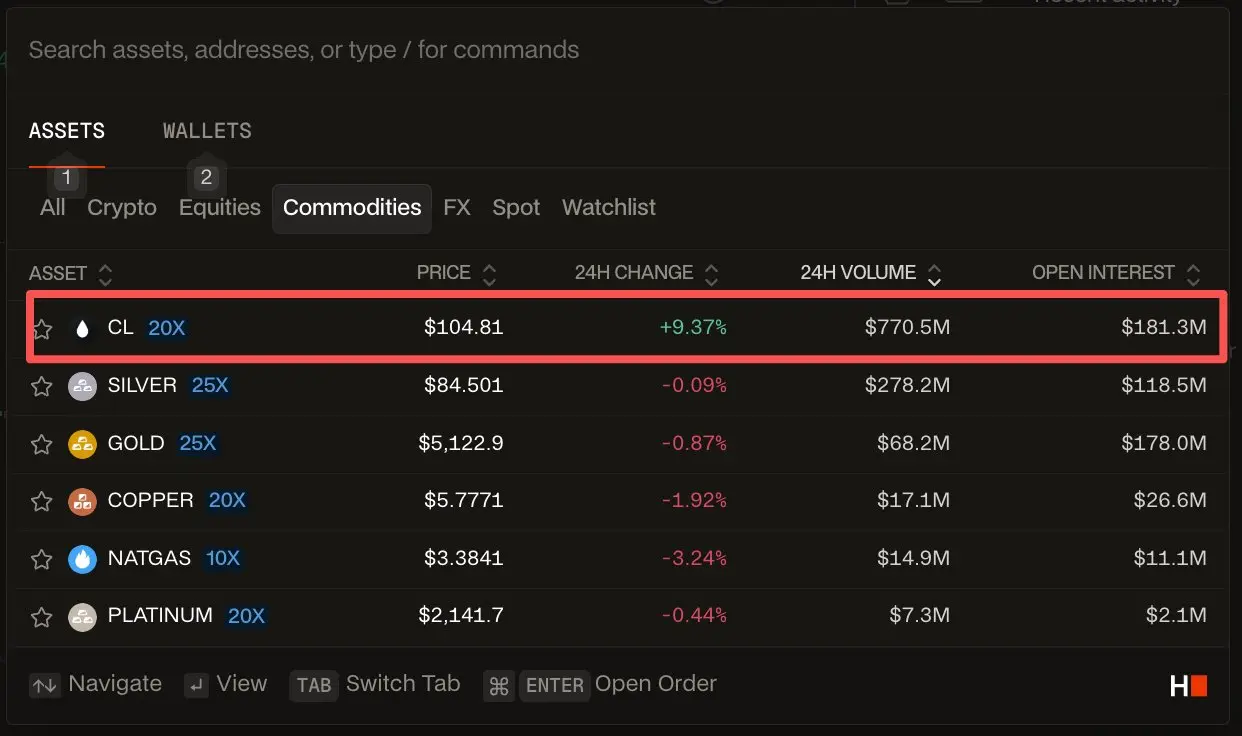
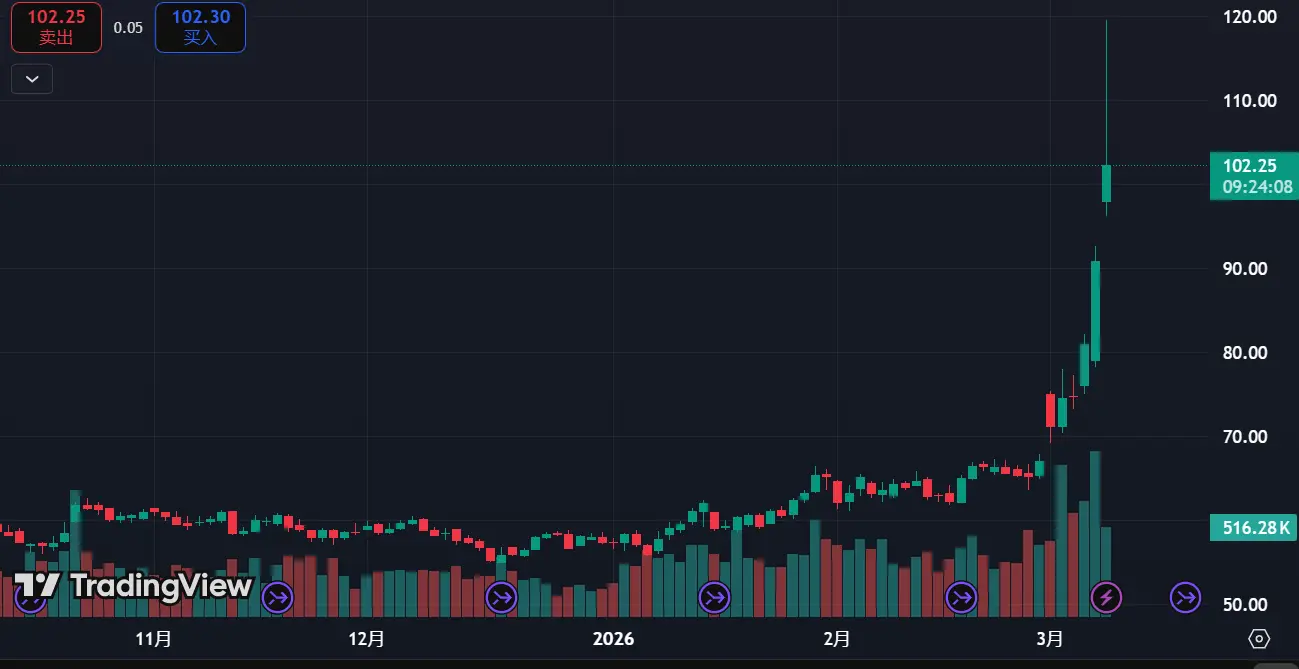
On Monday, when traditional futures opened, WTI once surged by over 30% in a single day. The trading volume of WTI crude oil contracts CL on Hyperliquid broke $100 million for the first time on March 3rd and reached nearly $1 billion by the 9th.
Everyone is saying this is the highlight moment for on-chain commodities, yet no one is asking who sets the price in this window?
The window has opened, who determines the price?
According to Bloomberg, the cryptocurrency market has become the only public window for traders to gauge the ongoing conflict risk in the Middle East.
As the war in Iran continues, on-chain platforms tracking oil, gold, and silver contracts have seen significant fluctuations driven by retail and crypto-native traders.
The fluctuations in on-chain prices can serve as a real-time indicator of market sentiment, but their reference value is limited. Crypto observers state that these platforms also provide a reference model for what "around-the-clock trading" could look like for traditional markets.
This time, reality is more extreme than the narrative.
Goldman Sachs monitoring data indicates that oil flow in the Strait of Hormuz has plummeted by about 90%, with an average daily supply of 18 million barrels disappearing out of thin air.
JPMorgan estimates that disruptions in Gulf area supply could scale from 1.5 million barrels per day within weeks, approaching 6 million barrels per day, which is 17 times lower than the peak reduction in Russian production in 2022.
Kuwait, the UAE, Iraq, and Qatar have announced production cuts or shutdowns successively. Since March, the cumulative highest increase in WTI has exceeded 50%.
In this wave of market, the real beneficiaries are those cryptocurrency exchanges that strategically positioned themselves in on-chain oil contracts, the burst in trading volume directly propels the surge in their fee income.
Gate data shows that Gate XBR (Brent crude oil) had a 24-hour contract trading volume reaching $12 million, with a month-on-month increase of 951.37%; XTI (WTI crude oil) had a 24-hour contract trading volume reaching $21.15 million, a month-on-month growth of 397.08%, with increasing capital focus and market participation.
On-chain monitoring data shows that even before this wave of market broke out, several well-known on-chain traders and institutions had already positioned themselves in the RWA US stocks and commodity tracks.
- Sky co-founder @RuneKek established a long position of $8.7 million in crude oil at an average price of $92 on March 7th, and simultaneously hedged with short positions in ETH and the NASDAQ.
- CBB (@Cbb0fe) opened a short position of $36.3 million at an average price of $78.3 on March 4th, while also shorting the South Korean stock market, natural gas, and the AI industry chain, with $4.76 million in long gold.
- Loracle (@loraclexyz) opened a $7.8 million short position in CL at an average price of $92 on March 7th, and also shorted $5.6 million in NVDA and PAXG. The current dual position is temporarily at a loss.
- A whale in the reverse index 0x8af had a $7.7 million short position completely liquidated, but without pause, re-established a new short position.
- An address that once made over $50 million in profits from shorting altcoins has incurred a loss of $7.3 million in commodities over the past month.
Among these people, some are doing structured hedging, some are betting on reversals, and some are increasing their bets following the trend.
Their directions vary, but one thing is the same — no one is a real oil trader, no one is seriously analyzing the actual blockade probability in the Strait of Hormuz, and no one is building an oil supply-demand model.
What is driving their entry is the narrative of war, amplified by the leverage provided by on-chain trading.
This is exactly the essence of the current on-chain commodities market. Liquidity determines who is pricing, while the liquidity of the on-chain market is still merely a fraction of the traditional markets. The daily crude oil futures trading volume on the Chicago Mercantile Exchange (CME) is counted in billions, while Hyperliquid's $910 million is already a historical peak.
A single position from a large player can top the leaderboard; perhaps the discovery of price has never actually happened on-chain, and the so-called 7*24 is merely a collective imagination of crypto traders regarding war.
The prices in this window are driven by emotions, magnified by leverage, and propelled by the narrative of war — not by crude oil supply and demand.
Money has been made from oil, but greater macro risks are accumulating
Those still engaging in on-chain oil contracts may not realize that the same war is accumulating risk from another direction.
According to the model from The Kobeissi Letter, if oil prices maintain around $120 for over three months, the US CPI inflation rate will rise to about 3.7%, reaching the highest level since September 2023.
Meanwhile, in February, non-farm payrolls increased by -92,000, and the unemployment rate rose to 4.4%. The employment slowdown should compel interest rate cuts, but expectations of re-inflation have paralyzed the Federal Reserve.
Once the interest rate cut window closes, the valuation logic of global risk assets will come under pressure again. The stock market, commodities, and cryptocurrencies will not be able to remain unaffected.
The risks do not stop there. Sovereign funds from the Middle East, such as Saudi Arabia, the UAE, and Qatar, are delaying large investments in US AI and data centers, while the US is also considering expanding AI chip export controls globally.
Additionally, BlackRock announced restrictions on redemptions for its $26 billion corporate loan fund, which has crazily bled into data center projects with high interest rates over the past three years. Investors can redeem quarterly, but the loan terms are as long as 5 to 10 years, leading to mismatched maturity and hidden risks.
The sources of funding for the crypto market and AI narrative are highly overlapping. Once the AI narrative cools and triggers a wave of fund redemptions, it will lead to more sell-offs. This scenario was seen before the subprime mortgage crisis in 2008.
Conclusion
A war has turned a group of people trading meme coins into oil traders. Some of them made money, while others got liquidated and reopened their positions.
On-chain trading never sleeps, and the war won't stop for this reason. The macro risk bills have yet to be settled, and the battle between long and short has not yet reached a true settlement.
Next time, who will stand on the right side?
免责声明:本文章仅代表作者个人观点,不代表本平台的立场和观点。本文章仅供信息分享,不构成对任何人的任何投资建议。用户与作者之间的任何争议,与本平台无关。如网页中刊载的文章或图片涉及侵权,请提供相关的权利证明和身份证明发送邮件到support@aicoin.com,本平台相关工作人员将会进行核查。


