Who would have thought that a tense Middle Eastern conflict would evolve into a financial market extreme "mass exodus" within 24 hours?
From crude oil skyrocketing nearly 30% to the miraculous deep V reversal of U.S. stocks, and the quiet ascent of Bitcoin, March 9, 2026, is destined to be recorded in history. On this day, global traders experienced not just simple ups and downs, but a "violent washout" concerning life and death.
I. Hellish Start: Hormuz “Chokes”, Inflation Ghost Returns
● The shadow of war never approaches gradually; it often knocks on the door in the most violent way.
● As the military actions of the U.S. and Israel against Iran deepened, the lifeline of global energy—the Strait of Hormuz—fell into substantial stagnation. According to Wall Street Journal data, in the past 24 hours, only one cargo ship related to Iran dared to sail out of the Persian Gulf. This amounts to directly choking the throat of global oil supplies.
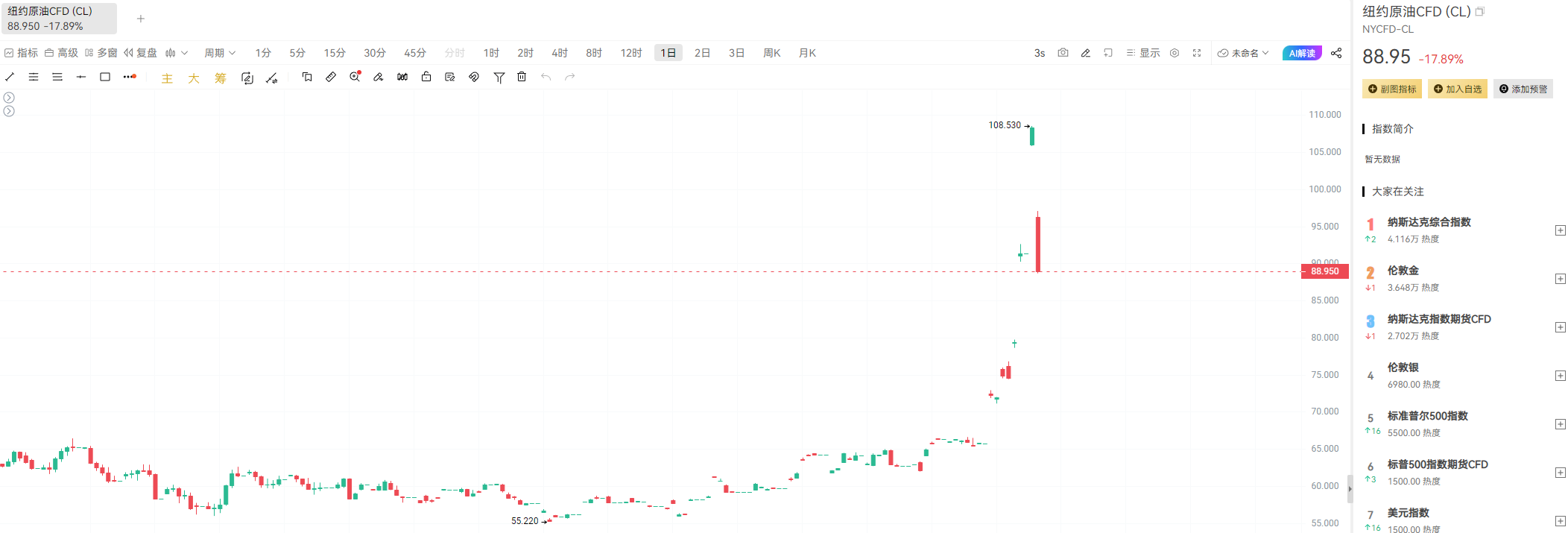
● The market's first reaction was physiological panic. Early on Monday in Asia, WTI crude oil futures skyrocketed, nearly reaching the $120/barrel mark, with an intraday increase of nearly 30%. Brent crude oil futures also did not hold back, easily surpassing $100, hitting the highest point since the Russia-Ukraine conflict in 2022.
● The crazy rise in oil prices instantly ignited the market's most primitive fear—uncontrollable inflation and economic recession. Under the domination of this "stagflation" logic, U.S. stocks faced a brutal slaughter as soon as the market opened, with the S&P 500 index dropping over 1.5% at one point during the day, while the Dow Jones index hemorrhaged. At that moment, traders seemed to see the shadow of the 1970s once again looming over Wall Street.
II. "Deterrence" from the Policy Toolbox: The Implicit Message of the G7
● At the very moment when global risk assets were on the verge of collapsing, finance ministers of the Group of Seven (G7) held an emergency video conference on the other side of the ocean. Contrary to market expectations for immediate intervention, the G7 issued a subtly worded and skillful statement: they are "ready at any time" to take necessary measures to support global energy supply, including releasing strategic oil reserves, but did not announce any immediate actions.
● This is a typical "forward guidance" deterrence. The G7's rotating presidency, France’s finance minister Le Maire even frankly stated that there is currently no substantial supply shortage in Europe or the United States, and that the G7 "has not reached that step." It is this "prepared but not used" stance that instead provided the market with a sense of reassurance—it tells traders that various countries still have cards in hand and are ready to play them at any time.
● The Director of the International Energy Agency (IEA), Birol, made an even more direct statement at the meeting, urging member countries to jointly release oil inventories. This expectation for a "combined policy" at the policy level caused previously skyrocketing oil prices due to purely panic to begin to ease. Crude oil prices slightly retreated from their intraday highs, but the real main event was yet to come.
III. Trump's One-Word Deal: From "Depth Charge" to "Air Force One"
If the G7 statement removed the fuse, then U.S. President Trump's remarks directly threw this impending bomb into the sea.
● On the afternoon of March 9, local time, during a phone interview with CBS News, Trump, in his characteristic confident tone, declared: "I think this war is basically over, it’s almost over. They have no navy, no communications system, and no air force left." He added that this was progressing "much faster" than his initial estimate of a 4 to 5-week timeframe.
● Crude oil prices plunged in response. U.S. oil dived sharply from near $120 to an intraday drop of over 31% from the daily high. This level of volatility had long departed from the realm of fundamentals, and was entirely a cleaning of extreme emotions triggered by remarks from the highest levels.
● The mountain weighing down on risk assets—inflation alerts—was instantly lifted. In the last hour before the market closed, U.S. stocks entered a frenzy of upward movement. The NASDAQ led the charge, with astonishing intraday volatility, and ultimately, all three major indices not only completely regained their losses but also closed in the green. The S&P 500 set a record for reversing from over a 1.5% intraday drop to close higher for the first time since April last year.
● Steve Sosnick of Interactive Brokers commented on this, saying it was a classic "familiar pattern": overnight futures plummeted, local traders woke up and tentatively bought, unease after the market opened, and finally "bargain hunters" flocked to the market. In this double kill situation of both bulls and bears, hesitating for even a second could lead to ruin.
IV. Bitcoin's "Rebellious Phase": Not Joining Gold, Quietly Evolving into an Independent Trend
● In this grand narrative dominated by geopolitics, there is a detail worth pondering—Bitcoin's performance.
● In the past, during similar Middle Eastern crises, Bitcoin was often labeled with the safe-haven property of "digital gold," or moved in tandem with U.S. stocks due to decreased risk appetite. But this time, it exhibited some "rebellion."
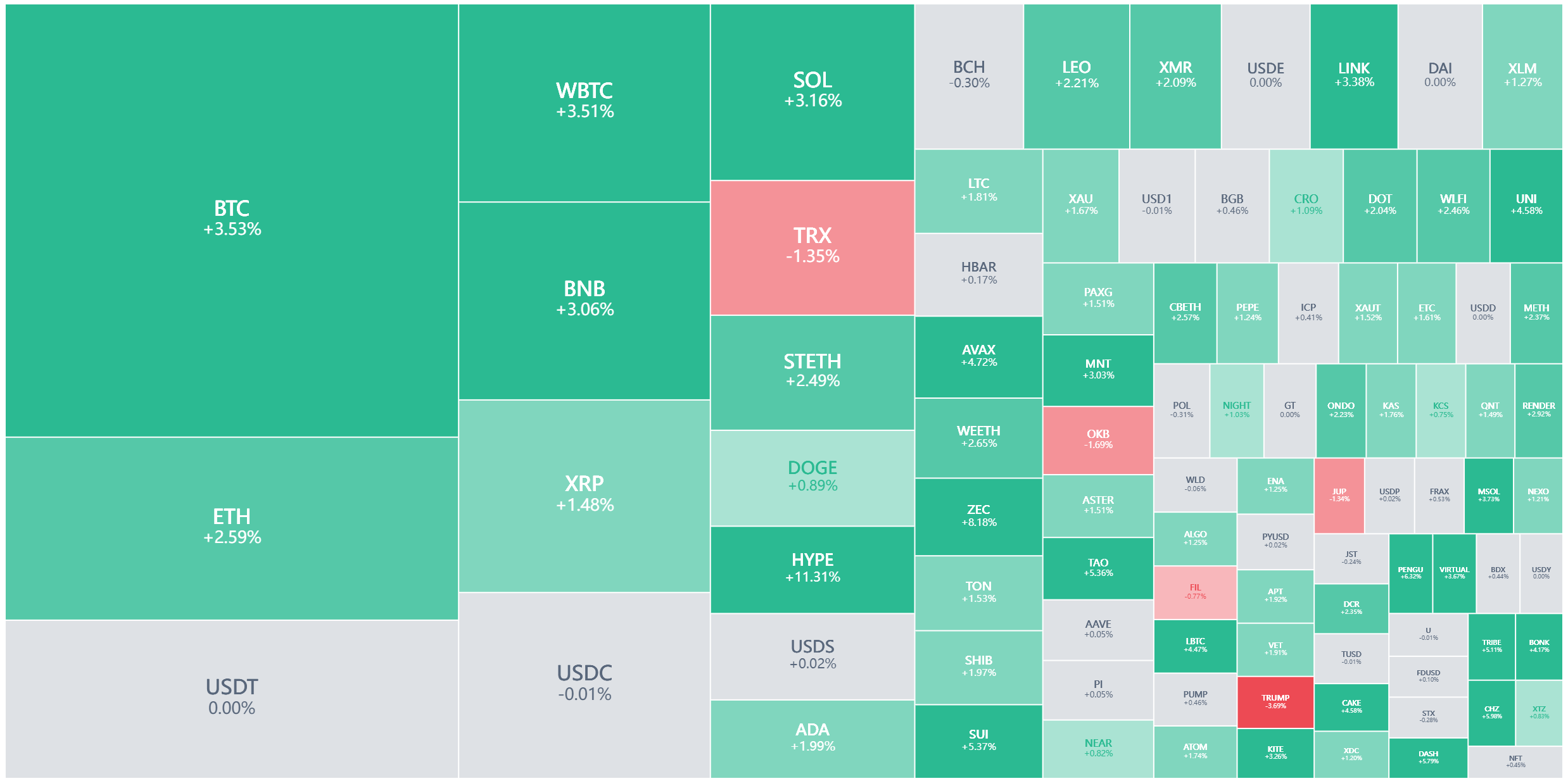
● Earlier on Monday, when crude oil was soaring and U.S. stocks were crashing, Bitcoin faced pressure along with risk assets. However, following Trump's speech and the market reversal, Bitcoin not only reclaimed losses from the weekend but also recorded substantial gains that day. Data showed that Bitcoin rose 2.63% during the day, while Ethereum increased by over 3.4%. Even on the morning of Tuesday in Asia, Bitcoin briefly broke past the $69,000 mark.
The logic reflected behind this may be more complex:
1. Mapping of Excess Liquidity: As Trump hinted at the end of the war, concerns about the Federal Reserve being forced to raise interest rates due to rising oil prices eased, leading to a retreat of the dollar index from its highs. The alleviation of liquidity tightening expectations directly benefited crypto assets sensitive to capital costs.
2. Evolution of Hedging Tools: Some funds may begin to view Bitcoin as a value storage tool independent of traditional policy interventions. When the G7 announced it would release oil reserves, that was a government intervention in the market; whereas the rules of Bitcoin's code are fixed, and this "anti-intervention" characteristic becomes scarce after extreme volatility.
3. Preference of Bottom-fishing Capital: While U.S. tech stocks (such as NVIDIA, Google, etc.) rebounded significantly, cryptocurrency concept stocks also strengthened. This indicates that during the window period of risk appetite recovery, funds are still willing to seek the most elastic targets for speculation.
V. Conclusion: A New Normal of Volatility
● Andrew Tyler from JPMorgan has shifted to a "tactically bearish" outlook, and Yardeni Research has raised the probability of a stock market crash to 35%. But at least on this day, the market declared who is currently in charge with a textbook-level deep V reversal—that is the news headlines, and the person within those headlines.
● For traders, the lesson learned on March 9 is a harsh reality: in this macro world filled with "Trump" and "war," any technical analysis appears powerless in the face of instantaneous policy shifts and statements from leaders. Whether it's the 30% shock in crude oil, the violent reversal in U.S. stocks, or the quiet ascent of Bitcoin, it all signifies that the capital markets of 2026 have entered a new normal of "high volatility."
● And what investors can do might be, as Carol Schleif from BMO Private Wealth stated: stay alert, accept volatility, and be ready to respond to the next headline.
Join our community to discuss together and grow stronger!
Official Telegram Community: https://t.me/aicoincn
AiCoin Chinese Twitter: https://x.com/AiCoinzh
OKX Welfare Group: https://aicoin.com/link/chat?cid=l61eM4owQ
Binance Welfare Group: https://aicoin.com/link/chat?cid=ynr7d1P6Z
免责声明:本文章仅代表作者个人观点,不代表本平台的立场和观点。本文章仅供信息分享,不构成对任何人的任何投资建议。用户与作者之间的任何争议,与本平台无关。如网页中刊载的文章或图片涉及侵权,请提供相关的权利证明和身份证明发送邮件到support@aicoin.com,本平台相关工作人员将会进行核查。


