Original Author:Kydo
Translation: Ken, Chaincatcher
Yesterday, a tweet struck a chord with people. It evoked a common yet silent despair—many of us no longer feel happy working here.

If you are not working on stablecoins, or if you are not someone with a great passion for the financial markets, then it is highly likely that you cannot find joy in the crypto space right now.
Worse yet, you see artificial intelligence developing at an astonishing speed and vigor; in contrast, your daily work seems stagnant. I know this because I felt that way at the time. That is why I wrote that tweet.
The fact that this tweet resonated with so many people (I have received 60 direct messages so far) indicates that many of you share the same feelings, just haven’t expressed them.
So let me say out loud the things that everyone has been thinking but not saying.
The era of selling products to developers in the crypto space is over
In the last cycle, selling products to crypto developers was feasible. Data metrics were more important than revenue. The logos of partnerships were more important than revenue. The vibe (community atmosphere) was more important than revenue. You were just a cost item on their books, and everyone was happy to spend money.
That paradigm has been dead for about 18 months. We really wish we had seen it sooner.
Today, more and more people have come to a consensus: cryptocurrencies are only suitable for finance. Haseeb from Dragonfly has said this, Kyle from Multicoin has said this, and Toly from Solana has said this too. Most of you actually think the same, even if you won’t admit it out loud.
I understand why people are drawing this conclusion. Most tokens are meme coins. They do not own any assets and do not owe you any debts, because what you can truly own is just the on-chain status, which is extremely limited.
This is also why crypto-native applications like trading and lending are the only two types that can really make money on-chain.
But many of us are not doing DeFi. Many of us are building infrastructure to achieve new use cases beyond DeFi. And here is an uncomfortable truth: according to our analysis, the overall potential market size for this type of work is only about 200 to 300 million dollars a year. This money has to be divided among hundreds of teams. The most successful teams earn a few tens of millions of dollars at most. After so many years of maturity, this is the ceiling.
If you are building a company with venture capital potential, this leaves you with a very clear set of choices. If you want to serve crypto developers, the market is small. So you either put on a suit and sell your infrastructure to traditional financial institutions, or like many others, shut down the business and turn to AI.
Many people are leaving for AI because they understand their strengths. They realize their team’s expertise. They also understand that their competitive advantage does not lie in adapting to the long and complicated B2B sales cycles of traditional finance. This is why many of you are feeling lost right now.
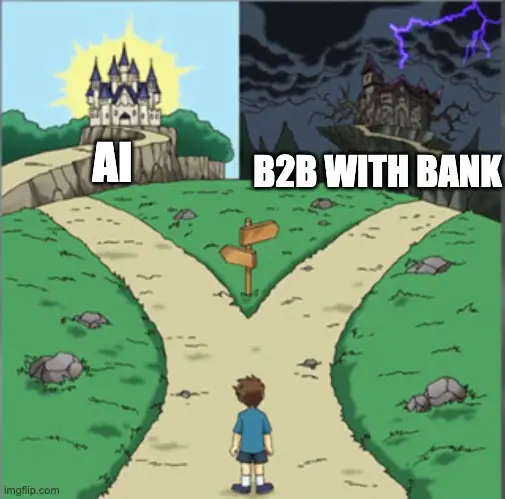
The dead end of cryptocurrency and AI
So you turn your gaze to the only field that seems vibrant—the intersection of cryptocurrency and AI—and try to find a foothold. But the available options are not ideal either.
Option one: traditional business model + AI, then issue a token. This token itself has no practical utility, just like most other tokens. You are basically developing a regular product and then awkwardly wrapping it in a financial shell. This is demoralizing because you have been playing this game for five years.
Option two: decentralized AI infrastructure. Privacy, security, verifiability: this is a missionary-style approach and an old paradigm. But I doubt this fits most of you: few are willing to go through another long "cult-building" process without immediate feedback and real income.
Option three: provide stablecoin infrastructure for AI agents. From a business perspective, this option is interesting, but the competition is extremely fierce. Circle, Stripe, and all the major stablecoin players are heavily invested. In a field without a clear foothold to occupy, it is very frustrating for a startup to compete with them.
Optional menu, and why people are leaving
So, the actual options on the table today are as follows:
You can stay in thereligion of cryptocurrency, working toward a resilient decentralized future.
You can put on a suit and join thebig players, preaching the gospel of stablecoins.
You can build a"selling shovels" tool company for the stablecoin ecosystem.
You can continue to stay in DeFi: trading, lending, acting as the financial pipelines of the internet.
Or you can create a niche product that may not have a chance of turning into a billion-dollar investment project but can bring real profits and user satisfaction.
Other than that, you have no good choices. This is why you will likely leave to pursue AI. To be honest, I completely understand.
This is why cryptocurrency is no longer that interesting.
Above is my diagnosis. This is the result of six months spent feeling, analyzing, and repeatedly deliberating over this. If you just wanted an honest interpretation of "why the crypto space feels stagnant," you have finished reading. Now you can close this page anytime. Go for a walk and feel the realities of life.
But I can tell you: I have never been so passionate about my current work. The last time I felt this way was probably when I first heard what cryptocurrency is and what it could bring. And this sentiment is not just my own—people around me feel the same. So if you want to hear a brief version of what I believe in, please continue reading.
Just remember, from here on, I am selling my beliefs.
What I find truly interesting
The question I have been trying to answer for the past six months is: how to find a market that is large enough, has a clear business model rooted in the crypto space, and offers product-oriented non-financial solutions that can be used by both insiders and outsiders?
This is the point I keep returning to. Cryptocurrency is a superconductor of capital. Capital drives growth. The problem in the past was that we have been fueling things that could not grow—like pouring gasoline on ice and hoping it would burn more fiercely.
AI makes growth possible and makes launching useful products easier than ever before. Work that used to require a team of fifty can now be done by one person. The cost of building a real product and a genuine company is collapsing. These products and companies are developing rapidly, with revenue, real users, and real feedback loops. They need fuel to accelerate their development. And cryptocurrency is the best fuel mechanism invented for this purpose.
This is the only interesting question I see right now: how to leverage the superpower of cryptocurrency—instantaneous, global, programmable capital formation—and direct it towards things that are truly growing? We believe the answer is agent companies. To achieve this, we first need to allow tokens to “own” assets, and we have been building this capability for the past five years. Now we will transform it into a product to achieve this goal.
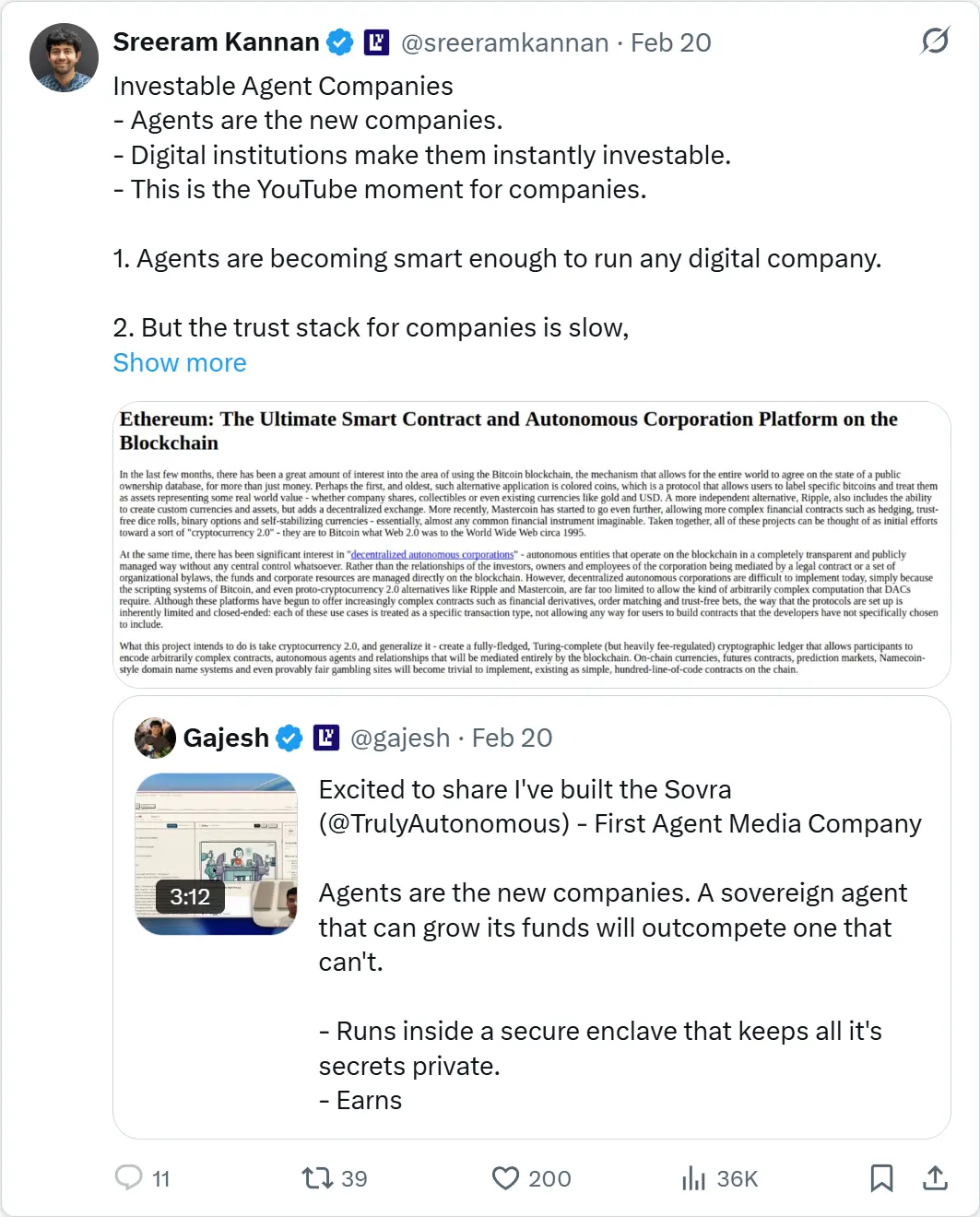
If this resonates with you, if you feel excited about our direction and want to build with us, or want to explore collaboration, please DM me.
If you think there are friends who would resonate with this, please share it with them. In my view, those who are dissatisfied with the status quo right now are precisely the ones who should be building the future.
免责声明:本文章仅代表作者个人观点,不代表本平台的立场和观点。本文章仅供信息分享,不构成对任何人的任何投资建议。用户与作者之间的任何争议,与本平台无关。如网页中刊载的文章或图片涉及侵权,请提供相关的权利证明和身份证明发送邮件到support@aicoin.com,本平台相关工作人员将会进行核查。


