Written by: Dong Jing
Source: Wall Street Early View
OpenAI may still have at least six months before going public, but Wall Street's pre-emptive preparations have quietly begun. Several investment banks are actively reaching out to public market investors to gauge opinions about the IPO prospects of this ChatGPT parent company—however, the responses received are much colder than expected.
On March 9, according to the tech media The Information, informed sources revealed that multiple investment banks vying for OpenAI's underwriting business have begun to "test the waters" with public market investors. The Information interviewed 11 public market investors, most of whom do not currently hold OpenAI equity.
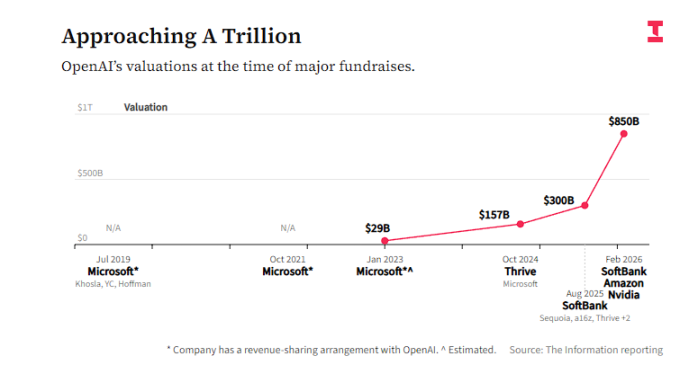
Respondents generally adopt a cautious attitude towards this IPO, with core concerns focusing on two points: first, the unclear profit outlook—OpenAI itself predicts it will continue to burn cash until at least 2030; second, the high valuation—the company is currently completing a new financing round at an $850 billion valuation, which is equivalent to 28 times the expected revenue for 2026, far exceeding NVIDIA's approximately 12 times sales ratio.
Reports indicate that the market's "indifference" reflects the deep contradictions faced by this potentially largest IPO in history: investors generally recognize OpenAI's leading position in the AI competitive landscape, yet remain skeptical about its ability to achieve reasonable pricing in the public market. Meanwhile, the strong rise of competitor Anthropic is further diverting investor attention and enthusiasm.
Valuation Controversy: 28 Times Sales Ratio, What's So Expensive
OpenAI is currently completing a new round of financing at an $850 billion valuation, with participants including NVIDIA, Amazon, and SoftBank. This figure has deterred many public market investors, and its IPO pricing may be even higher.
Based on the expected revenue for 2026, the $850 billion valuation corresponds to about a 28 times sales ratio. In comparison, NVIDIA, seen as a benchmark for AI investments, currently has a sales ratio of about 12 times.
Reports say that Bob Lang, founder of trading firm Explosive Options, bluntly stated:
"I do think OpenAI is an excellent company with a strong moat, but I don't believe any valuation on the first day of trading will be beneficial for investors."
He indicated that he is unlikely to participate in OpenAI's public market investments, especially with its valuation multiple higher than that of NVIDIA.
Lang also pointed out that the real beneficiaries of this IPO will be the early investors who already hold shares and the large-scale cloud computing companies—who will use it as an opportunity to cash out.
Notable short-seller Jim Chanos, referencing NVIDIA, questioned OpenAI's valuation logic:
"NVIDIA basically monopolizes the market, experiences rapid growth, has extremely high profit margins, and ample cash flow. So why would you give OpenAI a higher valuation?"
Profit Path: Burning Cash Until 2030, Can the Public Market Accept It
Reports suggest that OpenAI predicts it will continue to incur losses at least until 2030. This timeline makes public market investors, who are accustomed to evaluating profitability, quite anxious.
Some investors are concerned whether the funds raised from the IPO will be sufficient for OpenAI to reach profitability, or whether it will need to raise funds again, thereby diluting existing shareholder equity.
Mark Malek, Chief Investment Officer at Siebert Financial, stated that although OpenAI may struggle to achieve notable profitability in the short term, he would still consider building a position after the IPO, but would strictly control the size of the position—similar to his strategy when investing in Palantir many years ago.
Palantir currently has a sales ratio as high as 49 times, with a growth rate far exceeding its peers, but Malek believes Palantir's risks are still lower than those of OpenAI, due to its more flexible cost structure.
"If Palantir loses a government contract, that would be bad, but they can lay off workers. If you've spent five years building a data center, you can't just say 'never mind, stop it', Palantir is operating a Formula One car, while OpenAI is running a fully loaded cargo ship."
Analysts at JPMorgan highlighted in a report in January that OpenAI's initiative to introduce advertising in ChatGPT helps retain users but also noted that after the company announced significant spending plans on chips and data centers, customer sentiment towards OpenAI was "mixed".
Not everyone is sitting on the sidelines—some investors have clearly indicated that once OpenAI goes public, they will consider shorting its stock, betting that the public market's tolerance for its lengthy path to profitability is limited.
Chanos shares a similar stance. The core logic he conveys to clients is: "You should go long on chip production and short on chip storage." Implicitly, operating data centers is not a high-return business while OpenAI's business model heavily relies on significant investment in computational infrastructure.
Chanos also pointed out that there is currently a severe lack of financial information about OpenAI in the market, making in-depth analysis difficult. However, he expects that once OpenAI formally submits its IPO application, the public market will engage in fierce debate about its competitive landscape:
"Is this winner-takes-all, or does the market fragment like cloud computing? Or does one company become the standard and maintain it long-term like search engines? As it stands, the models are continually surpassing each other."
Disruption from Anthropic: Competitors Divert Funding and Attention
OpenAI's path to IPO also faces potential pressure from competitor Anthropic.
At Morgan Stanley's annual technology conference this week, Anthropic CEO Dario Amodei revealed that the company's annualized revenue run rate has doubled to $20 billion. Anthropic has recently completed a new round of financing, achieving a valuation of $380 billion, with strong sales momentum for its enterprise products like the AI programming tool Claude Code.
The Information previously reported that Anthropic expects its cost of training and operating AI models over the next few years to be much lower than OpenAI’s. Some investors are beginning to believe that, thanks to its success in the enterprise customer market—where clients are willing to pay a premium for AI services—Anthropic's long-term profitability may surpass that of OpenAI.
With Anthropic also preparing for its IPO, the two companies' IPOs may create competition, further diverting investors’ funds and enthusiasm. Investors like Chanos have clearly indicated a preference for Anthropic's relatively restrained computing power investment strategy, viewing it as a more prudent and sustainable business path.
免责声明:本文章仅代表作者个人观点,不代表本平台的立场和观点。本文章仅供信息分享,不构成对任何人的任何投资建议。用户与作者之间的任何争议,与本平台无关。如网页中刊载的文章或图片涉及侵权,请提供相关的权利证明和身份证明发送邮件到support@aicoin.com,本平台相关工作人员将会进行核查。


