Author: Tempo / Liam Horne
Translation: Deep Tide TechFlow
Deep Tide Overview: Tempo's mainnet has launched, immediately releasing the Machine Payment Protocol (MPP) co-drafted with Stripe—this is not a single crypto project building its ecosystem alone; Visa, Anthropic, OpenAI, Mastercard, and Shopify have simultaneously integrated this open standard.
The core innovation of MPP is the "session" mechanism, similar to OAuth in the payment field: Agents authorize once and pre-fund, after which each API call or data consumption is settled in real-time without the need for each transaction to be separately recorded on the blockchain.
If this set of protocols becomes the industry standard, the "autonomous consumption" of AI Agents will transform from a concept into a scalable reality.
The full text is as follows:
Tempo's mainnet has officially launched!
Tempo is internet-grade infrastructure aimed at real-world payments. Its design goals include: instant settlement, predictable low fees, high throughput, and global availability. Starting today, you can begin building on Tempo through our public RPC endpoint.
Start Building →
Alongside the mainnet launch, we also released the Machine Payment Protocol (MPP)—an open standard for machine payments co-drafted by Stripe and Tempo. See below for details.
When we first launched Tempo in September, the premise was simple: if stablecoins become the core layer of internet commerce, then the infrastructure for transferring funds must be built specifically for payments.
Stablecoins enable cross-border instant settlement and around-the-clock availability. However, most existing blockchains are not designed for large-scale payment workloads. Fluctuating fees, limited throughput, and transaction structures that are not suited for common payment processes are prevalent issues.
Unlike other blockchains, Tempo is designed around the demands of real payment systems: predictable costs, high throughput, and reliable settlement for a high volume of transactions.
In recent months, a new type of application has made these demands more visible:
The Rise of Agent Payments
Agents are now capable of writing code, coordinating services, retrieving data, and executing complex workflows across the internet. As these systems’ capabilities continue to grow, they increasingly require transactions.
A research-oriented Agent might need to pay to access a certain dataset. A development Agent might need to purchase computational power or testing infrastructure. A workflow Agent might need to coordinate multiple services, making payments upon completion of each task.
In these scenarios, payments become continuous and programmable. A single workflow may involve dozens or even hundreds of small payments to different services rather than a single transaction between two parties.
This model quickly exposed the limitations of existing payment infrastructure.
Traditional payment systems assume that transactions are initiated by humans and undergo manual approval processes. Many existing blockchains are also not designed for high-frequency, low-value transactions—in such scenarios, predictable costs and reliability are crucial.
Tempo provides settlement infrastructure for interactions of this scale, allowing Agents to transact programmatically.
Release of Machine Payment Protocol (MPP)
To lay this foundation, we are releasing the Machine Payment Protocol (MPP)—a set of open standards for machine payments. MPP is designed to be scalable and payment method-agnostic, currently supporting stablecoins, bank cards, and more payment types.
MPP provides Agents and services with a standardized programmatic payment coordination method. Each service does not need to invent its own billing process; MPP defines a simple protocol for initiating, authorizing, and settling payments between machines.
We chose to release MPP as an open standard to ensure that machine payments can remain consistent across services and payment channels.
MPP currently operates on Tempo, but the protocol itself is designed to be agnostic to the underlying track and scalable. For example, our design partner Visa has extended MPP to support card payments on its network. Stripe has extended it to support card, wallet, and other payment types through its platform. Lightspark has also extended it to support Bitcoin payments on the Lightning Network.
The Session Mechanism of Streaming Payments
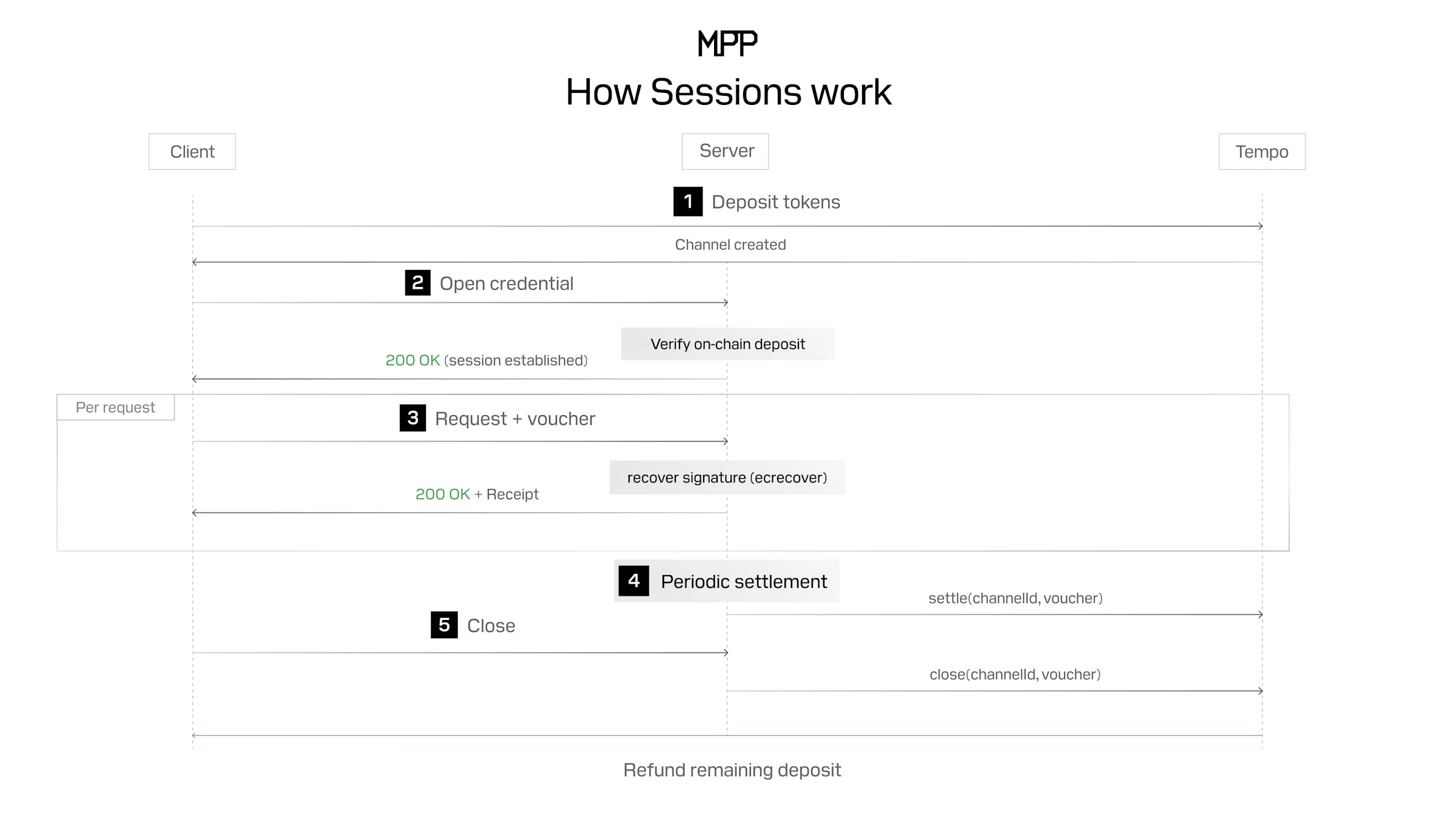
MPP enables Agents to autonomously pay for services: the Agent initiates a resource request to the service, and the service returns a payment request. The Agent authorizes the payment from its wallet, the transaction is settled instantaneously, and the service immediately delivers the requested resources to the Agent.
This mechanism is implemented through a new primitive called "session," which supports continuous payments. It can be understood as OAuth for payments: authorize once, then allow payments to be executed automatically within set limits.
When an Agent opens a session, it locks in funds in advance. As the Agent consumes resources from the service (API calls, model inference, data queries, etc.), payments continue to flow without needing to initiate on-chain transactions for each interaction.
Thousands of small transactions can be aggregated into a single settlement transaction, making true pay-per-use feasible at internet scale.
Payment Directory
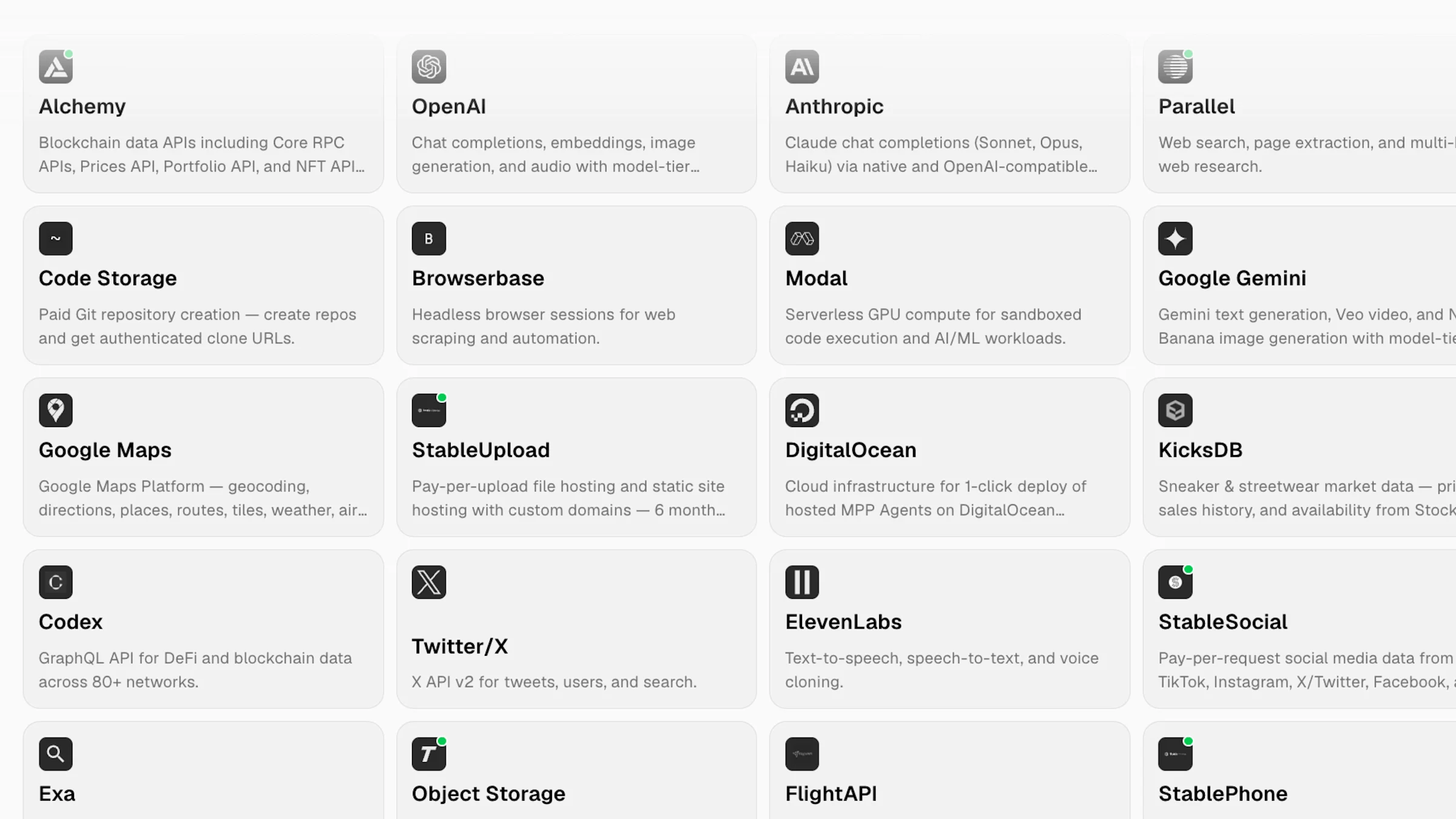
Our payment directory provides a unified directory of MPP-compatible services that any Agent can automatically transact with.
Service providers can also onboard to monetize their services and make themselves discoverable to Agents. MPP supports a variety of scenarios, including API billing by call count, monetized MCP servers, paid content and data, and multi-service workflows.
At launch, the payment directory already includes integrations of over 100 services, covering model providers, developer infrastructure, computing power platforms, and data services, including Alchemy, Dune Analytics, Merit Systems, and Parallel Web Systems.
Infrastructure for Scaling Payments
Although Agents represent a new type of business model emerging on Tempo, our infrastructure architecture also supports traditional payment scenarios, including global payroll, cross-border remittances, embedded finance, and tokenized deposits—these scenarios are still unexpectedly difficult to build and operate.
Since the public testnet went live last December, we have been working with design partners in payments, commerce, and financial services to migrate real payment workloads to stablecoins:
Global Payroll: Platforms that batch payments to employees, sellers, and creators often require handling millions of expenses at once. Such systems demand predictable costs and reliable throughput. Tempo's dedicated payment channels allow large payroll operations to settle instantly without being affected by congestion or fluctuating rates.
Cross-Border Remittances: Current international transfers typically pass through multiple intermediaries, with settlement periods lasting several days. Partners are testing remittance channels on Tempo that achieve near-instant settlement while maintaining complete auditability and predictable costs.
Embedded Finance: Software companies are increasingly embedding payment processes directly into products. Tempo's smart accounts and protocol-level notes allow developers to integrate financial workflows directly into their products without needing to build separate ledger infrastructure.
Tokenized Deposits: Financial institutions are exploring tokenized representations of deposits and other assets for continuous settlement instead of being constrained by traditional banking hours. Tempo provides reconciliation primitives and compliance registries corresponding to traditional financial control systems while supporting real-time settlement.
We are collaborating with partners such as Anthropic, DoorDash, Mastercard, Nubank, OpenAI, Ramp, Revolut, Shopify, Standard Chartered, and Visa to bring these scenarios to the mainnet. We will also be launching more features specifically designed for enterprise payment workloads and will share more progress in the coming months.
Start Building on Tempo
Tempo's mainnet is officially live today.
Developers building Agents can start using MPP to enable Agents to pay for services. Fund the Agent's wallet, set spending limits, and allow Agents to autonomously transact on the internet.
Developers building global payment systems can leverage Tempo's infrastructure for high-throughput settlements, cross-border transfers, and embedded financial workflows.
You can get started in the following ways:
- Create a wallet on Tempo and initiate your first transaction
- Explore the Machine Payment Protocol documentation and SDK
- Monetize your API through the payment directory, opening it up to Agents
- Build directly on Tempo mainnet through the public RPC endpoint
免责声明:本文章仅代表作者个人观点,不代表本平台的立场和观点。本文章仅供信息分享,不构成对任何人的任何投资建议。用户与作者之间的任何争议,与本平台无关。如网页中刊载的文章或图片涉及侵权,请提供相关的权利证明和身份证明发送邮件到support@aicoin.com,本平台相关工作人员将会进行核查。


