Author: Hu Tao, ChainCatcher
In the cryptocurrency industry, "listing coins" used to mean the birth of another wealth creation myth, but now, it may just be a prelude to a long clearing process.
On March 18, Binance announced that it would suspend trading and delist 8 tokens, including Ampleforth (FORTH), Hooked Protocol (HOOK), IDEX (IDEX), Loopring (LRC), Neutron (NTRN), Radiant Capital (RDNT), etc.
On March 16, Coinbase announced the delisting of 25 contract trading pairs, including REZ-PERP, BABY-PERP, GMX-PERP, T-PERP, YB-PERP, HOME-PERP, CATI-PERP, DOGS-PERP, DRIFT-PERP, etc.
On March 12, Binance Alpha announced that it would remove over 21 tokens, including DGC (DecentralGPT), BNB Card (BNB Card), PFVS (Puffverse), RDO (Reddio), MILK (MilkyWay), TAT (Tell A Tale), etc.
Earlier in January, OKX announced the delisting of 7 tokens, including ULTI, GEAR, VRA, DAO, CXT, RDNT , and ELON. In addition, Bithumb and Upbit also announced the delisting of multiple currencies.
This wave of delistings across both the spot and derivatives markets sends a cold and clear signal to the outside world: leading cryptocurrency exchanges are undergoing a paradigm shift from an "asset expansion phase" to a "contraction phase."
They are reassessing asset targets and establishing new listing and delisting mechanisms based on the liquidity, quality, and transparency of tokens/projects, which can deter other listed or potential projects while better protecting investor interests.
1. "Zombie-like" survival under a shiny exterior
It is lamentable that among those “cleared” are many once-promising track stars, such as LRC, FORTH, NTRN, and RDNT.
Among them, Loopring (LRC) emerged as a DeFi track star with the narrative of "Layer2 scaling + decentralized trading," and a light of Chinese projects; ELON became a popular meme coin due to Musk's IP effect, rapidly increasing its market value; MilkyWay (MILK) once secured $5 million in funding thanks to associations with respected institutions like Polychain and Hack VC.
In a bull market, the cryptocurrency market has never lacked shiny narratives. DeFi, NFT, meme, InfoFi, RWA, and other tracks emerge one after another, a slogan or a white paper can easily raise tens of millions in funds, and a brand new concept can support a valuation of hundreds of millions while gaining favor from various leading exchanges.
However, these seemingly glamorous projects often share a fatal flaw – a lack of core technology that is grounded and a sustainable business model. When market enthusiasm wanes and narratives are gradually debunked, these projects' shortcomings are infinitely magnified.
For exchanges, maintaining these projects that have lost community momentum not only signifies huge compliance costs but also implicitly depletes platform credibility. In an era of stock game dynamics, exchanges can no longer tolerate "air assets" occupying valuable liquidity resources for long, which is an inevitable result of the previous stage of brutal growth.
Looking at these delisted projects, DeFi and gaming sectors are the hardest hit, which also includes fields like Layer1 and DAO, echoing the changes in the industry mainstream narrative. Even more serious than delisting, many projects have publicly announced they will cease operations. According to RootData statistics, this includes decentralized storage platform DataHaven, DeFi options protocol Polynomial, DAO governance platform Tally, metaverse Bloktopia, incubator Colony, data analysis platform Parsec , etc.
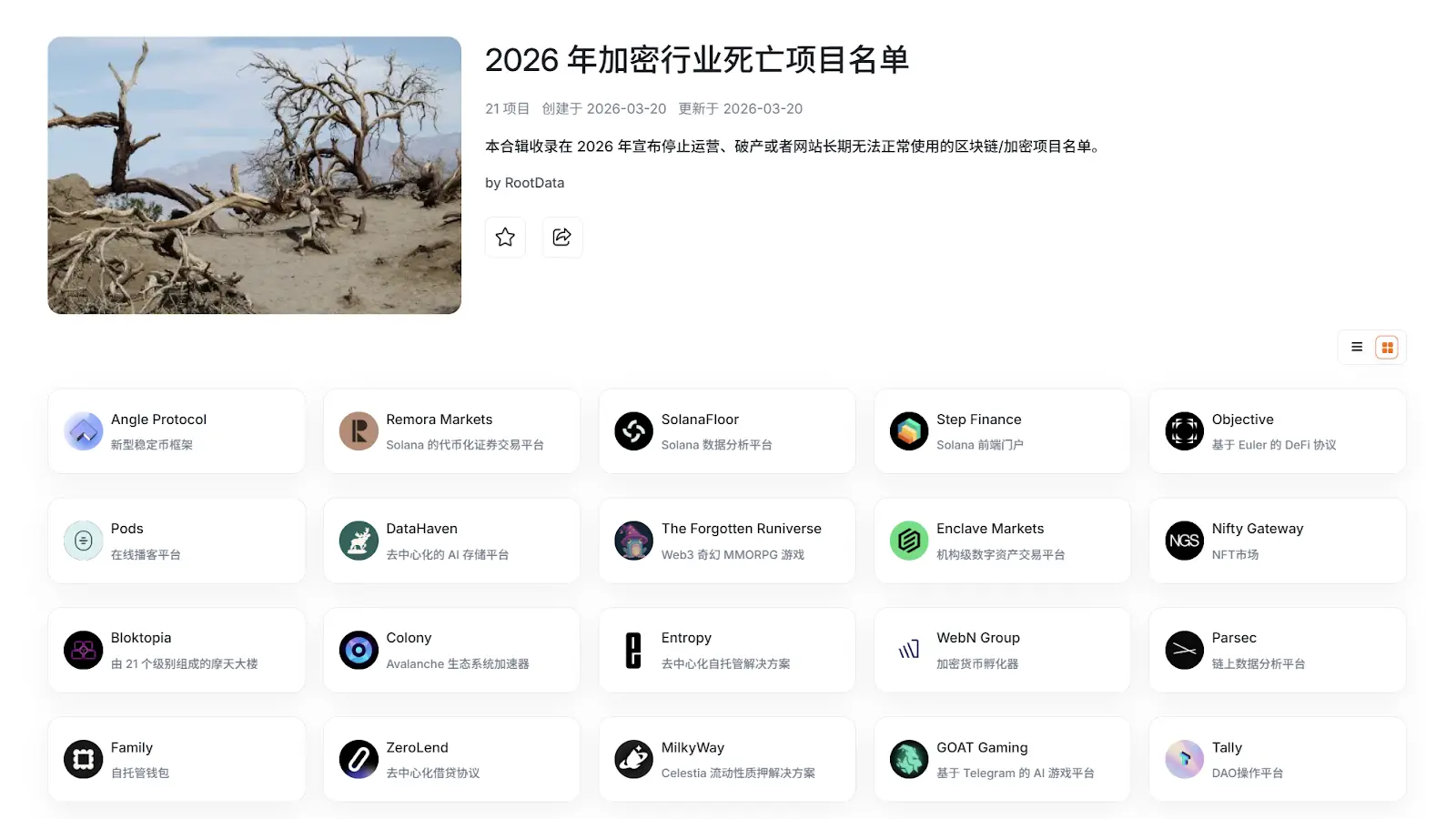
Meanwhile, cryptocurrency exchanges are successively shifting their focus to tokenized stocks, which have clear business models and market competitiveness while solving the problem of limited trading hours in traditional stock exchanges. Exchanges such as Binance, Kraken, OKX, Bitget, Bybit, and Gate have all supported the trading of such assets, with the latter three having supported over 100 stock assets within months, demonstrating strong strategic ambition.
2. Transparency is becoming a red line
In addition to insufficient momentum within the industry, a lack of transparency is also one of the main reasons why many projects are being delisted.
As regulatory efforts in the cryptocurrency industry continue to strengthen, along with an increase in investor risk awareness, exchanges are imposing ever stricter transparency requirements on token projects. According to official information, Binance has made it clear that it includes "the level of public communication, community participation, and transparency of the project team," and "the team's commitment to the project" in its assessment criteria for token health.
This means that having clear team and roadmap information, a sound information disclosure mechanism, and active community communication channels is crucial for any token. However, for many projects, the "listing and then lying flat" mentality has become an awkward and cruel reality.
According to the transparency scores recently launched by RootData, most tokens delisted by exchanges such as Binance scored below 70% for transparency, facing varying degrees of issues such as insufficient project progress disclosure and team member absence, while community communication stagnation has become the norm, severely weakening user attention and even trading willingness, thus creating a vicious cycle of insufficient trading volume and liquidity.
Taking Ultiverse, which is invested by YZi Labs, as an example, the project has released almost no tweets since January, only retweeting a few messages, and several core team members have done the same.
Such "black box" operations not only challenge the risk defenses of exchanges but also directly infringe on the right to know of retail investors. The recent collective "clearing out" by exchanges is essentially a supply-side reform targeting "inferior coins," reallocating more resources to high transparency and robust assets. In this way, exchanges are creating a systemic deterrent against in-house projects: transparency is no longer a soft "bonus item," but a necessary option for survival.
In the context of traditional capital accelerating penetration and a gradually clarified global regulatory framework, the competitive dimensions of exchanges have undergone a qualitative change, no longer focusing on trading volume and user count, but on the quality of asset targets and platform compliance. The coordinated efforts of leading exchanges such as Binance, Coinbase, and OKX signal the start of a "dehydration" cycle aimed at squeezing out bubbles.
免责声明:本文章仅代表作者个人观点,不代表本平台的立场和观点。本文章仅供信息分享,不构成对任何人的任何投资建议。用户与作者之间的任何争议,与本平台无关。如网页中刊载的文章或图片涉及侵权,请提供相关的权利证明和身份证明发送邮件到support@aicoin.com,本平台相关工作人员将会进行核查。


