U.S. equities extended their slide for a fourth straight week on Friday, with all major benchmarks finishing firmly in the red as geopolitical tension and inflation pressure converged. The Nasdaq Composite ended at 21,647.61, down 443.08 points, while the Dow Jones Industrial Average closed at 45,577.47, off 443.96 points, according to the final session data.
The S&P 500, an index of the 500 of the largest publicly traded U.S. companies, settled at 6,506.48, losing 100.01 points, marking its fourth consecutive weekly decline and its lowest level since September 2025. Meanwhile, the NYSE Composite finished at 21,616.73, down 324.30 points, reflecting broad-based weakness across sectors.
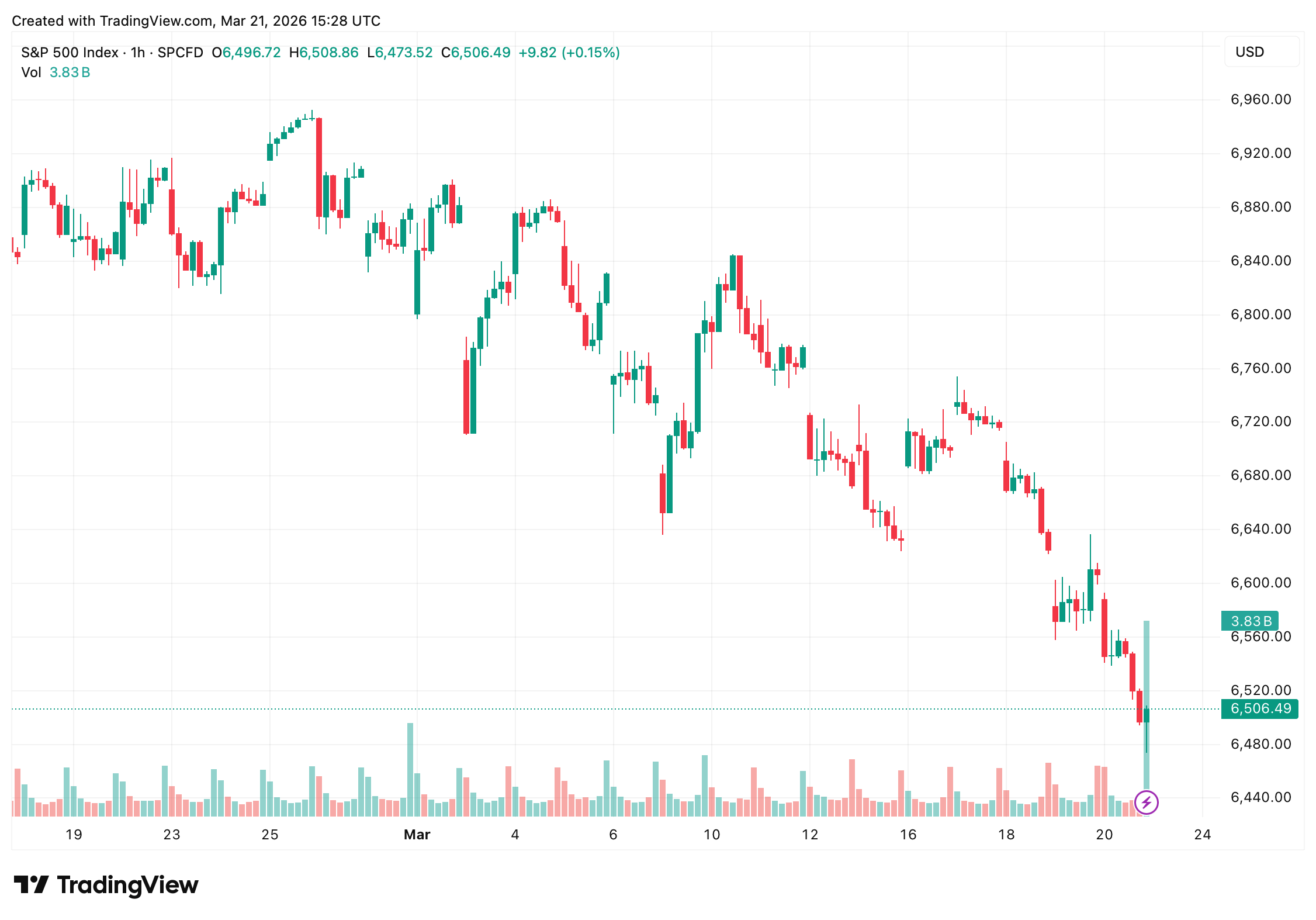
S&P 500 via tradingview.com.
Small-cap stocks took the brunt of the pressure, with the Russell 2000 falling roughly 2.3% and entering correction territory, signaling deeper stress beneath the surface. At the center of the move sits the ongoing U.S./Israel-Iran conflict, now in its fourth week, which has disrupted key energy routes and infrastructure.
Oil prices climbed toward multi-year highs, feeding directly into inflation concerns. Late Friday, policymakers introduced a potential counterweight. The Treasury Department lifted sanctions on roughly 140 million barrels of Iranian crude already loaded onto vessels, a move the Trump administration says could help ease supply pressure and temper price increases.
The Washington Post’s Evan Halper notes that the Trump administration’s move has left observers puzzled, as it could extend the conflict. “You don’t unsanction Iranian oil if you’re winding down. This is the action of an administration that has no exit ramp and knows it. The word for that is desperation,” Brett Erickson, managing principal at Obsidian Risk Advisors, told Halper.
Even so, markets treated the development cautiously. The scale of the conflict—and uncertainty around how quickly that oil can reach global markets—left traders focused on near-term supply risks rather than future relief.
That shift is already working its way through rate markets. Treasury yields moved higher, and traders pared back expectations for Federal Reserve easing, now pricing in fewer cuts and even the possibility of renewed tightening. Technology stocks amplified the downturn. Semiconductor names tied to artificial intelligence (AI) demand, including Nvidia and Micron, weighed heavily on the Nasdaq as investors rotated away from high-duration assets.
The S&P 500’s break below its 200-day moving average added another layer of concern. The index slipped under the widely watched technical level for the first time in more than 200 sessions, a signal many institutional desks treat as a change in trend.
Historically, these breaks do not always spell long-term trouble. Data going back decades shows equities often recover over a 12-month horizon, though the path tends to be uneven. This time, the backdrop is less forgiving. Energy-driven inflation, rising yields, and war in the Middle East are arriving all at once, limiting the market’s ability to stabilize quickly.
For now, investors appear to be adjusting rather than reacting. Capital is rotating, risk is being repriced, and the market is beginning to accept that the current conflict may not resolve on a short timeline. The unsanctioning of Iranian crude puts things at an odd juncture in terms of the conflict.
If additional supply—like the newly released Iranian crude—reaches markets efficiently, pressure could ease. If not, the strain seen this week may carry further into the second quarter.
- Why did U.S. stocks fall on Friday?
War-driven energy price increases and shifting Federal Reserve expectations triggered broad selling. - What impact does the Iranian oil release have?
It may ease supply pressure, but markets remain uncertain about timing and effectiveness. - What does the S&P 500 breaking its 200-day average mean?
It signals a potential trend shift and raises caution among institutional investors. - Which sectors held up during the selloff?
Energy and financials showed relative strength while most sectors declined.
免责声明:本文章仅代表作者个人观点,不代表本平台的立场和观点。本文章仅供信息分享,不构成对任何人的任何投资建议。用户与作者之间的任何争议,与本平台无关。如网页中刊载的文章或图片涉及侵权,请提供相关的权利证明和身份证明发送邮件到support@aicoin.com,本平台相关工作人员将会进行核查。


