Author: Frank, PANews
A "small lobster" has stirred the entire tech circle. The emergence of OpenClaw has excited everyone, as AI can be given operational permissions on a regular personal computer, helping you check emails, write code, and even operate trading accounts. The overwhelming cases online described it in grand terms: "You won't even need to work anymore." However, once it was implemented, most people found that things were not as they seemed.
In the field of cryptocurrency trading, the temperature difference from enthusiasm to calmness is particularly evident. Over the past two years, almost every exchange has launched its own "AI Agent," but most have stayed at the stage of chat assistance; you ask it a question, and it writes a long passage of analysis, and that's it. The appearance of OpenClaw seems to have opened Pandora's box, allowing everyone to see the possibility of AI "doing" rather than just "talking."
But this has also triggered new challenges. As a leading figure exploring the forefront of AI trading, Dr. Bill, head of Bitget AI, has a profound understanding of this. PANews conducted an in-depth interview with Bill. Before joining Bitget, Bill held senior positions in several leading internet and tech companies, leading the scaling of core algorithms and AI platforms, and has published dozens of papers at international conferences and held dozens of patents.
Now, as the person fully responsible for Bitget AI's strategic planning and intelligent trading technology development, he is committed to promoting the deep integration of AI and cryptocurrency trading scenarios. In the face of the current Agent craze, this leading expert's judgment is extremely calm: "Most ordinary people are not accustomed to being managers; suddenly giving them 10 AI subordinates, how to command, divide tasks, and assess performance itself is an art."
Enthusiasm will eventually fade, but capabilities have already been seen. The real question has become: who can package this capability into a product that ordinary people can use?
In the conversation with Bill, PANews attempted to deconstruct the real path of AI trading from concept to implementation from the perspective of a product designer. In Bill's view, Bitget's intensive launch of the Agent Hub and GetClaw AI products is not merely "doing what others do," but rather a natural overspill of an internal product process. "In summary, it’s about timing, location, and human harmony."
Timing refers to how OpenClaw ignited market awareness; Location is the deep accumulation we achieved through the continuous iteration of the AI assistant GetAgent released last year; and Human harmony is the internal validation of the product's value, leading to an external opening.
A panoramic view of Bitget's AI products: from GetAgent to the three-tier structure of GetClaw
To understand Bitget's layout in AI trading, it is essential to clarify the relationship between its three products. From the outside, names like GetAgent, Agent Hub, and GetClaw may easily confuse people, but in Bill's narrative, it represents a clear evolution path.
In June 2025, Bitget launched GetAgent within its app, which is an AI trading assistant in the form of a chat bot. According to Bill, GetAgent has gone through multiple iterations: from initial chat response to gradually adding one-click ordering, news summaries, and expanding to all categories of trading such as US stocks, gold, and silver, "every iteration is user demand-driven, expanding more and more." However, no matter how it expands, the essence of GetAgent is still "chat-driven"; it can answer questions and provide suggestions, but it cannot help users independently execute complex trading tasks.
The turning point occurred after the release of OpenClaw. Bill revealed that after OpenClaw was launched, Bitget quickly built its own version internally. "After using it internally, the feedback was very good, which naturally sparked the idea: could we do a major upgrade for GetAgent as well?" Following this thought, Bitget packaged the internally refined MCP capabilities for external use and officially released Agent Hub on February 13 this year.
Agent Hub is aimed at "professionals with relatively strong hands-on skills."
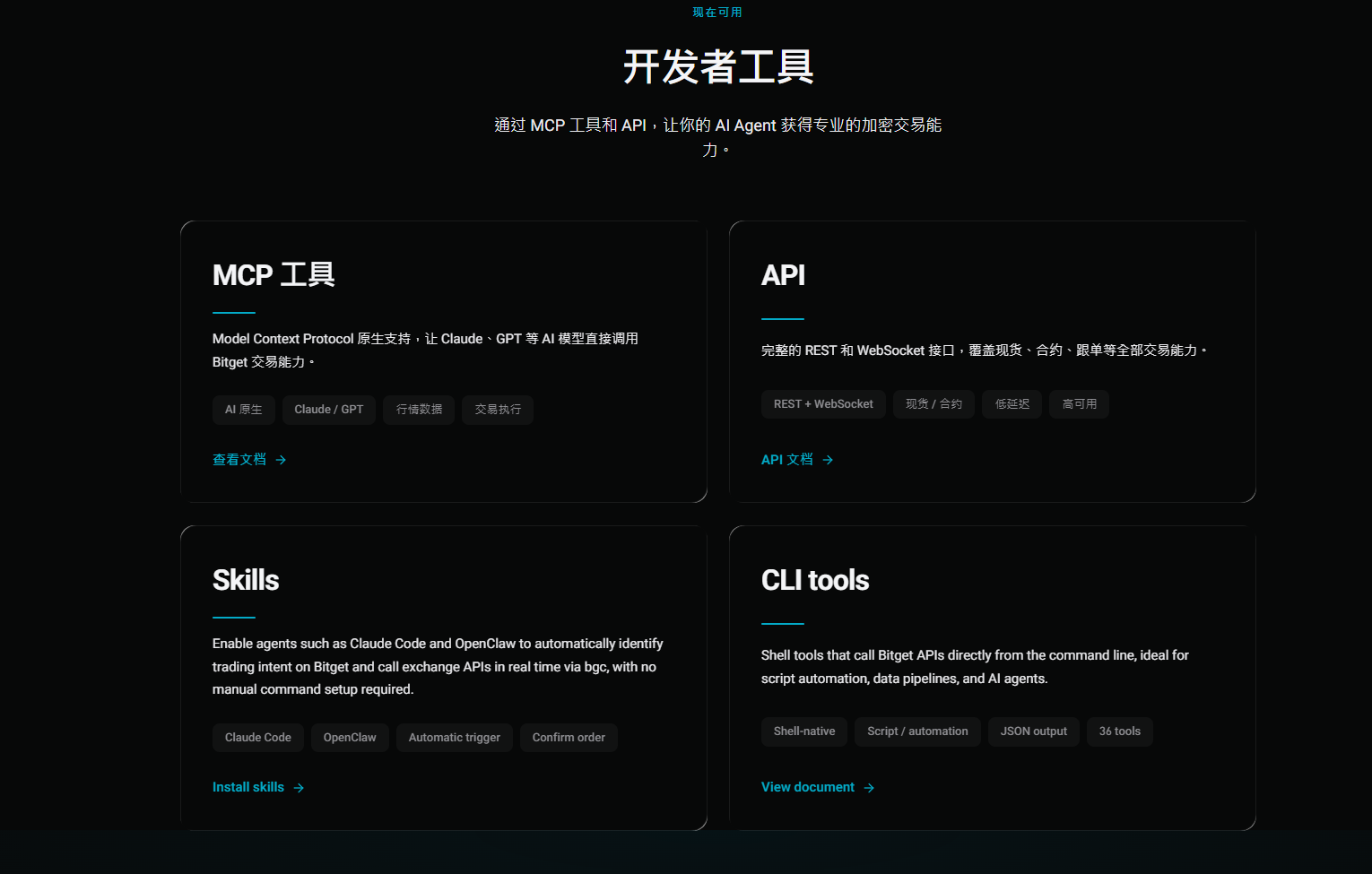
It offers four layers of capabilities from shallow to deep:
API is the atomic-level interface call, the highest barrier, requiring programming and key management;
MCP acts as a "universal interface," allowing external AI applications to directly read Bitget's data and execute operations;
CLI is geared towards developers, supporting direct terminal command line calls to all APIs;
Skills are the core of this upgrade, essentially encapsulating "business modules." Through Skills, the originally rigid API code is transformed into skills that AI can directly call (such as querying rates, analyzing candlestick charts, monitoring, and ordering), allowing AI to achieve a leap from "intent understanding" to "action execution."
Bill used a USB drive as a very intuitive analogy: "A USB drive itself has storage skills for saving, reading, and writing, but to make it work, you need a USB interface to connect devices, which is equivalent to an MCP. Simply having an interface isn't enough; you also need storage and cooperation from various protocols to complete a full interaction. This entire combination constitutes a Skill."
However, Agent Hub still poses a barrier for ordinary users.
Therefore, on March 14, Bitget launched GetClaw, an AI trading assistant based on Telegram, which is ready to use right out of the box without any installation required. Users can enter through a link, log in to their accounts, and use it, with the platform bearing the cost of the large model calls, leaving users completely unaware. Bill summarized it in one sentence: "The general user is recommended to use GetClaw, which is a fully assembled tool that can be played with immediately; professional players are recommended to use Agent Hub, selecting suitable Skills to build their castles, like playing with Legos."
These three products form a clear progressive relationship: GetAgent refined the underlying MCP capabilities which were opened to the outside through Agent Hub, and these capabilities were then embedded in GetClaw, lowering the usage barrier to the minimum. From chatbots to developer tools to one-click products, Bitget’s AI product line covers the entire user spectrum from geeks to novices.
"Just say a word to monitor the market," how AI trading truly changes everything
The product architecture is just a framework; what truly excites users is the transformative experience that AI brings to specific scenarios. In communication with Bill, one recurring keyword is "threshold."
The traditional trading process is a long chain: acquiring information, making analysis and decisions, placing orders, monitoring the market, reviewing outcomes; each link relies on manual operation. If users want to execute conditional trades or quantitative strategies, they either have to write their own programs to adjust APIs or configure a set of complex parameters on the platform.
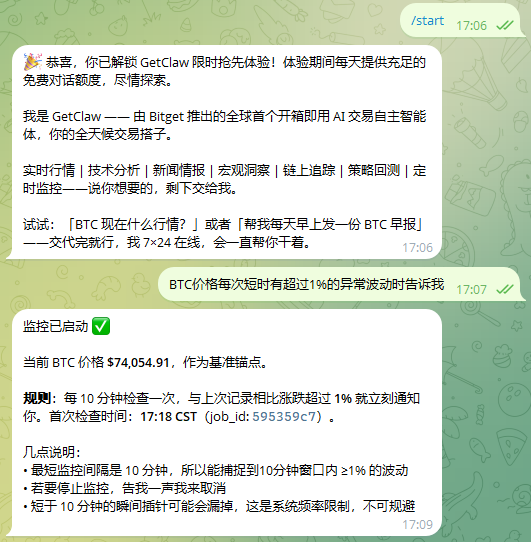
In Bill's view, this is precisely where AI’s value lies: “These functions can be achieved without Skills or GetClaw; programming will do. But the problem is, programming is simple for programmers but poses too high a barrier for ordinary users. Today, what we are doing is allowing users to achieve the same kind of results just by saying a word."
He provided a specific example: if a user says, "When Bitcoin drops by 3% within a minute, help me increase my position by 50%," the system behind will automatically turn this into a scheduled task that actually requires completing three things:
- Real-time monitoring of Bitcoin prices
- Calculating the price difference every minute
- Once conditions are met, immediately execute the position increase operation
This kind of logic, once only possible for programmers, can now be completed by anyone just saying a word.
Less than 40 hours after GetClaw went live, market monitoring reminders became the most explosive use case. This is not surprising; on traditional platforms, users need to understand various indicator parameters to configure monitoring alerts, "it might take half a day and still not work." Now, even for a complex monitoring logic involving multiple indicators like MACD or CCI, users can describe their needs in natural language, and the system can help achieve it.
However, Bill believes that the true transformation of AI monitoring isn't just "can do it," but also "can be tuned." "On traditional platforms, if the configuration isn’t done well, users might just give up, but now you can tell it 'this is wrong, reflect on how to improve,' and tweak it until satisfied." This kind of continuously iterative interactive method is a huge satisfaction for the large long-tail user group.
In the traditional stock market, the proportion of quantitative trading is increasing, and in the relatively mature U.S. market, it can even exceed 70%. Ordinary retail investors face institutional opponents competing at microsecond levels, with almost no chance of winning. Bill summarizes AI trading’s significance as a form of "equal opportunity": “Bitget's vision in the AI field is to enable 100 million users to stand alongside Wall Street,” in other words, to let them reach the trading logic and execution capabilities of top traders. In the past, something was thought of but could not be done; today, as long as one can think of it, it can be done.
The four locks of trust, safety boundaries when AI operations involve real money
When AI transitions from "giving advice" to "executing for you," the power of the functionality is not the biggest challenge; trust is. In Bill's view, it cannot be stressed enough: "The biggest concern for ordinary users is 'is it safe to use it?' This trust must be firmly established. Once security issues occur once or twice, no one will use it."
Based on this core concern, Bitget designed a four-layer isolation system.
- The first layer is identity isolation, accurately identifying user identity at each conversation
- The second layer is memory isolation, ensuring complete isolation and confusion between different users' conversation memories, protecting personal privacy from leaks
- The third layer is permission control, regulating what data and tools can be called based on user roles
- The fourth layer is credential and fund isolation, where API Keys are limited to triggering use, and transactions are executed within a sub-account sandbox
The sub-account sandbox mechanism is a pragmatic design. Bill provided an example: "For instance, if the main account has $1,000, the user can only transfer $50 to the sub-account for AI operation, significantly making the risk controllable." This means even if AI makes a wrong judgment, the risk exposure is strictly controlled within the user’s preset limits.
This safety-first approach is also reflected in Bitget’s attitude towards the Skills market. Currently, all Skills are developed and maintained by the official team, and third-party access is not open. Bill's explanation for this is straightforward: “If we open the Skill Market to let more people participate in the construction, it will inevitably cause security issues. For example, if a hacker says, 'I'll also put one in for you,' and the user incurs a loss, then that becomes inappropriate. We prefer to be cautious; rather not have it than risk losing all the money.” “After all, in the asset market, making quick money cannot compare to surviving longer.”
The caution shown by OpenClaw serves as a reasonable example of this wariness. It runs on personal computers in an almost unrestricted manner; while it excites, it has also spawned an absurd new industry, "helping you cleanly uninstall the lobster" has itself become a profitable business.
At the large model call level, Bitget initially chose for the platform to bear the costs rather than letting users configure Tokens themselves. On one hand, this is for safety considerations; on the other, it’s due to technical reasons. "Our Skills and MCP are deeply optimized for various built-in large models. If users casually switch to other models, the effect will be greatly diminished." Currently, the platform offers every user a $10 daily free call quota, which will be adjusted based on market feedback.
80% can be done, but 20% of decisions still rely on humans
When discussing the realistic capabilities boundaries of AI trading, Bill admits the reality is not optimistic: "Now, there are people online giving AI $100 to earn $1,000, only to find that such rough operations have a very high probability of losing everything."
AI trading's capabilities today cannot guarantee that users will earn money. Bill summarizes the current real state with the "80/20 principle": in a complete trading process (which may involve 100 tasks), AI can efficiently complete 80 complex tasks, such as information organization, real-time monitoring, conditional execution, and data review. However, the true decisions that determine profit and loss, the 20 core ones, AI still cannot accomplish.
Last year, Bitget held a playful AI trading competition to test the boundaries of AI capabilities, and the results provided a vivid footnote: many AI strategies ultimately ended in losses. The reason isn't complicated; AI has no emotions—this appears to be an advantage, but it also means it cannot respond to extreme events like "a sudden war." Bill mentioned that previously, when AI was extensively used in the U.S. stock market, abnormal spikes and drops occurred.
“Today, it is more about being a high-level assistant, similar to the transition from automatic driving L1 to L5.” Bill uses this analogy to position the current stage of AI trading development. Trends indicate that AI capabilities are indeed conquering residual challenges one by one, but when it comes to long-term creativity and empathetic judgment in extreme situations, machines still have significant bottlenecks.
However, Bill also provided a relatively optimistic judgment: “The technical closed loop around fully automated trading may be basically achieved next year, but that doesn’t mean it can guarantee continuous profitability.” In other words, there is still considerable distance between "can run" and "can earn."
From trading tools to "AI account operation system," the ultimate vision of Bitget
Since AI cannot completely replace human traders in the short term, where is Bitget's AI strategic endpoint? Bill provided answers from three dimensions.
The first dimension is "panoramic trading," which echoes Bitget's previously proposed UEX (Universal Exchange) strategy. Not just cryptocurrency, with the advancement of asset tokenization, traditional financial categories such as gold, silver, and US stocks are also being integrated. Bitget wishes to help users complete all-category trading operations on one platform, "enabling users to possess the all-category coverage ability of Wall Street traders."
The second dimension is the expansion of a global ecosystem. Combining the capabilities of Bitget Wallet, AI will be introduced into Web3 payments and global commercial scenarios, lowering the operational thresholds for cross-border trading and payments.
The third dimension, and also the direction Bill describes most vividly, is to build a "long-term account operation system" based on Bitget. The core of this concept is to establish a "high-trust fund execution layer," where multiple Agents will work together in the future to assist users in various aspects. The foundation supporting all this will be a "long-term memory system" that spans across platforms and scenarios.
In Bill's description, this memory system will analyze and integrate users' past trading habits, historical operations, and even small behaviors within the app, forming a deep personal profile. “Ensuring that users' trading logic remains consistently coherent across different platforms and scenarios rather than fragmented experiences.” This capability for continuous learning and adaptation is fundamentally different from one-time tools.
He provided a very everyday analogy to explain this gradual trust process: “Just like when you first buy a domestic robot, you let it vacuum, and after using it for a while and gaining trust, you are willing to let it take on more tasks.” AI needs to first prove its reliability in small tasks and then gradually gain more permissions and trust, with the ultimate goal of "growing with you, accompanying your asset appreciation."
From GetAgent to Agent Hub to GetClaw, Bitget's AI products have completed a leap from chatbots to task execution layers in less than a year. The intense layouts from major exchanges also indicate that AI trading is no longer an optional direction but a fundamental capability for future competition.
However, from the current reality, AI is better at replacing the "physical labor" in trading rather than the "intellectual labor." 80% of complex tasks can be delegated to machines, but the 20% core judgments that determine profit and loss will likely still need to be made by humans. Technology can lower the entry threshold for trading but cannot completely eliminate the risks of trading.
AI has given everyone access to Wall Street's toolbox, but the toolbox contains both opportunities and reverence.
免责声明:本文章仅代表作者个人观点,不代表本平台的立场和观点。本文章仅供信息分享,不构成对任何人的任何投资建议。用户与作者之间的任何争议,与本平台无关。如网页中刊载的文章或图片涉及侵权,请提供相关的权利证明和身份证明发送邮件到support@aicoin.com,本平台相关工作人员将会进行核查。


