On April 9, 2025, the S&P 500 surged 9.52% in a single day, marking the largest increase since 2008. The reason was not any favorable policy announcement, but rather Trump announcing the implementation of reciprocal tariffs that morning, only to suddenly declare a 90-day suspension at noon.
This was not a coincidence. From that day on, Wall Street named this pattern with an acronym, TACO, which stands for Trump Always Chickens Out. Over the past 14 months, this pattern has repeated at least 12 times. Each time there was a threat, there was a retreat, and each time the market rebounded. However, the incident on March 23 regarding Iran indicated that this once highly profitable trading strategy was failing.
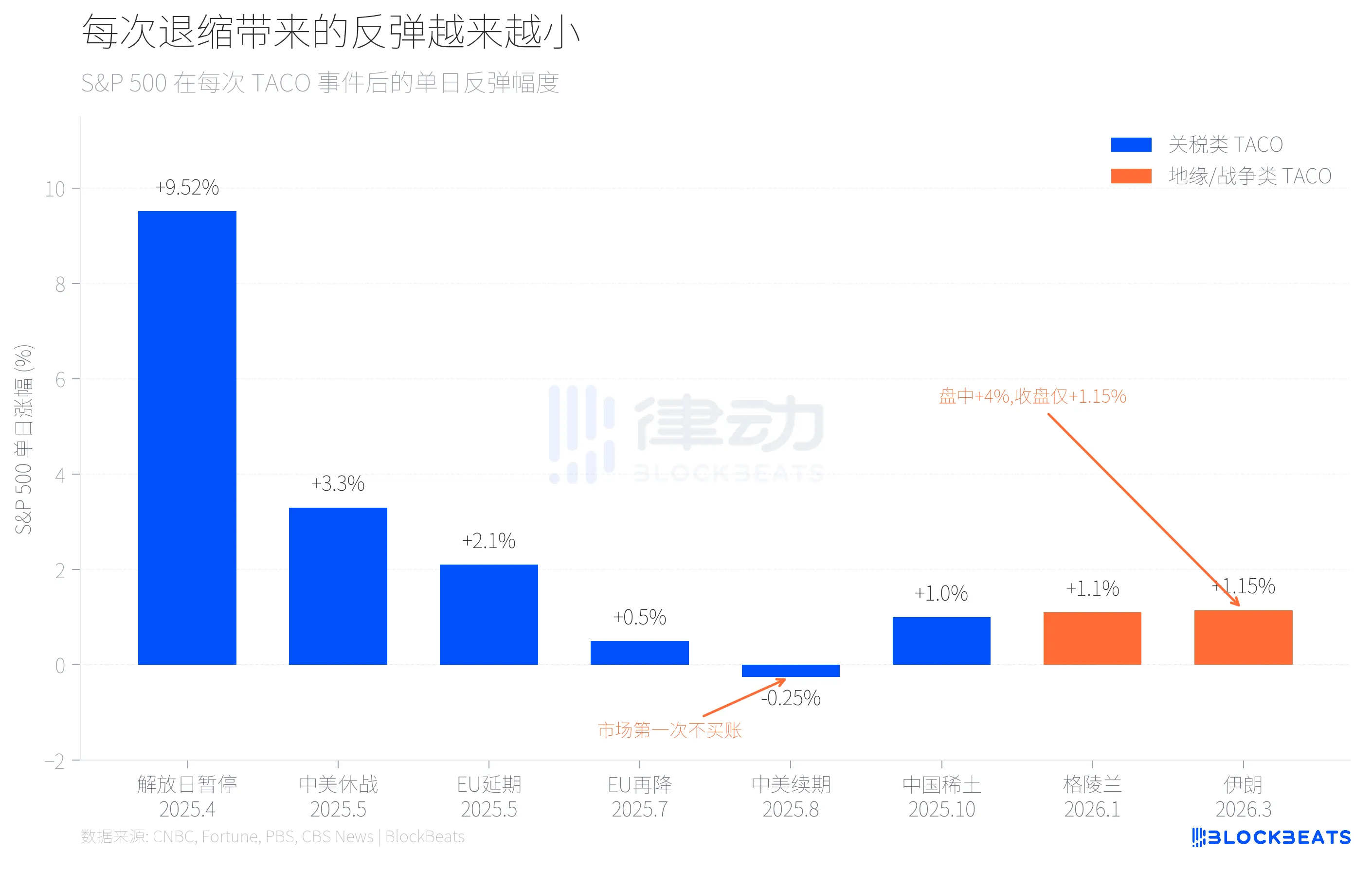
According to CNBC, the increase on April 9 was the third-largest single-day gain since World War II, with the Nasdaq soaring 12.16%, a record since 2001. The Dow Jones index rose by 2,962 points in a single day. FT columnist Robert Armstrong first used the acronym TACO on May 2, a month later. He wrote that the U.S. government's "tolerance for market and economic pressure is not high, and they quickly back down when tariffs cause pain."
That was the golden age of TACO trading. The logic of operation was extremely simple: every time Trump made harsh comments on Truth Social, the market would crash, and smart money would buy in. When the retreat news came out, they would sell for profit. The strategy was effective because the time gap between the crash and the rebound was very short, usually no more than a week, and sometimes only a few hours.
On May 12, a truce was reached between China and the U.S., with tariffs reduced from 125%/145% to 10%/30%, and the S&P 500 turned positive the next day. On May 25, Trump threatened to impose a 50% tariff on the EU, the market dropped, but two days later he announced a delay until July 9, and the S&P 500 rebounded by 2.1%. When asked about the term TACO, Trump called it a "malicious question," retorting, "Isn't this called negotiation? They came to the table because I added the 50% tariff." Vital Knowledge analyst Adam Crisafulli summarized, "Investors are becoming increasingly reassured about the seriousness of tariff threats."
But the returns were diminishing.
On July 11, 2025, the same EU tariff was reduced from 50% to 30%, and the market hardly reacted. On August 12, when the China-U.S. truce expired, Trump renewed it for 90 days as expected, and UBS economist Paul Donovan's comment was just one sentence, "The market anticipated this." The S&P 500 closed down 0.25%. According to Fortune, this was the first complete failure of the TACO trade. On October 10, Trump threatened to impose a 100% (totaling 130%) tariff on rare earths from China, and the S&P 500 plunged 2.7% that day. Two days later, he posted "Don't worry about China" on Truth Social, and the market futures rebounded by about 1%. Then in November, the U.S. and China quietly extended the truce agreement for another year. The market had hardly any reaction.
JPMorgan CEO Jamie Dimon expressed a deeper concern during this period, stating, "I think it's right for him to back down, but unfortunately, there is complacency in the market." He pointed out the core paradox of TACO trading: when the market treats each crash as a buying opportunity, the threats themselves lose their effectiveness as negotiation chips.
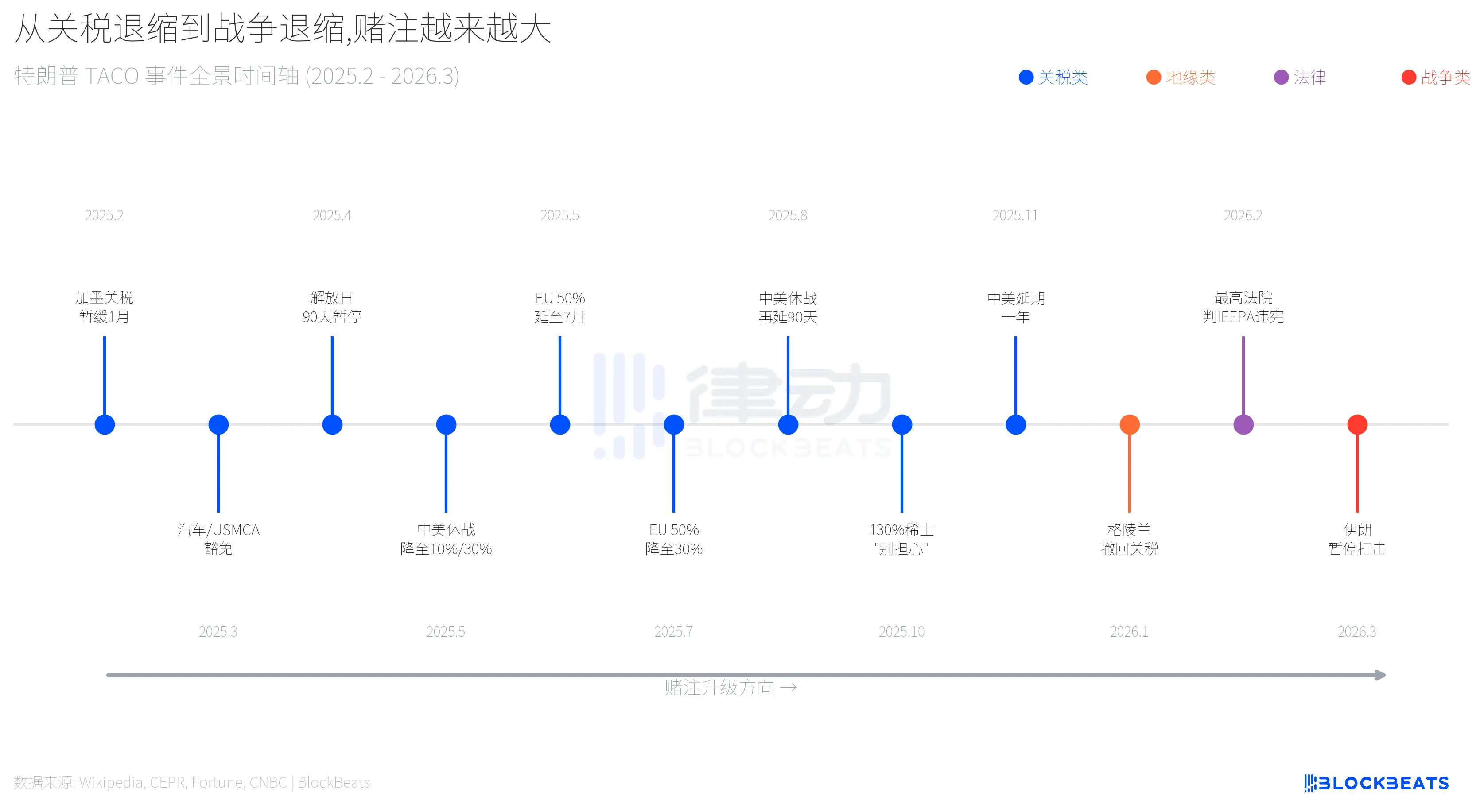
Over the 14 months, the stakes of TACO escalated from tariff increases to geopolitical issues, and then to war.
The TACO of 2025 was entirely centered around tariffs. Postponement of U.S.-Mexico tariffs, auto exemptions, suspension of D-Day, China-U.S. ceasefire, EU delays, "don't worry" on rare earths. These retreats had one common feature: Trump could decide it all alone. A post on Truth Social, tariffs suspended, the market rebounds.
In January 2026, the stakes changed. According to CNBC, Trump threatened to impose a 10% tariff on eight NATO countries before the Davos Forum, pushing Denmark to make concessions on Greenland. The S&P 500 dropped 2.1% that day. The next day he announced a "framework agreement" with the NATO Secretary-General, retracting the tariffs, and the Dow rebounded by 580 points. However, that so-called "framework agreement," according to CNN, was essentially just a rehash of the U.S. military presence agreement in Greenland that had existed since 1951.
On February 20, the Supreme Court ruled 6 to 3 that the IEEPA tariffs were unconstitutional, with Penn-Wharton estimating it involved about $175 billion in tariff revenue. Trump, within hours, used Section 122 to sign new 10% global tariffs. The legal foundation of TACO was stripped away, but he did not stop.
On March 23, the stakes escalated to the highest level.
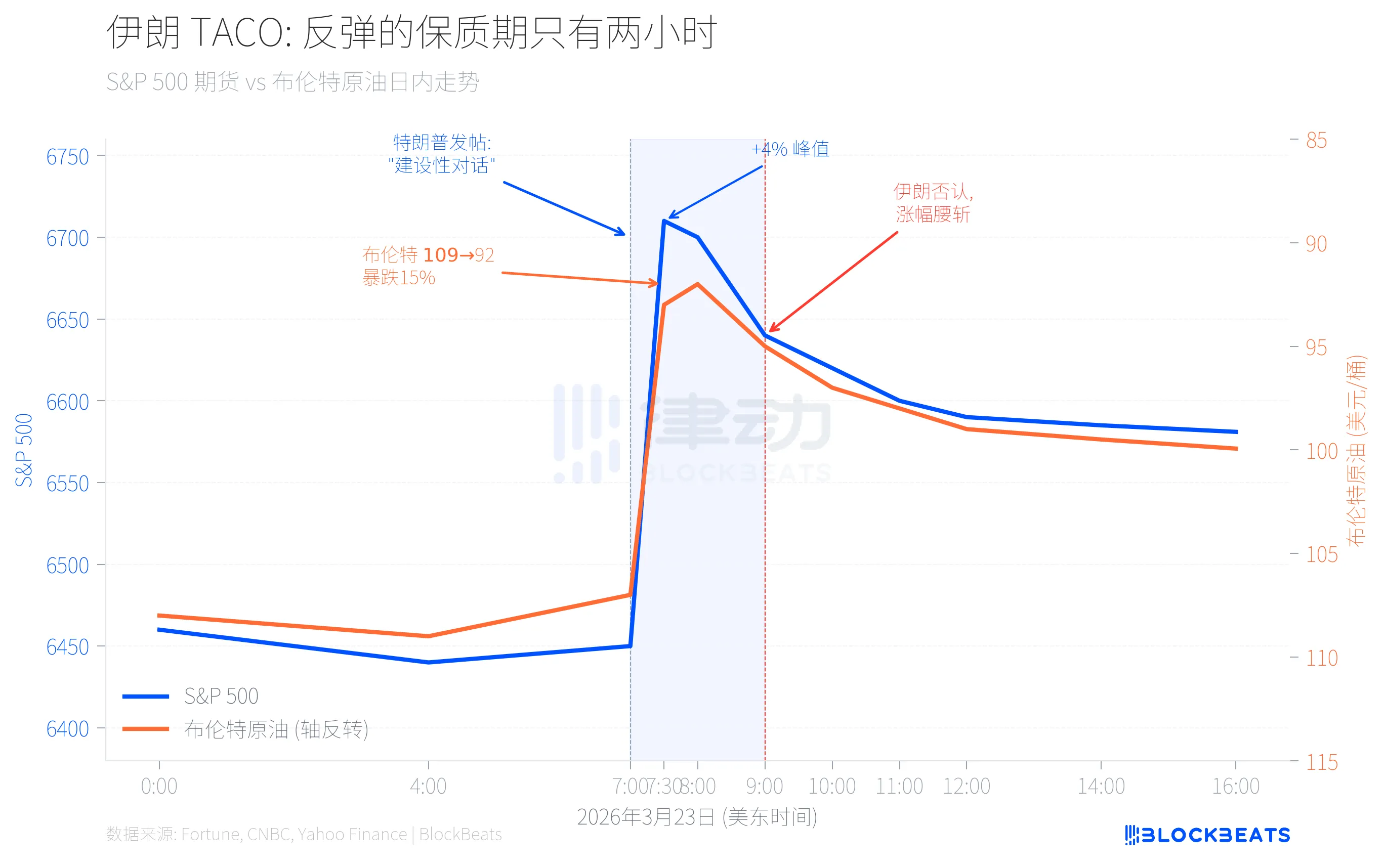
According to Fortune, Trump posted on Truth Social around 7 a.m. Eastern Time, claiming that the U.S. and Iran had engaged in "very good constructive dialogue" and ordered the Pentagon to suspend strikes on Iran's power grid and energy facilities for 5 days. S&P 500 futures soared nearly 4% from their lows within minutes, adding $1.7 trillion in market value in an instant. Brent crude oil dropped from $109 to $92, a decline of about 15%.
Then Iran denied the existence of negotiations.
According to BNN Bloomberg, Iranian state media quoted a "senior security official" stating that the dialogue never happened and was merely a tool to manipulate the market. The gains were halved within two hours. The S&P 500 ultimately closed up 1.15%, and Brent crude oil rebounded to $99.94. Oil analyst Rory Johnston pointed out, "The baseline expectation was that Trump would try to back down and declare victory, but it's not that simple to actually bring down oil prices."
This was a transformative moment for the TACO model. The retreats of the tariff era were unilateral; a post by the president could fulfill them. The retreats of the war era required cooperation from the adversary. When the adversary denies, retreat becomes a lie. And while Brent crude oil fell from $109 to a mid-day low of $92, it still closed at $99.94. The actual supply risks in the Strait of Hormuz do not disappear with a single post.
From +9.52% on April 9 to +4% during the day on March 23, but closing only at +1.15%. The TACO trade has completed a full cycle from high profits to failure in 14 months. It is not that Trump is no longer retreating; it is that the retreat itself has already been priced in by the market. When "retreat" becomes a consensus expectation, it is no longer a retreat but noise.
免责声明:本文章仅代表作者个人观点,不代表本平台的立场和观点。本文章仅供信息分享,不构成对任何人的任何投资建议。用户与作者之间的任何争议,与本平台无关。如网页中刊载的文章或图片涉及侵权,请提供相关的权利证明和身份证明发送邮件到support@aicoin.com,本平台相关工作人员将会进行核查。


