Written by: Cointelegraph
Translated by: AiddiaoJP, Foresight News
During the war between the United States and Iran, Bitcoin has been one of the strongest performing assets. However, due to the "out of control" state of the bond market, the upward momentum of Bitcoin is showing signs of exhaustion.
Key points:
- If the US-Iran war continues indefinitely, the yield on US benchmark government bonds could rise by 200 basis points.
- Historical experience suggests that oil-related conflicts often drive up inflation and suppress risk appetite, leading to speculation that Bitcoin's price may fall below $50,000 in 2026.
Oil supply shocks could push US government bond yields above 5%
Since the US and Israel launched attacks on Iran on February 28, the benchmark 10-year US government bond yield has climbed to about 4.42%, reaching a new high in nine months.
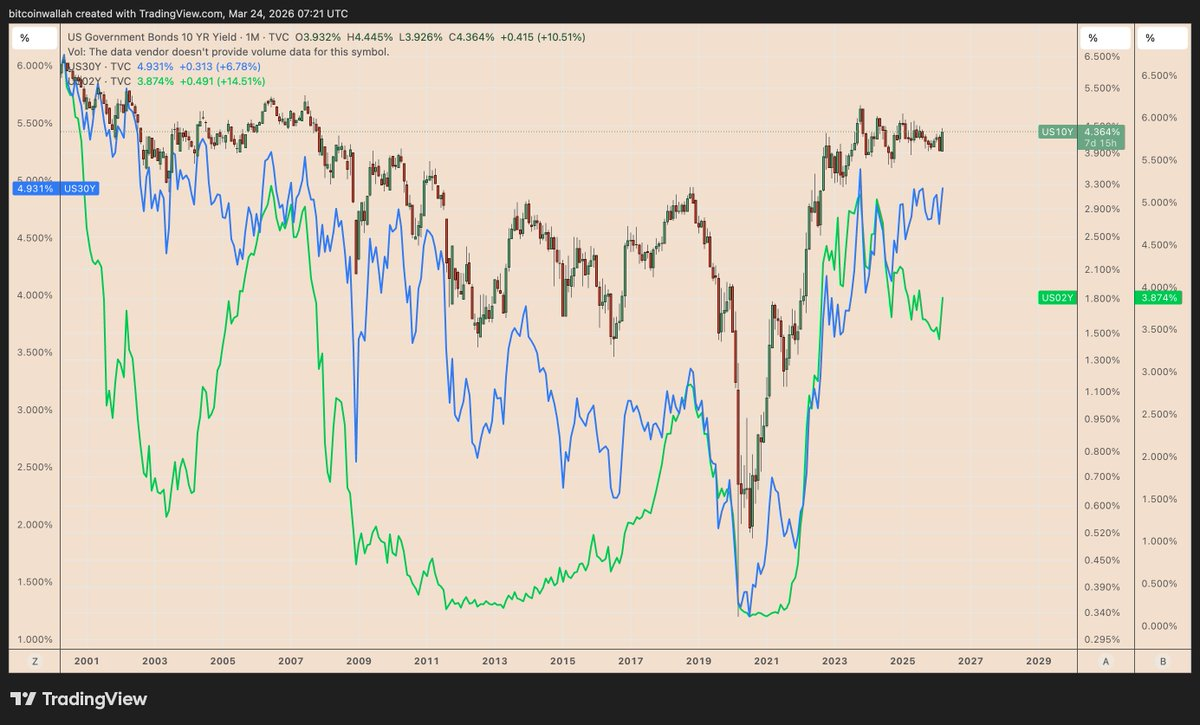
Monthly performance of US 2-year, 10-year, and 30-year government bond yields. Source: TradingView
The 30-year government bond yield rose to about 4.97%, while the 2-year government bond yield also climbed to a range of 3.95% to 3.98%.
Affected by the war, oil prices have surged, intensifying market concerns over rising inflation, thus pushing bond yields higher. In this context, the market generally expects that there will be no interest rate cuts in 2026.
US President Donald Trump announced a five-day suspension of operations, temporarily easing market concerns about immediate strikes on Iranian energy facilities. However, as Iran denied engaging in any negotiations and cross-border attacks continued as of Tuesday, the conflict situation remains effectively uncontrolled.
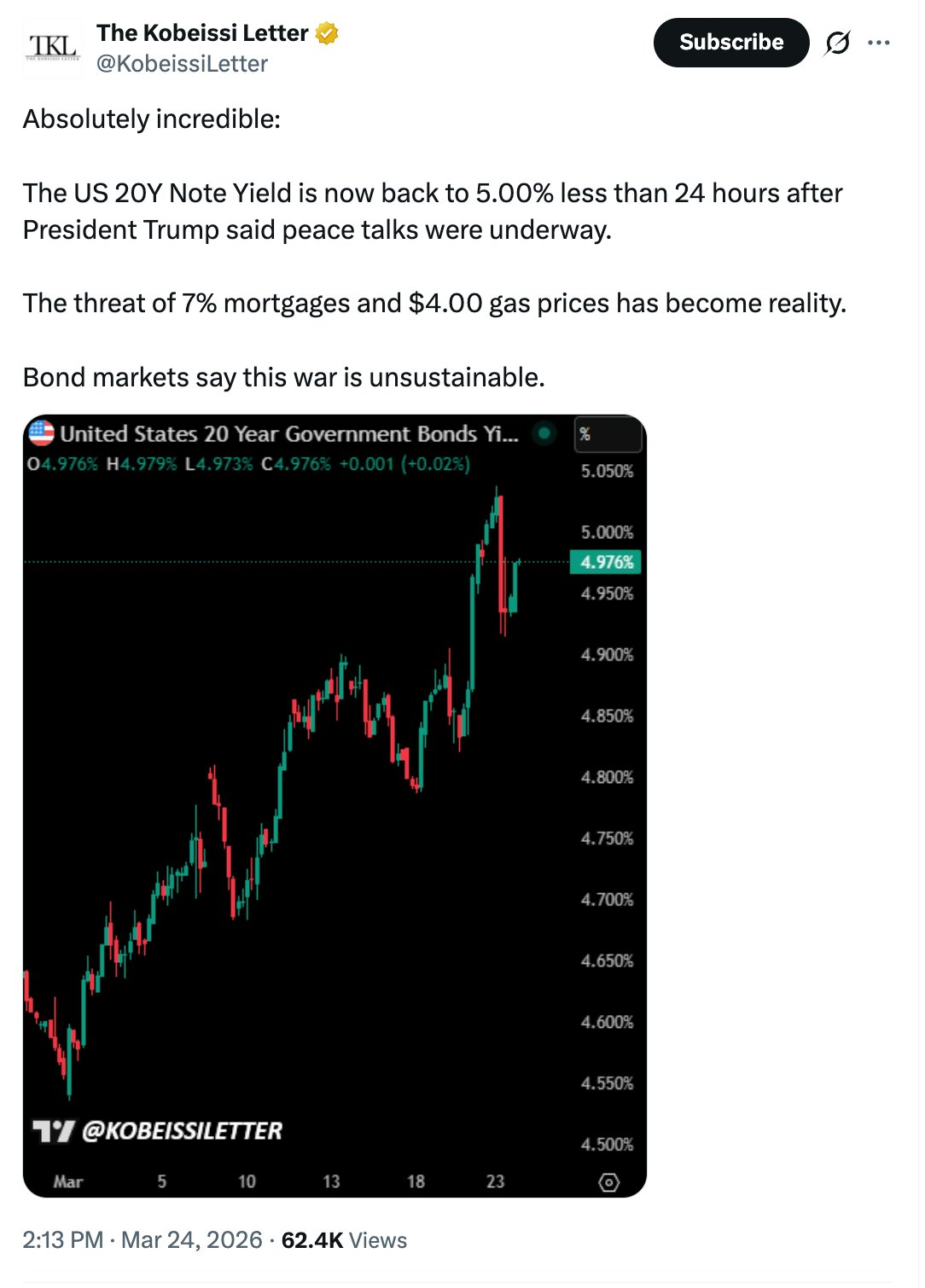
Source: X
Market observers are worried about the potential for further increases in US government bond yields. Technical analysts further point out that if the 10-year bond yield breaks the current symmetrical triangle pattern, it could rise by 200 basis points to reach 6.4%.
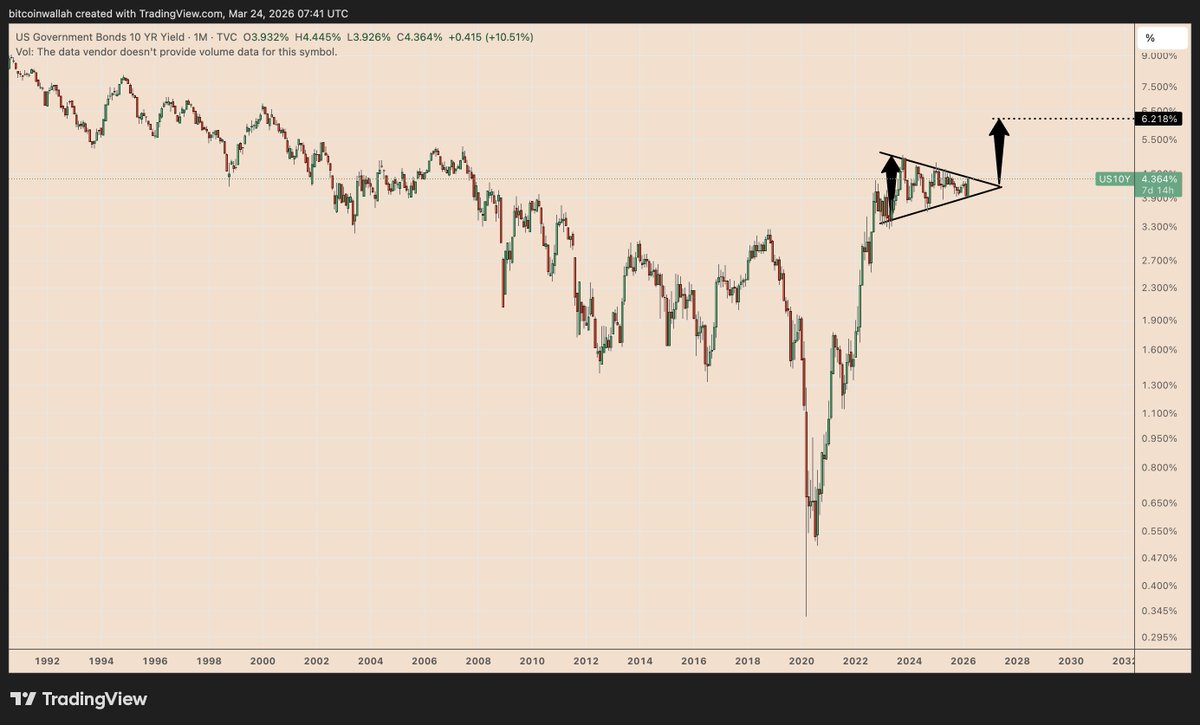
Monthly chart of US 10-year government bond yields. Source: TradingView
An increase in yields will lower the opportunity cost of holding risk assets such as stocks and Bitcoin. If Bitcoin continues to exhibit characteristics of a risk asset, once the 10-year government bond yield breaks above 5%, it may trigger selling pressure in the Bitcoin market.
Historical cases of oil-related shocks
Historically, short-term conflicts related to oil typically trigger dramatic but temporary fluctuations in government bond yields and the stock market, while long-term supply shocks may drive yields to rise continuously and put sustained pressure on the stock market.
During the Yom Kippur War in 1973 and the Arab oil embargo, government bond yields initially increased slightly, then rose significantly alongside worsening inflation, while the S&P 500 index fell by about 41% to 48% during the "stagflation" phase.
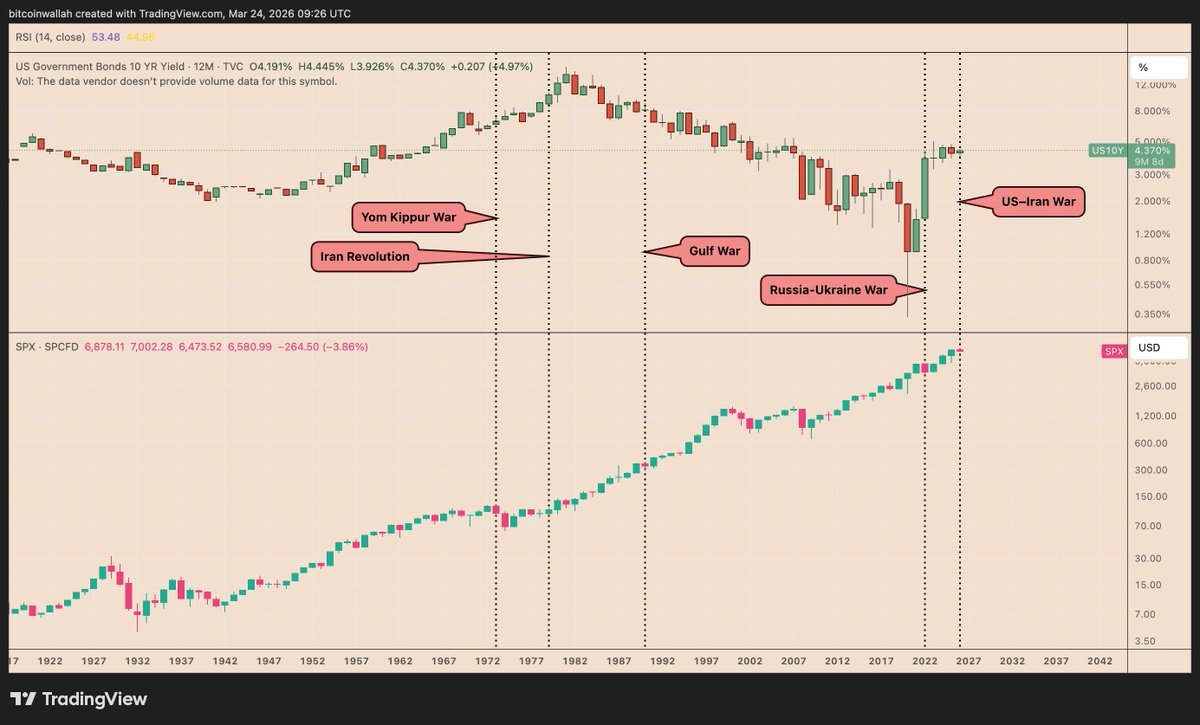
Annual chart of US 10-year government bond yields and S&P 500 index. Source: TradingView
During the Iranian Revolution in 1979, the bond market reacted more strongly, with the 10-year bond yield rising by about 150 to 200 basis points in the following year, while the stock market's correction was relatively mild.
In the Gulf War from 1990 to 1991, the 10-year government bond yield rose by about 50 to 70 basis points, while the S&P 500 index fell by about 16% to 20%, and then rebounded after the conflict was controlled.
After the outbreak of the Russia-Ukraine conflict in 2022, there was also an instance of rising bond yields and a short-term decline of 5% to 10% in the S&P 500 index.
The current conflict between the United States and Israel with Iran seems to be in the early stages of the historical patterns mentioned above. If the conflict continues to escalate and oil prices remain high, bond yields may rise further, putting risk assets under new downward pressure.
Bitcoin still maintains a high correlation with the S&P 500 index. Therefore, unless the conflict situation rapidly eases, Bitcoin's price may face greater downward pressure.
What level might Bitcoin's price reach?
From a technical analysis perspective, if Bitcoin's price falls below the current bearish flag formation, it could further decline to $50,000 or even lower levels in the coming months.
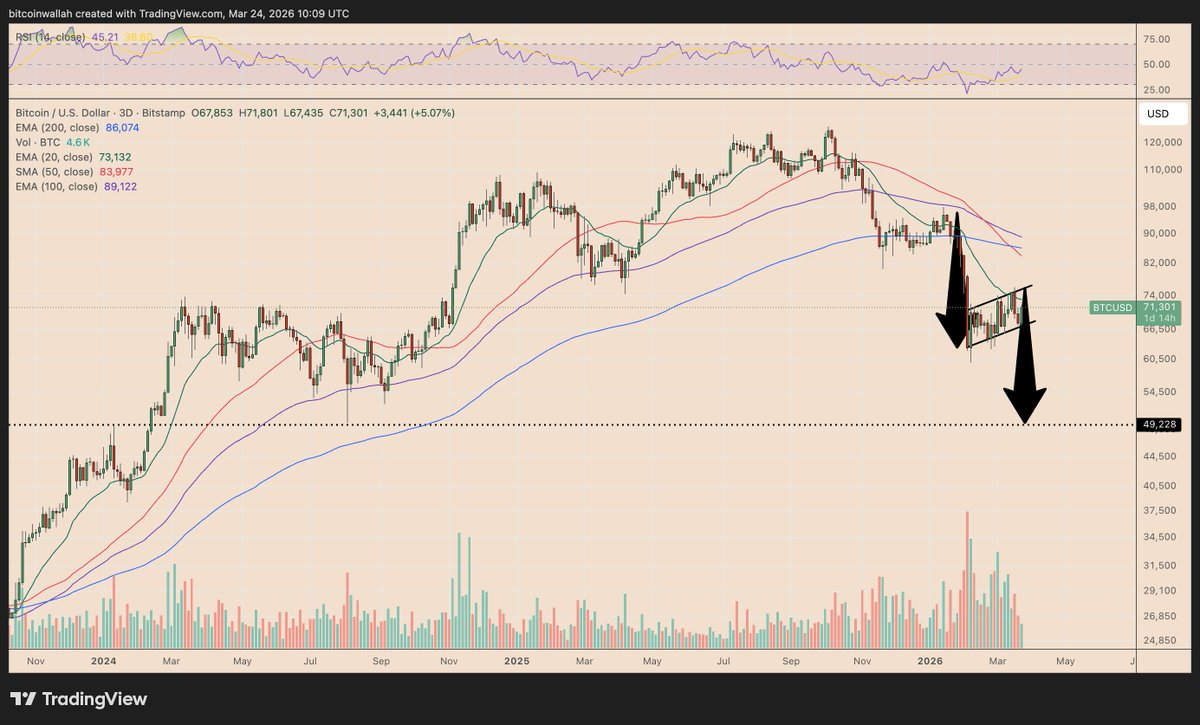
Bitcoin / USD three-day price chart. Source: TradingView
The above technical expectations are generally in line with trading data from the prediction market. Currently, traders expect a 70% chance of Bitcoin falling below $55,000 in 2026 and a 46% chance of it falling below $45,000.
Arthur Hayes, co-founder of BitMEX, stated that if the US-Iran war continues indefinitely, it may force the Federal Reserve to adopt an accommodative monetary policy, which would be favorable for Bitcoin.
He noted: "The longer the conflict lasts, the greater the likelihood that the Federal Reserve will print money to support the US war machine." He further added:
"When the central bank starts printing money, I will choose to buy Bitcoin."
免责声明:本文章仅代表作者个人观点,不代表本平台的立场和观点。本文章仅供信息分享,不构成对任何人的任何投资建议。用户与作者之间的任何争议,与本平台无关。如网页中刊载的文章或图片涉及侵权,请提供相关的权利证明和身份证明发送邮件到support@aicoin.com,本平台相关工作人员将会进行核查。


