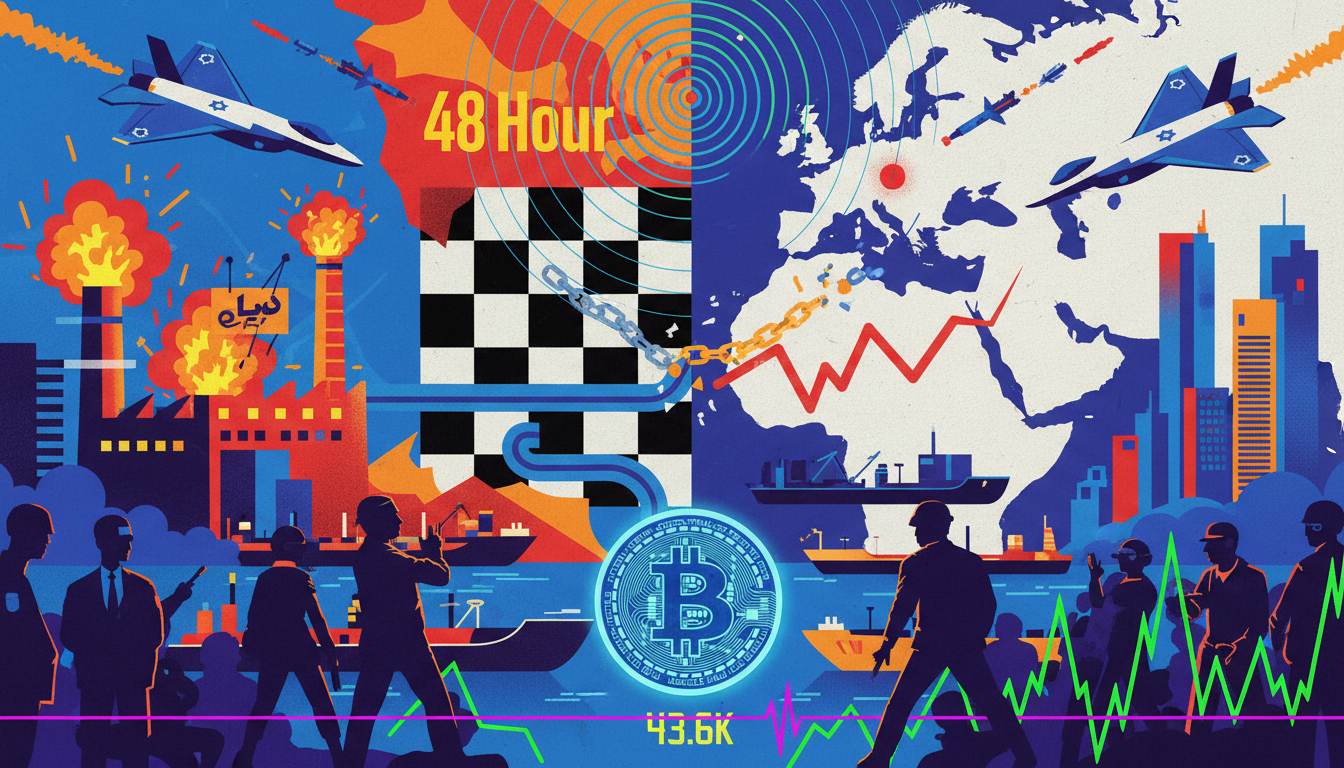
On March 25, 2026, Eastern Eight District Time, both the United States and Iran released signals of "approaching the end" and "conditional ceasefire" regarding military actions in the Middle East, with the battlefield narrative shifting from a full-scale escalation to a controllable de-escalation. At this juncture, the market began to retract the worst-case scenarios of conflict escalation, and the sentiment and price direction of Bitcoin and other assets perceived as safe havens also saw a turning point: the risk premium accumulated under the shadows of confrontations and sanctions gradually dissipated as expectations of a "soft landing of the conflict" rose. Meanwhile, the on-chain dollar volume continued to expand – marking the stablecoin market cap on the HyperEVM network surpassing $1 billion, a new mainline of "stablecoin expansion and traditional financial cryptoization in parallel" is forming, where the question facing liquidity is no longer just "should we hedge," but rather after geopolitical risks are priced by the market as secondary contradictions, how liquidity will be reallocated among Bitcoin, on-chain dollars, and traditional assets.
Pause Button on War: Stalemate in the Washington-Tehran Game
On March 25, Speaker of the U.S. House of Representatives Mike Johnson stated that the U.S. military operations in the Middle East had "achieved their goals" and claimed that the current actions were "approaching the end." This statement effectively conveyed two signals to the market: first, that military escalation would no longer be pursued in the short term, and second, that the prior "hard deterrence" against Iran had accomplished its political objectives – using military buildup and strike actions as warnings to suppress Iran's further actions in the region. This "mission accomplished" phrasing leaves Washington with flexible room for withdrawal and provides a calming anchor for risk assets.
In contrast, the narrative released by Iran through official media is notably more assertive. Iranian officials emphasized that Iran had proposed clear conditions for a ceasefire and stated that "Iran will end the war according to its own determined timeline." This statement acknowledges the existence of ceasefire negotiations and conditional games while also emphasizing that "the pace of the war is under its control," refusing to fall into passivity in public opinion and diplomacy. This divergence in narrative constitutes a typical game pattern: Washington hopes to de-escalate the situation with "goals achieved, actions nearing end," while Tehran maintains deterrence and negotiation leverage through "ending the war on its own timeline."
In this context, geopolitical risks have shifted from "full escalation risks" to "expectations of controllable de-escalation." The market is no longer focusing on further military strikes but instead is assessing ceasefire conditions, adjustments to sanctions, the attitudes of regional allies, and other medium to long-term variables. However, this does not mean that risks have truly vanished – on one hand, details about military actions and actual loss information remain highly opaque, and any misjudgment or local conflict escalation may reignite risks; on the other hand, there have been no substantive concessions from either side on strategic issues such as nuclear, missile, and naval capabilities, and the remaining uncertainties continue to be a background noise that cannot be ignored in global asset pricing.
Decline in Hedging Sentiment: Bitcoin Returns from Wartime Premium to Pricing Normality
During the phase of escalating conflict, the U.S.-Iran confrontation combined with expectations of sanctions led to rising concerns in the market about potential liquidity disturbances in the traditional financial system and disruptions in cross-border payments, prompting some funds to once again use Bitcoin and other crypto assets as "digital gold" and "sanctions hedging tools." Money quickly flowed into the spot and derivatives markets, pushing up volatility and trading volume, making the short-term performance of Bitcoin more driven by news headlines rather than pure macro data or on-chain fundamentals. A typical risk-hedging cycle of "escalation of war – price increase – amplification of volatility" emerged.
After the signal of "military actions nearing end, goals achieved" was repeatedly cited on March 25, this hedging narrative began to marginally weaken. The direct consequence of the retreating risk premium is that the "geopolitical risk premium" embedded in Bitcoin's price was gradually discounted by the market, and bulls could no longer rely solely on war expectations to drive upward momentum; daily volatility reverted more to macro policies, regulatory progress, and ETF capital flows. Meanwhile, the trading structure underwent subtle changes: short-term hedging buy orders and trend-following leveraged funds opted to reduce positions or switch portfolios, while long-term allocation and quantitative trading resumed dominance as volatility converged.
On the asset allocation front, investors began to re-evaluate their risk budgets between gold, government bonds, and crypto assets. During the tense phase of the conflict, gold and short-term U.S. bonds often served as the first line of defense, while Bitcoin was viewed by some funds as a "systemic alternative" asset; as the conflict was priced as "controllable," hedging demand waned, and the attractiveness of gold and government bonds shifted from "lifesaving" to "a component of return/inflation-hedging portfolio," with Bitcoin also retreating from being a "geopolitical conflict hedging tool" to one of the "high-volatility asset baskets." The marginal weakening of the hedging narrative does not signify the disappearance of the Bitcoin narrative but rather its re-integration into a broader valuation framework encompassing macro liquidity, technology narrative, and institutional ETF dynamics.
$1 Billion New Battlefield: USDC Expansion on HyperEVM
As the flames of conflict cool and hedging sentiment ebbs, another narrative thread in the crypto market subtly amplifies – the combination of on-chain dollars and new public chain ecosystems. According to single-source data, the stablecoin market cap on the HyperEVM network has surpassed $1 billion, a significant numerical threshold: it indicates that, even amid geopolitical tensions, there are still continuous inflows of funds choosing to hold on-chain dollars on the emerging network, using it as infrastructure for future trading and earning strategies. While the specific sources of incremental growth are still challenging to fully dissect, it can be reasonably speculated that part of the funds comes from cross-chain migrations and new project incentives, while others are institutional and high-net-worth users testing positions around "new narratives + dollar yields."
In this localized battleground of HyperEVM, the dominance of USDC is particularly noteworthy. Single-source information indicates that USDC occupies an overwhelming share in the stablecoin structure of the network, effectively planting Circle's flag on the new high ground of on-chain dollars. The combination of market cap, liquidity, and compliance expectations further amplifies Circle's voice in the "on-chain dollar system": as long as developers and protocols build trading, lending, or yield strategies on HyperEVM, USDC naturally becomes the preferred settlement and collateral, and this structural advantage will continually accumulate over time.
As the war subsides, market risk appetite has rebounded, and the role of stablecoins is undergoing a subtle transformation: from being a "hedging tool" during the conflict (temporarily holding cash, avoiding regional banking risks) to a "transaction and earning hub" under expectations of peace (providing low-friction dollar liquidity for leverage, market-making, and strategies). In this process, USDC is no longer just "digital cash" but rather a liquidity hub between DeFi and CeFi. For funds, the question is no longer "should we hold USDC to avoid short-term volatility," but rather "on which chain, through which protocol to hold USDC, to obtain better returns/portfolio exposure."
Circle Valuation Presentation: Geopolitical Stress Test for On-Chain Dollars
Bitwise Chief Investment Officer Matt Hougan previously proposed an imaginative viewpoint: by 2030, Circle's valuation is expected to reach $75 billion (source of the viewpoint: Bitwise). The core assumptions behind this prediction include: on-chain dollars continue to expand as a global settlement medium; USDC continues to increase market share in compliance, institutional cooperation, and cross-border payment scenarios; and the integration of crypto-native applications and traditional financial infrastructures brings Circle network effects and fee models similar to "crypto version of Visa." This resembles a valuation presentation aimed at a ten-year cycle, linking USDC's growth trajectory to the digitalization trend of the global financial system.
The U.S.-Iran conflict provides a real-world pressure testing scenario: when threats of sanctions and uncertainties in cross-border payments rise again, the global demand for "programmable dollars, on-chain settlement" has not diminished, but rather in some regions has amplified. For economies with high sanction risks or weak financial infrastructures, on-chain dollars like USDC can bypass some traditional intermediaries, providing a more stable cross-border value transfer channel within the scope of compliance permissions. This attraction in the shadows causes "on-chain dollars" to gradually shift from speculative tools to functional assets, with their use motivations closely entangled with geopolitical dynamics and regulatory environments.
However, to realize the valuation narrative of "crypto version of Visa," Circle faces significant uncertainty from regulation. On one hand, the U.S. and other major jurisdictions are imposing increasingly stringent compliance requirements on on-chain dollar issuers, and any policy tightening could compress their global expansion speed; on the other hand, the USDC business itself needs to balance payment, settlement, reserve management, and compliance reporting, as high growth and strict regulation are not inherently compatible. In comparison to the $75 billion valuation outlook, Circle needs to continuously walk a tightrope between maintaining market share, expanding new scenarios, and meeting regulatory expectations, and whether it can truly evolve into "the Visa of the crypto world" will still depend on the dual games of policy environments and business execution capabilities in the coming years.
Wall Street Testing the Waters and Exchanges Introducing New Tokens: Funds Shift from Watching Wars to Selecting Tracks
Beyond macro and geopolitical risk narratives, traditional financial institutions and crypto platforms are quietly adjusting their product lines. Single-source information indicates that asset management giant Franklin Templeton has launched an ETF with crypto wallet functionality, attempting to build a smoother interface between traditional securities accounts and on-chain assets. This design concept is a typical "compliance shell + on-chain core" model: users hold assets within the familiar ETF framework but interact with public chains through wallets at the underlying level, reserving channels for larger-scale institutional and retail funds to enter the on-chain world in the future.
At the same time, Coinbase has included MEZO in its token roadmap, which the market views as a tentative bet on new narratives and new tracks. As a leading compliant exchange in the U.S., Coinbase's token listing roadmap often carries a "weather vane" significance; incorporating a particular asset into the roadmap not only provides expectations for its future trading depth but also sends a signal that "this track deserves mainstream attention." Amidst headlines flooded with war news, these listing updates can easily be drowned out by noise, but they essentially outline the path of funds transitioning from macro panic narratives to specific track choices.
Connecting Franklin Templeton's ETF innovation with the expansion of on-chain dollars on HyperEVM and Coinbase's token roadmap paints a clear migration pathway: as the market gradually shifts from "watching the progression of war" to "thinking about asset layout post-conflict," the focus begins to shift from simple hedging decisions to "which infrastructures will carry more liquidity in the next cycle." Traditional institutions are trying out crypto through product innovations, exchanges are capturing early narratives through new listings and roadmaps, while on-chain networks and stablecoins provide the underlying space to accommodate these funds.
From the Battlefield to On-Chain: Three Paths for the Next Wave of Fund Migration
Overall, with the de-escalation of the U.S.-Iran conflict, the weakening of geopolitical risk premiums and the return of risk appetite are reshaping the balance between Bitcoin and on-chain dollars as two main lines. Bitcoin has withdrawn from wartime hedging narratives, returning to the main stage of macro liquidity and institutional allocation; on-chain dollars like USDC, through the expansion of new networks like HyperEVM, are upgrading their role from "digital cash" to a central asset for trading and earnings. In this process, funds are no longer priced solely within the binary framework of "war and peace," but are beginning to seek more sustainable structural opportunities.
Looking at the potential directions of fund flows in the near term, at least three possible paths exist: first, some risk-averse funds may choose to flow back into traditional safe assets such as gold and high-rated government bonds after the conflict subsides, to lock in previous hedging profits and reduce portfolio volatility; second, some investors and institutions may allocate more budgets to on-chain dollars and related earning strategies, betting on the continued expansion of assets like USDC in cross-border settlement, DeFi interest rates, and new public chain ecosystems; third, more aggressive funds may take advantage of the waning hedging sentiment to increase exposure to high Beta crypto assets, viewing the easing of conflict as a starting point for a new narrative and style shift.
It is important to note that even if the current conflict shows signs of a "soft landing," the military situation may still fluctuate again due to localized friction, misjudgment, or political cycles, unverified information and sentiment drives can still create tail risks. In allocation and trading decisions, geopolitical factors should be viewed as long-term background variables rather than the only anchor: they will influence valuation discount rates and risk premiums but should not replace independent judgments about fundamentals, regulatory environments, and technological advancements. For participants in the crypto market, detaching from battlefield news and returning to on-chain data and institutional evolution itself may provide a more forward-looking perspective in the next wave of fund migration.
Join our community, let's discuss and get stronger together!
Official Telegram community: https://t.me/aicoincn
AiCoin Chinese Twitter: https://x.com/AiCoinzh
OKX benefits group: https://aicoin.com/link/chat?cid=l61eM4owQ
Binance benefits group: https://aicoin.com/link/chat?cid=ynr7d1P6Z
免责声明:本文章仅代表作者个人观点,不代表本平台的立场和观点。本文章仅供信息分享,不构成对任何人的任何投资建议。用户与作者之间的任何争议,与本平台无关。如网页中刊载的文章或图片涉及侵权,请提供相关的权利证明和身份证明发送邮件到support@aicoin.com,本平台相关工作人员将会进行核查。