Author: Adhi Rajaprabhakaran
Compiled by: Jiahua, ChainCatcher
On the evening of February 12, in an exchange that typically reacts mildly to sporting events, three NBA games suddenly ignited trading: the Dallas Mavericks against the Los Angeles Lakers, the Milwaukee Bucks against the Oklahoma City Thunder, and the Portland Trail Blazers against the Utah Jazz. During these three games, they produced over 13 million contract trading volume. ForecastEx is a prediction market operated by Interactive Brokers and regulated by the Commodity Futures Trading Commission (CFTC). It is a legitimate exchange with a formal license, but had never seen any significant NBA trading volume before that night.
I don't think ForecastEx created a miracle of customer acquisition overnight. It did not improve its product, launch a marketing campaign, or deepen its order book with more liquidity. What happened was quite simple: Robinhood directed its massive order flow to another exchange, specifically for that night of three NBA games.
Currently, Robinhood is the dominant retail distributor of prediction market contracts. When users open the Robinhood app, click on an NBA game, and place a bet, that trade is allocated to an exchange regulated by the CFTC for execution. For most of Robinhood's prediction market history, that exchange has been Kalshi. But users do not know this, and they do not care. Regardless of which exchange is behind the scenes, the interface is completely the same: the same app, the same buttons, the same odds. The exchange has become an invisible infrastructure.
A Sudden Migration of 35% Trading Volume
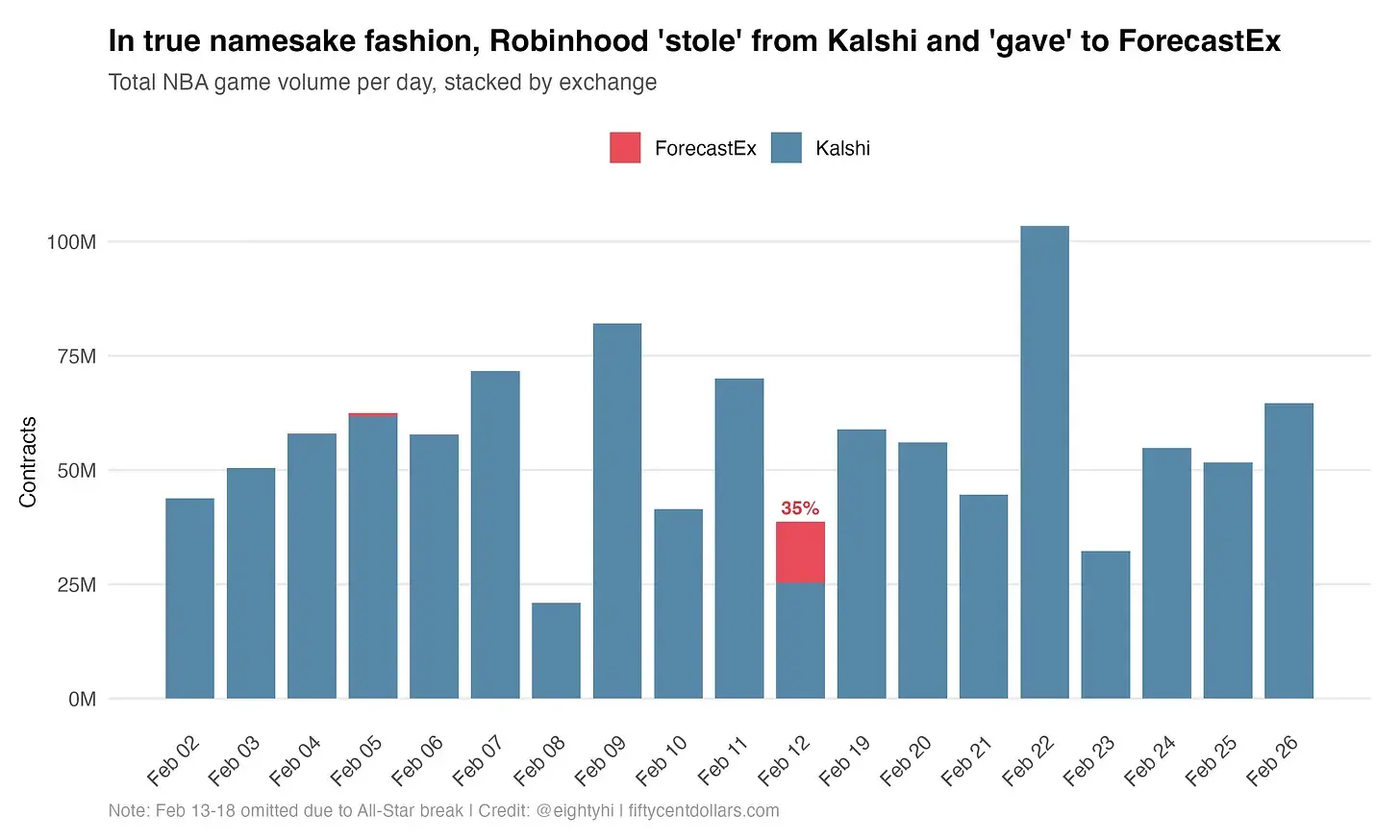
Each bar chart represents a day's NBA game trading volume, stacked by exchange. Blue represents Kalshi, while red represents ForecastEx. Except for February 12, every day is entirely blue, and on that day, 35% of the trading volume suddenly appeared on ForecastEx. Then everything returned to an all-blue state, as if nothing had happened.
The red portion on February 12 represents those three games: Mavericks vs. Lakers, Bucks vs. Thunder, Blazers vs. Jazz. Combined, they produced 13.4 million contracts on ForecastEx. Regardless of which exchange processed the trades, the user experience on Robinhood is the same: the same app, the same buttons, the same odds. Users cannot tell the difference at all. Because, for them, it truly makes no difference.
This is why the 35% figure is so important, as it is a relatively pure indicator of Robinhood's market share of NBA spread betting trading volume between these two exchanges. ForecastEx essentially had no naturally accumulated sports users, so it is reasonable to assume that every contract on ForecastEx that night came from Robinhood's orders.
Moreover, since Robinhood's interface is the same under any circumstance, these users placed bets at exactly the same frequency as they would on Kalshi. There is reason to deduce that about one-third of Kalshi's NBA spread betting volume in February came from Robinhood.
Robinhood controls where the trading volume goes, and it can flip this switch overnight.
A Similar Story in Weather Markets
The order flow in the NBA was brief and dramatic, constituting an extremely clear and compelling natural experiment for analysis. However, the rise of the weather market on ForecastEx tells a similar story on a different scale.
Both ForecastEx and Kalshi offer daily maximum temperature contracts: binary options about whether the maximum temperature in a given city will exceed a specified threshold on that day. Both markets are the same product, containing the same cities and the same dates. The only real difference is the exchange that matches the trades.
Before November 18, 2025, ForecastEx's weather trading activity was at zero. Then, trading volume exploded overnight, without any spontaneous growth transition or gradual adoption curve. This step function pattern is fully consistent with the NBA's features. To measure the overlap, I matched markets on ForecastEx and Kalshi that had the same "city-date" pairs, excluding cities that only existed on one exchange. This yielded 454 matched "city-date" data points.
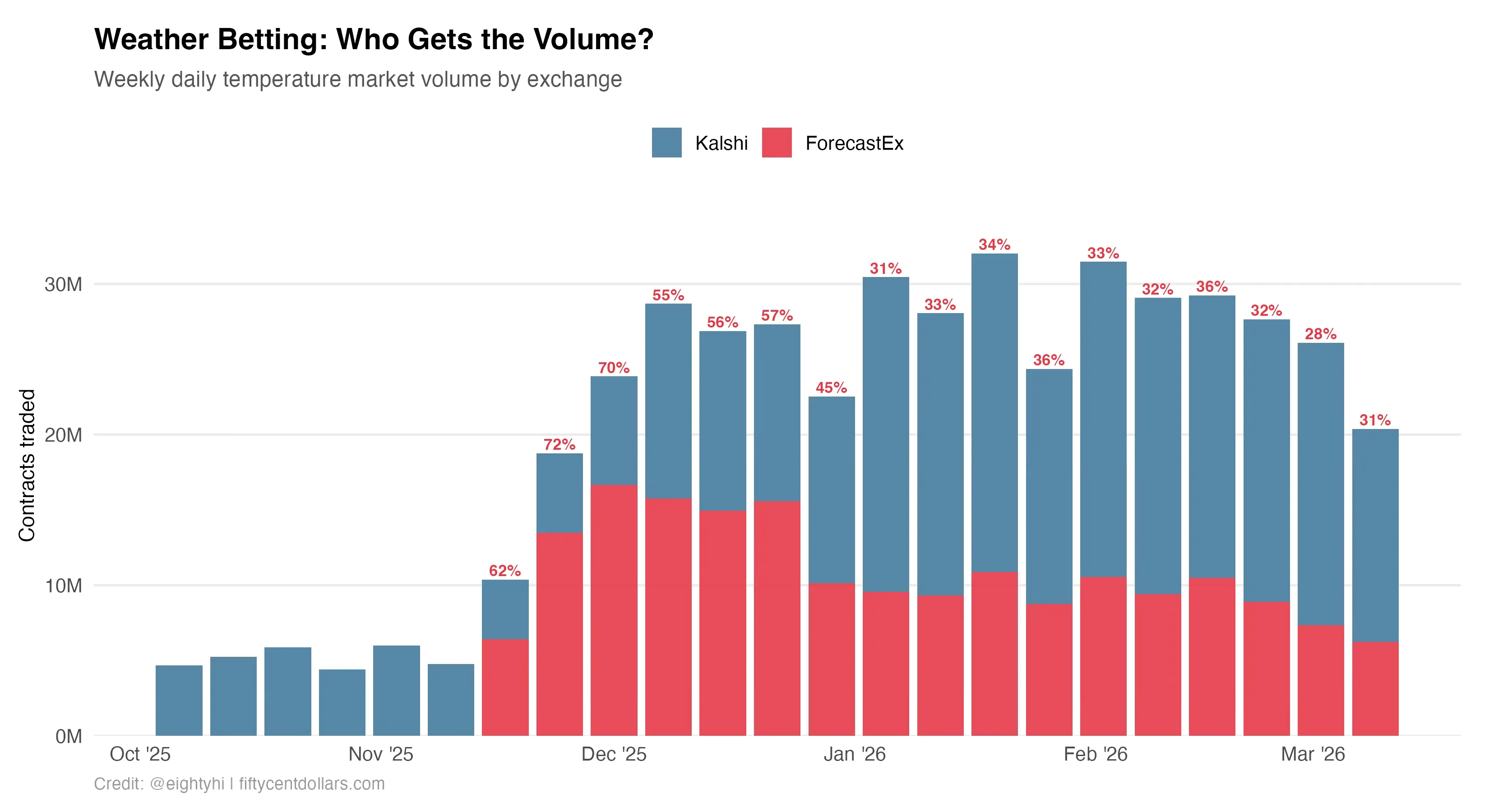
By the way, this chart provides an interesting case illustrating how platform competition can benefit the overall industry's trading volume. Robinhood opened the weather market's floodgates, generally increasing the activity of both exchanges, likely due to cross-exchange arbitrage. Market makers participating in such activities effectively distributed liquidity throughout the ecosystem.
For the first five weeks, it was only Kalshi, which serves as the baseline. Then ForecastEx appeared, and immediately captured 60% of the total daily temperature market trading volume. It peaked at 72% in late November, then remained overall between 53% and 67%.
The key detail is that when ForecastEx emerged, Kalshi's weather trading volume did not collapse. The blue bars remained roughly stable. Therefore, my interpretation is that ForecastEx's trading volume was superimposed on Kalshi's existing flow. This likely happened because Robinhood first opened the weather market and directed its traffic to ForecastEx from the outset, while its users were completely oblivious.
This distinction matters. In the January NBA case, Robinhood temporarily diverted the trading volume that would have gone to Kalshi. However, in the weather market, Robinhood seems to have added ForecastEx as a parallel destination while keeping Kalshi's original flow intact. Both scenarios confirm the same structural perspective: Robinhood determines the direction of trading volume. Exchanges can only passively receive orders that Robinhood chooses to feed.
The Absolute Magnifier of Product Innovation by Distribution Channels
The data from the NBA and weather shows that Robinhood can guide traffic. Furthermore, parlays (referring to combining two or more independent bets into a single bet. A player can only win the prize if all bound results are predicted correctly; if just one is wrong, the entire bet is lost. The difficulty increases, so the odds and returns are usually very high.) indicate that it can scale up an already growing demand.
Kalshi launched multivariable event contracts (i.e., "parlays") in September 2025, coinciding with the start of the NFL season. The product immediately gained attention: weekly trading volume grew from nearly zero in September to about 45 million contracts by early December. This growth was self-driven and pointed directly to Kalshi's platform. Kalshi built the product, submitted it for CFTC certification, and injected initial liquidity. The market responded positively.
Then, Robinhood got involved.
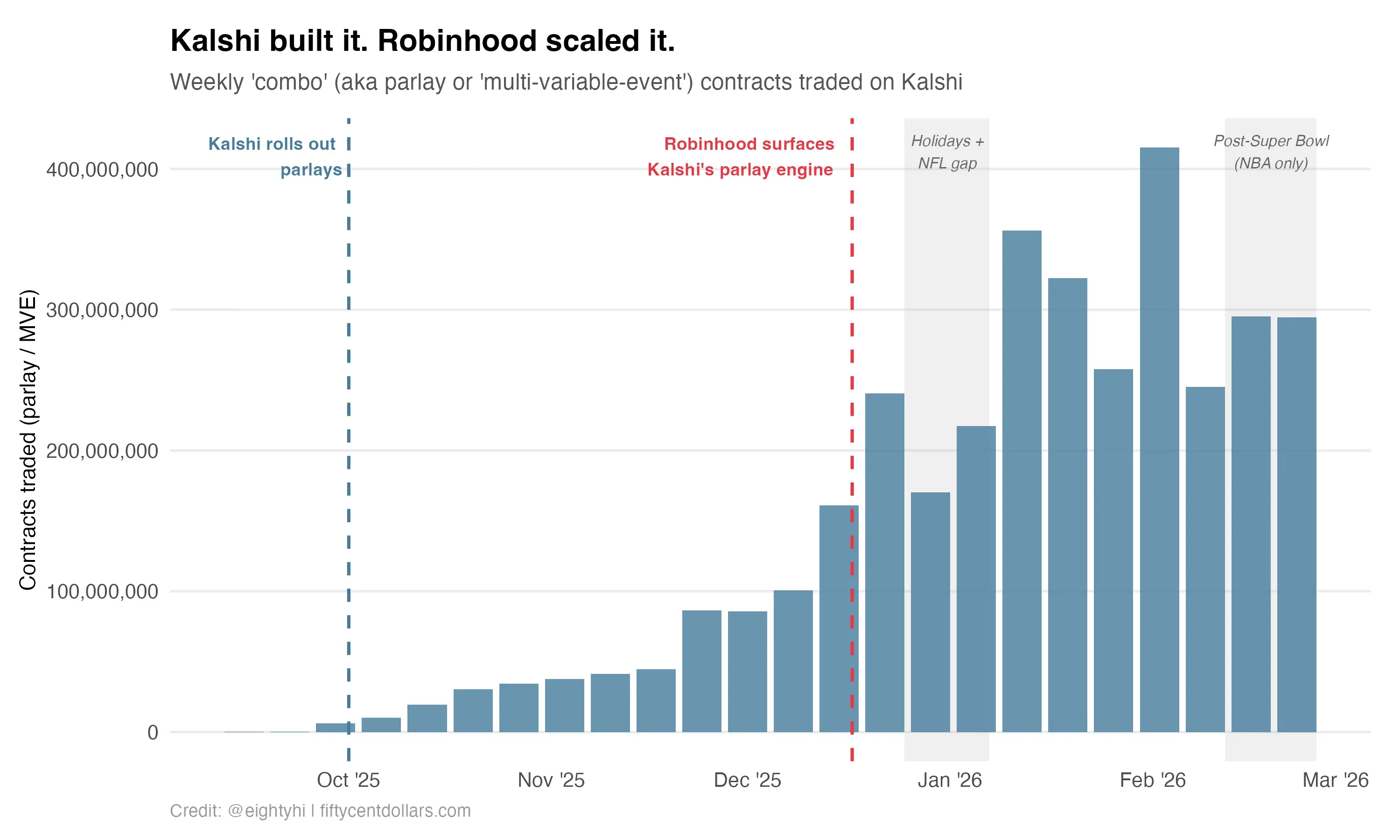
On December 17, Robinhood announced it would introduce preset parlays and player props betting in its app. Within just a few weeks, weekly trading volume exploded, surging from a range of 45 million to 60 million to nearly 100 million, then reaching 300 million per week by late January. The shaded area on the right indicates the period after the Super Bowl when NFL parlays disappeared, and the product was solely supported by the NBA. Even without football, trading volume remained around 260 million to 290 million per week.
Kalshi undertook the difficult work of creating a new product category. Robinhood's distribution channel elevated it to a completely different scale. Both contributions are real. The question is, which one holds greater structural leverage.
Not Just Kalshi
Kalshi has achieved tremendous growth over the past year, rising from about 7 million contracts per day at the end of 2024 to over 100 million by the end of 2025. This is not entirely due to Robinhood. Kalshi has already established real direct demand: new product categories, an expanding native user base, API traders, and institutional participation. A year ago, it was commonly believed that Robinhood accounted for the vast majority of Kalshi's trading volume. Now, NBA data shows that Robinhood accounts for about 35% of the spread betting trading volume. This de-risked operational capability is indeed commendable.
However, Kalshi is not the only exchange whose growth story is built on distribution channels.
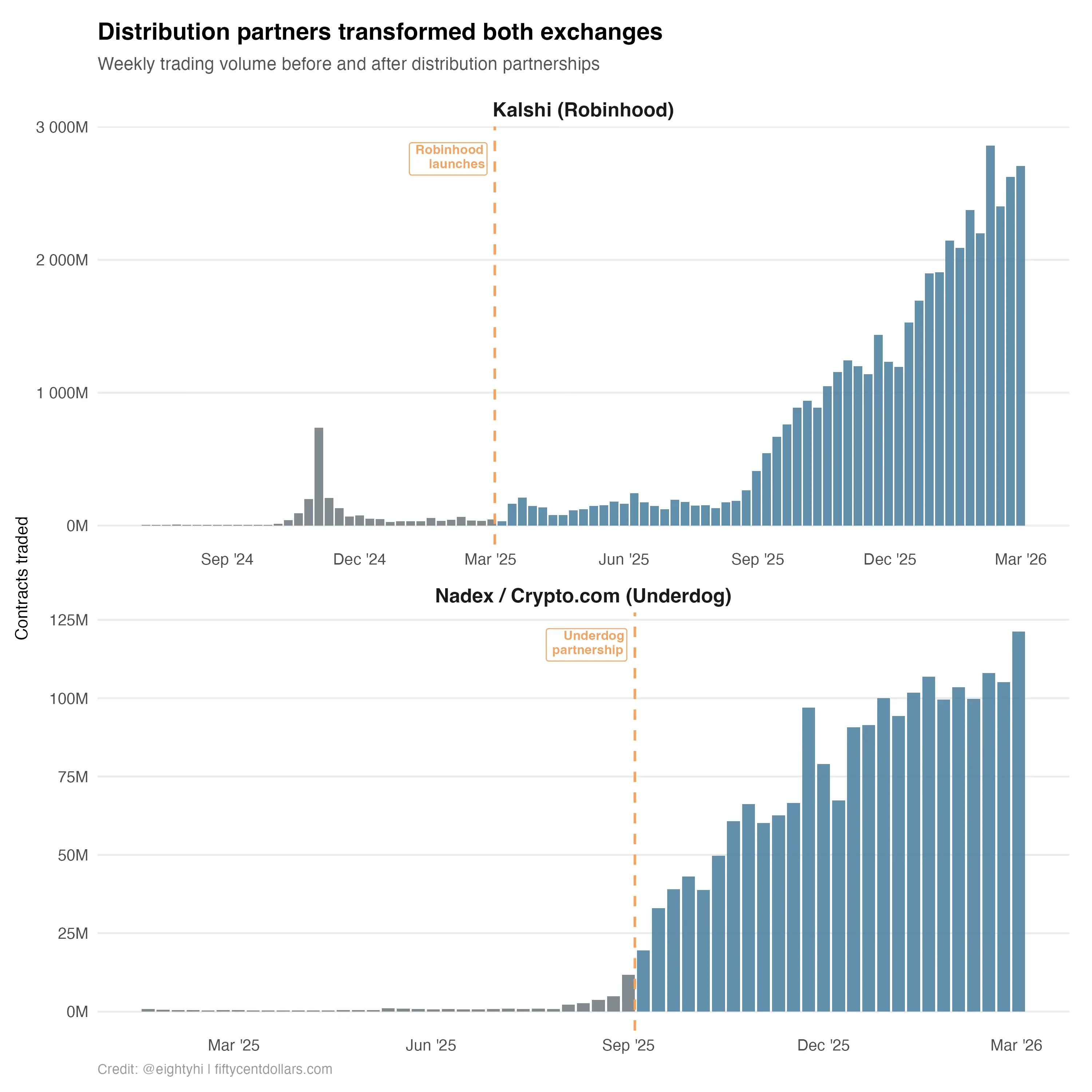
Nadex, as a CFTC-regulated exchange operated by Crypto.com Derivatives, tells an astonishingly similar story. Before Underdog integrated with Crypto.com in September 2025, Nadex's trading volume was unremarkable. After Underdog intervened and began directing its users' betting flow to that exchange, weekly trading volume exploded by orders of magnitude. The same pattern, different names. Underdog to Nadex is like Robinhood to Kalshi: the distribution layer that transforms a quiet exchange into a busy hub.
Interestingly, both of these distribution giants have now taken action to fully own their exchanges. Robinhood acquired its own CFTC-regulated exchange, while Underdog did the same last week. Both companies have independently reached the same conclusion on parallel tracks.
This is not a coincidence. It is game theory. If you are a distributor directing millions of trades to third-party exchanges, only to share a cut on every contract with an infrastructure that your users cannot differentiate from a white-label API. You are also handing over data, trading volume, and regulatory records to potential competitors, which is what makes their exchanges valuable. When you become large enough, the rational move is to internalize that infrastructure. The exchanges transform from profit centers for others into cost centers for you.
The data from weather and the NBA explains why it is so difficult to defend against this dynamic from the exchange's perspective. Even with only 35% of the trading volume, Robinhood can overnight add a parallel exchange for the weather market and immediately direct most of the new flow to it. It can redirect three NBA games to another exchange on Tuesday, generating the same trading volume as in any other location. Users remain unaware. They do not choose the exchange. They choose Robinhood or Underdog.
I Was Wrong
Last year, when rumors surfaced that Robinhood was considering acquiring its own CFTC-regulated exchange, I publicly stated that this was not possible.
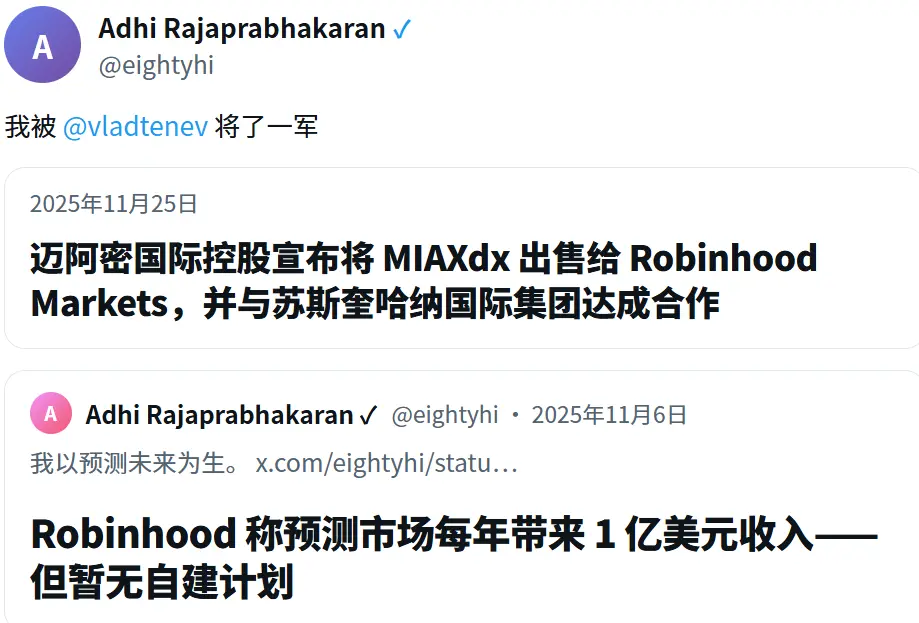
I was so confidently mistaken for two reasons.
First, from my experience at Kalshi, I learned firsthand how extremely difficult it is to establish and operate a regulated derivatives exchange: compliance infrastructure, monitoring systems, CFTC reporting, and more. Robinhood earned massive revenues from the prediction market, yet only did about 1% of the work. The exchange did the hard labor, while Robinhood reaped the distribution fees, which is one of the most perfect partnerships in fintech for years! Why break such a good arrangement?
Second, I was applying traditional thinking about the structure of the derivatives market over the past fifty years. Brokers don’t acquire exchanges. In the world I am familiar with, the entire point of an exchange is its irreplaceable transaction pipeline. The Chicago Mercantile Exchange (CME) is a $90 billion company, with net profit margins only trailing Visa and Mastercard, precisely because “liquidity depth” is its impenetrable moat.
An institutional trader needing to manage a $50 million Brent crude oil position would be highly concerned with order book depth, slippage, and counterparty concentration. This depth is incredibly difficult to establish and nearly impossible to replicate, especially in derivatives markets where contracts cannot be swapped across exchanges. In that world, exchanges win their structural positions through their own strength. Brokers are commodities that can be replaced at any time.
Prediction markets have disrupted this. On Robinhood, an average sports bet is merely a casual user clicking a button to wager $10 on the Lakers. That user does not care about order book depth. Hell, they don’t even know what an order book is. When transaction sizes are very small and users are not sufficiently professional, liquidity depth is no longer a moat. Robinhood changed the underlying pipeline on a Tuesday evening, but the same trading volume still flowed out on the other end.
When transaction sizes are very small and users are not sufficiently professional, liquidity depth is no longer a moat.
I was wrong because I was still navigating with an old map. The structural leverage of prediction markets does not lie where the past fifty years of derivatives history has pointed. It is firmly in the hands of those who ultimately own the users.
In fact, I have already written an honestly not very polite article discussing how ForecastEx mishandled sports events. This might resonate... And there was very little activity on ForecastEx on February 5 that I cannot explain. It might have been an early test by Robinhood. It could also be that Robinhood is distributing traffic among multiple exchanges, but external analysts cannot tell. I think this example is still up for discussion since Kalshi’s RFQ (request for quote) system and large team of market makers are truly hard to replicate. There lies an extremely deep technical moat. Additionally, it remains debatable “how important liquidity is in prediction markets.” This leads me to wonder: under game theory deductions, are we heading toward a homogeneous competitive endgame—where all exchanges are stuck in a mire of mutual imitation, racing to launch every market available on the market?
免责声明:本文章仅代表作者个人观点,不代表本平台的立场和观点。本文章仅供信息分享,不构成对任何人的任何投资建议。用户与作者之间的任何争议,与本平台无关。如网页中刊载的文章或图片涉及侵权,请提供相关的权利证明和身份证明发送邮件到support@aicoin.com,本平台相关工作人员将会进行核查。


