Author: Wall Street Journal
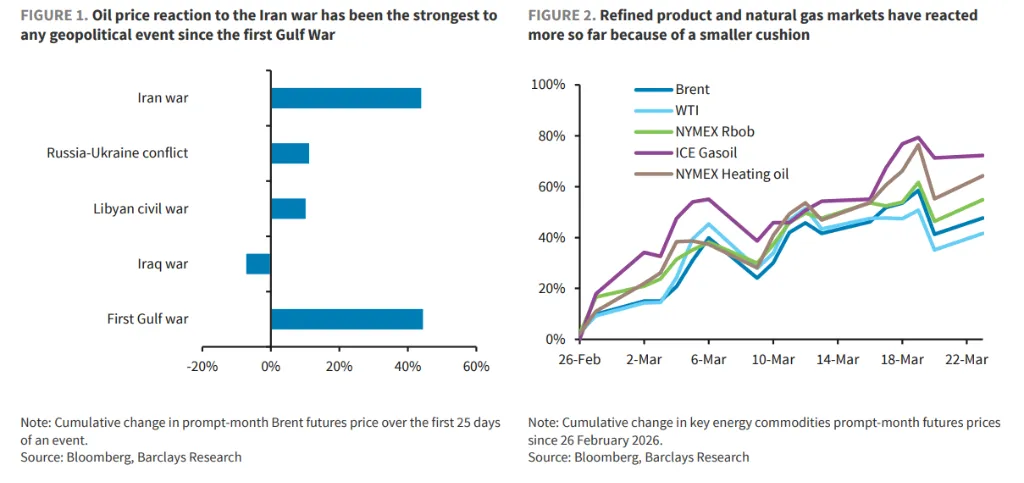
The Iran war has become the strongest geopolitical shock to the global energy market since the Gulf War of 1990.
Since the outbreak of the Iran war on February 26, 2026, Brent crude oil prices have surged by 44% in just 25 days, US gasoline wholesale prices (Rbob) have increased by 48%, US diesel prices have risen by 51%, and European diesel prices have jumped by 58%.
Barclays Capital's latest research report warns: When the war ends will directly determine whether crude oil prices return to the benchmark scenario of $85/barrel or break through $110/barrel. For investors, five key catalytic factors—military objectives progress, congressional funding battles, American military casualties, gasoline retail prices, and Trump's personal judgment—are key variables in the current energy market pricing.
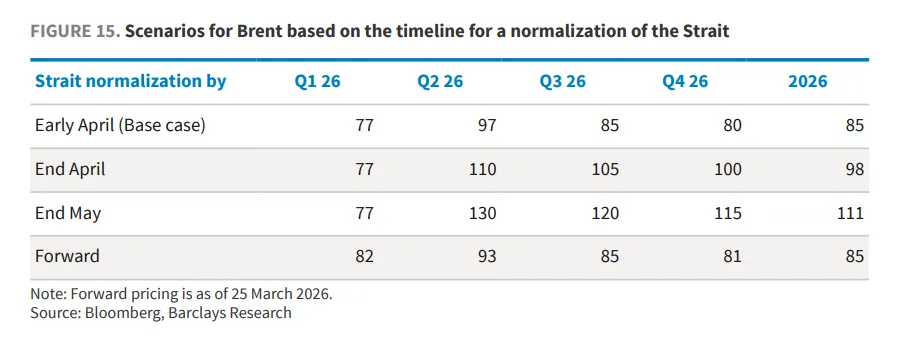
Barclays believes, oil price trends will diverge at three key time points: If the Strait of Hormuz returns to normal passage in early April, Barclays maintains its benchmark forecast of an average Brent crude oil price of $85/barrel for 2026; if delayed until the end of April, the average price may be repriced to about $98/barrel; if extended to the end of May, the average price could reach $111/barrel. Each day's delay accumulates inventory gaps that transmit backward in a snowball effect, pushing up the price center.
Five Key Factors: Core Variables Determining the End of the War
Barclays public policy analyst Michael McLean has outlined five possible catalytic factors that could end the Iran war:
Key Point One: Military Objectives Achieved
According to CCTV news, the US has previously defined three objectives against Iran: destroy Iran's ballistic missile and drone capabilities; strike Iran's navy to maintain passage through the Strait of Hormuz; and destroy Iran's military and industrial infrastructure, causing it to lose its ability to attack externally for many years. It is worth noting that the objectives do not include regime change or the Iranian nuclear program.
President Trump estimated at the beginning of the war that operations would last "four to five weeks." The war is now in its third week, and according to the White House, it may be at a midpoint.
However, in terms of the number of strike targets, the US Central Command has not seen a significant point of action contraction, and additional forces continue to be deployed. Although Iran's missile and drone attack frequency on the UAE, Kuwait, Saudi Arabia, and Bahrain has significantly decreased, it has not completely stopped, indicating that Iran still retains some offensive capability. Barclays believes that military objectives cannot be deemed achieved until related indicators further decline.
Key Point Two: Congressional Constraints—The War Powers Act Constitutes a Hard Deadline of May 31
The War Powers Act stipulates that the president must obtain congressional authorization (AUMF) within 60 days after deploying armed forces and submitting a report to Congress, and the president may extend it for an additional 30 days; after 90 days, military actions must be forcibly terminated. Trump submitted the report on March 2, thus the 90-day hard deadline is calculated to be May 31.
AUMF requires 60 votes to pass in the Senate, whereas Republicans currently hold only 53 seats. The Democrats have passed two resolutions in opposition, clearly expressing their position—therefore, AUMF is highly unlikely to pass, May 31 is a institutional hard boundary for the end of the war.
The economic cost of the war is also accumulating rapidly: about $11 to $12 billion was spent in the first week, and the current daily operational cost has dropped to about $500 million, with total cumulative expenditure estimated at about $21 billion so far.
In comparison, the nominal cost of the Iraq War over 13 years was $815 billion; the total discretionary defense spending for the 2026 fiscal year is $839 billion. Additionally, "One Big Beautiful Bill" has allocated $150 billion in advance to the Department of Defense, which currently provides a certain funding buffer.
Key Point Three: Rising US Military Casualties Will Further Erode Public Support
Barclays states that the level of support for this war domestically is weak, with a significant partisan divide.
As of March 22, the average from RealClearPolitics polls shows: support at only 41%, opposition at 49%. President Trump's overall approval rating has slightly decreased from 43% to 42%, marking the lowest record of his second term (his first term low was 37% in December 2017).
Currently, 13 US soldiers have died.
Historical experience indicates that wars usually bring a "rally-around-the-flag" effect, briefly boosting the president's approval rating, but Trump has not experienced this effect. The general rule is: the longer the war lasts, the higher the casualties, and the more pessimistic the public is about the prospects of victory, the stronger the anti-war sentiment.
Key Point Four: Gas Prices Touch the "Political Red Line"—$5/gallon is the Key Threshold
In July 2022, during Biden's administration, the national average gas price peaked at $5.01/gallon.
For the Republican Party, not exceeding this "Biden peak" is a psychological political defense line, corresponding to a WTI oil price of about $120/barrel, which is about 20% higher than the current oil prices.
Currently, Republican officials remain relatively optimistic, believing that even if gas prices are under short-term pressure, there is enough time for them to fall back before Labor Day (when investors really start paying attention to the upcoming midterm elections) with the end of the conflict. The administration has also taken a series of measures in an attempt to alleviate gas price pressure, including releasing strategic reserves and waiving related sanctions.
Key Point Five: Trump "Declares Victory" and Actively Shifts
Barclays believes that regardless of the actual progress on the battlefield, there is always a possibility that Trump may actively declare victory and end the war at some point. When previously asked how he would judge when the war ends, Trump's answer was intriguing—"when I feel it in my bones."
Barclays clearly points out that the timing of this catalytic factor is almost completely unpredictable.
In communications with clients, a mainstream analogy suggests that Trump's previous policy shift after "Liberation Day" (the tariff announcement on April 2, 2025) has conditioned investors to reflexively believe that a significant market downturn could drive Trump to shift directions.
However, Barclays believes that the current market response is not "panicky" enough: after Liberation Day, the S&P 500 index dropped about 12%, while it has only fallen about 5% since the start of this war; the yield on 10-year US Treasury bonds rose by 60 basis points after Liberation Day, while this time it has only increased by about 40 basis points; the investment-grade credit spread widened by 26 basis points after Liberation Day, while this time the peak has only widened by 9 basis points. More importantly, suspending a tariff executive order is far easier than ending a real war.
Significantly Skewed Risks of Rising Oil Prices
Barclays' core judgment is: the current rise in oil prices is not a speculative bubble, but a reflection of real supply and demand imbalances.
Before the war, Brent crude was undervalued by about 19% relative to OECD inventory levels and by about 15% relative to the replacement cost model; the net speculative long positions in Brent and WTI were at a historically low level, in the 2nd percentile since 2014 as of the end of 2025.
The dynamic evolution of five catalytic factors—military objectives progress, congressional funding battles, American military casualties, gasoline retail prices, and Trump's personal judgment—will be the most important high-frequency tracking dimension for predicting the direction of the energy market in the future. Barclays clearly points out that under uncertainty, the risk of the $85/barrel Brent crude oil forecast for 2026 is skewed upward.
免责声明:本文章仅代表作者个人观点,不代表本平台的立场和观点。本文章仅供信息分享,不构成对任何人的任何投资建议。用户与作者之间的任何争议,与本平台无关。如网页中刊载的文章或图片涉及侵权,请提供相关的权利证明和身份证明发送邮件到support@aicoin.com,本平台相关工作人员将会进行核查。


