Author: Shaurya Malwa
Translation by: Shenchao TechFlow
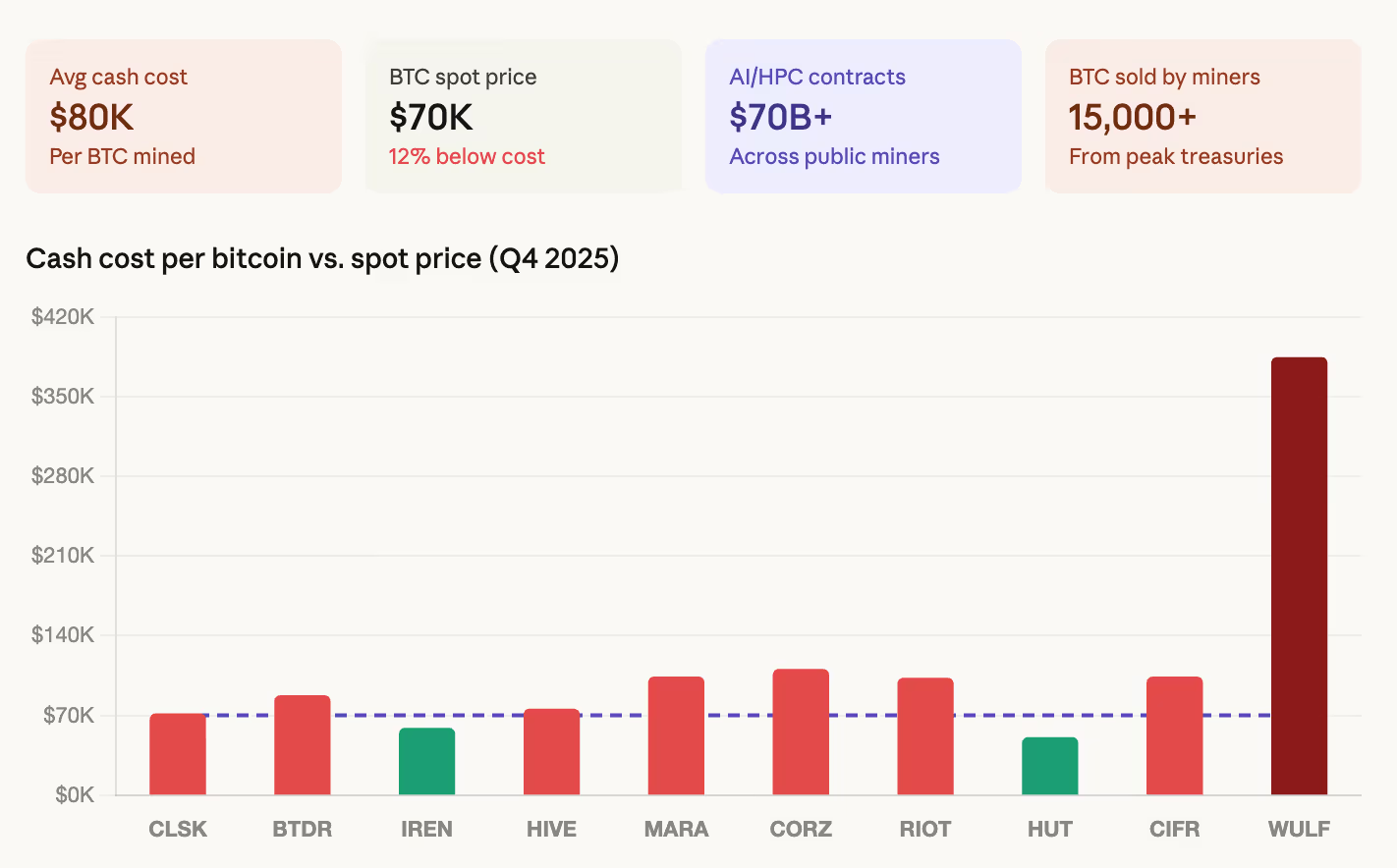
Introduction by Shenchao: CoinShares' latest mining report shows that the weighted average cost for publicly listed mining companies to mine one Bitcoin has risen to about $80,000, with the current price of BTC at $68,000 - $70,000, resulting in a loss of $19,000 for each Bitcoin mined.
The industry is undergoing the most fundamental transformation since its inception: over $70 billion in AI/HPC contracts have been signed, publicly listed mining companies have sold over 15,000 BTC in total, and companies like IREN and TeraWulf have taken on billions of dollars in debt. By the end of 2026, AI revenue could account for 70% of certain mining companies. They are transforming from Bitcoin miners into data center operators that just happen to still be mining. The core contradiction is that the very companies that ensure the security of the Bitcoin network by selling coins to shift to AI, have seen their hash rate fall from a peak of 1,160 EH/s to about 920 EH/s.
- The Bitcoin mining industry is undergoing the most fundamental transformation since its inception, and the clearest signal is not hash rate or difficulty adjustment, but the balance sheet.
- CoinShares' report released this week indicates that the weighted average cash cost for publicly listed mining companies to mine one Bitcoin rose to about $79,995 in Q4 2025.
- Bitcoin has been trading in the $68,000 - $70,000 range, with a report from CoinDesk last week estimating that each mined BTC incurs a loss of around $19,000.
- This number is unsustainable, and the industry is well aware of it. The response has been a full pivot to AI infrastructure - this is reshaping the essence of these companies.
According to the CoinShares report, publicly listed mining companies have cumulatively announced over $70 billion in AI and high-performance computing (HPC) contracts. The expanded contract between CoreWeave and Core Scientific is worth $10.2 billion over 12 years. TeraWulf has signed HPC contract revenue worth $12.8 billion. Hut 8 has signed a $7 billion, 15-year lease for AI infrastructure at the River Bend site. Cipher Digital has signed a multi-billion dollar agreement with Fluidstack, backed by Google.
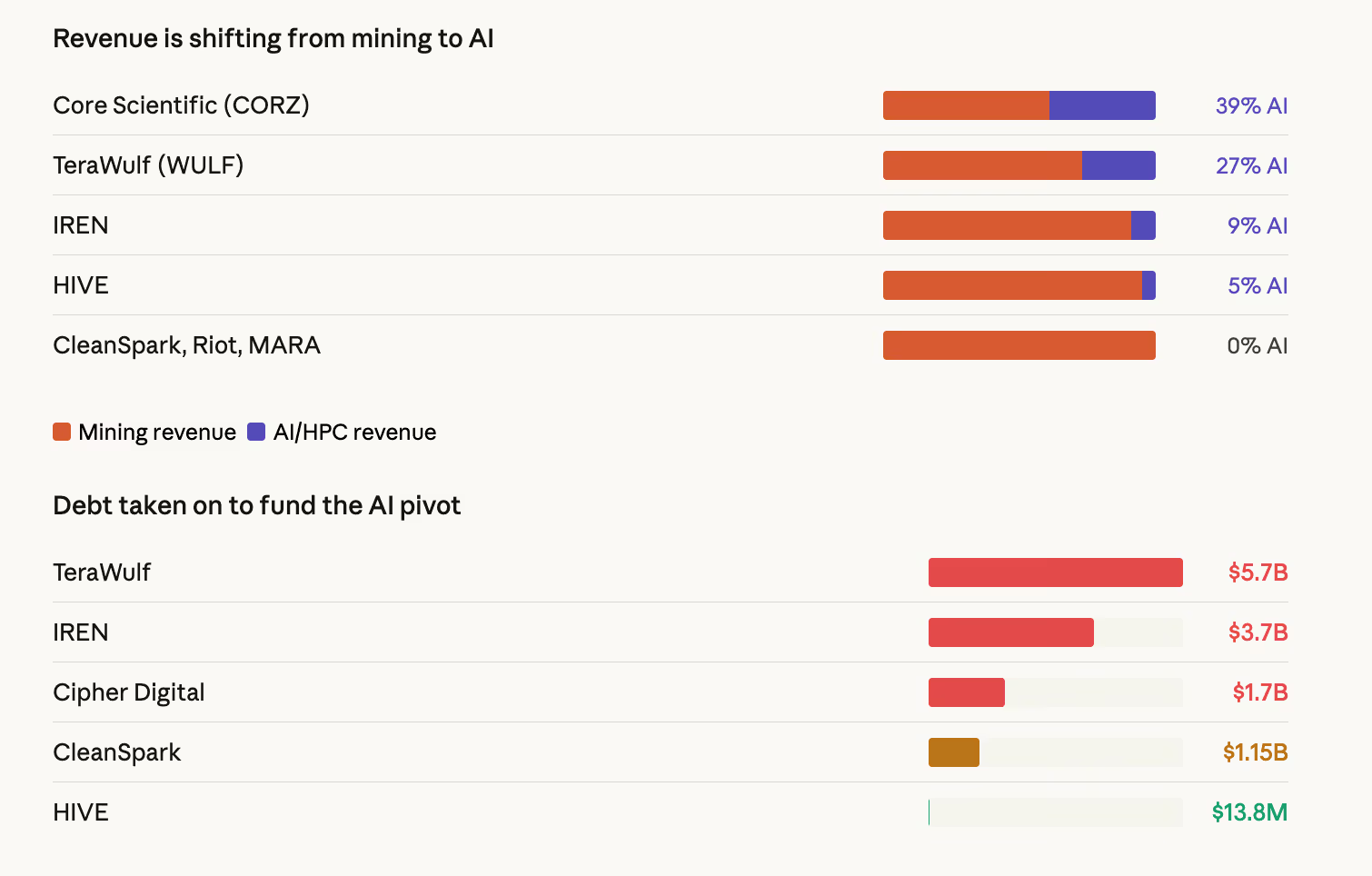
By the end of 2026, AI revenue could account for up to 70% of publicly listed mining companies, while it is currently about 30%. AI hosting revenue at Core Scientific has already accounted for 39% of total revenue. TeraWulf is at 27%. IREN is currently at 9%, but is quickly expanding, with a cooling GPU hash rate capacity under construction of up to 200 megawatts.
This means that these mining companies are increasingly resembling data center operators, just happen to still be mining Bitcoin.
The economic rationale explains the reason. CoinShares data shows that the cost of Bitcoin mining infrastructure is about $700,000 to $1 million per megawatt, while AI infrastructure is about $8 million to $15 million per megawatt. The gap is significant, but AI offers a structurally higher and more stable return.
The hash price - a measure of miner revenue per unit of hash power - fell to a post-halving historical low of about $28-$30 per PH per day in early March.
At this level, miners using mid-generation mining rigs need electricity prices below $0.05 per kilowatt-hour to maintain cash profitability. Meanwhile, AI infrastructure contracts promise profit margins exceeding 85%, with years of visible revenue security.
Where does the transformation money come from?
The CoinShares report points out that there are two sources of funds for this transformation, clearly visible in the data.
The first is debt. The leverage levels across the industry have undergone a qualitative change. IREN now carries $3.7 billion in convertible notes, across five series. TeraWulf's total debt is $5.7 billion, consisting of convertible bonds and priority secured notes from its hash rate subsidiary.
Cipher Digital issued $1.7 billion in priority secured notes in November, causing its quarterly interest expenses to soar from $3.2 million in the previous nine months to $33.4 million in just Q4. This is not a mining-level debt burden; this is infrastructure-level betting - betting that AI revenues can rise quickly enough to cover debt obligations.
The second is selling coins. Publicly listed mining companies have cumulatively sold over 15,000 BTC from peak levels. Core Scientific sold about 1,900 BTC in January (valued at $175 million) and plans to clean out almost all remaining holdings in Q1 2026. Bitdeer cleared its holdings to zero in February. Riot Platforms sold 1,818 BTC in December (valued at $162 million).
Even the largest publicly traded holder Marathon (which holds 53,822 BTC) quietly expanded its policy in the 10-K annual report in March, authorizing sales from the reserves of its entire balance sheet. Part of the reason is the pressure from its $350 million Bitcoin collateralized credit line - as prices fell towards $68,000, the loan-to-value (LTV) ratio has climbed to 87%.
Who will protect the Bitcoin network?
The companies that are selling coins to invest in AI are exactly the ones that operate the mining to secure the Bitcoin network. This constitutes the core contradiction of this transformation. When mining is unprofitable and AI is highly profitable, the rational economic decision is to redirect funds away from mining. But if enough miners do this, the network’s security budget will shrink.
Hash rate data has already reflected this. The network hash rate peaked at about 1,160 EH/s in early October 2025, and has since fallen to about 920 EH/s, experiencing three consecutive negative difficulty adjustments - the first since July 2022.
Valuation differentiation
The market has already priced in this differentiation. Mining companies with signed HPC contracts are currently trading at 12.3 times future 12-month revenue. Pure mining companies are only at 5.9 times. The market is paying more than double the premium for AI exposure, which further reinforces the motivation for transformation.
The geographical landscape is also changing. The U.S., China, and Russia currently control about 68% of the global hash rate. In just Q4, the U.S. gained about 2 percentage points in market share. However, emerging markets are also entering the game - Paraguay and Ethiopia have made it into the global top ten mining countries, driven by HIVE's 300 megawatt and Bitdeer's 40 megawatt facilities, respectively.
Hash rate forecast
CoinShares predicts that the network hash rate will reach 1.8 ZH/s by the end of 2026, and 2 ZH/s by the end of March 2027 (one month later than previously predicted).
But this forecast is premised on Bitcoin returning to $100,000 by year-end. If prices remain below $80,000, CoinShares predicts that hash rates will continue to fall, further reducing mining, with more miners exiting. Sustained dips below $70,000 could trigger larger-scale capitulation - ironically, this could benefit the survivors by lowering difficulty.
Next-generation hardware provides a potential lifeline. Bitmain's S23 series and Bitdeer's self-developed SEALMINER A3 both have energy efficiencies of less than 10 joules/TH, and large-scale shipments are expected in the first half of 2026. These mining machines could roughly halve the energy costs per Bitcoin compared to currently mainstream mid-generation models. However, deploying them requires capital - and many miners are putting money into AI.
The Bitcoin mining industry at the start of this cycle consisted of a group of companies protecting the network and hoarding Bitcoin. It is exiting this cycle under a different identity: a group of companies building AI data centers and selling Bitcoin to finance themselves.
Is this a temporary response to an adverse economic environment, or a permanent structural shift? It depends on one variable: the price of Bitcoin. If it returns to $100,000, mining profits will restore, and the AI transformation will slow. If it stays at $70,000 or lower, transformation will accelerate, and the mining industry, which has been core for the past decade, will continue to disappear into something completely different.
Original link: https://www.coindesk.com/markets/2026/03/27/bitcoin-miners-are-becoming-ai-companies-and-selling-their-btc-to-fund-the-transition
免责声明:本文章仅代表作者个人观点,不代表本平台的立场和观点。本文章仅供信息分享,不构成对任何人的任何投资建议。用户与作者之间的任何争议,与本平台无关。如网页中刊载的文章或图片涉及侵权,请提供相关的权利证明和身份证明发送邮件到support@aicoin.com,本平台相关工作人员将会进行核查。


