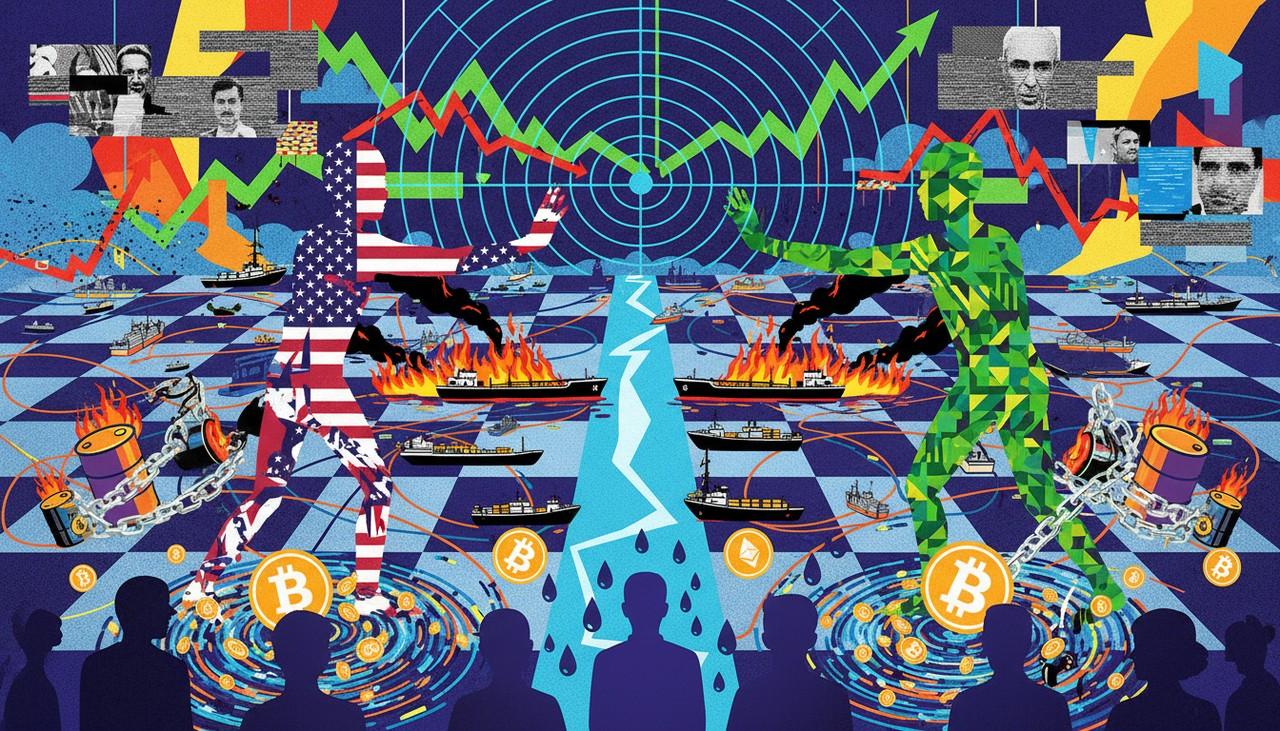
On March 30, 2026, at 8:00 AM Beijing time, U.S. Treasury Secretary Scott Bercet boldly claimed that the United States would "reassert control" over the Strait of Hormuz and ensure freedom of navigation through U.S. or multinational escorts. This statement quickly touched upon the most sensitive maritime nerve in the Middle East. On the same day, Iranian Foreign Ministry spokesperson Baghaei responded by stating, "Iran is not responsible for the current situation," attempting to distance itself from direct responsibility in the escalation of tensions, but concerns over energy supply security have already been ignited.
Under the premise of highly incomplete existing information, the market often trades based on the expectation of "if oil routes change": once the crude oil supply chain encounters blockages or the risk premium rises, how does the sentiment shift through risk appetite contraction and increased demand for safe assets, transmitting to crypto assets including Bitcoin? Whom is Bitcoin actually "avoiding" at this moment — sovereign risks, energy costs, or the scattered and fragile human decision-making?
The following will develop around three clues:
First, how risk aversion sentiment and Bitcoin’s "digital safe asset" narrative are reignited; second, under rising oil price expectations, how mining costs and computational power logic are reassessed; third, from retail traders to institutions, from exchanges to entrepreneurs, how positions are adjusted, increased, or missed in the face of geopolitical uncertainty.
A Strait that Moves Global Crude Oil and Emotional Nerves
The importance of the Strait of Hormuz in the global energy landscape cannot be overstated. Research briefs show that this narrow waterway accounts for approximately 20% of global maritime crude oil trade's daily transport volume, long regarded by the U.S. and Europe as a strategic chokepoint to guarantee energy security and maintain maritime hegemony. Any signs of "control" over this strait will be interpreted by the market as a potential impact on the global energy supply chain, even if real-world tankers continue to pass as usual.
Since the U.S. unilaterally withdrew from the Iran nuclear agreement in 2018, U.S.-Iran relations have remained tense, and the situation in the Strait of Hormuz has repeatedly heated up amid sanctions, military exercises, and ship seizures. For Iran, the strait is not only the economic lifeline but also a bargaining chip in external games; for the U.S. and its allies, ensuring the "safety" and "freedom" of energy routes is not only a struggle for discourse power but also a political explanation to domestic constituents and allies.
In this historical context, Bercet's statement on March 30, 2026 about "regaining control over the Strait of Hormuz" emphasizes that freedom of navigation will be ensured through U.S. or multinational escort forces. On the other side of the equation, Iranian Foreign Ministry spokesperson Baghaei publicly stressed that "Iran is not responsible for the current situation," attempting to convey to the outside world that it is not the provocateur. This public verbal confrontation alone is sufficient to amplify market imagination: who controls, who is responsible, who bears the blame, remains unanswered.
It is important to emphasize that the current market reaction is more focused on the expectations level rather than actual flow data:
On one hand, investors quickly add risk premiums in oil prices, energy stocks, and transportation-related assets, assuming extreme scenarios where supply chains may be obstructed; on the other hand, some funds will seek safe-haven and hedging tools in advance, reassessing their asset allocation structure amid uncertainties around sovereign credit, shipping routes, and regional order. This "imagined oil blockage" often precedes any real shipping delays or inventory statistics, first reflecting in sentiment and prices.
Risk Aversion Narrative Reignited, Bitcoin...
Over the past few years, whenever geopolitical conflicts escalate, traditional finance and sovereign credit come under scrutiny, Bitcoin has been elevated by some market participants onto the narrative stage of "digital safe assets." From pressures of sovereign debt to regional wars, from tightened capital controls to controversies over reserve currency credibility, Bitcoin’s story has been continuously retold within the framework of "systemic value storage," gradually leaving a mark in investors' minds: it comes to mind in events, not necessarily rationally, but sufficiently instinctively.
In this round of turbulence surrounding the Strait of Hormuz, the U.S.-dominated global maritime route contest has again become the focal point. On one side, the U.S. wants to "reassert control" over the waterways, while Iran emphasizes its lack of responsibility, with underlying cognitive differences regarding the dollar settlement system and U.S. maritime order. For some funds, redirecting a portion of assets to decentralized, non-freezable or non-confiscatable crypto assets is a kind of hedge against sovereign risks, sanction risks, and cross-border liquidity exhaustion — not because Bitcoin is perfectly secure, but because its risks are not completely dominated by a single sovereign.
Institutional level layouts are also reinforcing this impression. Research briefs show that Strategy company holds 762,099 BTC, a number that alone is enough to alter the narrative around "who is buying Bitcoin." This holding data currently comes from a single source and still needs multi-channel cross-validation, but at least reflects that, during the years of accumulating geopolitical and macro uncertainty, a large institutional player has been using Bitcoin as part of its long-term asset allocation. This long-term bet intertwined with short-term risk aversion sentiment causes every geopolitical conflict to be naturally interpreted as "is it Bitcoin's turn again."
However, simplifying everything to "risk aversion buying drives Bitcoin up" is obviously too romantic. In the short term, prices are more determined by sentiment and liquidity: some funds may use the opportunity to promote "digital gold," amplifying panic and FOMO, leading to sharp market fluctuations; while the on-chain mid-to-long-term holding structure—large institutions, long-term holders, miner reserves, etc.—changes slowly. Understanding the time-scale difference between these two factors is key to avoiding over-mythologizing risk aversion properties: Bitcoin can serve as a hedge tool in localized conflicts, but its main line still remains that of a high-volatility, high-risk asset, rather than a natural safe haven.
With Oil Price Expectations Rising, Cost of Power and...
The uncertainty in the Strait of Hormuz primarily reshapes the crude oil and energy cost expectations. When the market starts pricing in "potential constraints on shipping routes," the upward momentum of oil prices no longer derives from the basic supply-demand balance, but includes a geopolitical risk premium. This premium transmits downstream through refining, electricity generation, and transportation, ultimately reflecting in the electricity pricing structures of different countries and regions, affecting all energy-sensitive industries.
Bitcoin mining is one of the most typical energy-intensive businesses. Electricity costs account for a significant portion of miners' overall costs, often making up the majority of certain operational expenses. The rise in energy prices directly elevates miners’ marginal production costs, increasing the so-called "shutdown price"—the critical point at which continuing mining becomes loss-making when the spot Bitcoin price falls below a certain cost line. Once expectations for oil prices and associated energy price centers move up, the market will reassess which mining sites can withstand rising costs and which high-cost capacities are more likely to be eliminated.
In an extreme emotional scenario, if energy cost expectations rise sharply while Bitcoin prices do not rise in sync in the short term, some miners may be forced to shut down or sell inventory to maintain cash flow. Consequently, computational power may experience short-term fluctuations, and the difficulty of network block production adjusts periodically based on the protocol, further affecting block intervals and overall network output pace. For market sentiment, keywords like declining computational power and miner sell-offs can easily be exaggerated and interpreted as "weakened fundamentals," triggering a new wave of panic, even if the fundamental driver originates from energy costs rather than Bitcoin's intrinsic demand.
It is essential to emphasize that current key information regarding Iran's actual crude oil stock, specific potential shortages, and the enforcement intensity of sanctions is in a state of high uncertainty. Research briefs explicitly state that data on Iran's actual at-sea crude oil inventory and daily supply shortages in the oil market are either missing or prohibited from fabrication. Therefore, this article can only make directional deductions based on publicly available structural facts, rather than providing any "precise gaps" or inevitable scenarios. For investors, what truly needs caution is when sentiment is engulfed by oil price expectations, treating these incomplete messages as confirmations to make high-leverage, high-certainty bets.
Exchanges and Retail Investors: In Uncertainty...
In this macro and geopolitical volatility environment, retail investors are in the most vulnerable position, largely due to weak cognitive foundations. According to a survey by Coinbase, only 49% of investors can accurately identify taxable events for crypto assets, meaning more than half of participants are unclear about when they need to report to tax authorities and what actions constitute taxable behavior. The research brief also indicates that over 60% of crypto investors have incomplete cost basis data, meaning missing or chaotic purchase prices, times, and trading records.
During periods of high volatility, such cognitive and data gaps amplify all risks: on one hand, retail investors are more likely to follow narrow information to chase trends — rushing in upon seeing slogans like "the U.S. is controlling Hormuz" and "digital safe haven takes off," then panicking and fleeing during subsequent pullbacks or clarifications; on the other hand, they often underestimate tax consequences, accumulating a lot of hidden tax obligations while frequently engaging in short-term speculations and cross-platform arbitrage, only to discover afterward that they need to pay extra costs for "emotional trading."
Data from the exchange side provides another aspect of reality. Research briefs show that South Korean crypto exchange operator Dunamu's revenue dropped from 1.73 trillion KRW in 2024 to 1.56 trillion KRW in 2025, behind these numbers is the reality of pressured trading enthusiasm and commission revenues. Even if macro and geopolitical risks continually create topics and narratives, genuine sustainable trading volumes and revenues have not increased linearly alongside “news heat.”
When geopolitical risks amplify price volatility, while overall trading activity and regulatory awareness do not correspondingly improve, retail investors are more likely to make wrong choices at the wrong times: chasing highs during periods of low liquidity, frequently engaging in short-term operations at the most sensitive regulatory junctures, and undertaking cross-border transfers and cash-outs without fully understanding tax responsibilities. Once Bitcoin briefly spikes due to the risk aversion narrative and then rapidly retracts due to expected corrections, these participants will become the ones absorbing the cost of volatility.
Capital and Entrepreneurs: In Crisis Narratives...
Contrasting with retail’s passive response, institutional capital and entrepreneurs actively layout strategies in uncertain environments. Research briefs show that the crypto infrastructure project Valinor has completed a $25 million seed round financing, a highly symbolic signal in the midst of frequent macro and geopolitical risks: even with a noisy external world, some funds are betting on a new generation of crypto infrastructure, hoping to secure a position before the next round of cycles arrives.
For institutional capital, facing tighter regulations, rising compliance costs, and spillover from geopolitical risks, while continuing to increase investments in the crypto ecosystem seems contradictory, it actually reflects the principles of risk diversification and long-termism. Holding a portion of assets with lower correlations to sovereign risks is a natural choice for redesigning portfolios in the context of potential sanctions, capital controls, and currency devaluation disturbances. Crypto infrastructure, compliant custody, and services related to computational power and energy have become key tracks to navigate through the cycles.
If we place large-scale holding institutions like Strategy alongside new projects like Valinor in the same coordinate system, we can more clearly see a trend: traditional capital and crypto capital are accelerating their integration. The former is gradually embedding itself into the crypto ecosystem through direct holdings, participation in ETFs, and investment in infrastructure projects; while the latter introduces traditional financial standards and constraints into project financing, custody services, and compliance structures. Geopolitical and macro risks have not hindered this path of integration but rather provided additional narrative justification — in a more tumultuous world, building "off-system" financial infrastructures and asset choices seems increasingly necessary.
If anxieties over the Strait of Hormuz and uncertainties surrounding energy prices persist, then the segmented tracks around computational power, energy derivatives, and compliant custody may receive excess narrative premiums. Mining companies, energy hedging tools, and custody and settlement services tailored to institutions all have the opportunity to be packaged as "necessities in the era of geopolitical and energy risks." However, whether the narrative can translate into stable cash flows and healthy business models ultimately circles back to more fundamental questions: is there real demand, is the regulatory environment predictable, and are risks being correctly priced?
When Shipping Routes Become Battlefields, Bitcoin's Down...
Returning to the starting point, when tensions in the Strait of Hormuz are amplified into global news headlines, Bitcoin's position is not unidimensional. In the short term, this event transmits to the crypto market along three main lines:
First, demand for safe havens, amidst uncertainties surrounding sovereignty and shipping routes, some funds tend to pay a premium for decentralized assets like Bitcoin; second, mining costs, rising oil and energy price expectations have raised miners' marginal costs, reshaping the rhythm of computational power and capacity clearance; third, investor behavior, in a reality of weak knowledge and compliance foundations, retail investors are more likely to make extreme decisions amid high volatility and strong narratives.
At the same time, it must also be emphasized: current key information about actual shortages of crude oil, exemptions from sanctions, and Iran's maritime inventory still remain in a state of high uncertainty and information absence. Research briefs explicitly list relevant numbers and some statements as prohibited from fabrication or pending verification, which means that at this moment, the market seemingly trades based on future expectations rather than on the precise pricing of past events. In such an environment, short-term bets made under the guise of "accurate data" are often built on sand.
The mid-to-short-term judgment on Bitcoin may be framed within three constraints:
Firstly, emotion-driven volatility range — the risk aversion narrative may bring upward momentum, but could also rapidly reverse during information clarifications or risk repricing; secondly, computational power and cost floors — energy prices and mining costs jointly form an invisible barrier at Bitcoin's production end. When prices fall below the shutdown price zone, massive capacity clearance will have a reverse impact on supply and sentiment; thirdly, macro policy variations — changes in monetary policy, regulatory scales, capital controls, and the sanction environment are constantly reshaping Bitcoin's position within the global asset spectrum.
In such a scenario of overlapping multiple uncertainties, what truly needs caution is not one specific piece of news, but the impulse for chasing and panic selling wrapped in geopolitical narratives. For most participants, treating risk management and tax compliance as prerequisites for engaging in this round of volatile narratives, rather than as an afterthought, might be a more pragmatic strategy: before deciding "whether to get onboard," first confirm whether you clearly understand costs, rules, and worst-case scenarios to avoid becoming part of the crowd left behind in the next shipping route crisis.
Join our community, let's discuss and become stronger together!
Official Telegram group: https://t.me/aicoincn
AiCoin Chinese Twitter: https://x.com/AiCoinzh
OKX benefits group: https://aicoin.com/link/chat?cid=l61eM4owQ
Binance benefits group: https://aicoin.com/link/chat?cid=ynr7d1P6Z
免责声明:本文章仅代表作者个人观点,不代表本平台的立场和观点。本文章仅供信息分享,不构成对任何人的任何投资建议。用户与作者之间的任何争议,与本平台无关。如网页中刊载的文章或图片涉及侵权,请提供相关的权利证明和身份证明发送邮件到support@aicoin.com,本平台相关工作人员将会进行核查。