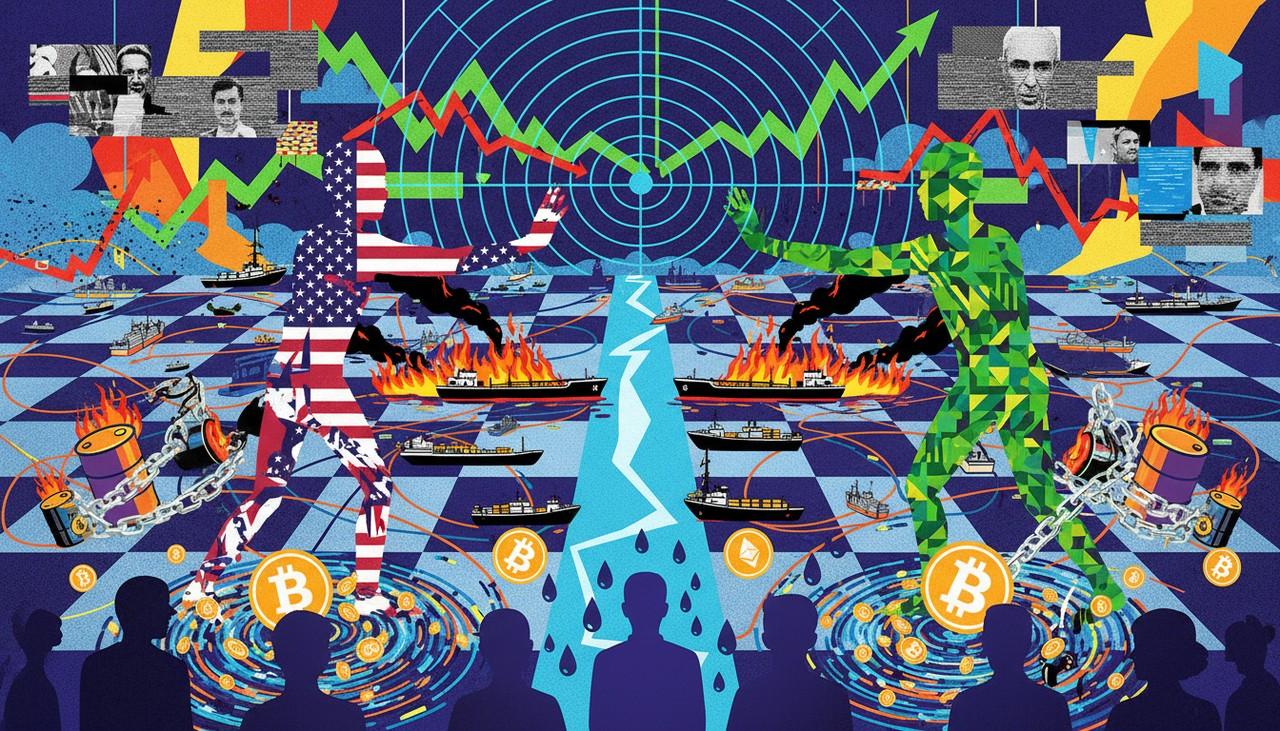
On March 30, 2026, Eastern Eight Time, U.S. Secretary of State Rubio made a series of tough statements during a media interview, directly targeting Iran's attempts to control and charge for the Strait of Hormuz. He made it clear that the U.S. absolutely will not accept Iran's permanent control of this critical waterway and the establishment of a charging system, while signaling that the "military objectives will be achieved in weeks rather than months", pushing an already highly sensitive strait dispute into a high-pressure state intertwined with military, diplomatic, and economic dimensions. On the surface, Washington continues to emphasize that "diplomatic avenues are preferred", but in Rubio's narrative, "preparing for the failure of negotiations" has been laid on the table, and military options have been openly included in public discussions. These words not only create new expectations of gameplay between Tehran and Washington but also quickly spill outwards, affecting expectations of energy prices, perceptions of regional security, and risk sentiment surrounding crude oil, natural gas, and crypto assets.
Countdown to Military Window
In the interview, Rubio explicitly stated that the U.S. hopes to achieve its set military objectives in "weeks rather than months", and this wording itself serves as a public time pressure device. It compresses potential action from the vague "some future point" to a countdown window, conveying to Iran and all parties: If there are no substantial developments aligning with U.S. expectations in the short term, military options are not just rhetoric. Compared to traditional diplomatic language that ambiguously handles "timelines", such specific wording carries upgrading signals and deterrent meanings.
Making the military time window public affects expectations differently among various audiences. For Iran, it represents an intuitive countdown pressure, forcing it to make a clearer choice between control of the strait and negotiation postures; for regional allies, the countdown signifies a need to complete their own defenses, risk avoidance, and diplomatic positioning more swiftly; and for the global market, especially energy and shipping chains heavily reliant on the Strait of Hormuz, it introduces a "short-term uncertainty peak" at the level of prices and inventory, stimulating a reassessment of oil and gas supply security in the coming weeks.
The contradiction lies in the information from briefings indicating that the related negotiations are "at an initial stage" and communicated through intermediaries, meaning that parties are still in a stage of probing and groundwork. From a procedural logic perspective, normal diplomatic processes typically require weeks or even months of back-and-forth communication and technical consultations, yet the military time window given by Rubio is extremely compressed, creating a clear rhythm dislocation: on one hand is a newly established communication channel, and on the other hand, a countdown clock has already started. This tension will force negotiations to accelerate but also increase the risk of miscommunication and rhythm disruptions.
If we compare this round of time setting with previous strait crises, an obvious difference can be found—the U.S. is bringing the "timeline" to the forefront earlier and more openly. In the past, Washington typically released pressure through troop movements and military exercises in an "action precedes signal" manner, whereas this time, it has provided a time scale of "weeks rather than months" without any detailed public disclosure of military actions. This "speak first, act later" rhythm is more aggressive and makes it harder for the market and regional parties to predict what will happen next based on past experiences.
Verbal Emphasis on Diplomatic Priority while Presenting Alternative Plans
In the public rhetoric of the White House and the State Department, the Trump administration currently still emphasizes a preference for resolving the Hormuz dispute through diplomatic means, which forms the basic tone of the official external stance. However, Rubio both repeats the notion of prioritizing diplomacy and bluntly states that "we must prepare for the possibility of negotiation failure", effectively presenting military and hardline measures as an "immediately usable Plan B" to all audiences. This dual-layered framework of being "gentle in words but sharp in meaning" semantically retains maneuvering space for the government while psychologically reinforcing deterrence.
Briefings indicate that the current negotiations are still at a starting stage and rely on intermediary communication, suggesting that parties have not yet entered the substantive, technical text negotiation phase, but are laying foundations and probing baseline lines. The presence of intermediaries itself indicates that there are significant barriers to mutual trust and direct dialogue channels between Iran and the U.S. It is in this early stage of mutual probing that Rubio prematurely makes the "contingency plan for failed negotiations" public, not only sending a message to Tehran but also "showing cards" to these intermediaries through media.
Publicly emphasizing "preparing for failure" serves as an operation that increases pressure leverage: for Iran, the cost of time and security risks is highlighted; for intermediaries, if they cannot facilitate some framework consensus within a limited time, they will also face reputational risks and real consequences due to the situation going out of control. Rubio's statements, leveraging the public opinion arena, make this pressure more visible and help create an atmosphere outside the negotiation table that "if not resolved quickly, the situation will escalate", thus improving the U.S.'s relative position in the negotiations.
From the perspective of domestic politics and public opinion in Washington, a tough stance also serves domestic audiences. For some voters and legislators, in issues involving strategic waterways and Iran, "weakness" is often harder to accept than "strength". Therefore, while emphasizing diplomatic priority, Rubio must also demonstrate both internally and externally that the U.S. is seriously preparing to deal with the worst-case scenario, responding to domestic expectations regarding security, deterrence, and commitments to allies. Without speculating on the specific decision-making process, one can infer that similar statements serve as both a "safety net" description for the diplomatic team and a groundwork for legitimizing potential military options.
Strait of Hormuz Dispute: Iran's Charging Proposal Touches the Bottom Line of Rules
The Strait of Hormuz is one of the most strategic chokepoints in global energy trade, with a large volume of Middle Eastern crude oil and natural gas needing to pass through this narrow waterway to global markets. If this passage is locked down by a single country using a "permanent control + charging system", the global oil and gas transportation chain will inevitably add a layer of stability-poor "political premium" to costs. For energy-importing countries, this means that the onshore price for every tanker of crude oil and every unit of natural gas may be repeatedly reassessed due to safety risks and policy changes, ultimately passing through to inflation, industrial costs, and consumer prices.
In this context, Rubio's assertion that "Iran will not be allowed to permanently control the Strait of Hormuz and establish a charging system" has exceeded the scope of a specific friction and is being framed as a bottom line of rules. The U.S. is not simply competing for tactical control over a waterway but is defending its long-established narrative that "critical international shipping lanes must remain open and cannot be treated as toll gates by a single country". If this bottom line is breached, any future passage affected by geopolitical disputes could lead to similar actions by other countries, thus undermining the predictability of the current maritime order.
From Iran's situation and motives, it is also understandable why it has been accused of intentionally strengthening control and bargaining power over the waterway. Under long-term sanction pressures, Tehran needs to enhance its influence over key passages to gain more negotiating leverage and economic returns, and the "charging proposal", regardless of its phrasing, is fundamentally about monetizing geopolitical positions. In a cycle of high oil prices and high risks, turning the strait into a strategically advantageous asset with additional returns presents obvious temptations for Iran, and it can also be more easily interpreted as an "escalation in asking for prices against the international order".
For energy-importing countries, shipping companies, and producing nations, even if the charging is still at the proposal stage, the expectations themselves are enough to trigger a chain reaction. Importing countries will consider diversifying supply and inventory strategies in advance, shipping companies need to assess whether to adjust routes and insurance plans, while producing nations must face buyers' demands for "risk discounts". In this process, risk premiums are repriced, reflected not only in spot and future contracts but also in corporate investment decisions, production capacity planning, and long-term contract negotiations. A "charged passage" that has been politicized has repercussions far beyond a single toll fee bill.
Night of Rising Risks: Strong Stock Market and Leveraged Derivatives
On the same day Rubio made his statements and tensions in the Strait of Hormuz escalated, crypto concept stocks saw a broad increase: reports showed that Coinbase rose 1.79%, Robinhood rose 1.54%. One side is the high-profile display of strait disputes and military windows, and on the other side, risk assets represented by trading platforms are strengthening, seemingly contradictory but actually reflecting a different logic of the capital market—geopolitical tensions often mean amplified trading and hedging demands, and platforms that facilitate buying and selling and provide channels naturally benefit from increased volatility and transaction volume expectations.
Meanwhile, Binance announced it will launch perpetual contracts for crude oil and natural gas on April 1, with leverage up to 100 times, further indicating that market participants are quickly building speculative and hedging infrastructure for potential energy fluctuations. From traditional futures markets to emerging crypto derivative platforms, a multilayered leverage system is forming around the uncertainty of oil and gas prices: some funds bet on soaring prices, some try to profit from volatility itself, while others see it as a tool to hedge real business or other asset exposures.
Under such a structure, expectations of geopolitical conflict, the Hormuz risk premium, and the leverage effect of the derivatives market can easily resonate. Any slight disturbance from Hormuz—whether it's a standoff of vessels, verbal threats, or negotiation news—could be instantly amplified into price signals, triggering program trading, leveraged liquidations, and emotion-driven chain reactions. Oil and gas pricing is not isolated; it intertwines with the stock market, crypto assets, and related corporate bonds at the funding level, forming a complex cross-market transmission chain.
At the stage where military and diplomatic games have yet to materialize, financial markets typically choose to price in advance. This means that in the upcoming weeks, even if there is no substantial blockade or military conflict in the Strait of Hormuz, the panic and hedging demand surrounding the "potential occurrences" may still create several rounds of sharp rises and falls. For highly leveraged traders, short-term excessive volatility can be even more damaging than medium to long-term trends—if the decision-making rhythm continues to follow "traditional political events", it may very well be thrown behind by this round of multidimensional derivative amplification effects.
From Tehran to Global Classroom: Adjustments to Life Under the Shadow of War
Beyond the high-level game surrounding the strait and red lines, the subtle changes in Iranian domestic society are also worthy of attention. Research briefings indicate that Iran announced that as of April 4, all universities will switch to online teaching, which provides the outside world with a peripheral window to observe Tehran's risk perception. School closures do not equate to an immediate outbreak of conflict, but against the backdrop of escalating regional tensions, this timing and policy adjustment cannot be seen as purely technical arrangements.
This move may contain multiple considerations: on one hand, security concerns cannot be ignored—reducing personnel concentration is viewed as a common tool to lower uncertainty in scenarios where large gatherings carry potential risks; on the other hand, the demand for social stability and public opinion management may also play a role, as the university community often serves as a bellwether for opinion and protests, moving classes online can somewhat weaken the capacity for offline gatherings and organization. Of course, the specific intelligence background remains unknown to the outside world, and it can only be viewed as a preventive signal in preparation for potential escalations.
When university teaching modes are forced to adjust due to the strait dispute and regional military tension, the story of Hormuz does not remain merely at the level of maps and oil price curves but begins to influence the daily rhythms of ordinary people. Students attend classes at home, campus activities are compressed, and the uncertainty of educational rhythms is quietly changing the daily experiences of a generation. For the young population in Iran, Hormuz is no longer just a term in the news but has become a tangible variable that can directly affect class schedules and graduation timelines.
Similar social measures are frequently seen in crises in other regions: from shifting to remote teaching due to conflict, to compressing public activities due to security threats, the shocks of geopolitical games often descend along the chain of "diplomatic rhetoric → military deployments → social management → individual lives". The dispute over the Strait of Hormuz appears on the surface to be a power game between great powers and regional forces, but on a more micro level, it is rewriting attendance records in Tehran's classrooms, altering family rhythms, and drawing countless individuals who were originally distanced from geopolitics into the storms of this era.
The Red Line Drawn Bolder, the Outcome Still Undetermined
Based on the current public information, a progressively clearer pattern emerges: on one hand, the U.S. has publicly set a tense time frame for "weeks rather than months", placing military options on the table while still verbally emphasizing "diplomatic priority"; on the other hand, Iran is sending multiple signals regarding control over key waterways and adjustments in domestic social management, from the discourse power surrounding Hormuz to the arrangement of online teaching in universities, all pointing to a posture of "preparing for uncertainty". Between the two, there is a nascent stage of negotiations that passes through intermediaries, while also dividing expectations of the market, allies, and domestic public opinion.
The struggle over control and charging in the Hormuz passage has already shifted from a theoretical game on paper to a reality of deterrence and rehearsal. Whether or not the charging system truly takes effect, the contention over "who can control this waterway to what extent and how to benefit from it" is being written into the logic of market pricing. The most direct reflections will inevitably first appear in energy prices and shipping costs, further amplified through financial derivatives related to crude oil and natural gas. The high-leverage oil and gas perpetual contracts planned by Binance are just a microcosm of this process, and more products will emerge around the reconstruction of risks associated with this strait.
For investors and observers, the next few weeks will require attention not only to the high-decibel confrontations at the discourse level between Washington and Tehran but also to three more substantial trajectories: the actual passage conditions of the strait, the genuine rhythm of negotiation progress, and the intensity of market volatility influenced by high-leverage derivatives. Verbal threats and posture shifts are common in political dramas, but what truly changes supply and risk structures is whether tankers can pass smoothly, whether texts can be finalized on paper, and whether funds are forcibly cleared at specific price points.
Equally important, it must be acknowledged that many key variables remain in a highly uncertain state. Whether it is the details of any specific military action plan, the amount structure of potential charging mechanisms, or the internal negotiation processes of governments, all exceed the range of public information that can support them. Imagining fill-in-the-blank scenarios for these facets not only fails to improve judgment quality but may also amplify misjudgment in a high-leverage, emotionally charged market environment. Genuine robust observation and decision-making should be based on verifiable public information, preparing for the worst-case scenario while acknowledging uncertainty, and remaining vigilant against short-term violent fluctuations driven by emotional and leverage resonance.
Join our community to discuss and grow stronger together!
Official Telegram community: https://t.me/aicoincn
AiCoin Chinese Twitter: https://x.com/AiCoinzh
OKX Welfare Group: https://aicoin.com/link/chat?cid=l61eM4owQ
Binance Welfare Group: https://aicoin.com/link/chat?cid=ynr7d1P6Z
免责声明:本文章仅代表作者个人观点,不代表本平台的立场和观点。本文章仅供信息分享,不构成对任何人的任何投资建议。用户与作者之间的任何争议,与本平台无关。如网页中刊载的文章或图片涉及侵权,请提供相关的权利证明和身份证明发送邮件到support@aicoin.com,本平台相关工作人员将会进行核查。