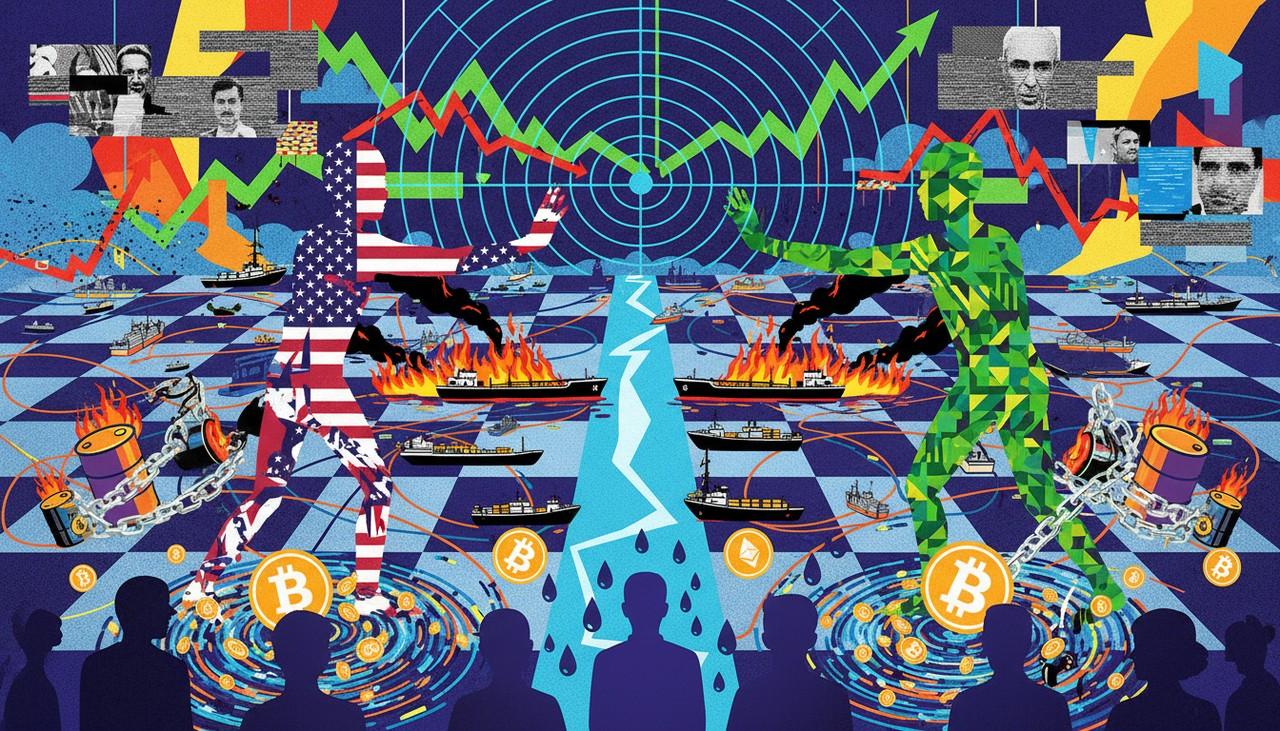
On March 30, 2026, in Eastern Daylight Time, a key oil refinery in Haifa, northern Israel, was hit by a missile attack and caught fire. Several international and local media described the act as "suspected Iranian missiles," but the party responsible has not received official confirmation. A few hours later, U.S. President Trump responded to reporters' inquiries with "You'll see shortly", releasing a vague signal of "forthcoming action but without a timeline or format." The Haifa oil refinery is a core component of Israel's energy system, responsible for domestic refined oil supply and the operation of the northern industrial belt. Its attack is both a tangible blow to energy infrastructure and a symbolic amplification of Middle Eastern tensions. The deeper issue at this juncture has shifted from "who launched the missile" to "how global risk appetite and crypto assets, including Bitcoin, will be repriced under the uncertainty of energy supply and the escalation of U.S.-Iran gamesmanship."
The Missile Strikes Haifa: The Lifeline of Energy Exposed to Flames
On March 30, multiple media sources and on-site footage showed explosions and flames in the sky above the Haifa refinery, followed by billowing smoke. Firefighting and emergency forces quickly arrived, but the source and responsibility for the missile remain publicly labeled as "suspected Iranian". This statement reflects an intuitive direction in the regional situation rather than a final judicial confirmation. Relevant parties have not yet disclosed complete details regarding motives, command chains, and technical specifics, and outsiders can only piece together the contours of facts from limited images and brief official reports. Within hours, major outlets such as CCTV and Jin10 Data amplified the incident, quickly occupying global financial and crypto media headlines, with the market's perception of its "escalation signal" preceding the quantification of physical losses.
The Haifa refinery is recognized as Israel's key energy infrastructure, undertaking major refining functions for domestic refined oil supply and the northern industrial corridor, making it one of the most recognizable and symbolically significant "hard targets" in the country's energy system. Its central position in the refining chain lies in its connection between upstream crude oil imports and downstream transportation, power generation, and chemical demand. Any disturbance, even if large-scale capacity loss has not yet occurred, will instinctively amplify market worries regarding the supply side. This "symbolic significance" even transcends the short-term measurable extent of physical damage, as it releases a signal: the basic energy infrastructure in the Middle East has been re-included in the list of conflict targets.
From a geopolitical perspective, this attack occurred against the backdrop of long-standing U.S.-Iran confrontation and Israel's security anxiety. Iran and the U.S. have been engaged in a lengthy game over nuclear programs and regional influence, with Israel consistently viewing Iran as one of its core security threats. The attack on the Haifa refinery was automatically interpreted by the market as a "node of conflict escalation," regardless of whether the responsible party is ultimately confirmed as Iran. Investors are inclined to embed the event within the narrative framework of "U.S.-Iran confrontation—Israeli front," thus reflecting this tension by raising regional risk premiums. The missile did not only strike the facility but also hit the market's psychological bottom line regarding the safety of the Middle East's energy lifeline.
Oil Price Risk Premium Rises, Global Assets Realigned
From a pricing mechanism perspective, refineries do not directly determine international crude oil spot output, but once refining operations are disturbed, the market quickly expands concerns about local facility risks to the entire Middle Eastern energy supply chain. The logic is that if one dares to strike a refinery, it indicates a willingness to further touch ports, pipelines, or even upstream output, especially when the target is located within a core regional ally's territory; political signals significantly outweigh the damage to a single asset. This "chain reaction" will first reflect in oil prices through futures contracts, manifested as increased risk premiums—investors pay in advance for future uncertainties.
Historically, similar paths have frequently appeared: when key refineries in the Middle East are attacked or important shipping routes become tense, oil prices often spike within a short period, followed by a pullback as the situation clarifies, capacity recovery expectations emerge, or diplomatic resolutions are found. The market is not paying for the current "lack of how many barrels of oil" but is hedging against "how many barrels might be lacking in the future." The Haifa incident occurs during a phase of accelerated global energy transition and marginal decreased dependence on the Middle East, yet the region remains one of the pricing anchors, and any image of missile strikes on large refining facilities will automatically evoke traders' memories of past oil price surges.
As oil price risk premiums rise, pricing realignment is not limited to the energy sector. First, in the stock market: energy and military, defensive sectors often attract capital, while high-valuation growth stocks and interest-rate-sensitive sectors come under pressure, as higher oil prices imply potential inflationary pressures and a tighter monetary environment. Secondly, in the bond market: when inflation expectations rise, long-term treasury yields may increase, causing prices to fall, as the pull of demand for safe-haven and inflation hedging strains within bonds. Furthermore, in the foreign exchange and commodities markets: currencies of major exporting countries may find support, while import-dependent economies face greater balance pressures, and traditional safe-haven assets such as gold often benefit from dual expectations of uncertainty and inflation. The beam of light over Haifa essentially reminds the market that global assets must reposition within the "safe haven—growth—inflation" triangle.
After Trump's Statements, Markets Bet on "Invisible Next Steps"
After the fire at the Haifa refinery, U.S. President Trump responded to questions from reporters about how the U.S. would react with "You'll see shortly". The substance of this remark conveys a signal of deliberate strategic ambiguity: no commitment to specific action paths, nor a timeline provided, just an indication for all parties to "wait and see." This ambiguity is precisely what the market is most sensitive to, as it indicates vast future policy space, and prices need to offer a "preview version" of answers in advance.
Currently, publicly available information reveals that Washington has not clarified the timing, form, and combination of future responses, whether military strikes, escalated economic sanctions, or reinforced diplomatic alliance coordination remain at the analysis and speculation stage. Media and think tanks will list various options, from limited retaliation to increased negotiation pressure, but none of these paths have been defined as established plans by the official side. For traders, the key issue is not "which one will definitely occur," but rather "which one is considered more likely and needs to be discounted in prices." Therefore, Trump's brief statement resembles a "volatility option": the time value is dissipating, but the direction remains unclear.
In this environment of strategic ambiguity, Wall Street and global funds often engage in anticipatory trading ahead of policy implementation. In the crude oil and refined products markets, speculation and hedging positions increase, leveraged funds amplify hedging and arbitrage through futures and options; in military and defensive sectors, targets reflecting expectations of geopolitical conflict easily receive excess attention, even if their profit prospects do not materially change in the short term; while globally, safe-haven assets—including gold, certain strong currencies, and high-grade short bonds denominated in dollars—may be re-included in the candidate list for increased allocation weight. The movement of funds indicates that the market does not wait for Trump to deliver a script but instead writes a version of the script itself, making bets in terms of pricing.
Risk Aversion Spills Over: Will Bitcoin Be Considered a "Digital Wartime Asset"?
The linkage between geopolitical conflict and crypto assets has repeatedly emerged over the past decade: whether due to sudden tensions in the Middle East, the outbreak of the Russia-Ukraine conflict, or military frictions in other regions, Bitcoin and major crypto assets often experience price fluctuations in sync with risk-averse sentiments within a short timeframe. Sometimes this manifests as a rapid surge under the narrative of "digital gold," while other times it involves overall risk assets being sold off together, followed by a rebound at lower prices. These cases illustrate that during high uncertainty periods, funds attempt to regard crypto as an "option" outside traditional systems, even if this risk-averse attribute is unstable.
The transmission chain of the Haifa incident to the crypto market can at least be broken down into several paths. One is energy and inflation expectations: if crude oil and energy prices are repriced by the market due to geopolitical tensions, nominal asset yields, inflation expectations, and real interest rates' rebalancing will indirectly influence the valuation anchors of all "non-cash flow assets," including Bitcoin. The second is fiat currency and asset risk aversion demand: in specific regions or among certain populations, if trust in local currency and banking systems is challenged, some funds may flow into crypto through off-market channels to facilitate asset transfers across borders and systems. The third is changes in funding allocation behaviors from the Middle East and broader emerging markets: when perceiving escalating risks in traditional assets, some sovereign and private capital may increase their focus on digital assets, even if initially they remain more contemplative and exploratory.
However, there remains a significant gap between the narrative of Bitcoin as "digital gold" and actual transaction data. Experience shows that in certain geopolitical conflicts, Bitcoin's short-term correlation with risk assets like U.S. stocks remains high, indicating it is viewed as a high beta asset in many scenarios rather than a purely risk-averse tool. Trading volume and on-chain flows also reveal that those who genuinely consider it a "wartime asset" usually come from marginal areas or specific groups, while global mainstream institutional funds are more likely to integrate it into macro allocation frameworks, weighing it against the triangle of interest rates, inflation, and liquidity. In response to the "digital gold" slogan heightened by flames and emotions, investors need to be vigilant: emotional amplification often occurs first at the narrative level, rather than a solid shift in on-chain data and institutional positions.
The Coincidental Time Node of SWIFT on the Chain
On the same timeline as the missile attack and Trump's statements, a seemingly technical development was simultaneously mentioned by some media: according to a single source, the SWIFT blockchain shared ledger project has entered the MVP construction phase. This news currently awaits verification from more financial institutions and official channels, but regardless of the details, the traditional cross-border payment hub beginning serious experimentation with blockchain is a notable time node. It has no direct causal relation to the flames over Haifa but, in the same week, adds a new footnote to "the geopolitical sensitivity of financial infrastructure."
Iran has long been excluded from the mainstream cross-border settlement network by SWIFT sanctions, a key tool in the financial war waged by the U.S. and its allies. The current events remind the market that, in geopolitical games, traditional payment and settlement infrastructure, like oil tankers and pipelines, is also a key lever that can be weaponized. For the sanctioned side, what is severed is not just the flow of funds but also the access rights to the global trade and financial systems; for players within the system, this characteristic of being "selectively excluded" represents a source of structural risk. The Haifa incident, combined with U.S.-Iran tensions, revives the intensely geopolitical issue of "who controls the settlement network."
In this context, SWIFT trialing blockchain is seen by the outside world as a signal of traditional finance seeking technological and governance upgrades: on one hand, blockchain shared ledgers hold the promise of providing toolbox for cross-border reconciliation, compliance tracking, and settlement efficiency; on the other hand, how to find balance between decentralized technology and highly centralized sanction powers remains an unresolved challenge. For the crypto ecosystem, if future cross-border settlements and on-chain assets see deeper integration—for example, more banks completing settlements through on-chain certificates or tokenized assets under regulated frameworks, then the valuation logic of Bitcoin and mainstream public chain assets may partially shift from "pure speculation" to "infrastructure premium". The historical marginalization of Iran by SWIFT and its chain transition attempts are linked together by the simultaneous missile attacks and energy shocks, reminding us that the power dynamics between finance and the blockchain are quietly being rearranged.
The Long-Term Game between Geopolitical Conflict and On-Chain Assets
In summary, the attack on the Haifa refinery, the escalation of U.S.-Iran tensions, and Trump's ambiguous statements have collectively elevated the geopolitical premium on global energy pricing and risk assets. The missile did not strike merely Israel's refining facilities, but also the global market's expectations regarding the safety of Middle Eastern energy infrastructure; Trump's "You'll see shortly" leaves room for imagination regarding future policy responses, prompting preemptive volatility in oil prices, military, defensive assets, and traditional safe-haven goods. Meanwhile, the technological news of SWIFT's blockchain MVP progress has inadvertently been pulled into the same narrative coordinate system: the boundaries of sanctions, settlement networks, and on-chain assets are being re-explored.
In the short term, market movements are easily driven by headlines and emotions: new images of explosions, tough statements, and single-source technical advancements could trigger dramatic price fluctuations in Bitcoin and traditional assets. However, the medium to long-term impact will ultimately depend on two slower curves—a curve indicating whether geopolitical conflicts continue to escalate and evolve into systemic shocks to real supplies and global growth; another determining the pace of traditional financial infrastructure moving on-chain and the willingness of institutional funds to structurally allocate to crypto assets within the regulatory framework. The former will determine the height and duration of risk premiums, while the latter will establish whether crypto can genuinely evolve from a "high-volatility bet" to "part of a global settlement and storage system."
In periods of rising uncertainty, investors need to focus on geopolitical developments and policy movements, understanding the positioning of singular events like Haifa within the larger strategic chessboard; on the other hand, they must also monitor on-chain capital flows and institutional behavior data to see through the real flows of chips behind the "digital gold" narrative. Most importantly, one should avoid being influenced entirely by any single narrative—whether "war必涨油," "war必买金," or "crypto必成避险"—in forming judgments. The game of geopolitical conflict and on-chain assets is destined to be a long, winding, and noisy process; what truly merits tracking is the slow displacement of the global capital structure and financial infrastructure forms after each round of light and volatility.
Join our community, let's discuss and grow stronger together!
Official Telegram community: https://t.me/aicoincn
AiCoin Chinese Twitter: https://x.com/AiCoinzh
OKX benefit group: https://aicoin.com/link/chat?cid=l61eM4owQ
Binance benefit group: https://aicoin.com/link/chat?cid=ynr7d1P6Z
免责声明:本文章仅代表作者个人观点,不代表本平台的立场和观点。本文章仅供信息分享,不构成对任何人的任何投资建议。用户与作者之间的任何争议,与本平台无关。如网页中刊载的文章或图片涉及侵权,请提供相关的权利证明和身份证明发送邮件到support@aicoin.com,本平台相关工作人员将会进行核查。