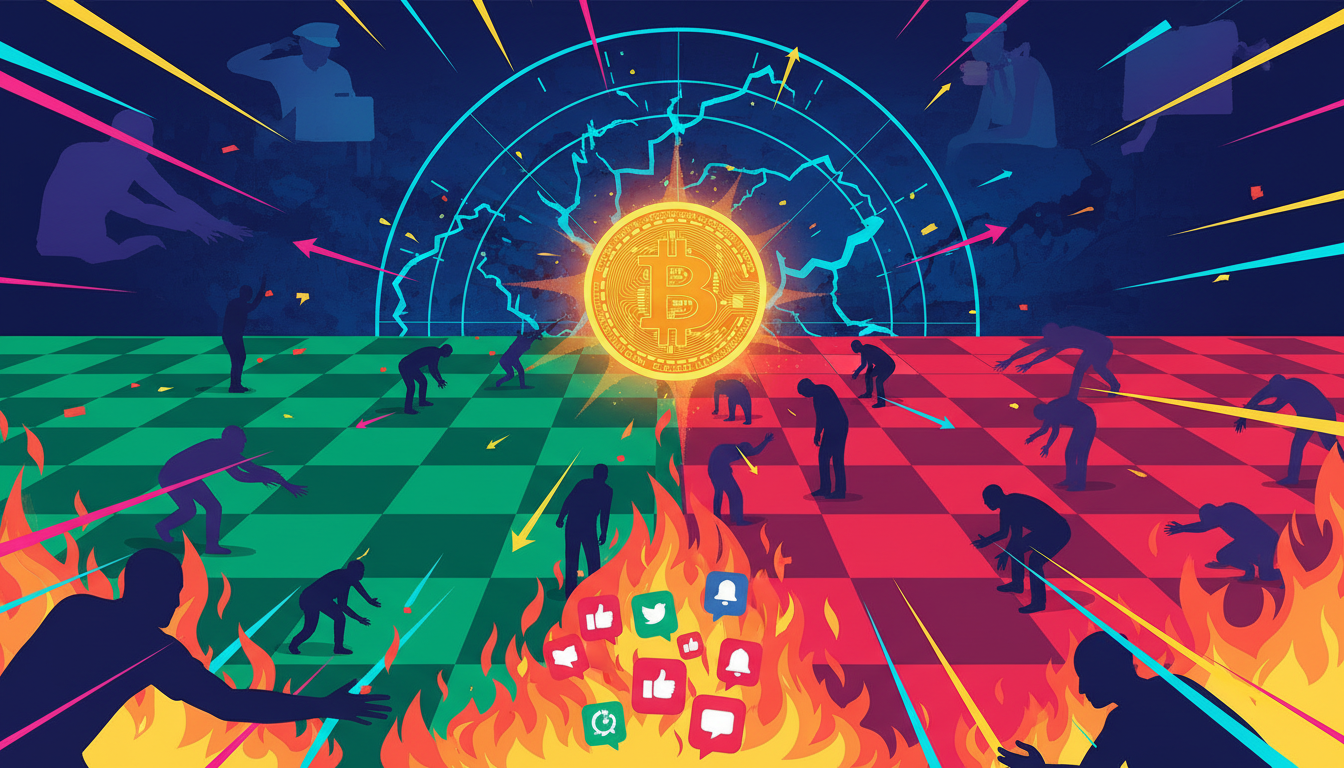
Recently, a high-risk rescue operation involving US F-15 crew members extended the battlefield beyond the wreckage of the aircraft deep into Iranian airspace. In the American narrative, this was a precise raid conducted in the heart of an enemy country, ultimately successfully rescuing a severely injured colonel; meanwhile, the Iranian side claimed the operation was a “failure,” and both conflicting versions quickly collided in the international public opinion arena. The same event, under different narratives, has been magnified into either a “precision victory” or an “adventurous setback,” underpinned by a re-competition of sovereignty, security, and deterrence. For the crypto market, any escalation of the US-Iran tensions could reshape risk appetite, elevate safe-haven demand, and cast shadows of the battlefield over the candlesticks of Bitcoin and mainstream tokens. This article will follow the main line of “battlefield games—discourse conflicts—geopolitical escalation—asset pricing” to dissect how this operation has been reflected on-chain as a new logic of risk aversion and trading opportunities.
High-risk rescue operation deep into Iran
From the currently available information, the core narrative of this rescue operation is that the US military penetrated deep into Iranian territory to rescue a colonel officer from the F-15. In the American version, special forces conducted two raids at a high operational tempo, aiming to extract the severely injured pilot from the Iranian military’s search perimeter. Briefing reports indicate that the entire operation was considered a “high-risk raid,” meaning it required rapid penetration, contact, and withdrawal before the enemy’s air defense and ground forces fully locked in.
The tension arises from the geographical and situational overlays: the operation took place within Iran, where the Iranian military not only quickly initiated a massive search but also at one point “closed in on the target.” This meant that the rescue force was exposed to the risk of encirclement or escalation of gunfire for a considerable period. For decision-makers, this operation on adversary territory is not just a tactical matter but also a direct touch on sovereignty and bottom lines, where any mistake could escalate into a larger-scale military conflict.
The brief mentioned that a single source claimed “some actions took place in daylight”, which is traditionally viewed as a choice that further elevates risk, owing to the reduced difficulty of reconnaissance and interception in daylight environments. Since this information currently comes only from a single source, it awaits cross-validation from more channels, and thus can only be treated as a background clue rather than a definitive fact during analysis. Even so, it helps to sketch out a more reckless picture: not entirely relying on the cover of night but completing key steps under greater exposure.
US President Trump, in evaluating this operation, emphasized that “all participants demonstrated remarkable courage and capability.” This was not merely a conventional commendation for the soldiers but deliberately packaged the rescue as a high-difficulty political-military achievement: being able to “freely come and go” in enemy territory not only reflects the functioning of intelligence and special operations systems but also shapes an image of “strong counterattack and precise control” for domestic audiences. Externally, this acts as an open provocation to Iran’s defensive capabilities and intelligence systems; internally, it is a marketing of the leader’s decisiveness and the ability to project national power.
Success or failure? The US-Iran discourse war begins
The operation itself is only the starting point; what truly ferments in the long term is the discourse war surrounding “success or failure.” The American side emphasizes the operation’s “success,” with key information stating that the injured colonel has been rescued, thereby constructing a narrative of “high risk but precise control”: even deep within a hostile nation, the US military can still set objectives, execute missions, and withdraw unscathed. In opposition, Iran has released signals—claiming this rescue operation was a “failure,” attempting to reshape the same event into a narrative of adventurous setbacks for the American side in Iranian airspace.
Between these two narratives, there has appeared a large amount of detail fragments in the public discourse, with one of the most viral being the claim that “the US military lingered in Iranian airspace for seven hours.” Research briefs have clarified that this statement is marked as information pending verification. This judgment is critical: if the stay duration is confirmed, it would significantly amplify the image of “Iran’s air defense system being suppressed”; if ultimately weakened or overturned, it would more reflect the exaggeration and emotionality of information warfare. Therefore, at this stage, a more prudent approach is to treat such details as tools of the discourse war, rather than definitive conclusions.
Iranian sources report that there may be plans to disclose purported “evidence of operational failure,” which is similarly listed by the brief as pending verification. From a political logic perspective, this statement itself carries signal value: by previewing “evidence,” Iran is providing psychological expectations for its domestic audience while sending an image of “sovereignty not easily breached” to the outside world, even though the form, timing, and content of the evidence remain unclear. Whether or not it is ultimately disclosed, this practice has partially hedged against the American narrative of victory at the discourse level.
The political demands of both the US and Iran become particularly clear in this incident. For Trump, in a highly polarized domestic political environment, he needs a “victory story” that can be repeatedly mentioned in the electoral context: daring to take risks, striking accurately, and successfully rescuing, which doubles as an endorsement of his tough image and the capacity of national security governance. For Iran, passively accepting the external narrative of “US forces deep into their airspace and successfully retreating” would directly impact domestic confidence in the military and government. Therefore, emphasizing “operational failure” and promising to disclose evidence is a necessary option to uphold national dignity and deterrent capacity. In such opposing narratives, the factual details are often subordinated to the “usable truths” directed at their respective audiences.
Geopolitical impacts under threats to power plants and bridges
Beyond tactical and discourse wars, the market is further tense due to open threats released by Trump. According to reports from research briefs, he stated: “Tuesday will be Iran’s day for power plants and bridges, both combined.” This seemingly obscure yet directional statement equates to publicly identifying key infrastructure as potential targets for strikes. Power plants represent the energy heart, while bridges are transportation and logistics arteries; the metaphor of “both combined” exerts comprehensive pressure on the operational core of the nation.
Such a level of threat itself will be quickly coded by market algorithms and macro traders as an escalation signal. Should the US-Iran conflict shift from limited actions toward strikes on infrastructure, market pricing logic will swiftly change: from “manageable friction” to “potential war premium.” Futures initially respond to the tightening expectations of oil prices, which then transmits to airlines, shipping, energy stocks, and related indices, subsequently influencing the global stock market and credit spreads through the risk appetite channel. In this chain, safe-haven assets like gold and some developed country bonds usually see inflows, while crypto assets occupy a more nuanced position—neither conventionally regarded as “safe assets,” yet often seen as unconventional containers for hedging against fiat currencies and geopolitical risks.
If subsequent retaliation or escalating strikes occur—whether against US interests in asymmetric responses or disruptions targeting regional allies or shipping lanes—oil price fluctuations will become the primary observation indicator. A sharp rise in oil prices often signifies a rebound in inflation expectations, subsequently affecting central bank policy outlooks and global asset repricing. In the stock market, sectors with higher exposure to the Middle East will be pressured, while capital will seek new landing points between panic and arbitrage. In such an environment, Bitcoin and mainstream tokens are often viewed as “experimental wartime safe-haven assets” by some investors: in the short term, certain investors prefer to see them as attempts at value storage not reliant on a single sovereignty, especially in regions where local currency and capital accounts are under stress.
For the crypto market, the true sensitivity lies not in the threat itself but in the paths of capital migration it triggers. When traditional safe-haven assets become rapidly congested, some high-risk-oriented funds will spread along the gradient of “gold—dollar—Bitcoin,” attempting to achieve asymmetrical returns related to geopolitical fluctuations through crypto assets. This migration, on the one hand, amplifies the upward elasticity under favorable narratives; on the other hand, it subjects crypto assets to more intense backlash pressure during subsequent emotional reversals.
Panic and speculation coexist: traders as
Looking back at history, during phases of sudden conflicts or escalations of sanctions in the Middle East, Bitcoin and mainstream tokens often display a “emotional first, logical second” short-term trend. Whether from past rounds of Iranian sanctions, escalations of the Syrian situation, or local frictions in the Gulf region, similar patterns can be seen in market movements: within a few hours to a couple of days after news of warfare breaks, Bitcoin frequently experiences rapid volume fluctuations, sometimes recording short-term fluctuations up to several percentage points or even double-digit rates, subsequently gradually returning to macro and on-chain fundamentals dominating after news resolution and risk re-evaluation.
This time, the US military's rescue operation and subsequent threatening rhetoric have also spread rapidly within the crypto community. Research briefs point out that several Chinese crypto media outlets nearly simultaneously pushed related news, causing this event, fundamentally categorized within geopolitical and military realms, to be rapidly introduced into trading contexts. Once key phrases like “Iran,” “airstrike,” “power plants and bridges day” frequently appear, the panic and excitement on social platforms are amplified in tandem, with some communities beginning to interpret the market with titles such as “a new round of conflict may commence,” as speculative expectations become intertwined within the risk-averse narrative.
On a market level, it is crucial to differentiate between several types of fund behaviors: one is short-term safe-haven buying, largely coming from investors who have distrustful expectations towards their domestic currency or regional financial systems, likely to slightly increase holdings of Bitcoin or leading tokens during heightened warfare expectations; the second is purely speculative funds, chasing up “war themes” with high leverage, leveraging social media sentiments and candlestick patterns for short-term gambles; the third is algorithms and quantitative systems, which automatically respond to spikes in public sentiment around keywords like “war,” “attack,” and “Iran,” amplifying originally limited fluctuations within certain ranges. The combination of these three leads to a marked overreaction in price during the initial stages of news.
In this context, for ordinary traders, the risk arises not just from directional price judgments but is also driven by unverified intelligence and single-source leaks. In this incident, many details, such as “lingering for seven hours” and “operation completely failed or completely succeeded,” are still pending verification. If one heavily bets on direction based on these fragments, they might face emotional reversals brought about by subsequent official clarifications, while the risk of liquidation in high-volatility environments with high leverage positions multiplies. A more rational approach would be to actively reduce leverage and concentration during such “war-driven market” movements, controlling position ratios and treating unverified content as emotional catalysts rather than trading bases.
From Tehran to Pyongyang: the grey zone
The story of the US military entering Iranian airspace casts a shadow over those countries that have long lived under sanctions and blockades, exploring how they connect with the crypto world in the grey zone. The research brief mentions reports of North Korean IT workers deeply involved in blockchain development as a typical case: under highly restricted traditional financial channels, participants mastering technology and online resources embed themselves into the global blockchain ecosystem through remote development, outsourcing projects, and code contributions, thereby acquiring foreign exchange and technical dividends. While data is limited, the specific projects and scales of contributions cannot be accurately described; however, this model itself has become a “detour sample” in the environment of sanctions.
Similar to North Korea, Iran, under financial siege, is also viewed by various studies as showing greater reliance on on-chain activities, mining, and technical outsourcing. By mining Bitcoin, it transforms its national energy into globally circulating on-chain assets; by participating in decentralized networks or development work, it provides services to overseas entities, circumventing constraints of some traditional settlement systems. On this dimension, there exists a certain mirroring between Tehran and Pyongyang: one side involves war-edge policies and missile tests, the other side seeks new chips and exits in GitHub and on-chain networks.
As geopolitical tensions and cyberspace struggles converge, war-edge policies often have potential ties with cyberattacks, money laundering on-chain, and ransomware payments. On one hand, state or state-affiliated actors may utilize ransomware to attack infrastructure, anchoring ransoms in crypto assets; on the other hand, by way of complex on-chain mixing and cross-chain conversions, they merge sanction evasion with fund concealment. These activities may not necessarily immediately reflect in prices, yet they will, from a regulatory perspective, reinforce the label “crypto assets = geopolitical grey tools.”
From a medium to long-term view, these participants introduce implicit variables into the flow of on-chain funds, project ecosystems, and compliance pressures. The opacity and cross-border nature of fund flows on-chain present higher thresholds for law enforcement and regulation; project parties and infrastructure providers must seek new balances between openness and compliance. Once specific public chains or agreements are repeatedly named in relation to sanctioned countries, their ecological development, institutional participation rates, and compliance prospects may encounter “extra discounts.” Therefore, these seemingly distant geopolitical events will, in reality, reshape the landscape and rules of the crypto industry over a longer period.
Survival guide for crypto assets under the shadow of war
Returning to the US military rescue operation itself, its direct impact on the market manifests more clearly in the short-term impact paths of risk appetite and demand for safe havens: the downing of the aircraft and the rescue raid constitute the starting point of the event, followed by the discourse war between the US and Iran surrounding “success and failure,” further overlapping with infrastructure threats likened to “power plants and bridges day,” leading to a repricing of the market regarding direct conflict escalation between the US and Iran. Throughout this process, some funds have shifted from risky assets into traditional safe havens, while others have sought to include Bitcoin and mainstream tokens into hedging combinations amid “uncertainty premiums,” where short-term volatility is simultaneously amplified by panic and speculation.
From a medium to long-term perspective, if geopolitical pressures gradually become the new normal globally, crypto assets will find themselves continually pulled between regulation and demand. On one hand, the demand for on-chain tools in regions under sanctions and conflict will drive technological and application penetration, reinforcing their functions as cross-border value carriers; on the other hand, concerns about money laundering, sanctions evasion, and ransom payments will push major economies to accelerate the introduction of stricter compliance frameworks and on-chain monitoring tools. Along this path, crypto assets might increasingly resemble “regulated unconventional safe-haven assets”: in crisis, they are in demand; post-crisis, they are scrutinized.
In terms of trading and asset allocation, more feasible principles under the current environment include: not betting on unverified battle reports themselves, but paying attention to how they transmit to the crypto market through oil prices, stock indices, and credit spreads; during intense short-term price fluctuations, prioritizing reducing leverage and concentration to avoid being forced to accept on-chain liquidations due to single leaks; utilizing macro data, ETF fund flows, and large on-chain transfers as resonance signals to determine whether capital is genuinely migrating from traditional markets to crypto assets, rather than merely trading “war stories” based on emotional clues.
In the coming days, the press conference that Trump previewed and the subsequent US-Iran interactions will become the next stage node of this narrative. Whether further escalating threats or releasing signals of easing, both will carry out secondary molding of market expectations: on one hand, correcting prior panic or optimism scenarios built on fragmented information; on the other hand, redistributing funds between different assets. For crypto participants, it is more important not to rush to bet on directional movements but to clearly understand their positioning on the risk curve amid each wave of emotional turmoil triggered by geopolitical shocks, learning to reserve survival space for assets and strategies under the shadow of war.
Join our community to discuss and become stronger together!
Official Telegram community: https://t.me/aicoincn
AiCoin Chinese Twitter: https://x.com/AiCoinzh
OKX Welfare Group: https://aicoin.com/link/chat?cid=l61eM4owQ
Binance Welfare Group: https://aicoin.com/link/chat?cid=ynr7d1P6Z
免责声明:本文章仅代表作者个人观点,不代表本平台的立场和观点。本文章仅供信息分享,不构成对任何人的任何投资建议。用户与作者之间的任何争议,与本平台无关。如网页中刊载的文章或图片涉及侵权,请提供相关的权利证明和身份证明发送邮件到support@aicoin.com,本平台相关工作人员将会进行核查。