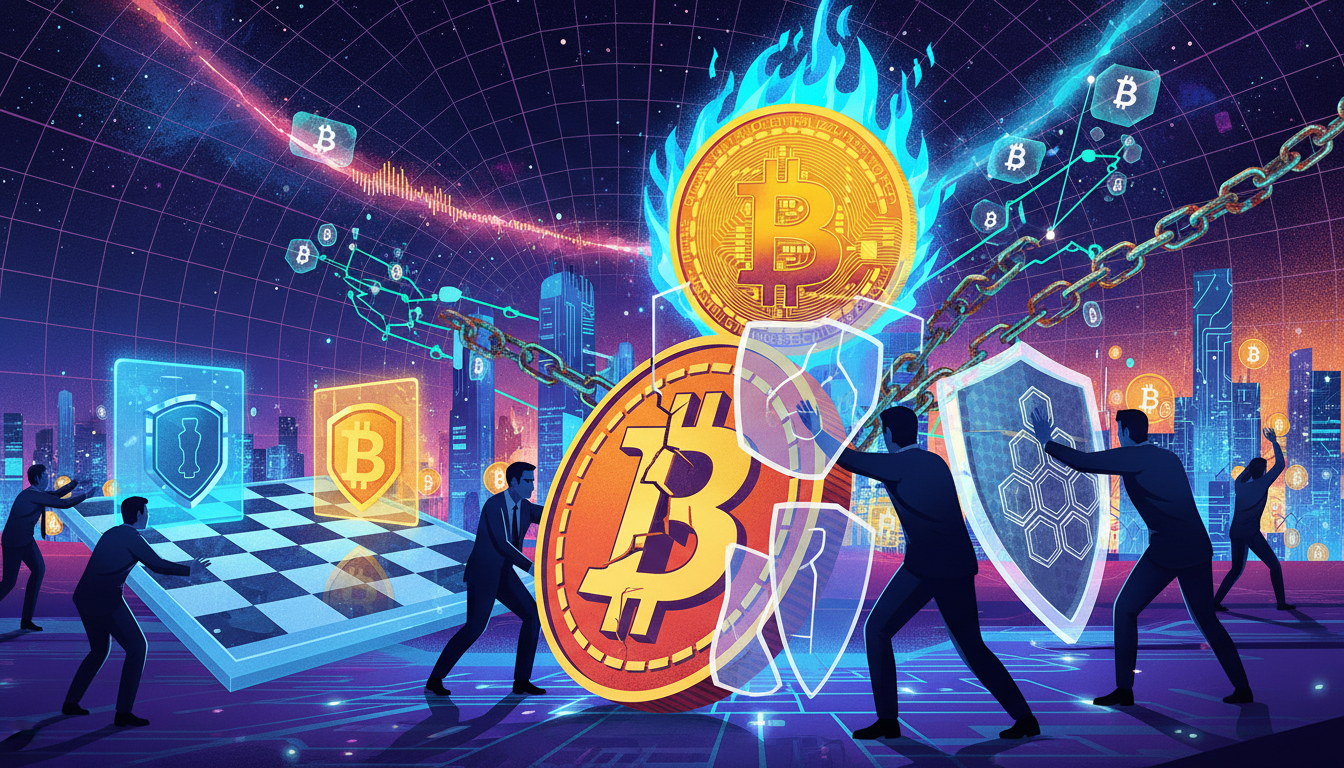
On April 6, 2026, market activity in the eastern time zone was influenced by two seemingly unrelated pieces of news: on one side, Iran openly rejected the 15-point peace proposal relayed by the United States through Pakistan, while on the other side, the South Korean Financial Services Commission (FSC) demanded that local cryptocurrency exchanges implement high-frequency real-time reconciliation systems. Almost on the same timeline, spot gold prices reached a historic high of $4700/ounce, U.S. stock futures strengthened, and the resonance of geopolitical tensions intertwined with risk and safe-haven assets. Security anxiety was brought to the forefront, and the different choices made by various countries between “war” and “finance” are rewriting the risk pricing of global assets.
Iran Rejects the Fifteen-Point Plan: War and Leverage
On the same day, Iranian Foreign Ministry spokesperson Ismail Baghaei clearly denied the "15-point plan" conveyed by the United States via Pakistan through official channels. According to the Islamic Republic News Agency, Tehran views this plan not as a genuine path to peace but as a political list aimed at reshaping regional order. Iran’s decision to have the Foreign Ministry spokesperson speak out, rather than using vague “sources,” itself is a signal to the outside world—that this is a formal stance reviewed by top officials, rather than tentative commentary at the negotiation table.
In wording, Iran used highly confrontational expressions. The official statement called the U.S. 15-point plan “ambitious and illogical” and emphasized that “a swift response should not be viewed as yielding to the enemy.” These two statements deny the legitimacy of the plan itself while actively claiming the narrative high ground: Tehran aims to show both domestically and internationally that it is not passively reacting in panic, but rather continuing a consistent strategy under the “resistance economy” and a hardline security approach, refusing to equate speed with weakness.
However, behind the tough rhetoric lies a significant information gap. The specific terms of the U.S. 15-point plan have not been made public, and official channels like IRNA have not provided any details for external analysis; Iran has merely stated that it will announce its demands at the “appropriate time,” without giving any timeline. In the absence of text for comparison, it’s difficult for outsiders to gauge whether Iran’s claim of “great ambition” refers to security, sanctions, or a redefinition of regional influence, further amplifying market speculation.
In stark contrast, former U.S. President Donald Trump claimed on social media that “Iran has agreed to most of the content of the U.S. proposal.” This statement is still regarded as unverified information, lacking an official endorsement from current Washington authorities and has not been publicly acknowledged by Tehran. The domestic public opinion environment in Iran continues to emphasize the central theme of “not yielding,” and the cognitive dissonance between Trump’s optimistic narrative and Iran’s official denial adds more uncertainty to the geopolitical situation, making it harder for the market to make a clear judgment on “peace pricing.”
Gold Breaks $4700: Geopolitical and Liquidity Resonance
Following Iran’s strong signals, safe-haven sentiment quickly found an outlet in the market. On April 6, 2026, spot gold prices broke through the $4700/ounce mark, setting a new historical high, with the rise in prices almost synchronized with the dissemination of Iran’s statement. For a traditionally crowded safe-haven asset, continuing to pull new gains at high levels is often not due to a singular event, but rather the accumulation and affirmation of various risk perceptions.
This new high first and foremost reflects a further elevation of geopolitical risk premium. Market concerns over the escalating situation in the Middle East do not just stop at localized conflicts but extend to energy supply, shipping security, and the larger landscape of great power competition. Iran’s public rejection of the peace proposal effectively compresses any potential for easing in the short term, raising the probability weights for “long-term confrontation” and “unexpected escalation.” At this moment, gold is not simply following inflation expectations, but is pricing in the “tail risks of war.”
More intriguingly, as gold strengthens, U.S. stock futures also rise, showcasing a rare resonance of “risk assets rising + safe-haven assets hitting new highs.” This seemingly contradictory trend reflects that global markets are still immersed in an environment of ample liquidity, with funds constantly seeking containers that accommodate risk and hedging needs; on the other hand, it indicates that some investors are betting on a scenario where “conflicts are controllable, and policies remain accommodative”—capturing growth premiums with stock index futures while hedging possible strategic misjudgments with gold. As for cryptocurrency assets, their classification as either “digital gold” or “high beta risk exposure” is once again a matter of contention amidst this round of safe-haven surge.
South Korea's Regulatory Push: The Signal of Five-Minute Reconciliation
In contrast to the tense atmosphere in the Middle East, South Korea's actions unfold within cold compliance regulations. The South Korean Financial Services Commission (FSC) announced that it requires local cryptocurrency exchanges to establish a real-time ledger reconciliation system every five minutes, which means automatic comparisons between on-chain records, internal ledgers, and client asset details at very short time intervals. This signifies that the previous risk control model, which relied more on post-audit and end-of-day reconciliations, is being pushed toward a quasi-"real-time monitoring" phase.
This regulatory upgrade did not appear out of thin air; its direct trigger can be traced back to a significant operational incident at Bithumb in February 2026—the erroneous issuance of 620,000 BTC records, which raised collective doubts in the market regarding the internal controls and asset security of exchanges. Although the subsequent details, accountability, and compensation arrangements have not yet been fully disclosed in official documents, this extreme number has been enough for regulators to recognize that in an industry characterized by high-frequency trading and massive capital flows, traditional low-frequency ledger reconciliations cannot cover the tail risks arising from “operational errors + systemic flaws.”
The introduction of high-frequency reconciliations will reshape the exchange ecosystem from multiple dimensions. On one hand, it is expected to significantly reduce time-based exposure windows for erroneous transactions, theft, and internal control failures, thereby enhancing the security of funds and the robustness of systems; on the other hand, such frequent automated checks will also increase technological investment and operational costs, placing small platforms under pressure from rising compliance thresholds, forcing them to invest more resources in on-chain data integration, risk control engines, and audit interfaces. For the entire industry, this represents a “transparency upgrade” pressured by regulation.
It is important to emphasize that currently, information on “five-minute real-time reconciliation” mainly comes from a single source of reporting, and specific technical standards, implementation details, and transitional arrangements have not yet been fully disclosed. Investors and practitioners should maintain ongoing tracking of subsequent regulatory documents when interpreting this signal, rather than drawing a complete picture of punishment mechanisms or accompanying tools based solely on a headline.
From Resistance Economy to Transparent Risk Control: A Contrast of National Security Views
If we place the news from Iran and South Korea within the same coordinate system, we find that both essentially discuss the same subject: how states redefine “security” in an uncertain era. Iran opts to continue the “resistance economy” route, maintaining negotiating leverage and regional influence by firmly rejecting the U.S. 15-point plan in the face of external pressure, conveying a security logic of “maintaining autonomy through confrontation”; South Korea, on the other hand, attempts to establish a “verifiable, accountable” security system in the financial and cryptocurrency realms through meticulous regulation and technical requirements, aiming to enhance the resilience of its domestic industry in a highly volatile environment through institutional means.
Geopolitical adversarial security and institutional financial security each have their advantages and costs in practical operation. The former can inspire national cohesion in the short term, consolidate regime legitimacy, and secure greater bargaining space at the negotiation table but can also internalize structural risks like sanctions, escalated conflicts, and capital flight as long-term costs; the latter, through rules and transparency, reduces the frequency and impact of systemic incidents in exchange for trust in international markets, but at the same time bears constraints on the freedom of innovation within local industries and the compliance premium that may come with being “ahead of the curve” in global regulatory competition.
In the context of capital cross-border flows and the rise of cryptocurrency assets, the security game between sovereignty and the market becomes especially complex. On one hand, states wish to preserve control over their currency systems, payment networks, and capital flows to prevent external shocks and internal risk accumulation; on the other hand, market participants continually disrupt traditional boundaries using new technologies and asset classes, migrating value from one regulatory jurisdiction to another. Iran seeks to control its own negotiating leverage in regional games, while South Korea aims to掌控 its own financial system’s capital flows and data truths—the common keyword behind both is "control."
The Dilemma of the Cryptocurrency Market: Safe-Haven Narratives and Regulatory Red Lines
Under this global narrative, the cryptocurrency market has been pushed into an awkward middle ground. On one hand, the safe-haven sentiments raised by the situation in Iran might theoretically enhance the appeal of “anti-censorship assets” and “decentralized value storage,” prompting some investors to allocate both gold and mainstream cryptocurrencies simultaneously, viewing the latter as a more elastic “digital safe-haven asset” while seeking excess returns amidst the intertwining of geopolitical conflict and monetary easing expectations. On the other hand, when panic truly amplifies and risk appetite sharply contracts, cryptocurrency assets are often classified as high beta risk assets, becoming the first to be sold off to obtain liquidity.
Meanwhile, developed markets like South Korea continue to tighten compliance standards, putting forward higher requirements for exchange transparency, on-chain data, and off-chain ledger connections; this regulatory pulse will spread outward along the path of global liquidity. High-frequency reconciliation, real-time monitoring, and standardized audit interfaces will compel trading platforms to embed on-chain verification mechanisms more deeply into their technical architecture while reducing the operational space for “black-box” operations. This is a long-term benefit for leading platforms aiming to attract institutional funds, yet it also means that the compliance threshold for the whole industry is systematically raised.
Under the dual pressure of geopolitical tensions and stringent regulation, the asset allocation logic of institutions and retail investors may also undergo a rebalancing. Large institutions need to readjust their weightings within the “compliance-holdable asset pool,” placing greater emphasis on custody safety, audit clarity, and compliance pathway transparency; retail investors, on the other hand, find it easier to switch back and forth between gold, U.S. stocks, mainstream cryptocurrencies, and high-risk altcoins in response to emotional fluctuations and policy risks, chasing narrative hotspots at different stages. Regardless of which side they are on, market participants must learn to pay for two types of non-traditional risk premiums: the premium of war shadows and the premium of regulatory costs.
The Shadow of War Remains: To Whom Will Capital Vote
Returning to the starting point, Iran's hardline stance and South Korea's regulatory tightening seemingly occur between the shadows of warfare and in meeting room documents, yet both reflect the same global sentiment: security anxiety is reshaping asset prices. The former demonstrates a political will of “not conceding under pressure” by rejecting the U.S. 15-point plan; the latter transmits regulatory determination that “systemic operational failures will no longer be tolerated” through the five-minute reconciliation rule. Both choices are forcing funds to reassess the weights of geopolitical risks, institutional risks, and technological risks.
It is essential to remain clear-headed that the current key information regarding whether there are direct contacts between the U.S. and Iran, and whether Iran has accepted the proposal to some extent, remains in a pending verification state. Besides public statements and limited official channels, there is no reliable text for comparison available, and most “insider claims” seem more like tools for different political camps to seize narrative advantages. For financial markets, in this stage of high information asymmetry, over-reliance on a single source or emotional interpretations often means incurring additional misjudgment costs.
Looking ahead, if geopolitical conflicts escalate further, the allure of gold and other traditional safe-haven assets may continue to rise, while conversely, some high-risk assets might face valuation discounts; if the situation unexpectedly eases, markets could quickly recover the previous “war discounts,” drawing attention back to economic data and monetary policy rhythms. Meanwhile, as countries like South Korea impose stricter regulations on cryptocurrencies, funds may migrate from regulatory gray areas to platforms and assets with higher compliance, forming a “high transparency asset premium.”
During periods of intense emotional volatility, investors need to increase their emphasis on the quality of information sources, interpretation of policy details, and their own risk control capabilities. Rather than trying to rush ahead at every news headline, it is better to leave space for tail events and regulatory changes when constructing positions—because in an era where war and finance intertwine, capital will ultimately vote for strategies that can continue to survive in uncertainty, rather than fleeting dazzling bets.
Join our community to discuss and become stronger together!
Official Telegram community: https://t.me/aicoincn
AiCoin Chinese Twitter: https://x.com/AiCoinzh
OKX Welfare Group: https://aicoin.com/link/chat?cid=l61eM4owQ
Binance Welfare Group: https://aicoin.com/link/chat?cid=ynr7d1P6Z
免责声明:本文章仅代表作者个人观点,不代表本平台的立场和观点。本文章仅供信息分享,不构成对任何人的任何投资建议。用户与作者之间的任何争议,与本平台无关。如网页中刊载的文章或图片涉及侵权,请提供相关的权利证明和身份证明发送邮件到support@aicoin.com,本平台相关工作人员将会进行核查。