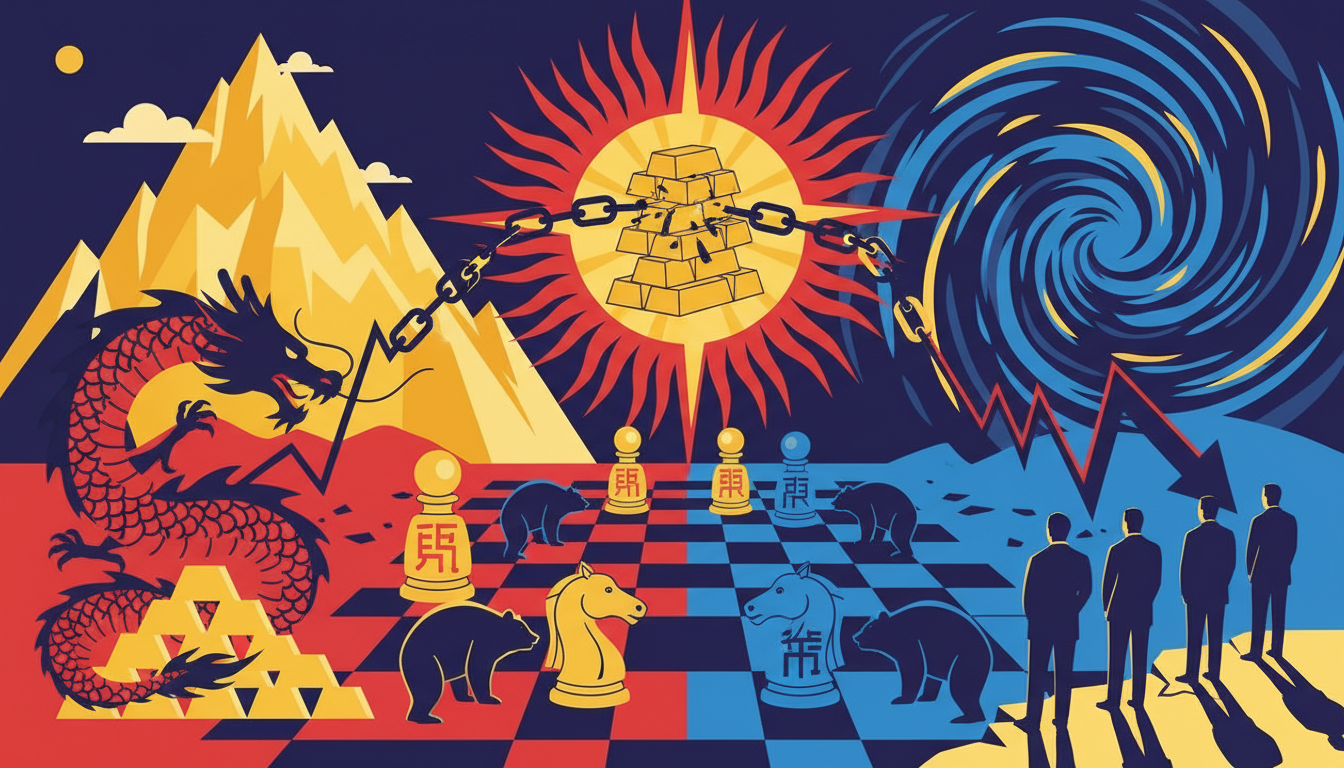
Starting from the second half of 2027 in UTC+8, the originally independent two computational power tracks began to collide head-on over the same resource: electricity. On one side, there are AI training clusters pursuing larger models and faster iterations; on the other side is the Bitcoin network, which has seen both global computational power and mining difficulty reach new highs, with both parties competing for limited and progressively re-priced energy. Tech companies like Anthropic are signing long-term computational power and hosting collaborations with large mining companies, pushing mining farms to the forefront of AI infrastructure. Meanwhile, Bitcoin mining is estimated to consume between 13 to 25 gigawatts (marked in the brief as pending verification), and under the pressure of fluctuating coin prices and rising costs, some mining companies have been forced to sell over 19,000 BTC recently (also pending verification), leading to rising market tensions over sell-off pressures and energy reallocation. A new order is forming between the power grid, data centers, and mining farms, with an unavoidable question: How will the interests of miners and AI companies be rewritten when electrical resources are redistributed between AI and mining?
Turning from Mining to AI Hosting
As we enter 2027, Bitcoin's total network computational power and difficulty continue to break records, compounded by rising electricity prices, leading to a sharp contraction of profits in traditional mining businesses of leading firms like Core Scientific. In the reality of reduced block rewards post-halving, with transaction fees failing to stabilize the gap, they must seek a second cash flow curve to hedge against dual uncertainties of coin prices and difficulty. Continuing to solely bet on "mining more BTC" can no longer sustain a highly leveraged, high capital expenditure balance sheet.
The infrastructure accumulated over the years by mining farms is revealing new value in this AI wave: they are located in remote areas with low-cost electricity, possess large pieces of developable land, and have highly industrialized data centers, electrical wiring, and cooling systems, all of which can be transformed into AI data center hosting bases in a relatively short time. Compared to building a compliant data center from scratch, upgrading existing mining farms to accommodate AI chips involves shorter construction paths, less regulatory pressure, and more controllable input-output ratios.
Against this backdrop, mining companies like Core Scientific began negotiating with AI ecosystem participants such as Anthropic, Google, and Broadcom, extending from initially small-scale server hosting to multi-year computational power cooperation frameworks. On one side are tech companies with a strong demand for AI training, yet keenly aware of the long cycle of building their data centers; on the other side are mining companies aiming to revitalize existing assets and reduce dependency on single-source mining, with the misalignment in time and resource structure bringing "computational power cooperation agreements" into reality. The essence of this shift is that mining companies' business models are changing from “producing BTC and speculating on market prices” to “selling the computational power and rack space of the electricity they carry,” replacing highly volatile block reward incomes with long-term leasing, hosting, and operations contracts.
The Power Struggle on the Electricity Grid
This transformation is not occurring in a vacuum. The brief shows that Bitcoin mining’s estimated electricity consumption is between 13 to 25 gigawatts (clearly stated as a pending verification range), while at times of rising prices and difficulty, total network computational power continues to climb, indicating that the overall willingness of miners to consume electricity has not significantly retreated. At the same time, mainstream market voices suggest that AI computational power construction is rapidly becoming one of the largest sources of new electricity demand in the United States, as large cloud providers and AI companies continuously sign long-term power purchase agreements with utility companies to lock in substantial incremental electricity for the coming years.
When these two demands converge on the same power grid, conflicts are no longer abstract numbers but very specific contests over distribution capacity, transmission lines, and electricity price discounts: traditional mining farms and newly built AI data centers within the same state are applying for additional load allocations from the same power company, negotiating who can secure more stable and cheaper electricity price contracts. For mining companies, even losing the “off-peak electricity price” discount could directly erase their already limited mining profits; for AI companies, electricity prices determine the marginal cost of training a large model, which in turn affects product iteration speed and market competitiveness.
In this game, local governments and energy companies are pushed to the forefront. On one hand, they see AI being packaged as "new productive forces," hoping for high value-added industries, jobs, and tax revenues brought by AI data centers; on the other hand, Bitcoin mining continues to face pressure from regulation and public opinion, being questioned for its "high energy consumption and low output." Electricity regulatory agencies must balance “supporting AI upgrades” and “controlling mining expansion” when approving new load connections and negotiating long-term electricity prices, and this policy tilt itself will change the allocation ratio of electricity resources between blockchain computational power and AI computational power.
The Tension of Profit Temptation and Business Migration
In capital markets and industry discussions, a provocative statement has begun circulating: moving the same kilowatt-hour from Bitcoin mining to AI computation could yield a profit margin that is 3 to 5 times that of traditional mining. The brief explicitly defines this claim as a "pending verification viewpoint," but it’s sufficient to explain why an increasing number of mining companies are seriously evaluating paths to transform into AI hosting — even if the actual multiplier may not be that exaggerated, as long as the marginal profit and cash flow stability brought by AI are significantly superior to continued investment in mining, the economic motivation for computational power migration will naturally form.
This temptation is supported by real business fundamentals. According to the brief, Anthropic's annual revenue has surged from $9 billion to $30 billion, although the exact proportion of infrastructure investments has not been broken down, the revenue explosion at least indicates that there is a huge growth space around cloud services and AI infrastructure related to large models. To accommodate such demand, mining companies are no longer just selling "current electricity + hardware time," but are attempting to become the "landlords of computational power" in the AI era, locking in AI company's rack, electricity, and operational expenditure over several years through long contracts.
Meanwhile, recent accusations suggest that mining companies collectively sold over 19,000 BTC (the brief also marked this as pending verification), providing another subtle hint for the transformation motive mentioned above: under the squeeze of electricity prices and difficulty, relying solely on mining income is no longer adequate to support daily operations and expansion, forcing miners to leverage their inventory of BTC for fiat currency to cover electricity bills, equipment depreciation, and new business layout costs. With the increasing proportion of hosting and computational power rentals, miners' income structure is also undergoing a qualitative change: transitioning from depending on block rewards and on-chain transaction fees with "high volatility income" to a "utility-like cash flow" from long-term computational power leases, AI hosting service fees, and value-added operational services.
Cross-Industry Collaboration of Shared Infrastructure
This migration is being scaled rapidly due to the natural compatibility of mining farms and AI data centers at the infrastructure dimension. Mining farms are often located in remote areas close to the power source, enjoying relatively low electricity prices, and have accumulated land reserves suitable for large-scale data center construction; while AI companies, if they choose to establish their sites, often need to navigate much longer land approval, power distribution expansion, and environmental assessment processes. The "ready-to-use" land and power access conditions of mining farms perfectly fill the pain points of AI companies in terms of construction cycles.
At the equipment level, although AI training clusters and ASIC mining machines differ greatly in chip architecture and cooling requirements, the existing cooling systems, data center structures, power redundancy designs, and wiring channels of mining farms can still be largely reused during the transformation. By upgrading transformers, optimizing power distribution architecture, and introducing higher density racks and cooling technologies, mining companies can meet the deployment demands of the new generation of AI chips and accelerator cards without entirely starting from scratch. This model of “hardware reconstruction + infrastructure reuse” significantly reduces the marginal costs of AI computational power expansion.
In the chip supply chain segment, Broadcom and other manufacturers play a crucial role as technological and ecological links: on one end, they deeply service cloud providers and AI companies, offering customized acceleration chips and interconnection solutions; on the other end, they collaborate with mining companies on infrastructure upgrades and compatibility transformations. However, the brief has not disclosed any specific procurement quantities or amounts for TPUs or other chips, and the related cooperation mainly remains at a macro level of "participation in cross-industry infrastructure construction." It is certain that electricity, land, and cooling capacity have upgraded from "production factors" in Bitcoin mining to strategic assets spanning the crypto and AI industries. Whoever can control these resources will have a better chance of gaining the upper hand in the next computational power cycle.
The Divergent Survival Paths of Miners
In this macro reconstruction, miners are not a homogenous group but are rapidly moving toward divergence. Some mining companies, in the environment of extreme price fluctuations and compressed mining profits, can only "extend their lives" by selling their inventory BTC to pay for high electricity costs, depreciation of old mining machines, and necessary maintenance costs. These companies are usually at a disadvantage in terms of electricity price negotiation capability, balance sheet health, or technological iteration speed, and lacking sufficient bargaining chips to attract leading AI clients, ultimately being forced to "tough it out" on traditional mining paths.
In stark contrast to them, other larger, better-equipped mining companies with deeper ties to the capital market are utilizing their advantages in land, electricity, and data centers to sign long-term computational power and rack agreements with AI companies. Although these contracts lack publicly available details (the brief also classifies specific terms as pending verification and not suitable for inference), it can be inferred that they bring mining companies a more stable, predictable cash flow, bringing them closer to traditional data center or utility company valuation logic when financing and expanding production.
This divergence in operational paths is amplifying the valuation differences among mining companies: the market is beginning to reassess "mining stocks," viewing mining companies with AI hosting revenues and long-term computational power leasing contracts as mixed infrastructure assets with higher growth and defensive attributes, while those still relying solely on mining revenues are classified as high-beta subjects sensitive to Bitcoin prices. Meanwhile, within the miner community, the approach of "using the same batch of electricity and infrastructure to serve AI, rather than merely contributing computational power to the Bitcoin network" is also causing identity-level rifts: one faction insists that computational power should serve a decentralized monetary system, while another values shareholder returns and corporate survival more, viewing computational power as an asset that can be freely allocated across multiple tracks.
The Future of Bitcoin Under the New Order of Computational Power
In summary, the rapid expansion of AI infrastructure is forming a long-term squeezing effect on the supply of cheap electricity worldwide and placing significant uncertain constraints on the future growth path of Bitcoin's computational power. As more electricity becomes locked into long-term AI contracts, the space for miners to acquire low-cost electricity diminishes, and the marginal costs of mining may overall shift upward, forcing the industry to undertake more refined optimizations in hardware efficiency, site selection strategies, and energy structures, rather than continuing to rely on "extensive expansions" to stack total network computational power.
This does not mean that miners will collectively "abandon mining for AI" in the short term. From a realistic decision-making perspective, a "mixed computational power" pattern is more likely to emerge: the same batch of infrastructure may serve the Bitcoin network and AI training alternately over different periods or form divisions in different regions — continuing to mine in areas with more lenient electricity regulation and lower prices, while shifting to centralized operations in regions favoring AI with superior grid conditions. The overlap of regional discrepancies and business displacements will make the map of computational power migration more complex than a simple linear transition.
At the same time, critical information such as detailed cooperation terms between mining companies and AI firms, as well as the future evolution path of Bitcoin's total network computational power and difficulty, remain in a pending verification state. The brief deliberately avoids sensitive details such as the installed gigawatts of TPUs or contract profit-sharing ratios, indicating that any precise predictions based on this missing data may carry significant deviations. For participants trying to find investment opportunities from this computational power reconstruction round, continuously tracking electricity policies, data center project progress, and the structural changes disclosed by leading mining companies is more crucial than simply applying past mining cycle experiences.
In a world where electricity is being repriced and continuously flows between AI and cryptocurrency, Bitcoin mining finds it difficult to maintain the old model of "extensive power consumption + betting on coin prices." A more realistic picture is that miners are forced to evolve into more complex energy financial participants, configuring assets among long-term power purchase agreements, renewable energy projects, flexible load management, and inter-industry computational power leasing. The security and decentralization degree of the Bitcoin network will also be deeply tied to this degree of energy financialization, entering a new order shaped by power, capital, and computational power.
Join our community to discuss and grow stronger together!
Official Telegram group: https://t.me/aicoincn
AiCoin Chinese Twitter: https://x.com/AiCoinzh
OKX Benefit Group: https://aicoin.com/link/chat?cid=l61eM4owQ
Binance Benefit Group: https://aicoin.com/link/chat?cid=ynr7d1P6Z
免责声明:本文章仅代表作者个人观点,不代表本平台的立场和观点。本文章仅供信息分享,不构成对任何人的任何投资建议。用户与作者之间的任何争议,与本平台无关。如网页中刊载的文章或图片涉及侵权,请提供相关的权利证明和身份证明发送邮件到support@aicoin.com,本平台相关工作人员将会进行核查。