Author|Turbo Guo IOSG Ventures
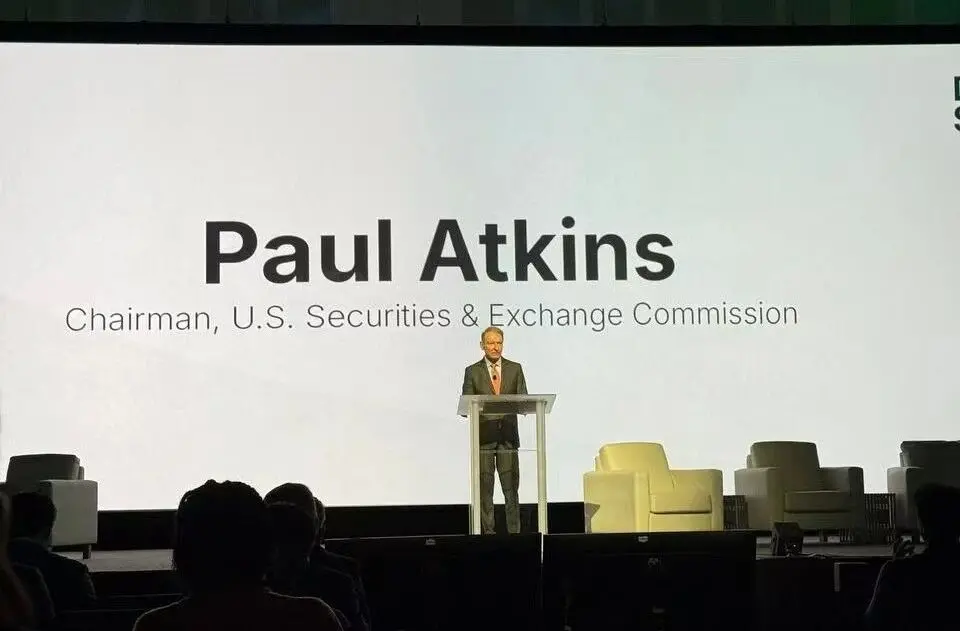
In March of this year, I attended the Digital Asset Summit (DAS) in New York. This was the most "institutionalized" blockchain conference I have ever been to, and it made me feel quite complex.
After a few days of listening to the conference, what kept coming to my mind was not how hot a particular track was or how strong a particular project was, but a pervasive sense of alienation. This alienation exists not only within the conference venue but extends to my observations of the entire industry during my time in the U.S.
A Ticket That Few Want
This does not mean that no one wants a ticket to DAS; in fact, the venue was very lively, but I want to first mention a detail that struck me.
I am currently studying for my master's at the University of Pennsylvania and joined the school's blockchain club, Penn Blockchain Club. The DAS ticket costs $1800, and this time the club got free tickets to distribute to members, as well as reimbursements for round-trip train fare. As someone who has always been in the industry, my first reaction was excitement. The SEC chair gave a keynote speech, executives from BlackRock and Bank of New York Mellon took the stage, and DTCC, Kalshi, Dragonfly, Ethena, Aave, OKX, BNB Chain, etc., were all involved, a very impressive lineup. An $1800 ticket, free of charge, what’s to hesitate about?
But very few people in the club wanted this ticket.
This is the first layer of alienation I speak of:I feel very excited about such opportunities; however, most American undergraduates do not care as much. They are more interested in Goldman Sachs’ info sessions, want to secure an internship at an AI lab, or go into banking. The allure of crypto for them is not that significant. There is no right or wrong in this, but it clearly tells you one thing: in the eyes of young people at top universities in the U.S., the appeal of crypto is continuously being diluted by AI and traditional finance.
Institutionalized Conference
The DAS venue was full of suits; this was the only crypto event I attended where almost everyone was in formal attire. The overall atmosphere was relatively institutional.
I met many people during one-on-one discussions both at the venue and offsite: the founders of Inversion, Santiago and research head George, Guy Young, founder of Ethena, Managing Partner Richard from Fabric.vc, and people from Bridge, Circle, KPMG, Deloitte, Token Terminal, DoubleZero, and more. This list itself indicates the positioning of DAS: it is a place where traditional finance and crypto infrastructure deeply intersect.
Institutions Continue to Advance, Crypto Natives Feel Confused
After listening to DAS for a few days, my core feeling can be summed up in a sentence: institutions continue to advance, while crypto natives feel relatively confused. We have always been looking forward to the arrival of mass adoption, but when it actually came, it was already another world.
This is the second layer of alienation.
Let’s first talk about the institutional side. The entire agenda of DAS itself tells you that the pace of advancement in traditional finance is actually very fast:
Tokenized securities are no longer just a concept; they are becoming a reality. The SEC has released a classification system for tokenization, dividing it into direct tokenization (the issuer directly issues through a transfer agent), indirect tokenization (custodian institutions like DTCC issue "digital twin" rights certificates), and synthetic tokenization (exposure mapping based on derivatives). Among them, the DTCC scheme is the most noteworthy, as it can complete the conversion between tokens and traditional securities in about fifteen minutes while maintaining liquidity parity between the two capital pools. DTCC plans to go live on-chain with Russell 1000 stocks, major ETFs, government bonds, and fixed income products by the second half of 2026 and has already received a no-objection letter from the SEC. These are not derivatives packages, but real rights certificates with genuine dividends, real investor protection, and real ownership.
Stablecoin as a Service is forming three clear sub-markets. After talking to Bridge, Circle, and Ethena, I discovered a common theme: Bridge focuses on institutional white-label solutions; Circle concentrates on region-specific compliance scenarios (such as stablecoin payments in the construction industry in Latin America); Ethena serves crypto native projects (Jupiter, MegaETH, Layer 1/Layer 2 projects like Sui are all looking for Ethena to provide Stablecoin as a Service). These three paths do not conflict with each other, each advancing in its own sub-market.
The credit market using Bitcoin as collateral is rapidly maturing. At the end of February 2026, Ledn issued the first publicly rated Bitcoin loan ABS (asset-backed security), which received an investment-grade rating from S&P. This is a three-year financing involving over a dozen insurance, pension, mutual fund, and hedge fund participants, with custody provided by Fidelity Digital Assets. Compared to crypto loans, which typically have terms of less than twelve months, this is a milestone. Maple has also added $400 million in loan capital inflow this year. Traditional banks are entering the crypto prime brokerage business because they fear hedge fund clients might turn to crypto exchanges.
The liquidity in prediction markets is the real moat. John Wang from Kalshi shared an interesting perspective on stage: the self-built prediction markets by Robinhood and Coinbase do not pose a significant threat because the hardest part of prediction markets is liquidity, not distribution. Kalshi maintains a unified liquidity pool globally; competitors are forced to split their pools between the U.S. and non-U.S. due to regulatory reasons, which naturally creates a deep divide.
On-chain Vaults are being regarded as a new type of ETF. This topic was repeatedly mentioned at DAS. The logic of traditional ETFs is to bundle a basket of assets into standardized products, while on-chain Vaults do essentially the same thing but with added combinability and transparency. More institutions are beginning to build strategy management services around Vaults, and the role of Vault managers is very similar to that of traditional fund managers. Coupled with the recent surge in traders engaged in futures and commodity trading on Hyperliquid, the demand for capital management of on-chain Vaults will continue to grow.
The discussion of public chains vs. private chains is also interesting. JPMorgan's approach is multi-chain deployment, with private chains used for internal efficiency (no need for additional wallet configurations) and public chains used for distribution, driven entirely by demand. DTCC initially deployed on Canton (a private chain), but since the SEC lifted restrictions, it has also begun deploying on public chains, working on building a cross-chain orchestration layer to allow free token transfer. From the perspective of crypto natives, public chains excel in terms of practicality, as DEX trading, lending markets, and composability all occur on public chains. However, it cannot be denied that private chains like Canton and Tempo have inherent compliance advantages in institutional backend scenarios. Currently, the number of L1/L2 chains is excessive, mainly due to over-funding by VCs, and several guests expect that this will ultimately consolidate to no more than ten meaningful chains.
Multicoin provided four structural de-risking catalysts, calling them "rare turning points": regulatory clarity (the GENIUS Act was signed in July 2025), mature infrastructure (stablecoin transfers are nearly zero cost, wallet experience is abstracted), AI compressing build cycles (a single engineer can deliver an MVP within days), and mainstream cognition (over 52 million Americans hold cryptocurrencies). Multicoin also highlighted the concept of "DeFi Mullet," where the front end is the user experience of traditional finance while the back end runs DeFi protocols, making the users completely unaware they are using DeFi.
Another interesting investment perspective comes from Santiago of Inversion. His core argument is that technologies like AI and crypto that reduce costs often benefit traditional giants that possess distribution channels and adopt them rather than the startup companies building them. He used Western Union as an example, as everyone used to think stablecoins would eliminate Western Union, but Western Union is actually the company most qualified to utilize stablecoins. It has brand recognition, a distribution network covering over 200 countries, and an EBITDA of $923 million. The CEO of Western Union clarified their stablecoin strategy on the main stage of DAS and announced the launch of their own stablecoin USDPT on Solana. A 175-year-old company shifted from skepticism to issuing a coin in less than a year, yet the market still assigns it a valuation of $2.8 billion with a 6x price-to-earnings ratio and a 10% dividend yield, indicating that the market prices the probability of technological adoption at zero. If executed properly, this represents a free re-evaluation option.
These data and facts sound inspiring. However, in other corners of the venue, the atmosphere was completely different.
Many crypto natives expressed bearish emotions in private conversations. Some funds dealing with altcoins have liquidated their token positions for more than six months because many project parties treat tokens as "Monopoly game currency," and the issue of "dual profit" from equity and tokens has not been resolved. Some directly stated: You know what the future will look like; the question is how and when, but as someone in the industry, it seems you cannot participate. There is a huge gap between what these institutions are pushing and what you can do.
The Alienation on the Student Side: Penn Blockchain Conference
Not long after DAS ended, I worked with classmates from the club to organize the Penn Blockchain Conference (PBC) in Philadelphia. If the alienation at DAS was "institution vs. crypto natives," then PBC showed me another side of this alienation: "resource quality vs. the interests of the new generation."
The attendees at PBC were also very impressive, including the head of digital assets at Fidelity, the CEO of Strategy (formerly MicroStrategy), ParaFi Capital, Dragonfly, MasterCard, Ribbit Capital, and so on.
However, the larger student population is not very enthusiastic about crypto. Most undergraduates are more interested in AI-related events or in banking; this is an undeniable fact.
However, from another perspective, this is also a signal. The quality of attendees at PBC is rising. Fidelity and Strategy are not coming just to go through the motions. BNB Chain has also started touring U.S. universities, attempting to expand developers and users at the campus level. This indicates that the trend of crypto is becoming more institutionalized and centralized. If you are providing infrastructure that serves institutions, this is actually a bullish signal.
Two Worlds
Standing in New York in the spring of 2026, I see two worlds that are accelerating their division.
In one world, the SEC chair talks about regulatory frameworks on stage, DTCC prepares to move Russell 1000 onto the blockchain, S&P rates Bitcoin loan ABS as investment grade, and Western Union issues a stablecoin on Solana, while traditional banks race to formulate digital asset strategies. The keywords for this world are advancement, implementation, and seizing positions.
In another world, crypto natives are hesitating about whether to switch to AI, students show little interest in blockchain, altcoin liquidity funds are liquidating, and the job market is frozen. The keywords for this world are confusion, contraction, and waiting.
Resources and opportunities in this industry are flooding in at an unprecedented speed, but their flow is highly concentrated: concentrated at the institutional end, concentrated in the hands of very few top-tier individuals.
As a practitioner in the Chinese-speaking region, I want to say: do not let short-term market emotions and AI narratives obscure your vision. This industry is undergoing a profound structural transformation, and the logic driven by institution, compliance, and infrastructure is taking over. The divide between these two worlds will likely persist for a considerable time.
Author Note: This article is based on the author's on-site records and exchanges at the Digital Asset Summit in New York in March 2026 and the Penn Blockchain Conference in Philadelphia. The project information and market views mentioned herein are for reference only and do not constitute investment advice.
免责声明:本文章仅代表作者个人观点,不代表本平台的立场和观点。本文章仅供信息分享,不构成对任何人的任何投资建议。用户与作者之间的任何争议,与本平台无关。如网页中刊载的文章或图片涉及侵权,请提供相关的权利证明和身份证明发送邮件到support@aicoin.com,本平台相关工作人员将会进行核查。


