Source: "Milk Road" Podcast
Compiled by: Felix, PANews
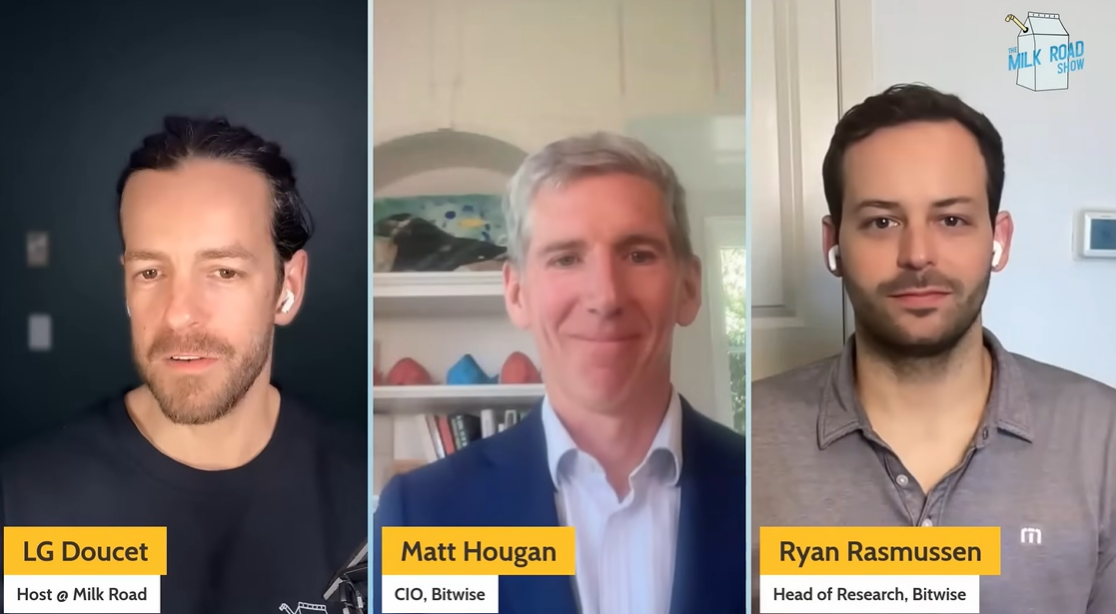
Bitwise Chief Investment Officer Matt Hougan and Head of Research Ryan Rasmussen appeared on the "Milk Road Show" (recorded on April 6) to delve into the true driving forces of the current crypto market, and why institutional demand may be key to Bitcoin's next move.
They pointed out that although the overall sentiment in the crypto market is pessimistic, institutional investors are quietly increasing their holdings. From ETF inflows to regulatory dynamics and macroeconomic changes, there are several key signals that could propel Bitcoin to challenge the $95,000 level in 2026. PANews has compiled highlights from the conversation.
Host: Ryan, I saw an article saying you predicted Bitcoin would reach the $95,000 range by the end of the year. Is that true?
Ryan: That was an interesting conversation because we discussed many long-term bullish factors that could drive the market higher. One example I provided was that entering 2026, we see certain catalysts that might bring the market back to the $95,000 level, which is what we need to break the four-year cycle. I think it’s quite likely to happen, and we might even close the year above $95,000. There are several very specific catalysts that will drive us to that goal, and of course, some conditions must be met. I did say that and I believe it will happen.
Host: What are those catalysts?
Ryan: Three specific environmental factors need to shift favorably toward Bitcoin to drive the price higher. The first is the macroeconomic and geopolitical situation, and I firmly believe it will normalize within a relatively short time. Many are concerned that this prolonged conflict may last many months and have a ripple effect on inflation, interest rates, and both the U.S. and global economies. I don't believe that will happen. I think this is just a relatively short-term shock that will gradually subside, and six months from now, the way we talk about it will be like how we talk about the tariff debacle or other short-term market shocks caused by Trump. So, I believe the macro geopolitical environment needs to shift from uncertainty, instability, and persistent chaos to a more normalized environment. I think this will happen in the coming months. We will have Kevin Wars taking office, and I believe we will see interest rates stabilizing or even lowering. I don’t think there will be rate hikes, which would favor Bitcoin’s positive price return.
The next is regulatory clarity. The regulatory environment for Bitcoin has been very uncertain; the Clarity Act is still pending, but I believe the Clarity Act will pass before the 2026 window closes. I think this is positive news for Bitcoin and other crypto assets.
The biggest catalyst (not just for 2026 but a long-term catalyst) is strong institutional demand for Bitcoin. Last month, amidst all this geopolitical macro uncertainty and the regulatory uncertainty I just mentioned, we still saw Bitcoin ETF inflows exceeding $1 billion. So you can imagine what would happen from the perspective of institutional demand if these matters settle and become tailwinds for cryptocurrencies. I believe these factors will drive Bitcoin back above $95,000 before the end of the year.
Host: Is there a possibility that these positives happen but the conflict continues, and they might offset each other?
Ryan: It’s possible they may offset each other. If rate hikes happen and the conflict continues for six months or longer, it would be difficult for any financial asset to perform relatively strongly. However, interestingly, the market has started to respond less sensitively to these threats or declarations. For example, when Trump issues ultimatums and Iran responds by saying they won’t comply, and Trump changes the deadline, the market's reaction diminishes with each occurrence. So I think this is just a gradual desensitization of the market, and other forces will start to dominate.
Ultimately, Bitcoin's price is based on supply and demand, so institutional demand will be the strongest driving force. From our communications with investors, they see the current price as a good entry point and are making many long-term allocations in their portfolios. I don't believe this long-term demand will be offset; as for whether it will materialize in a month, six months, or nine months, remains to be discussed.
Host: Matt, do you feel there will be momentum to reach $95,000 before the end of the year?
Matt: I do think this is contingent on the things Ryan mentioned. I’d add another catalyst: we need some kind of resolution or clear roadmap to address the growing concerns people have about quantum computing threatening Bitcoin. The only place where I might disagree with Ryan is that if all our cards flipped to the positive side, I think prices would be well above $95,000; if it’s mixed, we could be in a sideways pattern; and if all factors worsen, we might close at lower levels. My view is more diversified. But if we gain regulatory clarity, the Iran issue is resolved, and we address the quantum computing problem, the end of the year could be fantastic. But it requires a series of events to unfold favorably.
Host: Is the quantum computing issue that easy to solve? I recently interviewed some guests and it sounds a bit complicated; you need to reach a consensus among all the stakeholders in Bitcoin to solve this. The Ethereum Foundation seems to be more proactive recently, and the systems are quite different. Can this be resolved or mitigated quickly in Bitcoin?
Matt: My view is that the things you want to see happening to address quantum threats are actually happening. That is, high-reputation individuals are raising concerns, and there are more and more such individuals, so the community is paying closer attention to it and is willing to weigh the pros and cons. In terms of preparedness, we are in a much better position today than we were 12 months ago. I don’t believe we need to solve all problems; what we need is a reliable roadmap to unlock the demand from those "OG" investors in Bitcoin to lead us out of winter and into the spring of the four-year cycle. This doesn’t mean Ethereum has completely solved the problem; they just have a reliable roadmap. If we also have a reliable roadmap and commitments to bring early OG investors back to market. I believe institutional investors will come regardless because they realize their allocation to Bitcoin has diverged from the market, and holding zero positions is no longer a tolerable stance. My point is that to break through the upward space Ryan mentioned of $95,000, we need to involve those OG crypto players and retail crypto players, and I think they will want a clear roadmap.
Host: Do you mean these OGs must feel that after warnings from Google and various parties last week, the situation is being handled or will soon be under control? So Matt, for those OGs who started to massively sell their holdings last year, is this concern the initial reason for the loss of demand?
Matt: Yes. I generally think single-cause explanations are incorrect, but is it a contributing factor? Yes. Is it as significant as the four-year cycle and the avoidance of historical 75% drawdowns? No. But it’s definitely an excuse that people used to make emotional moves to adjust their risk exposures as the four-year cycle approached. So it’s a bit complicated, but it is indeed a factor that has increased people's focus. And I think that’s a good thing; it shows the system is self-correcting. But I do believe that if organized well, it will become a catalyst at this time.
Host: Ryan, was there a discussion on this quantum issue at the digital asset summit? If not, what were people discussing?
Ryan: Quantum computing was indeed mentioned at the digital asset summit, but the focus was not as high as you might think. The article from Google about the accelerated timeline of quantum risk actually came out after the conference ended, so it gained more attention last week. I would say most attention at the summit focused on institutional adoption, regulatory clarity, and topics like tokenization and stablecoins, with less focus on quantum risk, although it is indeed a concern for investors. In the past month, many investors have asked about quantum risk regarding Bitcoin and Ethereum. They see communications about efforts to address these risks, which gives them some comfort, but we really need to see substantial actions taken to truly alleviate long-term concerns.
Host: Ryan, you said institutional investors feel "curious"; does that mean they still have an information gap and do not understand these assets, or are they trying to gain internal support? What do you mean by "curious"?
Ryan: When you talk to different institutional investors and professional investors about their level of interest in the crypto industry, as well as their focus on specific developments in the industry, you find it varies widely. Many professional investors spend very little time thinking about Bitcoin or the broader cryptocurrency. Their information about the space usually comes from the Wall Street Journal or headlines from CNBC, or they hear people talking about market risks on CNBC. So when they hear about quantum computing, or Google publishes an important paper that catches their attention, they come to ask us: how big is this risk really? As professional asset managers who monitor this space 24/7 and communicate with core Bitcoin developers and support them through donations, what do you think? So the information gap lies in that they rely on us to understand what is real and what is noise.
Host: Matt, at the summit, what risks or opportunities were the institutional crowd most concerned about? Or what did you learn that you had previously underestimated?
Matt: One big takeaway for me is that the attire of people at the summit has changed over the past five years. Five years ago, there were probably only two or three people in suits; this year, 80% to 85% of people were in suits, which is quite remarkable. This indicates an unstoppable institutional bull market is emerging in the crypto space, manifested in stablecoins, tokenization, and vaults, where the essence of cryptocurrency is undergoing a real evolution. You only need to compare photos of the summit audience from 2020 to now to see the huge change. Another hot topic is "vaults." People have shown tremendous interest in vaults, and I describe it as the next ETF. I believe institutional interest in vaults even exceeds the actual asset levels and growth currently in the market.
Host: What’s the difference between ETFs and vaults?
Matt: Historically, the problem asset management solved is that individuals want to invest in the market but cannot obtain the required diversification and management (because it’s not their full-time job), so they hand over their money to asset managers to deploy. Three hundred years ago (in the 17th century), when asset management first began, it was cumbersome and expensive. By the 1920s, we had open-end funds; in the 1990s, we had ETFs, which made it more efficient. Vaults differ from ETFs in that they further enhance that efficiency. In the traditional world, asset management firms handle custody, auditing, and tax reporting, combining this with the intellectual property of where investments are going. Vaults strip away all those "real-world cumbersome affairs," leaving only the intellectual property. Investors put funds into smart contracts, and these contracts allocate based on the operations of the asset management firms. Therefore, it’s a more streamlined, efficient, and perfect version of asset management, while other cumbersome parts are left for individuals to manage themselves.
Host: Ryan, do you think vaults are an area where AI will have a massive impact? Because, as Matt described, it sounds like it will involve very sophisticated strategies. I'm asking because last week you shared a tweet stating that those working in AI are more excited about cryptocurrency than those working in cryptocurrency.
Ryan: Absolutely right. That was a very engaging tweet. Over the past 6 to 9 months, crypto sentiment has been hovering near historical lows, close to the lows seen during the FTX collapse in 2022, with prices plummeting and liquidity drying up. However, when you talk to institutional investors, they don’t see a price bear market; they see positive factors that will drive the market higher long-term: vaults, tokenization, stablecoins, etc. And when you talk to people building AI products, they see numerous benefits from the underlying technology: AI needs to solve identity proofing issues, which crypto/blockchain does very well; it needs to address privacy issues, where cryptographic technology also excels; it needs to provide a means for AI agents to transact without bank account access, in which stablecoins and blockchain excel as well. So, AI developers see the synergy and are extremely bullish; institutional investors see the synergy between traditional finance and cryptographic technology and are becoming increasingly bullish. Meanwhile, crypto-native investors only see prices falling, liquidity drying up, continual liquidations, and meme coins collapsing, believing that everything is over. There’s a significant disconnect. It’s like crypto is holding an umbrella in sunny areas while it’s raining.
Host: Why is the crypto community so emotional? Is it because it’s more volatile? Can it break free from this emotional rollercoaster?
Ryan: I think part of it is the difference in investment time horizons. Many crypto investors enter this space because they want to gain substantial wealth in relatively short timeframes to get ahead of institutions. With market boom and bust cycles, people feel disillusioned and deeply impacted. In contrast, the professional investors we engage with at wealth management firms and platforms tend to be long-term oriented. They plan retirement strategies for clients for 5 years or even 45 years, able to see the larger trends and feel excited. Crypto investors, due to excessive concentrated investments, exhibit highly emotional behavior when the market fluctuates, which is incredibly dangerous in investing. Professional investors are better at systematically investing to obtain long-term returns, and their current placements are based on anticipating that this technology will yield returns in 10 years.
Matt: I think that’s correct. I’d also add that certain areas of the crypto market (like meme coins, alt L1s, and air applications) are indeed "in winter." Many people holding these assets have bleak prospects. This contrasts entirely with the mindset of making an initial allocation from scratch. If you’re entering now and see stablecoins and tokenization ready to thrive, while these assets have dropped 50%, you see it as an opportunity. But if you hold an asset that has dropped 90% or is set to drop another 99%, the perspective is entirely different.
Host: Matt, you published a great memo today that answered the five biggest questions about prediction markets. As a professional "Degen," I love betting on all sorts of weird things, but prediction markets do face many controversies and issues right now. You hinted in the article that prediction markets are one of the most important tools in finance. Why do you say that?
Matt: Because they provide the world with new key information and are useful portfolio tools. First, there's the quality of information. We all get frustrated that the Fed is always looking at lagging data, with employment data often revised significantly, which has a massive impact on economic and investor decision-making. If we could improve the quality of economic data, the world would operate better.
I mentioned a Fed paper in the article which indicates that prediction markets like Kalshi (even though currently small) have been more accurate in predicting Fed rate cuts, GDP, CPI data, etc., than the best economists from Bloomberg and even the Fed's own expectation surveys, and they do so in real-time. From a portfolio perspective, the real world is influenced by political and economic events. If you believe that Elizabeth Warren will become SEC Chair after several years of elections, that would affect cryptocurrencies, but currently you have no way to cleanly hedge that probability. This isn’t only in crypto; defense stocks and AI stocks will also be affected, and our current portfolios are unable to express that. Bundling these risks through prediction markets would be a very valuable hedging tool. Are they perfect? No. Do some markets need to be reformed? Absolutely. But overall, I think they are very positive things.
Host: The biggest criticism facing prediction markets is that they are just another form of gambling, especially when tied to cryptocurrency, like meme coins. How do you respond to that?
Matt: Some are indeed gambling. If you’re betting on a soccer game in a prediction market, that’s no different from putting a bet in sports gambling, and that’s fine. But if you’re predicting the outcome of Fed interest rates, that’s equivalent to the Federal Funds futures market of the Chicago Mercantile Exchange (CME), where the largest financial institutions in the world trade $5 to $15 trillion in value daily, and we refer to that as investing. Prediction markets can encompass both scenarios simultaneously. We can separate complex financial investments/hedges from sports or pop culture events. They are very powerful tools.
Host: Will these prediction markets diversify in the future? For example, currently, going to Polymarket, you'll see thousands of topics, which can be overwhelming. Will there be a prediction market that specializes only in financial classifications?
Matt: I think that’s absolutely possible. When we consider applying to launch prediction market ETFs, what we focus on is definitely financial market indices, not Taylor Swift's concert revenue. Just like the existing ETF market, there are the simplest S&P 500 ETFs and 3x leveraged stock ETFs. Search tools will clearly differentiate ordinary and special ETFs. So as more financial users adopt these markets, I think they will distinguish themselves, and I wouldn’t be surprised to see sports betting separate from that, especially given the additional legal and lawsuit risks in that area.
Ryan: For investors, I feel prediction markets enable investors to express their views on certain binary outcomes, which is a very important capability. In the past, it was hard to decompose someone’s expectation of winning an election into complex cross-asset class portfolios of commodities, tech, gold, bonds, and so on. Prediction markets greatly simplify investors’ ability to hedge portfolios or plan. Crafting financial products like ETFs around specific prediction market events will make operations very direct and easy. Furthermore, as Matt mentioned, the accuracy of prediction markets in macroeconomic or economic events (like Kalshi) even exceeds traditional polling and expert consensus; the strength of information aggregation is very powerful.
Matt: I completely agree. One more point that hasn't been stated is that the largest institutions in the world have previously had their ways of directly obtaining these odds (like hedge funds spending money hiring well-paid lobbyists in Washington to sniff out news). What I love about prediction markets is that they surface this information, making it visible to every investor; it’s a more equitable playing field. This has a sort of equalizing advantage that is very important for fairness in the investment ecosystem.
Host: Is there a day when people no longer read the news but rather directly look at the information provided by Polymarket?
Matt: That’s one of my favorite points. I think Polymarket deserves a Pulitzer Prize for its coverage of Trump's election victory. It’s the only place that accurately stated what was going to happen, better than polls and every media outlet. If that’s not news, then I don’t know what is. That was the most important news of that time, and it was the only place that got it right. So I believe that many people will watch Polymarket and Kalshi as much as they watch the New York Times and Wall Street Journal to understand what’s happening in the world, and they may get better information as a result.
免责声明:本文章仅代表作者个人观点,不代表本平台的立场和观点。本文章仅供信息分享,不构成对任何人的任何投资建议。用户与作者之间的任何争议,与本平台无关。如网页中刊载的文章或图片涉及侵权,请提供相关的权利证明和身份证明发送邮件到support@aicoin.com,本平台相关工作人员将会进行核查。


