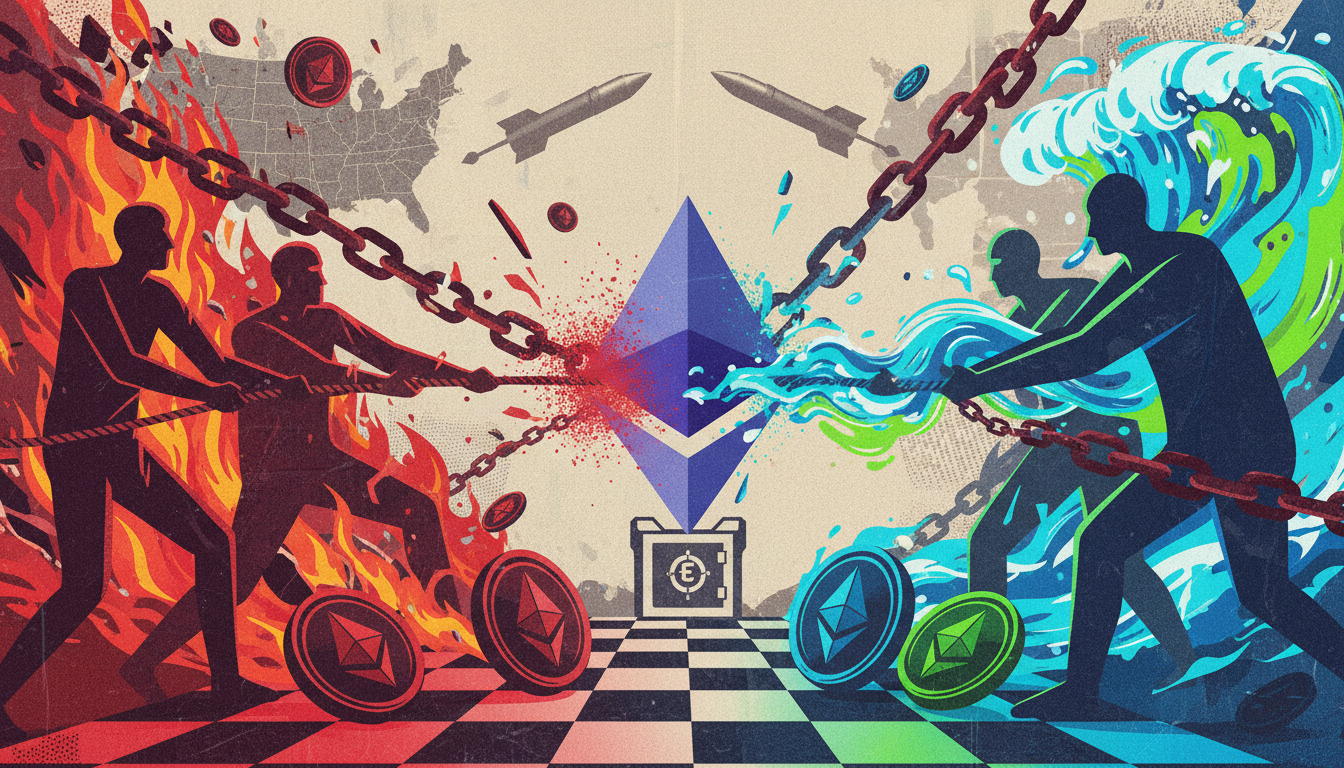
On April 15, 2026, Eastern Eight Zone time, the U.S. and Iran entered a prolonged negotiation regarding the temporary ceasefire agreement that is set to expire on April 22, with the third day of deadlock pushing the entire risk asset market into a suspended state. The two-week ceasefire announced on April 8 was initially seen as a sign of de-escalation, but negotiations held in Islamabad on the 11th and 12th ended abruptly without any substantive results, leaving the extension terms and duration unresolved. Since the negotiations broke down, the market has begun to reprice geopolitical risks, with commodity prices and cryptocurrency volatility amplifying in unison: spot silver, according to a single source, soared to as high as 80 dollars per ounce, and high volatility quickly spread onto the blockchain. This article will center around a core issue: how geopolitical uncertainty amplifies the vulnerability of risk assets under the tug-of-war of the ceasefire and the information gap, especially manifesting intensely among high-leverage on-chain accounts and users with relaxed security awareness.
Seven Days to Ceasefire: The Vacuum Period of Stalled Negotiations
From the timeline perspective, this round of risk repricing has progressed almost in sync with the ceasefire negotiations. On April 8, the U.S. and Iran announced a two-week temporary ceasefire arrangement under multiple mediations, and the market briefly bet that the tensions would ease. However, just three days later, talks held in Islamabad from April 11 to 12 failed to yield any substantive results, leaving the extension plan unresolved. By April 15, only one week remained until the ceasefire expiration on April 22, with the U.S. and Iran merely stating they were "continuing discussions on extension," without providing clear guidance on duration and details.
The ceasefire clock is continuously counting down to zero, while the extension plan remains elusive, directly raising concerns over the security of the critical shipping lanes in the Strait of Hormuz and oil supply. The Strait of Hormuz itself is a critical chokepoint for global energy transport, and as soon as the market perceives "possible disruption," oil price risk premiums will quickly adjust upward. Although specific safety passage terms have not been disclosed, in this sensitive coordinate, any uncertainty regarding whether the ceasefire will be extended is enough for traders to hedge potential supply disruption risks with increased volatility.
On the public opinion front, a stark contrast has emerged. According to a single-source disclosure, Trump publicly stated that "Iran is very eager to reach an agreement," a statement that was widely shared on social media and interpreted by some as optimistic regarding the negotiation outlook. However, the reluctance to produce any text or timeline at the negotiation table continuously reminded the market: willingness does not equal results, and statements cannot be directly translated into asset pricing certainty. Thus, in the vacuum of new facts, imaginations regarding military escalation and energy shocks were infinitely amplified, becoming the psychological starting point for the subsequent violent fluctuations in commodity and cryptocurrency prices.
Silver Soars to 80 Dollars: The Misaligned Amplification of Safe-Haven Sentiment
In this round of repricing, traditional safe-haven and commodity assets were the first to fall out of balance. A single-source cited in the research report revealed that spot silver prices once touched an extreme level of 80 dollars per ounce, which is almost considered an "outlier" in recent pricing frameworks. Although this quote stemmed from a single channel, it was sufficient to illustrate one fact: in the context of unclear ceasefire prospects and rising energy risks, some funds chose to lock in so-called "safety buffers" at extreme prices rather than withdraw from the paper peace situation quickly.
In contrast to the single-sided surge of silver, the crude oil market displayed a more complex tug-of-war between bulls and bears. On one hand, concerns surrounding the security of the Hormuz shipping lane and supply help logically support the upward adjustment of oil price risk premiums; on the other hand, macro demand expectations, inventory cycles, and the possible release of reserves from policy also prompted some traders to hedge or even take a contrary position. Silver was the first to amplify volatility under the "war premium + inflation hedging" logic, while crude oil tugged in the debate over "whether it will actually impact the supply chain," reflecting the psychological chasm of investors wavering repeatedly between safety and returns.
As traditional safe-haven assets have already priced in extreme tail scenarios, the spillover effect soon transmitted to the cryptocurrency market. Some funds shifted between stocks and commodities, while another segment of more aggressive capital shifted the battleground to high-leverage derivatives and on-chain protocols—attempting to "make a big move" amid intense volatility. Thus, we saw a familiar combination reenacted: "commodity price volatility + high-leverage derivatives", which laid clear emotional and behavioral foreshadowing for the subsequent on-chain oil contract gambling failures.
On-Chain Oil Gambling Fails: Single Address Loses 1.149 Million Dollars
Emotions spread from the trading floor to the blockchain, just one "courageous address" away from betting direction. According to a single source cited in the research report, a certain Ethereum address heavily positioned in oil-related positions faced a floating loss that once expanded to 1.149 million dollars due to the extreme market reversal. From the known information, this is a typical sample of on-chain commodity derivatives "gambling failure": betting directionally on geopolitical escalation and oil price increases, but the volatility path under negotiation deadlock is far more complicated than simply "one-sided upward."
Although the report did not disclose the complete trading path and specific product structure, the results suggested that such addresses often employed high leverage or even layered derivative strategies, such as utilizing leveraged tokens, perpetual contracts, or structured products to amplify bets on-chain. Once the news rhythm and expectations misaligned—i.e., the negotiations had not fully broken down, nor provided enough signals to support "full-scale escalation"—prices can dramatically "whip," leading to acute losses for high-leverage both long and short positions. In such an environment, even if fundamental logic hasn't completely failed, the aggressive behaviors in capital management can quickly translate into massive floating losses.
More importantly, this is not an isolated case. The report disclosed that high-risk trading accounts' losses are not limited to this one, with two typical cases totaling over 5 million dollars. This paints a group portrait: a cohort of on-chain players confident in their geopolitical judgments fell into a liquidity trap under a narrative of "misjudging direction + aggressive bets." Compared to the price differences in silver and crude oil highlighted in news headlines, these traceable real loss figures on-chain have a more direct psychological impact on market participants—they vividly showcase how geopolitical risks penetrate DeFi protocols, on-chain derivatives, and high-leverage speculators.
Fear Extended Beyond the Market: 310,000 U Dollars in Phishing and Security Collapse
The fear during the period of geopolitical tension does not only manifest as abrupt rises and falls on the K-line. A case disclosed by the GoPlus Chinese community showed that a user lost 316,000 USDC in a phishing attack. This incident itself does not have a direct causal relationship with the U.S.-Iran negotiations, yet it compounded the overall sense of insecurity among crypto participants during the same timeframe along with the noise of the conflict: one aspect is the price turbulence caused by the unresolved ceasefire, while the other is the helplessness of assets being transferred off-chain in an instant.
In the stage of rapid bombardment by macro and conflict information, users are often in a state of emotional excitement and anxiety. With frequent news updates and constant attention to markets, amid the pressure of "fear of missing out," they are more inclined to overlook security reminders and risk control processes, such as lacking sufficient patience to verify unfamiliar links, authorization pop-ups, or disguised DApps. Phishing attackers capitalize on this psychological gap—when everyone discusses extending the ceasefire, oil price trends, and a certain address losing millions of dollars, the real hackers quietly reap the rewards of "no counterparty."
At the same time, crypto exchanges and security agencies are seeking new defense lines. According to a single source quoted in the report, multiple platforms are attempting to incorporate AI technology to address novel cyber threats, trying to identify risk patterns in the vast number of on-chain transactions, abnormal authorizations, and social engineering attacks in advance. This technological arms race constitutes another "invisible front line" in the crypto industry: officials are upgrading defense systems, hackers are iterating attack scripts, and ordinary users are suffering losses on this front without visible smoke.
When viewed together, one side actively leverages bets on geopolitical trajectories and gets forcefully liquidated by the market, while the other passively bleeds out in phishing links; two entirely different risks exploded centrally in the same high-pressure period. For many retail investors, the issue is no longer "how to make quick money in a big market," but rather a more fundamental survival question—under this environment where uncertainty is layered and magnified, how to avoid losing money and survive first.
From Washington to On-Chain Wallets: Multiple Games Resonating in Concert
If one raises the perspective, the diplomatic tug-of-war between the U.S. and Iran regarding the extension of the ceasefire, along with the implicit games surrounding energy prices, constitutes the upstream source of global risk pricing. Every posture adjustment by Washington and Tehran regarding ceasefire duration, supervision mechanisms, and subsequent political arrangements will quickly reflect through the filter of "whether it threatens supply chains" onto crude oil, shipping, and inflation expectations. The market does not need a detailed ceasefire document; as soon as it sees "negotiations are inconclusive" or "there are new twists," it will swiftly adjust its pricing hypotheses on energy and commodities.
Within the same time window, the safe-haven flows of traditional financial markets and the high-volatility trends of crypto assets formed an interlocking emotional feedback loop. When some funds withdrew from the stock market to transition to U.S. Treasuries and precious metals, another portion of liquidity rapidly rotated among commodity ETFs, energy stock options, and on-chain derivatives. Silver reaching extreme quotes, crude oil experiencing intense tug-of-war, the amplified volatility of Bitcoin and mainstream tokens—all these appearances point to one logic: risk appetite is being reshaped by geopolitical uncertainty.
On a micro level, the competition among weaker parties is even more ruthless. High-leverage retail investors on-chain are gambling on a ceasefire breakdown or conflict escalation, while hackers and phishing teams precisely prey on their anxiety and greed. The former attempts to "reverse their fate," using several times or even a dozen times the leverage to win big on macro narratives in a single day; the latter employs social engineering and technical means to treat these similarly resource-limited participants as "high yield targets." On this long chain extending from Washington's negotiation table to on-chain wallets, those who genuinely possess bargaining power and information advantages have never been these terminal individuals.
This also helps to understand why, when the critical information around the ceasefire extension remains ambiguous, the market feels more like it is betting on a political script rather than making decisions based on quantifiable fundamentals. No one accurately knows how long the ceasefire will last or what specific details will be attached, but asset prices have already pre-priced various potential paths with different versions. For most participants, what they buy or short is not a certain future, but a subjective interpretation of an unwritten geopolitical script.
The Next K-Line Written at the Negotiation Table
Returning to the present, key information regarding the extension of the ceasefire remains critically lacking: whether concerning duration, supervision mechanisms, or subsequent political arrangements, there is no publicly available clear text. Under such premises, any attempts to specifically bet on "how long the extension will last, when to negotiate again, and the specific terms of agreement" are essentially highly speculative, more reliant on emotions and positions rather than verifiable data. The research report also explicitly pointed out that the core details such as the duration of the ceasefire extension, the timetable for the next round of talks, and the broader scope of the conflict remain uncertain, and any precise statements from the outside world belong to self-interpretation.
This also means that any unverified rumors—including circulated claims about "a country proposing specific number of days," the alleged "new round of talks expected within days," and assertions regarding the extension or contraction of ceasefire coverage—should be treated with ample restraint. Treating unconfirmed content from non-authoritative sources as established facts not only amplifies one's own exposure but also creates a "telephone effect" on social networks, further muddling market sentiment.
In this high-pressure cycle, the survival principles of crypto investment are more straightforward:
● At the leverage level, actively reduce multipliers, control total position exposure, avoid amplifying long-term uncertain bets with short-term credit, and prioritize "not being liquidated from a single volatility."
● At the security level, reassess wallet authorizations, signing habits, and asset diversification, and maintain a "think twice before clicking" instinct regarding any links and contracts of unknown origin, not giving phishing attackers any opportunity.
● At the emotional level, be wary of the herd impulse of "everyone else is taking action, I can't fall behind," and avoid making the largest and most aggressive decisions during the noisiest moments.
In the coming weeks, if negotiations signal substantial easing and energy supply concerns diminish, extreme premiums for traditional safe-haven assets may decline, with some funds expected to flow back into high-risk assets, and mainstream assets with high macro correlation and better liquidity in the crypto market could become the first beneficiaries. Conversely, if the situation unexpectedly escalates and expectations for supply chain disruptions rise, the "war premium" in commodities will be further elevated, pulling more liquidity from traditional safe-haven assets, while high-leverage and illiquid segments of cryptocurrencies are more likely to become the hardest-hit areas for sell-offs and liquidations.
The next critical K-line has already been written at the negotiation table. For on-chain participants, instead of speculating on which diplomatic statement is more "hawkish" or "dovish," it is more important to adjust their positions and security lines before results land, preparing to withstand the worst-case scenarios.
Join our community, let's discuss and become stronger together!
Official Telegram community: https://t.me/aicoincn
AiCoin Chinese Twitter: https://x.com/AiCoinzh
OKX Benefits Group: https://aicoin.com/link/chat?cid=l61eM4owQ
Binance Benefits Group: https://aicoin.com/link/chat?cid=ynr7d1P6Z
免责声明:本文章仅代表作者个人观点,不代表本平台的立场和观点。本文章仅供信息分享,不构成对任何人的任何投资建议。用户与作者之间的任何争议,与本平台无关。如网页中刊载的文章或图片涉及侵权,请提供相关的权利证明和身份证明发送邮件到support@aicoin.com,本平台相关工作人员将会进行核查。