Author: Bitget
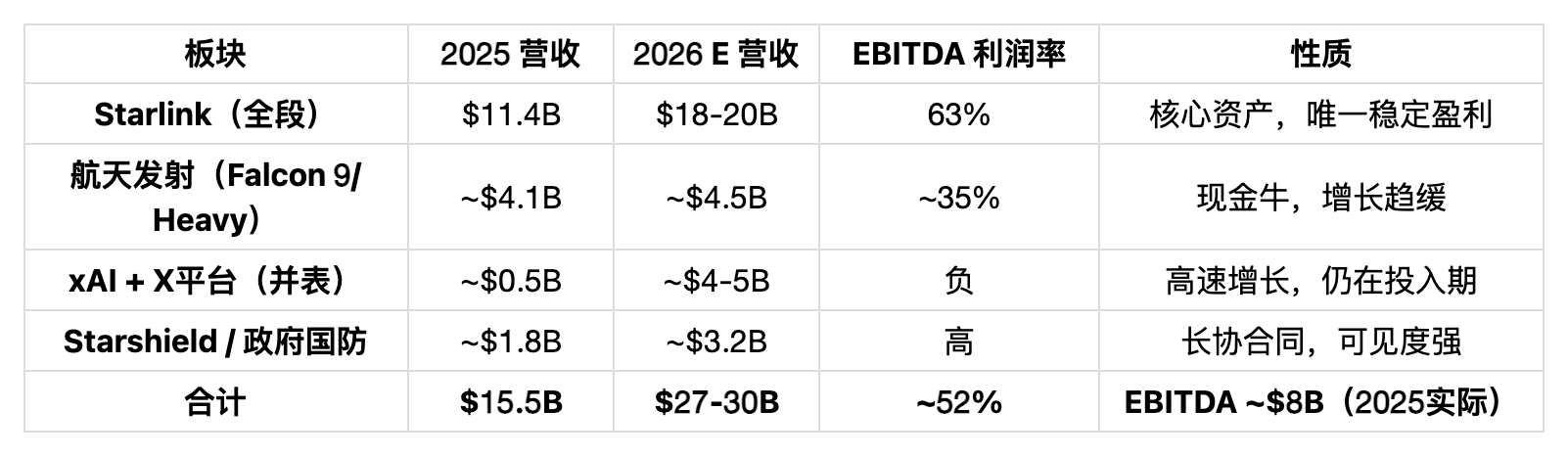
SpaceX is projected to achieve $15.5 billion in revenue and $8 billion in EBITDA by 2025, with Starlink being the most profitable global satellite network currently. After the merger with xAI, the company will have launch capabilities, global low-orbit bandwidth, and AI inference capabilities—together forming a complete closed loop of orbital data strategy. The $1.75T IPO target price is fundamentally supported, and the index inclusion mechanism will create a continuous structural buying momentum after its listing. The current most cost-effective liquid entry point is Bitget preSPAX, priced at $650, with an implied valuation of $1.54T, lower than all comparable references.

What is SpaceX: Three Moats, One Vertical Closed Loop
SpaceX's business cannot be understood through a single framework. It is simultaneously a rocket company (with over 60% market share in global commercial launches), a satellite operator (with over 9M Starlink users covering 100+ countries), a defense contractor (Starshield, Space Force contracts), and starting in February 2026, an AI company (xAI fully consolidated). These four identities are not parallel but have a clear strategic dependency relationship.
Falcon 9 is cash cow, not a growth engine. With around 130 launches planned for 2025, with single commercial quotes between $67M and $97M, it maintains a market share of over 60%. However, the growth of this business has nearly reached its ceiling, and competition will emerge from within once Starship matures. Its value lies in the continuous cash flow that supports the entire company's capital expenditures.
Starlink is the current core asset. With projected revenue of $11.4 billion in 2025 and an EBITDA profit margin of 63%, it is the only business unit that can independently support the company’s valuation. User count increased from 4.5M at the beginning of the year to over 9M by the end, expected to surpass 10M by February 2026. The revenue structure is divided into three tiers: consumer broadband ($120/month), enterprise/maritime/aviation ($5,000+/month), and government defense (Starshield, long-term contracts). Quilty Space predicts that Starlink's total revenue will reach $20 billion in 2026, with EBITDA around $14 billion. This prediction is based on the scaling of D2C (direct-to-consumer) and ongoing penetration into the enterprise sector, without aggressive assumptions.
xAI is the source of platform premium, not a valuation bubble. After consolidation, SpaceX gained a user base of 64M MAU with Grok, over $3.3 billion in advertising and subscription ARR on the X platform, and Musk's complete layout for AI computing strategy. The exchange ratio of 0.1433 implies that xAI enters with a valuation of $250B—this price reflects a premium derived from comparing with Anthropic ($61.5B/$3 billion ARR) and OpenAI ($157 billion/$11 billion ARR), sourced from the revenue support of the X platform and the rapid growth of Grok, rather than mere narratives.
Spectrum and orbital resources are invisible assets not reflected on financial statements. The $17 billion acquisition of EchoStar's spectrum assets will secure operational qualifications for Direct-to-Cell by 2025. The FCC's spectrum usage rights have changed from first-come, first-served to auction allocation, and SpaceX's advance layout forms a competitive barrier under a tightening regulatory backdrop. The maximum limit for Space Force's PLEO contracts is $13 billion over 10 years, and the Pentagon's contract for military communications in Ukraine is $537 million—the strategic irreplacability of government orders far exceeds commercial value.
Orbital Data Center: When AI's Bottleneck Turns from Computing Power to Energy
The first hard constraint faced by AI development in 2025-2026 will not be chips, but electricity. The construction cycle for U.S. transmission networks is as long as 10-15 years, and the distribution infrastructure is severely lagging. The site selection for data centers is becoming increasingly constrained by power grid capacity rather than geographic location or labor force. Jensen Huang and Sam Altman have mentioned this bottleneck on multiple occasions—this is not a complaint but a constraint condition for capital allocation decisions.
The logic starting point for Orbital Data Centers (ODC) is the removal of physical constraints, not engineering gimmicks. By deploying computing nodes in geosynchronous or low earth orbit, it can bypass three core constraints of terrestrial power networks: power capacity, heat dissipation, and data sovereignty compliance.
Google's core discovery in its 2025 paper: If LEO launch costs drop below $200/kg, the energy cost of orbital data centers would be $810-$7,500/kW/year, on par with the terrestrial data center cost of $570-$3,000/kW/year, reaching an economic feasibility threshold. Starship's target cost: $100/kg.
Space energy density is significantly higher than on Earth. The solar irradiance received in geosynchronous orbit is about 1.4 times the peak on Earth's surface, with no atmospheric attenuation, and near-earth orbit theoretically allows for 24-hour uninterrupted power generation (in comparison, terrestrial photovoltaic systems achieve less than 4 hours of effective daily generation). Heat dissipation relies on vacuum radiation cooling rather than mechanical cooling, and thermal management systems can be specially designed for orbital conditions without relying on terrestrial air conditioning infrastructure.
Technical feasibility has empirical evidence, not assumptions. In 2025, Google's V6e Trillium cloud TPU paired with AMD servers completed total ionizing dose (TID) and single event effect (SEE) tests. The conclusion is: except for HBM experiencing temporary disorder at a dose of 2krad (Si), the end-to-end computing process was normal. 2krad is three times below the required lower limit, indicating that commercial AI chips can operate in space with proper shielding. This is a research-level paper from Google, not a PPT from Musk.
SpaceX is already taking action. By the end of 2025, it will submit an application to the FCC for an orbital data center system covering 1 million satellites. Musk has publicly indicated that launches of AI satellites will start within 2-3 years. SpaceX is concurrently laying out large-scale solar manufacturing, targeting a capacity of 100GW to prepare the supply chain for the large-scale deployment of orbital photovoltaic arrays.
The engineering challenges currently faced are real and need specific clarification:
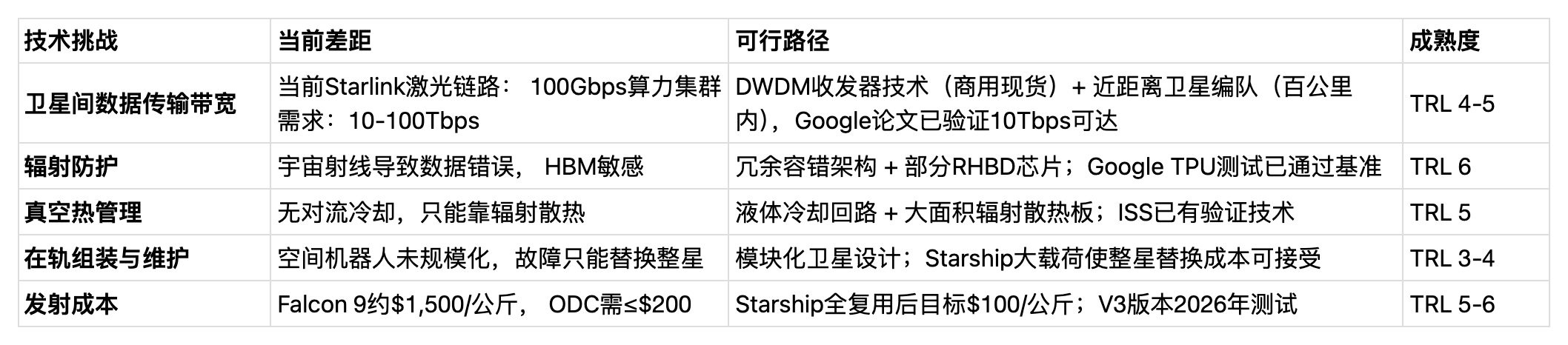
Each of the aforementioned challenges has known engineering solutions based on principles and does not rely on undiscovered physical laws. Compared to reusable rocket technology before 2015, skeptics believed that recovering the first-stage booster was "theoretically feasible but not practical engineering"—SpaceX achieved sea recovery in 2016 and actual reuse began in 2017. The complexities of the engineering challenges ODC faces are higher, but the resources SpaceX has at its disposal are far beyond what was available in 2015: the world's largest operational experience with satellite constellations, the lowest-cost launch system, and AI engineering capabilities after the consolidation with xAI.
More crucial is uniqueness. No other company possesses simultaneously: large-scale low-cost launch capability (Starship), a global low-orbit bandwidth network (Starlink with 6000+ satellites), AI models and inference capabilities (xAI/Grok), and on-orbit operational experience (real-time management of thousands of satellites). Amazon has Kuiper and AWS, but its launch capabilities depend on third parties, making costs uncontrollable. Google lacks launch capability and strategically binds itself to SpaceX with a 5% shareholder position. The moat of this combination is not a technological advantage, but the non-replicability brought by vertical integration.
The weight of ODC in the current valuation should be understood as a real-option value rather than a discount on core business. Even if ODC forever cannot be realized, the cash flow from Starlink is sufficient to support a valuation of over $1T. ODC represents the option value source that drives the valuation evolution towards $1.75T or even higher, and the characteristic of such options is: the shorter the time and the higher the technology maturity, the more certain the option value.
Segment Valuation: Is the $1.75T Fundamentally Supported?
$1.75T corresponds to $737/share, reflecting a 40% premium over the merger anchor point of $527. The following SOTP will conduct forward valuation based on 2026 Expected Financials, aiming to assess if the IPO pricing is within a reasonable range, rather than reiterate historical anchor points from the merger.
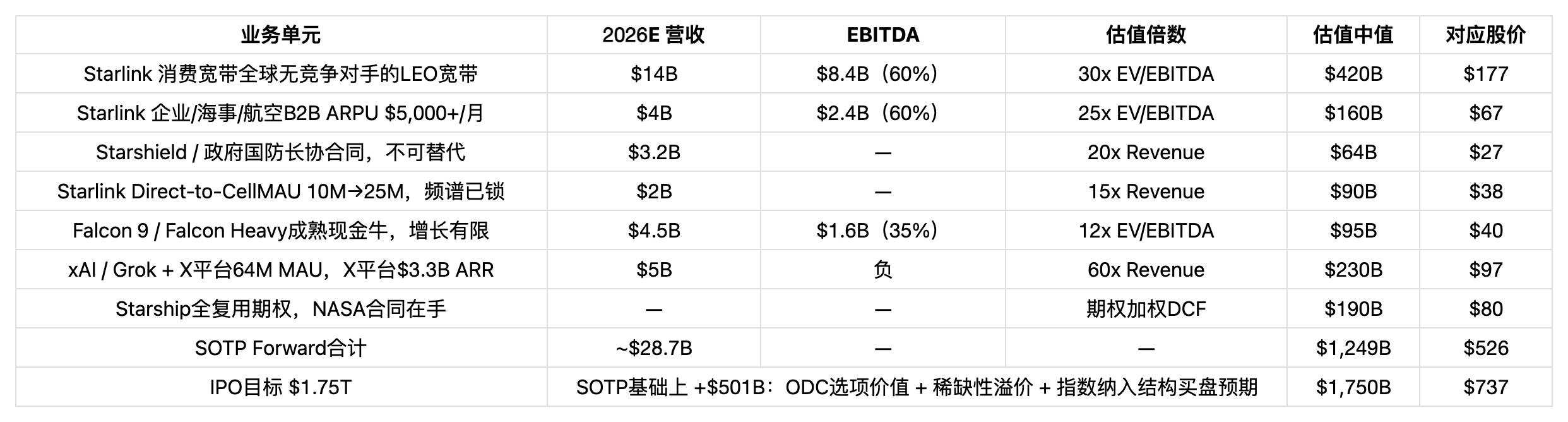
xAI is priced based on 60x revenue: Anthropic at $61.5B/$3 billion ARR (20x), OpenAI at $157 billion/$11 billion ARR (14x), with xAI expecting more rapid growth and a cash flow safety net from the X platform, 60x is a reasonable cap. The $190B option assumption for Starship reflects a 30% probability of achieving complete reusability, contributing a market cap of $630B in a successful scenario, discounted to $190B.
SOTP Forward median is $1.25T ($526/share), fully aligned with the merger anchor point—this indicates that the merger pricing is anchored on fundamental valuation, rather than premium. The IPO target of $1.75T requires an additional pricing of about $500 billion based on SOTP, which needs three types of support:
First, the fundamental option value of ODC. If Starship can drop launch costs to $100/kg, the economic feasibility of ODC has been validated in Google's paper. Historically, the option premiums granted to monopoly-level platform infrastructures (AWS, Starlink itself) are often reflected in valuations 5-7 years before realization. An option premium of $30 billion-$50 billion for ODC is not aggressive.
Second, market scarcity premium. SpaceX is the only publicly investable entity that possesses aerospace infrastructure, a global communication network, and AI capabilities simultaneously. This rarity has historically always corresponded with an additional premium. Palantir (government data + AI) has long enjoyed a revenue multiple of 40-70x, not due to growth rates, but because there are no substitutes.
Third, structural passive buying's forward discount. This part will be elaborated in the next section, but the core logic is: passive index inclusion will create hundreds of billions of dollars in mandatory buys after listing, and the market will price in this support when determining IPO pricing.
In comprehensive judgment: $1.75T is defensible within the 2026E forward valuation framework, with clear sources for the premium that are not arbitrariness. A higher target of $2.0T requires Starlink to outperform expectations in 2026E or a quicker ODC realization, with a lower probability than the baseline scenario.
Why the Post-IPO Is Not a High Point: The Structural Buying Mechanism of Passive Funds
Active management investors can choose not to buy, but passive index funds cannot. When SpaceX enters the Nasdaq 100 and S&P 500, all funds tracking these indices must simultaneously allocate, without exceptions or timing choices. This is the key structural difference that separates SpaceX's listing from an ordinary IPO.
The Nasdaq approved the SR-NASDAQ-2026-004 rule amendment in Q1 2026 (effective May 1): for newly listed companies entering the top 40 by market value before joining Nasdaq 100, evaluation will be triggered on the 7th trading day and mandatory inclusion on the 15th trading day. SpaceX enters the global top five at a valuation of $1.75T, with no reason not to trigger this.
The new rules also introduced a low liquidity multiple: when public float is below 20%, the index weight calculation applies a maximum multiplier of 5x. If SpaceX maintains control and releases only 5% of its shares to the market, the index weight would be calculated based on 25% of the equivalent floating market value. This means that allocation demands for funds tracking QQQ (with a size of $372.5 billion) may far exceed the actual total of freely traded shares.
1. IPO Listing (Expected June 2026)
Listing at $1.75T on Nasdaq. Retail allocation 30% (historically the highest). Musk retains the vast majority of shares to maintain control, resulting in a very low public float.
2. 7th Trading Day: Triggering Index Inclusion Assessment
Ranking in the global top five by market cap, the evaluation for Nasdaq 100's top 40 passes without any suspense. The low float multiplier mechanism is activated, magnifying the equivalent weight to five times the actual float.
3. 15th Trading Day: All Passive Funds Must Synchronize Mandatory Buy
QQQ, QQQM, and all Nasdaq 100 tracking funds will execute allocation instructions simultaneously. Meanwhile, to free up funds, there must be a simultaneous sale of about $100 billion worth of existing weights such as NVDA, AAPL, MSFT. Steve Sosnick (Interactive Brokers): "Everyone buys at the same time, who will be the natural seller then?"
4. Five Months Later: Lock-up Period Ends, Price Floor Established
As the insiders' 180-day lock-up period expires, index funds have built positions at higher prices. Structural buying pressure forms price support, allowing insiders to reduce holdings in an orderly manner. This isn’t manipulation, it’s a mechanism.
History reference from Tesla: After the announcement of inclusion in the S&P 500 in November 2020, Tesla's stock price rose 57% in the 30 days leading up to index inclusion. At the time of inclusion, its valuation was equivalent to the total market cap of the world's top 9 automakers, with PEs in the hundreds. In the six months post-inclusion, the stock price fell about 10%—but that was due to the valuation itself being too extreme, not an issue stemming from the index inclusion mechanism. SpaceX's fundamentals are significantly stronger than those of Tesla in 2020, and its EBITDA is positive.
Apollo chief economist Torsten Slok estimates that in the case of simultaneous listings for SpaceX and OpenAI, the combined weight of the top 10 stocks in the S&P 500 will increase from about 40% to nearly 50%. The result of this trend toward concentration is that index funds effectively become amplifiers for super-weighted stocks, and SpaceX represents the most crucial new component for the next few years.
Google holds about 5% equity in SpaceX, valued at over $100 billion at a $2T valuation. Google is not a passive holder—it signed a long-term data return and edge computing agreement with SpaceX in 2025, launching a preview of "Anthos Space Edge," which routes AI inference tasks to the nearest low-orbit satellite coverage area. SpaceX's orbital assets are being integrated into Google Cloud's physical infrastructure, providing a strategic endorsement for post-listing valuation.
Pre-listing Entry: Three Price Discovery Channels and Pricing Analysis
There are currently three channels providing pre-market access to SpaceX. Core anchor point: $526.7/share = $1.25T (merger pricing), with a total capital of 2.374 billion shares. The following analysis will examine the pricing, structure, and upside potential of each channel.
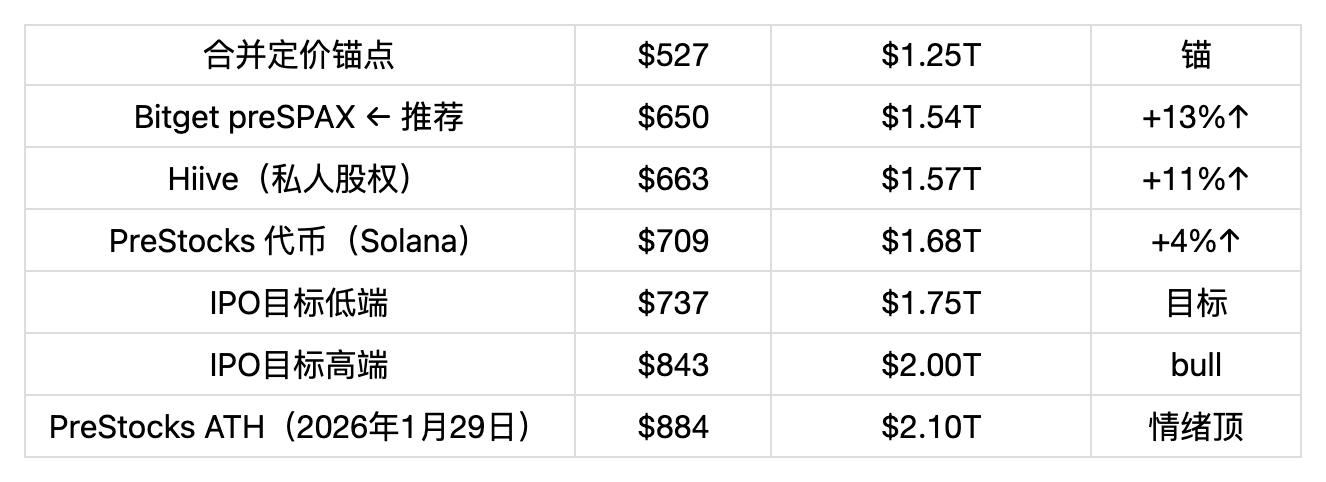
BITGET IPO PRIME·Tokenization·Recommended preSPAX at $650 Implied valuation $1.54T·Launched on April 21, close to IPO target low end by +13.4% and high end by +29.7%. Backed by Republic, referencing performance after SpaceX goes public. $650 is currently the lowest entry price among all tradable channels, lower than Hiive private equity ($663) and PreStocks tokens ($709), and does not require accredited investor status. Economic exposure directly tracks market price post SpaceX listing.
Real Equity·Qualified Investor Only Hiive at $663 Implied valuation $1.57T·100+ active orders, close to IPO target low end by +11.2% and high end by +27.1%. True equity transfer, best liquidity among private equity platforms. 3-5% handling fees, lock-up period based on holding structure. Price is $13 higher than preSPAX, but grants direct shareholder rights. Qualified investors only.
Synthetic Asset·SOLANA chain PreStocks at $709 Implied valuation $1.68T·ATH $884 (1/29) close to IPO target low end by +3.9% and high end by +18.9%. Market cap of $4.7 million, daily turnover of $840,000, extremely poor liquidity. Priced above preSPAX by $59, only 4% away from the IPO low end. Reached $884 on January 29, implying a valuation of $2.10T, then retraced to the current position. The price does not reflect fundamentals but rather the sentiment of the small circles on the Solana chain.
Pricing Conclusion: preSPAX at $650 is the only option among the three channels that meets both the "lowest pricing" and "acceptable liquidity" criteria. Compared to Hiive: $13 cheaper (-2%), and no accredited investor status required. Compared to PreStocks: $59 cheaper (-8.3%), with 9.5 percentage points more upside potential, and more assured liquidity (Republic backing vs. Solana chain spontaneous tokens). Post-IPO, preSPAX settlement references SpaceX public market prices, with a clear path for economic returns.
Scenario Analysis and Key Assumptions
Pessimistic Scenario $421—$527
$1.0T—$1.25T Starship continues to fail, xAI enterprise API does not reach $1.5 billion in 2026E, Musk's political risks affect government contract renewals, macro tightening leads to a discounted IPO price. Valuation returns to SOTP fundamentals, with Starlink's $11.4B revenue still supporting a $1T floor. Calculating from preSPAX at $650: down about -20% to -30%.
Optimistic Scenario $843—$950
$2.0T—$2.25T Starlink exceeds expectations reaching $20 billion, Starship completes reuse milestones during the roadshow, first commercial contracts for ODC are announced, retail sentiment combines with structural buying resonance. Calculating from preSPAX at $650: up about +30% to +46%.
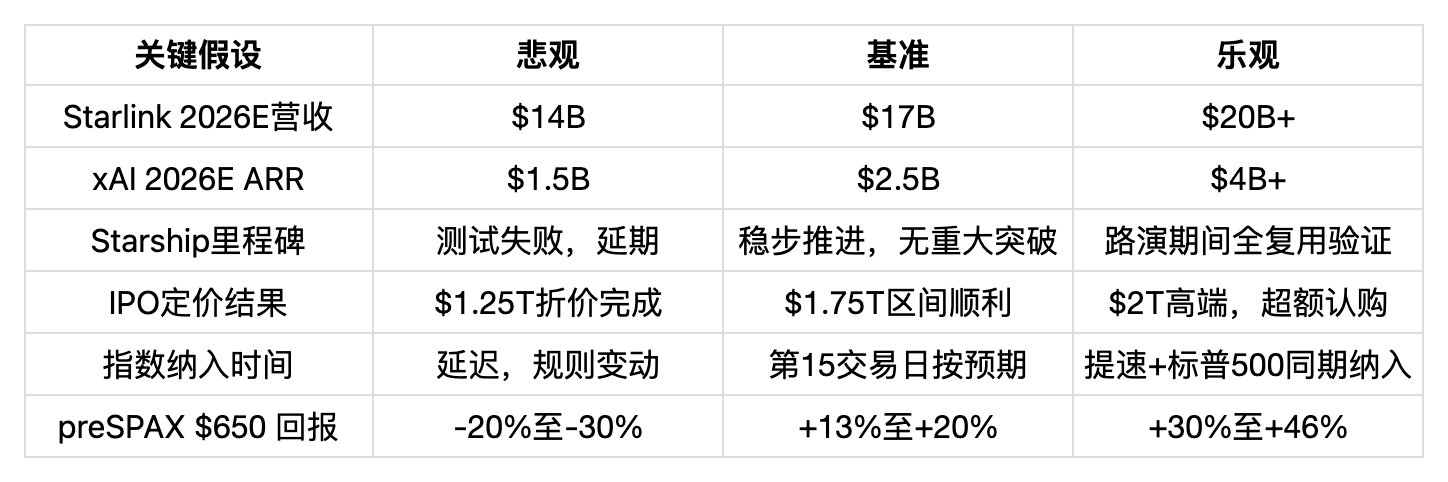
Major downside risks: ① Starship experiences a major accident (highest probability impact); ② Deterioration of Musk's relationship with Trump affects government contracts; ③ Nasdaq index rule revisions face congressional challenges; ④ Macro environment tightening leads to a complete shutdown of the IPO market. The probabilities of these risks occurring independently are relatively limited, but their impact is significant when they occur in combination.
This report is for internal research reference only and does not constitute investment advice. Tokenized products (preSPAX, PreStocks) do not grant shareholder rights, have no voting rights, and no dividend rights, with economic returns tied to reference indices, settlement mechanisms relying on platform credit. Private equity (Hiive) is limited to accredited/verified investors, with handling fees of 3-5%, and lock-up periods determined by holding structure. SpaceX's S-1 is under confidential review, and IPO valuation, timing, and issuance structure may change.
免责声明:本文章仅代表作者个人观点,不代表本平台的立场和观点。本文章仅供信息分享,不构成对任何人的任何投资建议。用户与作者之间的任何争议,与本平台无关。如网页中刊载的文章或图片涉及侵权,请提供相关的权利证明和身份证明发送邮件到support@aicoin.com,本平台相关工作人员将会进行核查。


