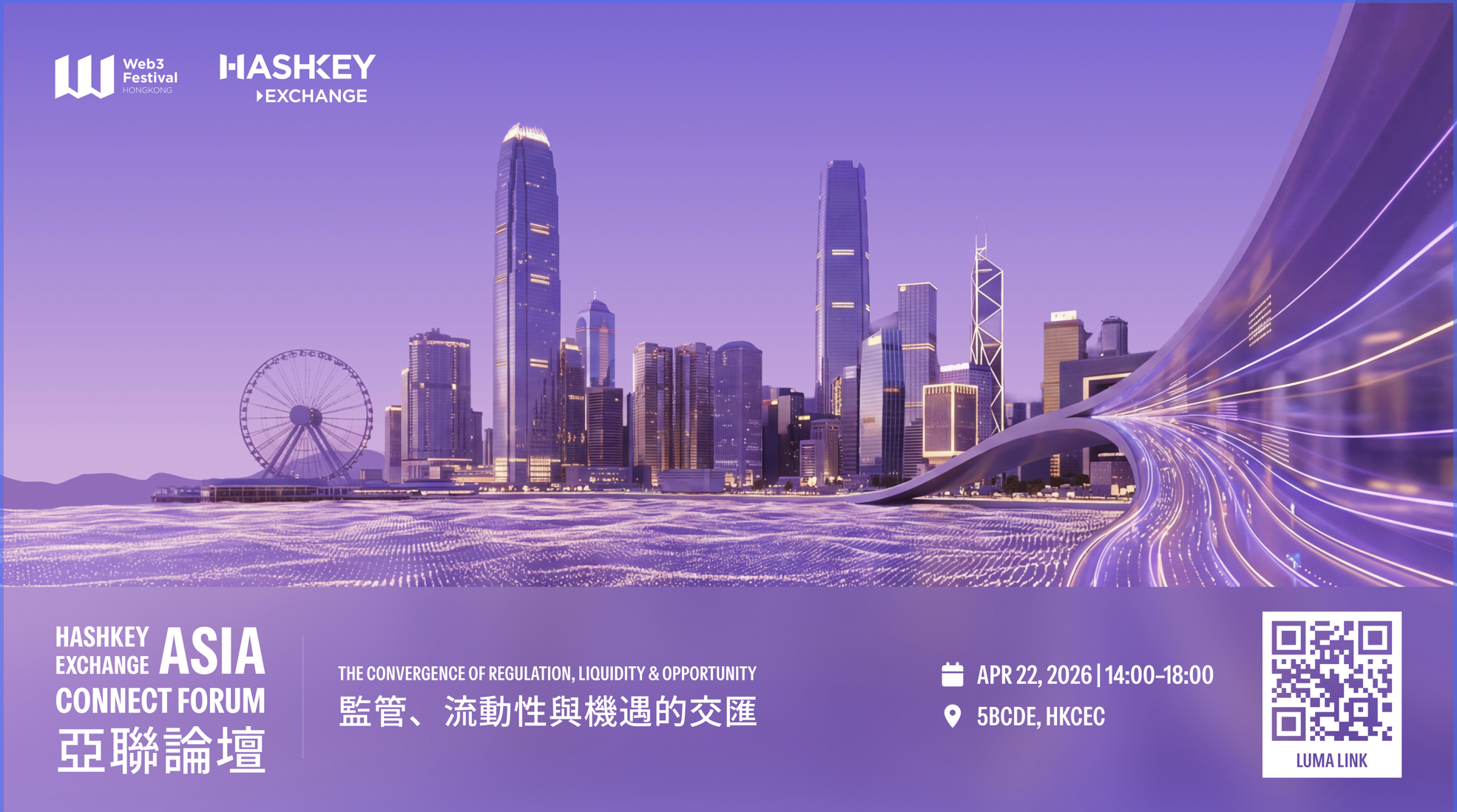
This year, the Hong Kong Web3 Festival has once again brought many industry participants back to the same venue. The official definition of this event is very clear: it is not merely a project roadshow, but a window to observe changes in the landscape of Web3 and digital assets in Asia. Meanwhile, the agenda for this session has already included specialized setups such as the HashKey Exchange Asia Connect forum.
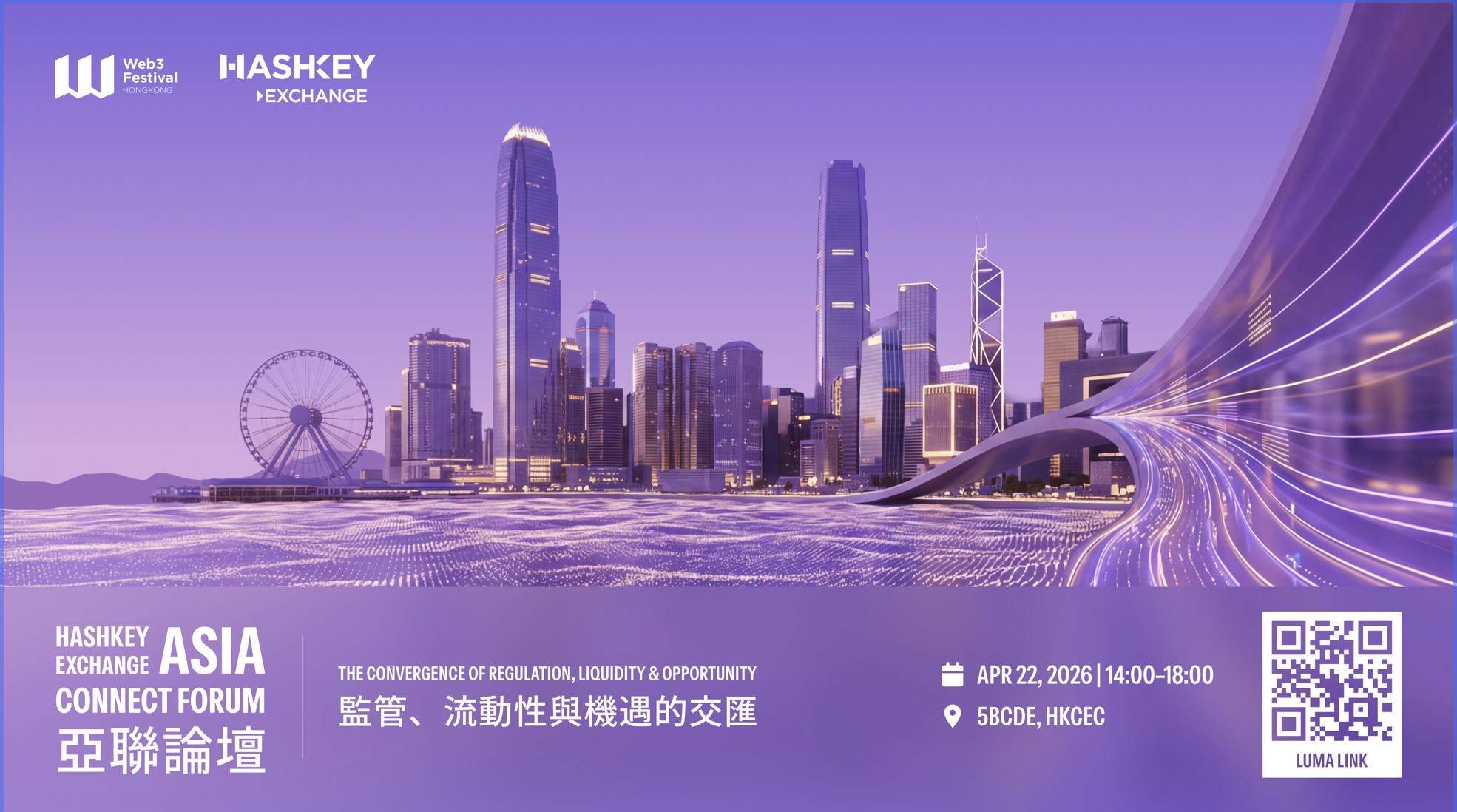
It is precisely in this context that HashKey Exchange emphasizes Asia Connect, making it particularly worth discussing. Because, viewed from the current industry background, this carries a somewhat counter-trend meaning. For some time now, regardless of capital direction, project valuation, media narratives, or market attention, the overall trend has obviously tilted towards the US and European markets. On one side, Coinbase continues to solidify its position in the US market and extends into a broader range of financial products; on the other side, Europe is accelerating the formation of a new round of licensed competition under the MiCA framework, with more platforms expanding their layout around EU licenses and compliance. In other words, today's mainstream narrative is more easily revolving around “US platforms,” “EU licenses,” and “institutionalization in Europe and America.”
Thus, when HashKey Exchange underscores Asia Connect at this point in time, what is genuinely worth analyzing is not the slogan itself, but the judgment behind it: As industry resources, capital, and narratives increasingly converge towards the US and Europe, is Asia perhaps underestimated? And why would a licensed exchange based in Hong Kong position itself with the notion of “connecting Asia”?
1. The Second Half of Exchanges: Changing Competitive Logic and the Formation of Differentiated Competition
In the past, the market assessed exchanges primarily based on direct indicators such as trading volume and user scale. Whoever can aggregate liquidity more effectively is more likely to become a center. This logic was very effective in the early days of the industry, with the rapid rise of offshore exchanges essentially reflecting this efficiency advantage.
Even today, retail investors remain an extremely important part of the exchange ecosystem and the most intuitive commercial indicator. However, it is necessary to recognize that the industry is undergoing a more subtle change: retail investors are increasingly gravitating towards a few major offshore exchanges. After the combination of liquidity, product diversity, trading habits, and market inertia, the absorption effect of leading platforms on retail trading volumes will only grow stronger. For newcomers or platforms that are compliant and regulated, purely competing for scale in the retail market is becoming increasingly challenging, with advantages not necessarily on their side.
This also implies that the next stage of competition among exchanges can no longer solely revolve around retail investors. As the user structure becomes increasingly diverse, the market is no longer dominated solely by retail investors; institutional investors, asset management firms, market makers, and corporate clients are all accelerating their entry.
The more pressing question is: when the retail market landscape gradually tends to concentration, what can other platforms rely on to establish their own position? Can they form differentiated advantages around the needs of different types of users in areas like institutional access, compliance infrastructure, asset distribution, and banking cooperation, establishing more stable and sustainable competitive barriers than traditional leading offshore exchanges?
This is precisely where the logic of exchange competition begins to change. The current question is, aside from trading volume, what other types of irreplaceable value can you provide for different types of clients? Are there banks willing to cooperate with you? Are there brokers, asset management firms, or family offices willing to connect their clients, order flow, and products into your system? Do you have the capability to integrate trading, custody, risk control, audit, and compliance into a set of infrastructures that are acceptable and practical for institutions?
From this perspective, HashKey Exchange's moves over the past one or two years have essentially been responses to a single question: as retail trading increasingly concentrates on leading offshore platforms, how should a regulated exchange establish its differentiated competitiveness?
In reviewing public actions from the past year or two, one relatively clear change is that HashKey Exchange has maintained a noticeable prudence and restraint in the pace of listing crypto-native tokens, not adopting an aggressive route to expand categories or chase hot tokens. In contrast, however, the supply of products around RWA, asset tokenization, institutional collaboration, and distribution infrastructure has been accelerating.
This change is not difficult to observe: according to the author's analysis, since launching its one-stop RWA solution this year, HashKey has successively announced collaborations with institutions such as Mox Bank (a digital bank under Standard Chartered), Matrixdock, and compliant exchanges in Vietnam like CAEX.

Source: WuBlockchain, CoinDesk
Looking at these clues together, the focus has become quite clear. At least from the direction and density of public actions, HashKey is directing more resources toward another path: not competing for attention through the speed of native token listings, but establishing differentiated capabilities more suited to its positioning through institutional access, asset acquisition, and compliance distribution.
This does not mean that HashKey Exchange does not value crypto-native asset trading; rather, it is more about proactively allocating resources in a direction that aligns better with its attributes in the current competitive landscape. Because for a platform characterized by compliance and regulation, merely competing head-on in terms of the speed of native token listings and the activity level of retail trading against leading offshore platforms is unlikely to generate advantages or establish long-term barriers; in contrast, establishing a position around RWA, institutional cooperation, and a compliance distribution network is more aligned with the role it is forming.
Thus, understanding HashKey Exchange’s Asia Connect strategy in this context clarifies the first layer of meaning: it is not a simple regional slogan but implies a direction for differentiation.
2. Why Asia? Why will “Connecting” become a scarce capability?
If we look at Europe and America alongside Asia, we find that they are not facing the same issues.
The digital asset landscape in the US and Europe is gradually moving toward a relatively clear equilibrium: regulatory frameworks are becoming increasingly defined, pathways for institutional participation are maturing, and market resources are more easily concentrating on a few leading platforms. Whether in the US or Europe, while platform competition remains fierce, it is increasingly converging towards a structure of a few giants plus strong regulation.
Asia, by contrast, is completely different. It is not a single market but a composite region made up of multiple systems, currencies, and regulatory frameworks. Hong Kong, Singapore, Japan, the Middle East, and Southeast Asian countries have varying degrees of financial maturity, different licensing systems, distinct capital attributes, and different behavioral habits of market participants. A model established in Hong Kong may not be directly replicable in Japan; a business framework that is viable in Singapore may not have even fully established a regulatory definition in some Southeast Asian markets.
It is precisely for this reason that Asia's difficulty has never been that the market is not large enough, but rather that the market is too fragmented. Fragmentation brings not simple diversity, but high friction. Capital flows between different regions must contend with different currencies, clearance paths, custody arrangements, and compliance requirements; assets that need cross-market distribution also face varying investor suitability, legal structures, and local cooperation networks. In other words, the real issue in Asia is not about “whether there is capital” and “whether there are assets,” but about the many invisible walls that always separate the two.
But complexity does not mean less space; often, the opposite is true. Asia does not lack capital. Japan has a deep institutional capital pool, the Middle East continues to release incremental capital, and Hong Kong and Singapore respectively cater to international capital and wealth management needs. Asia also does not lack the momentum for asset digitization. In the past year, Hong Kong's activities surrounding RWA, tokenized funds, and on-chain assets have significantly increased, and HashKey itself continues to integrate trading, tokenization, and institutional services into the same narrative.
The issue has never been about whether there are opportunities, but about who can “connect” these opportunities.
This is also why, in Asia, what is truly scarce is not the number of platforms, but the ability to connect. It’s not enough to just have trading functions; it’s about whether you can string together licenses from different jurisdictions, streamline the flow of capital across different currencies, and integrate institutional clients and asset supplies from different markets into the same system. To put it more directly, while it is easier in Europe and America to emerge with a large platform, Asia needs an interface layer that can stitch together fragmented markets.
It is in this sense that Asia Connect holds deeper discussion value. The implied judgment is: Asia may not be the market that is easiest to articulate, but it may be the market that most needs and can truly test a platform's real capabilities. If a platform can only operate its logic within a single market, it may not genuinely possess cross-regional organizational capabilities; however, if it can establish connections in a complicated environment like Asia, which coexists with multiple systems, currencies, and capital sources, what it proves is not just business capability but a deeper foundational capability of infrastructure.
3. HashKey Exchange’s Asian Layout: From Licensing to Institutional Collaboration, the Connection Network is Taking Shape
From the publicly available information, HashKey's layout in Asia does not resemble a simple story of an exchange setting up branches in different markets; rather, it resembles a layered architecture. It is not mechanically replicating the Hong Kong experience in other regions but gradually organizing compliance nodes, capital collaborations, institutional access, and asset acquisition into a network through different approaches in different markets.
The logic behind this network, rather than being regional expansion, is about building a new generation of financial infrastructure aimed at Asia. If you pay attention to the recent strategic releases from HashKey Group, you will find that its discourse system has undergone noticeable migration: shifting from a single licensed exchange to a new generation of digital financial infrastructure: from trading, custody, and on-chain foundations to tokenization and institutional services, it is no longer just providing standalone products, but is forming more complete capabilities of infrastructure.
First is self-operated licensing. According to publicly disclosed information, the compliance foundation based on HashKey Exchange has covered Hong Kong, Singapore, Japan, Bermuda, and Dubai. For a platform aiming for regional connection, these licenses will establish the starting point of institutional trust across different jurisdictions. The significance of Hong Kong lies in providing a high-standard regulated trading and asset service framework; nodes like Singapore, Japan, and Dubai allow these capabilities to extend beyond staying within a single market.
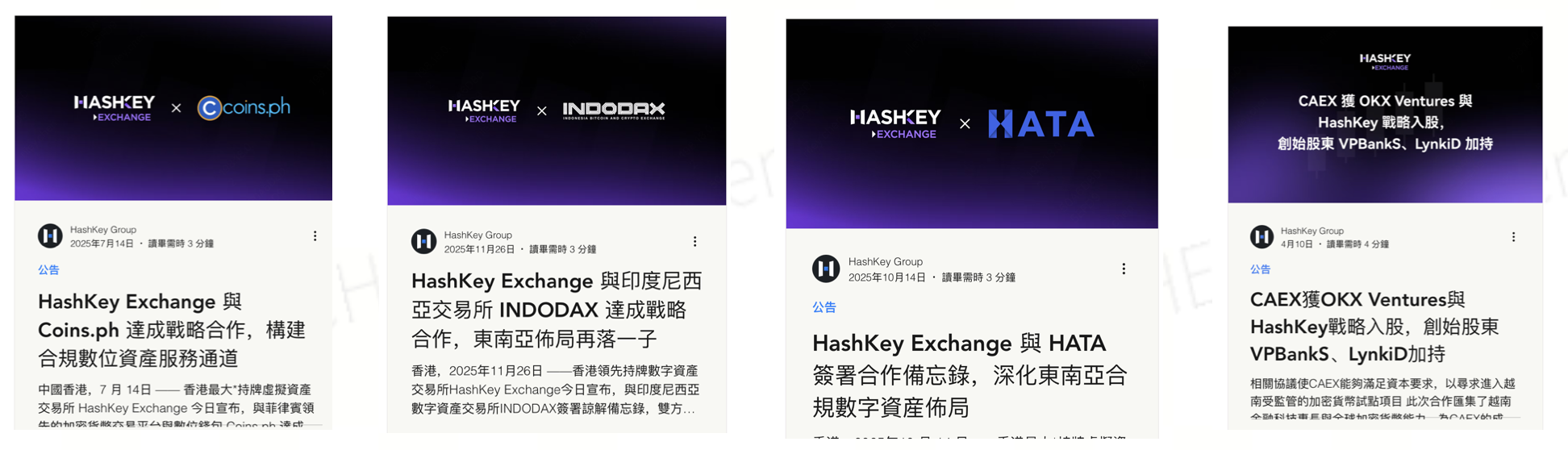
Secondly is capital cooperation and local binding. Based on publicly available information, HashKey's recent movements in Southeast Asia have already manifested this thinking. The most typical example is Vietnam: HashKey Capital has strategically invested in CAEX alongside OKX Ventures and explored collaboration on technical infrastructure, security systems, compliance and risk management, and liquidity connection; this project also connects with local financial and technological resources such as VPBankS and LynkiD. The significance of this move is not merely financial investment but rather entering the pilot regulated environment and local institutional network through capital collaboration.
Source: HashKey official website
Looking further outward, the公开 institution collaborations are no longer limited to Hong Kong. On the banking side, publicly visible collaboration partners include Mox, Deutsche Bank, Shanghai Commercial Bank, as well as earlier mentioned ZA Bank and Bank of Communications (Hong Kong), etc. In 2025, Deutsche Bank explicitly announced it would help HashKey Exchange expand new fiat deposit channels; Mox, in 2026, launched regulated bank-level crypto trading services in collaboration with HashKey Exchange.
If we look at these公开 institution collaborations in other Asian regions, their distribution is actually quite widespread. Toward the Philippines, HashKey Exchange announced cooperation with Coins.ph in 2025, attempting to establish a compliant digital asset service channel between Hong Kong and the Philippines; toward Vietnam, there are the CAEX project and its local collaborations with VPBankS and LynkiD; concerning Japan, the licensed node in Tokyo itself implies the possibility of future institutional capital entry; and regarding the Middle East, HashKey Global MENA has entered the local market with a VASP license. Strictly speaking, this statistic is not complete, but at least from the coverage of public messages, clear institutional cooperation nodes have appeared in markets such as Southeast Asia, Japan, Singapore, and the Middle East.
Viewing all these together, HashKey's Asia layout no longer appears like a story of point-based expansion but rather a process of network formation: using self-operated licensing to establish institutional anchor points, embedding local resources through capital cooperation, facilitating inter-market connectivity through business cooperation, and then reorganizing these nodes within a new generation of financial infrastructure framework. What it aims to achieve is evidently not to become the largest player in every market, but to enable connections between different markets through itself.
The real importance here is not the territory itself, but whether these markets can form mutually supporting relationships. Only when Hong Kong is not just Hong Kong, Vietnam is not just Vietnam, Japan and the Middle East are also not merely independent nodes, but together constitute a regional network where capital, assets, and institutional trust can flow, will Asia Connect become not just a slogan but a real commercial structure.
4. The Real Meaning of Asia Connect : Not Simply Expanding from Hong Kong, but Re-evaluating the Role of Asian Exchanges
If Asia Connect is merely understood as expanding from Hong Kong to Asia, it seems too narrow.
Because for HashKey Exchange, this is not just a matter of geographical expansion. Especially after its listing, facing a weakening market, intensified competition, and continued concentration of retail traffic toward leading offshore platforms, what it needs to address is no longer how to craft a larger story but rather how to find a more sustainable position in the new competitive landscape.
Traditional exchange narratives emphasize user scale, trading volume, and brand perception. This logic is very effective in a single large market, as the core task of the platform is to aggregate traffic, compress trading costs, and form network effects.
However, Asia is not a single market. No single license can cover the entire region, nor can any product structure naturally fit all markets. For Asia, a truly representative exchange is likely not just the platform with the most users, but the one that can best connect capital, assets, and regulation.
From this perspective, HashKey's public actions over the past one or two years have slowly pieced together a more complete picture. Compliance capabilities and on-chain infrastructure correspond to infrastructural output capabilities, while the network of licenses from Hong Kong and multiple regions corresponds to the regional spillover capacity of regulatory trust, and the RWA solutions correspond to the capacity for asset acquisition and distribution. Although they superficially appear as different business lines, they actually point toward a larger platform paradigm: exchanges are no longer just trading fronts but are gradually evolving into crucial interfaces within the digital financial network of Asia.
This path is certainly not easy. Multi-market, multi-license, and multiple partners mean higher execution costs; the complexity inherent in Asia also determines that this path cannot progress linearly like in a single market; and once this model is proven effective, latecomers will surely follow suit. Nevertheless, this first-mover advantage still possesses real value. Because license networks need time to accumulate, banking relationships require long-term establishment, institutional collaborations need ongoing adjustment, and cross-border asset distribution capabilities are not easily replicable in a short time. The common point of these capabilities is that they cannot be quickly gained through subsidies, marketing, or short-term traffic; rather, they require long-term organization, repeated validation, and real-world implementation.
Thus, today, describing HashKey Exchange merely as a licensed exchange based in Hong Kong remains the most direct entry point for the public to understand this platform. However, in my view, especially since HashKey's listing, its development path has become increasingly difficult to fully cover with this single label. Rather than being just a regulated exchange based in Hong Kong, it is trying to extend toward a larger direction: aiming to be a key interface within the digital financial infrastructure of Asia.
This might also be why HashKey chose to formally launch Asia Connect during this conference— it is responding to the continuous layout and resource accumulation of exchanges in the Asian market over the past period, consolidating originally fragmented licenses, collaborations, institutional interfaces, and asset capabilities into a clearer external expression.
More importantly, the significance of Asia Connect for HashKey Exchange goes beyond regional expansion. It is more like naming a new role: outside of Europe and America, facing a long-underestimated yet highly complex Asian market, what role should exchanges truly play?
If this question holds, what HashKey Exchange aims to obtain is not just a share in a specific market, but a more critical position: becoming a node that connects capital, assets, and regulation in the context of a fragmented, diverse, and multi-system environment like Asia. This might be the most genuine significance of Asia Connect. It is not merely a regional slogan but a directional judgment on the evolution of the role of exchanges.
免责声明:本文章仅代表作者个人观点,不代表本平台的立场和观点。本文章仅供信息分享,不构成对任何人的任何投资建议。用户与作者之间的任何争议,与本平台无关。如网页中刊载的文章或图片涉及侵权,请提供相关的权利证明和身份证明发送邮件到support@aicoin.com,本平台相关工作人员将会进行核查。


