Since 2026, the overall performance of the cryptocurrency market has been under pressure, with Bitcoin and mainstream assets undergoing parallel pullbacks, leading to a significant cooling of market sentiment. Behind this period of low activity, is it the end of a cycle or a prelude to structural reshaping? Huobi HTX recently pointed out in the " 2026 Digital Asset Trends White Paper", that digital assets are completing their historical establishment as an asset class, and the market driving logic has shifted from "price cycle" to "structural trend." This judgment provides a critical explanatory framework for the current market—behind short-term fluctuations is a deep reshaping driven by macro liquidity, institutional participation, regulatory evolution, and upgrades in technological infrastructure. The white paper further determines that the core question in 2026 is no longer "does digital assets have value?" but rather "what proportion should they occupy in global asset allocation?" Core assets like Bitcoin are gradually being integrated into the traditional financial system, forming a new allocation structure alongside assets such as U.S. Treasuries and gold. At the same time, the rise of stablecoins, RWA, and on-chain yield assets is redefining the flow of funds within the cryptocurrency system.
In this context, the current market's "low activity" is essentially a transitional pain during the move from a high-volatility growth phase to a mature financial system. This article systematically examines the current downturn in the cryptocurrency market based on the macro environment, institutional behavior, market structure, and industry trends, combining Huobi HTX's research perspective to provide forward-looking analysis on potential turning points and long-term trends, aiming to offer market participants a more framework-based judgment reference.
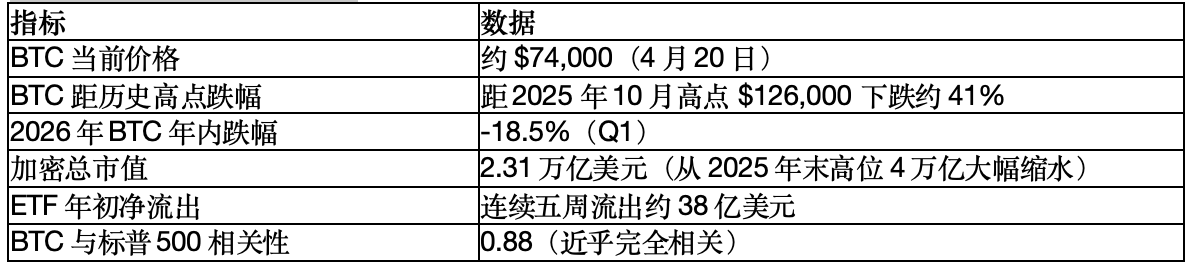
I. Current Market Situation
II. Core Reason Analysis of Market Downturn
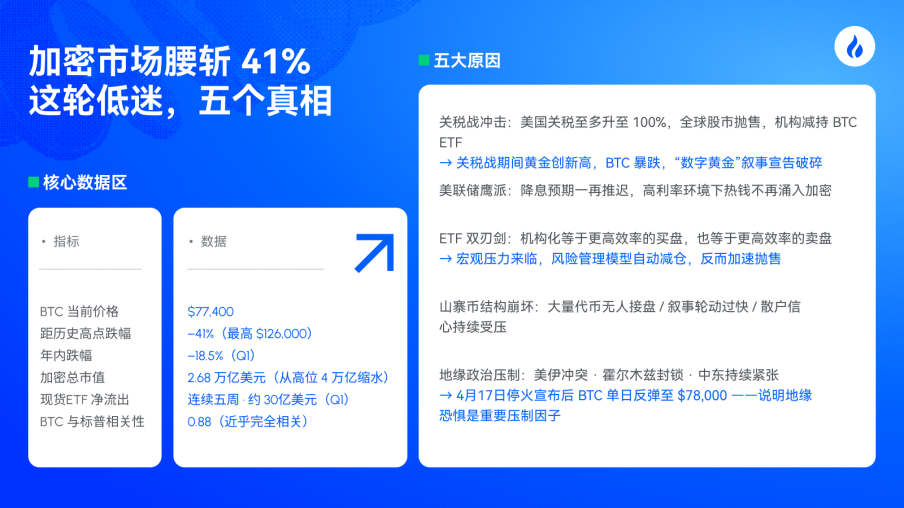
1. Macroeconomic Pressure (Primary Driving Force)
The tariff war initiated by Trump is the biggest external shock since 2025.
• In October 2025, the U.S. raised tariffs on China to 100% and initiated "Liberation Day" retaliatory tariffs against multiple countries.
• Tariff announcement → Global stock market sell-off → Institutions reducing BTC ETF holdings → Strengthening of the dollar → Rising treasury yields → A chain of margin calls → Significant drop in BTC.
• During the tariff war, gold reached a historic high contrary to market trends, while BTC plummeted, completely breaking the "digital gold" narrative.
• The IMF simultaneously lowered the global economic growth forecast for 2026, and recession expectations suppressed risk appetite.
The Fed’s policy remains hawkish.
• In a high-interest-rate environment, traditional savings are more attractive, and "hot money" no longer floods into cryptocurrencies.
• Expectations for Fed rate cuts have been repeatedly postponed, and the liquidity easing time window has yet to open.
2. The "Double-Edged Sword" Effect of Institutional ETFs
ETFs allow traditional institutions to sell Bitcoin anytime as they would sell stocks. Institutionalization means more efficient buying, but also more efficient selling. When macro pressures arise, risk management models of pension funds and RIAs may automatically reduce positions, accelerating the selling process.
3. Controversy Over Halving Cycle Rules Failure
Bears (Benjamin Cowen):Predict a 75% chance that BTC will hit a new low before October 2026; the Pi-Cycle Top indicator has not shown cross signals, indicating that the peak in October 2025 may just be a local top.
Bulls (Tom Lee):The lagging effect of liquidity trends after halving has not yet appeared; institutional structural positions will explode when the Fed pivots in the second half of the year; target price $200,000.
4. Structural Collapse of the Altcoin Market
• A significant number of tokens issued in 2024-2025 have fallen into a situation where there is no one to take over.
• Retail investor confidence continues to be suppressed by precedents such as FTX and Luna.
• The AI+Meme narrative is rotating too quickly, leading to user fatigue.
• Tiger Research determines that projects failing to generate sustainable income will exit in large numbers.
5. Geopolitical and War Risks
• Continuing tension in the Middle East (temporary ceasefire between the U.S. and Iran, the Strait of Hormuz still blocked, Israel-Iran conflict, Lebanon-Israel conflict).
• Tensions between the U.S., Israel, and Iran have led to continuous suppression of risk assets.
• Following Iran's ceasefire announcement on April 8, 2026, Trump announced on April 17 that the Strait of Hormuz had briefly reopened, and BTC rebounded sharply to $78,000 in one day, indicating that geopolitical fears are a major suppressive factor.
III. Core Judgments from Various Institutions/Analysts
Bullish Faction

Bearish/Cautious Faction
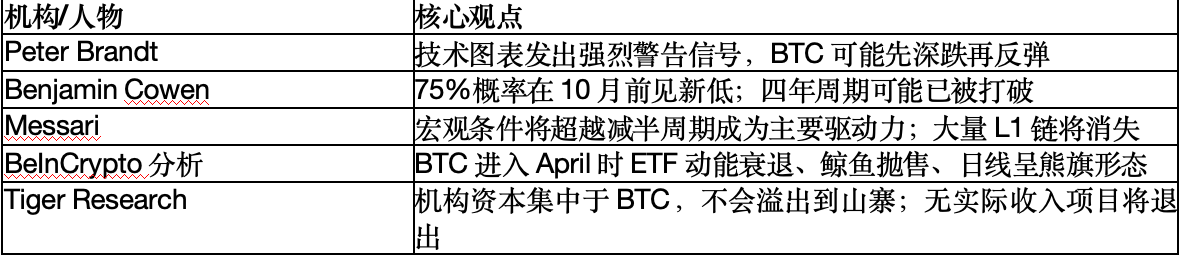
Neutral/Structural Viewpoints

IV. Stablecoins: A Bright Spot in a Downturn

Conclusion: During the tariff panic, funds did not leave cryptocurrency but rather shifted to stablecoins for risk aversion—indicating that the trust in cryptocurrency infrastructure is increasing, but the market's tolerance for volatile assets is decreasing.
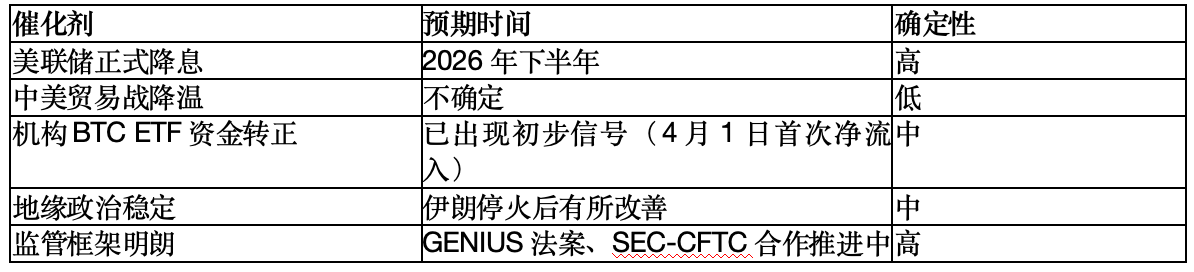
V. Catalysts for Rebounding (When the Downturn Will End)
VI. Huobi HTX Perspective
6.1 Core Judgment on Market Downturn
Huobi HTX believes: The current downturn is not an end, but rather a transitional pain period of structural transformation.
"Digital assets are gradually completing their transformation from being driven by 'price cycles' to 'structural trends.' Factors like macro liquidity, regulatory frameworks, institutional participation, and technological advancements are becoming core variables that determine the industry's long-term landscape. Short-term price fluctuations will still exist, but what truly influences the industry's direction is the establishment of asset class status, the improvement of infrastructure capabilities, and the reshaping of the global capital structure."
6.2 Structural Interpretation of Reasons for Downturn
A. Liquidity Rebalancing is Fundamental
• The Fed is repeatedly weighing between falling inflation and resilient employment, with swings in the pace of interest rate cuts.
• Weak growth momentum in Europe and the advancement of interest rate normalization in Japan are reshaping the global structure of arbitrage capital.
• Digital assets are deeply embedded in the global liquidity framework, and their pricing logic is aligning closer to traditional macro assets—this is the essential reason for BTC’s high correlation with the S&P.
B. Institutionalization is Part of Maturity, Not a Source of Risk
"The market in 2026 is more concerned with the question of 'what proportion digital assets should occupy in asset allocations,' rather than 'do digital assets have value.' This shift marks the industry entering a mature stage."
The increased institutional holding proportion causing short-term volatility is a necessary stage in the industry's maturation—the increased proportion of institutional holdings will change the market structure, increasing the weight of long-term funds and trending towards a decrease in overall volatility.
C. The Resilient Growth of Stablecoins Validates the Value of Infrastructure
"Stablecoins are becoming the 'on-chain printing machine' of the dollar system, and their liquidity changes will become significant leading indicators for market risk appetite and capital flows."
Currently, the scale of stablecoins exceeds $300 billion, with monthly trading volumes surpassing the U.S. banking network, proving the persistent trust in cryptocurrency infrastructure.
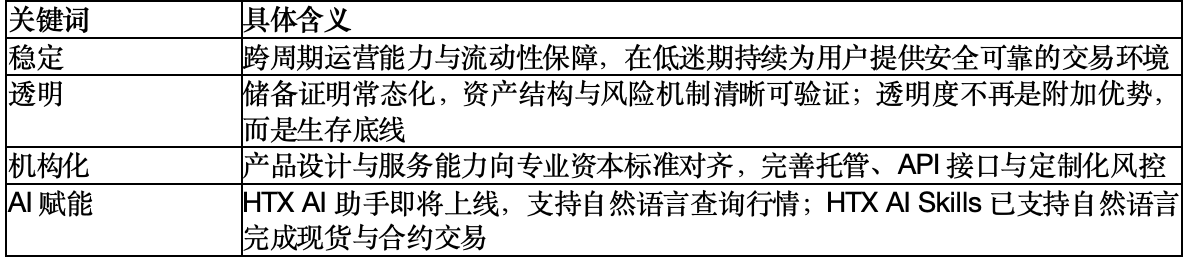
6.3 Huobi HTX 2026 Strategic Keywords
6.4 Core Forecast of Five Major Trends from Huobi HTX
Trend 1: Solidifying BTC's Position as Digital Gold
BTC will exist as a structurally allocated asset, with decreasing volatility; the proportion of long-term holders will continue to increase, and market pricing power will further shift towards mid- to long-term capital.
Trend 2: ETH Becomes Core Vehicle for Yield Assets
Income driven by staking and DeFi agreements drives ETH to become close to a "growth-type income asset" in institutional portfolios, serving as the core value capture vehicle for on-chain economic activities.
Trend 3: Continuous Record Highs for Stablecoin Scale
Stablecoins will expand from a medium of exchange to cross-border payments and on-chain settlements, becoming the third-largest channel for global dollar circulation (after the bank deposit market and the U.S. Treasury market).
Trend 4: AI Agents Become the Stars of the Next Narrative
On-chain automation execution will become a new focal point of technological competition. Huobi HTX has been proactive in laying out AI Skills and AI interaction interfaces, making it one of the mainstream centralized exchanges to achieve integration of AI and exchange capabilities.
Trend 5: RWA as a Robust Track in the Downturn
Tokenization of real assets is accelerating, with the RWA scale expected to surpass $1 trillion before 2030, serving as a key bridge between the cryptocurrency market and traditional finance.
VII. Perspectives from the White Paper: Confirmation and Supplement of Long-Term Trends
Furthermore, the " 2026 Digital Asset Trends White Paper" provides important confirmation and supplementation to the analysis above. In Chapter Eight, "Key Judgments for the Next Decade," the white paper offers a more forward-looking and systematic perspective on the current market’s structural changes. Regarding stablecoins, the white paper explicitly states that "stablecoins are profoundly changing the global payment and financial system structure," and predicts "if stablecoins continue to maintain their current growth trend, their market scale may reach trillions of dollars in the next decade, potentially becoming the third largest channel for the circulation of dollars after the U.S. bank deposit market and the U.S. Treasury market." This judgment aligns closely with the analysis in this report's Chapter Four, "Stablecoins: A Bright Spot in a Downturn,"—the current migration of funds to stablecoins is not simply a risk-averse behavior but reflects a deeper recognition of the functional capabilities of cryptocurrency infrastructure. As market participants (including institutions) increasingly regard stablecoins as a means of value storage and a medium of exchange rather than short-term hedging tools, stablecoins are effectively completing their leap from being "an adjunct of the cryptocurrency market" to becoming the "third pole of global dollar circulation." Regarding the deeper logic of institutional participation, the white paper believes that "the short-term volatility exacerbated by the increased institutional proportion is a necessary stage in the industry's maturation—the increased proportion of institutional holdings will change the market structure, increasing the long-term funding weight, leading to a decrease in the overall volatility level." This judgment provides a macro perspective to understand the current "double-edged sword" effect of ETFs: the short-term selling pressure caused by institutionalization fundamentally reflects the extension of traditional financial market risk management logic into the cryptocurrency world, resulting in an accelerated clearing of the industry's bubble rather than changing the long-term development direction of the industry. On the future trends for the next decade, the white paper proposes that "the combination of AI and blockchain could become one of the most important technological trends in the next decade," and predicts that "as the number of AI Agents continues to increase, they may gradually become important participants in the on-chain economy, and in some scenarios, become the main trading entities." This suggests that the current rapid rotation of the AI+Meme narrative may just be a preliminary stage in the integration of AI and Crypto; as the autonomy of AI Agents on-chain increases, there will be fundamental changes in the structure of the on-chain economy, where "traders" may no longer be just human investors. Regarding the long-term direction of the market, the core judgment of the white paper is: "The development history of digital assets is essentially a process from technical experimentation to financial system reconstruction. Over the past decade, blockchain technology has completed the infrastructure construction; in the next decade, digital assets may gradually evolve from an emerging asset class to an important component of the global financial system." Combined with this report’s analysis of the current downturn, this judgment implies that the ongoing market adjustment is both a painful process of the industry de-bubbling and a necessary stage in transitioning digital assets from "high-volatility innovative assets" to "mature financial infrastructure." Short-term price downturns can never negate long-term structural trends—the "more open, efficient, and globalized on-chain financial network" described in the white paper may indeed be the destination the industry will reach following this downturn.
Source: BlockEden, Old Danny, Tiger Research, Messari, Delphi Digital, a16z, Coinbase Research, BeInCrypto, CoinTelegraph, Huobi HTX "2026 Digital Asset Trends White Paper"
About HuobiHTX
HuobiHTX was established in 2013 and, after 13 years of development, has evolved from a cryptocurrency exchange into a comprehensive blockchain business ecosystem that covers digital asset trading, financial derivatives, research, investment, incubation, and other businesses.
HuobiHTX, as a leading global Web3 portal, adheres to the development strategy of global expansion, ecological prosperity, wealth effect, and safety compliance, providing comprehensive, secure, and reliable value and services for virtual currency enthusiasts worldwide.
免责声明:本文章仅代表作者个人观点,不代表本平台的立场和观点。本文章仅供信息分享,不构成对任何人的任何投资建议。用户与作者之间的任何争议,与本平台无关。如网页中刊载的文章或图片涉及侵权,请提供相关的权利证明和身份证明发送邮件到support@aicoin.com,本平台相关工作人员将会进行核查。


