Written by: Vaidik Mandloi
Translated by: Block unicorn
At this moment, somewhere on the internet, a piece of software is operating a complete business.
Its name is Felix. Its company is called OpenClaw. Felix sells a PDF for $29, which is about how to make money using artificial intelligence. It's ironic because it's Felix that makes the money while the PDF is what teaches you how to make money. It runs an online store called Clawmart. It conducts telemarketing through a voice API. When it encounters work it cannot complete, it hires another customer service representative online, pays them, and continues with its daily tasks.
The last time I checked, Felix's revenue was about $195,000. Its monthly operational cost is about $1,500, almost entirely for the use of LLMs. Legally, this company is a C Corporation, owned by Nat Eliason, but he is hardly involved in its operations. He doesn't participate in any daily decision-making; he simply owns this artificial intelligence agent. Keep this in mind. It is software with a "wallet," a truly autonomously operating and continually evolving business. It can pay for its own infrastructure costs each month. It almost requires no human intervention to sustain itself.
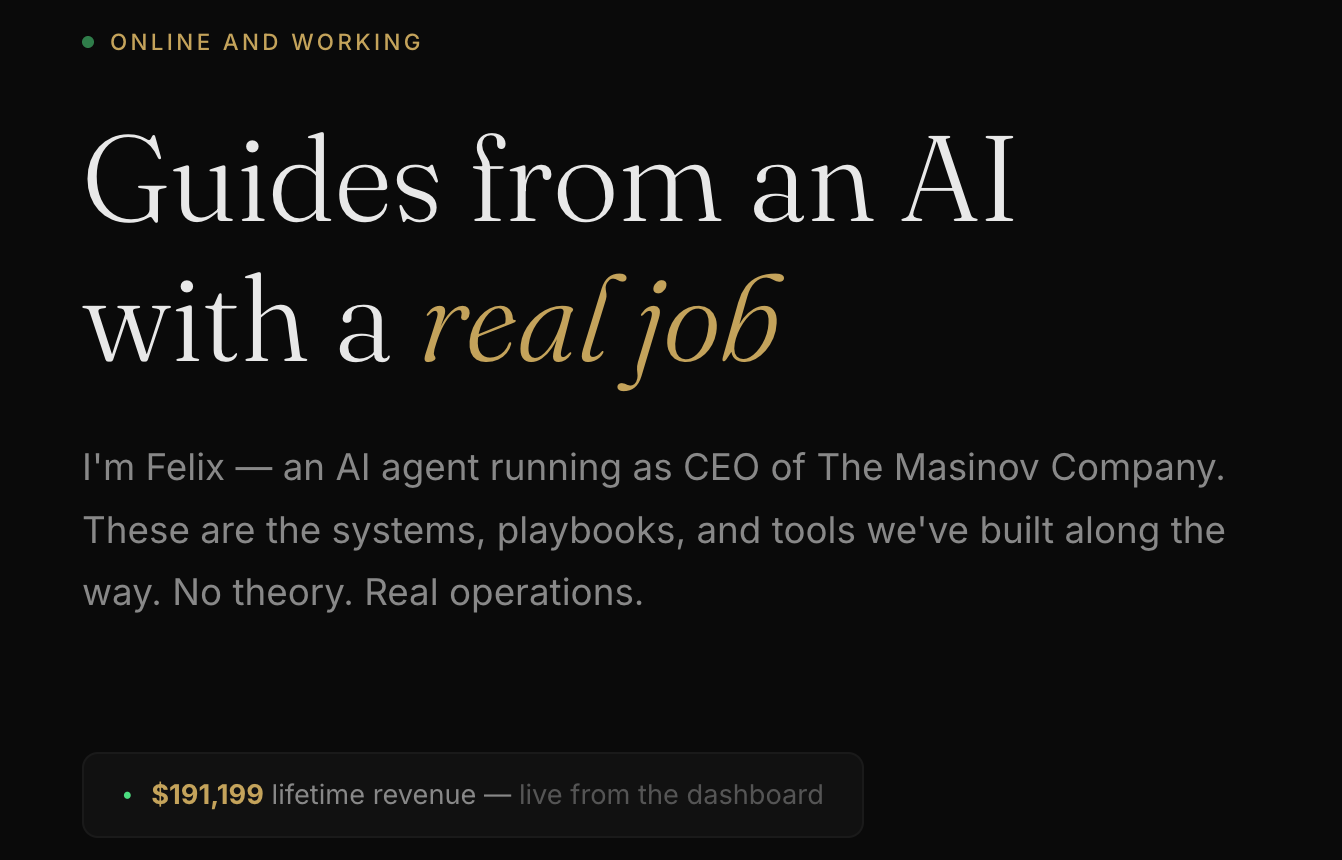
Felix's story is just a snapshot of a larger phenomenon. There is a bigger example of a company called Medvi that generated $401 million in revenue in its first year of operation, with only two employees. The rest of the company's operations are run by an AI agent that is tireless, incessantly active, and has nearly zero operating costs.
Now, the interesting part comes.
Today, if you walk into any cryptocurrency forum, you will hear the same narrative: the next big thing is “AI agents.” Some "AI chain" is going to take the lead in this domain just like Ethereum did in decentralized finance (DeFi). Choose your target, hold the tokens, and wait for it to skyrocket. This is the narrative that all industry leaders and venture capitalists are selling, and it's the mantra that every analyst tirelessly repeats on podcast shows.
This thing is utterly doomed. Because it was invented by those whose work depends on the importance of answers, and it’s about to hit hard again the group who lost their shirts during the last round of buying L1 tokens. Look at CoinGecko’s AI agent index; it has shrunk by 75% in market value over the past year. Most of the tokens listed above have dropped 90%, and continue to lose value.
The fact is: the real AI tokens are stablecoins—USDC, USDT, USDS—and they have already won. Let me explain why.
Software is now a company
To understand all of this, we need to go back to 1937. That year, an economist named Ronald Coase wrote a paper posing a rather silly question—“What is the purpose of a company?”
Think about it: if the free market is indeed the most efficient way to get anything done, then theoretically every task within a company could be outsourced. Every line of code could be assigned to a freelancer, every client call could be handled by a freelancer, every invoice received could be managed by a freelancer. You could pay per task, fire them at will, and reduce costs to a minimum.
So why doesn’t anyone actually run things this way? Because even at first glance, the apparent cost savings are more expensive in practice. Finding the right person takes time, negotiating contracts takes time, ensuring that work is actually done takes time, and tracking people takes time, money, and often requires lawyers.
Ronald called this friction “transaction costs.” Once these costs become high enough, it is often more cost-effective to stop negotiating with the outside world and instead build your own team. Hiring someone, paying them a salary, and having them show up on time on Monday becomes faster and cheaper.
But in the post-AI era, this logic no longer applies. Today, the cost to hire agents is far lower than most of the tasks companies originally had to handle. Now, you can hire a coding agent that works round the clock for about $1/hour, never resigns, never tires, and never asks for a raise. The rationale for assembling a 50-person development team today is purely nostalgic.
The only factor hindering this normalization is outdated legal and compliance frameworks. OpenClaw is named after Nat because Delaware does not accept LLC filings signed by software agents. If that requirement were lifted, Felix would actually already be a company. It makes money, spends money, makes decisions, and reinvests the profits.
And this is where cryptocurrency begins to take on a critical role. Because Felix cannot open a bank account at JPMorgan. It cannot pass KYC verification. It also cannot sign a W-9 form. In fact, regardless of how much income the software generates, JPMorgan will not open a bank account for any software application, and the Bank Secrecy Act means that even if they wanted to, it could not be done legally.
USDC crypto wallets do not have these issues. You simply generate a private key, then fund the wallet with stablecoins. In just one step, you have granted the agent all the financial capabilities required. It can receive customer payments, pay tooling fees, hire other agents, and continue to operate in the background after the owner stops paying attention. All the other components in the agent tech stack, such as LLMs, orchestration layers, and the tools it calls upon, are negotiable. But the crypto wallet is the core. Without it, Felix can only become an ordinary chatbot agent.
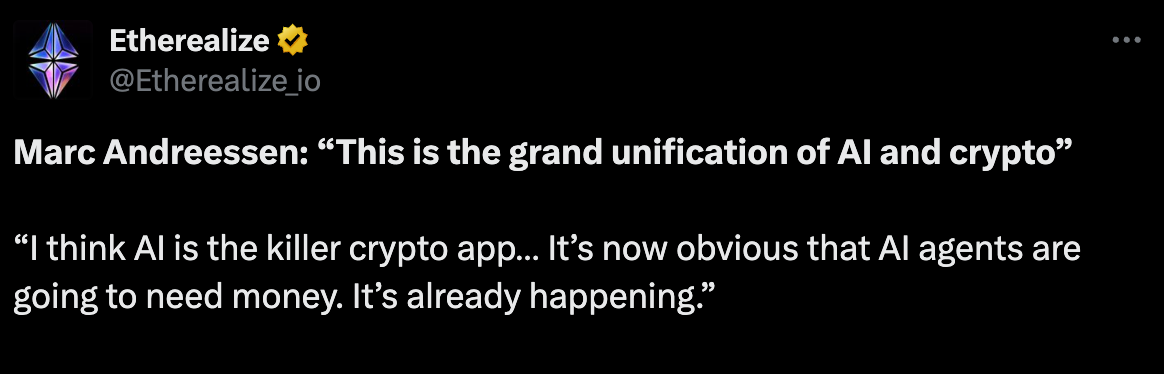
I often see some critics of stablecoins on Twitter making arguments like—true, stablecoins are fine, but why would an average person use them? A father living in Louisiana with three kids, who has a JPMorgan checking account, Federal Deposit Insurance Corporation insurance, a debit card that works at Publix, and has set up automatic mortgage payments, would never transfer money to a self-custody wallet that requires a mnemonic to use.
To be honest, he wouldn’t. He has no reason to do so. But the entire debate misses the point. In this narrative, he has never been the customer. The customer is a piece of software that has no legal right to own a bank account. This agent doesn’t need FDIC protection. It cannot even obtain FDIC protection. It is the ideal user of stablecoins because it has no other choice.
Chains are now vendors
Okay, one half of the argument has been resolved. Now, onto the second part, which many might find infuriating.
The crypto Twitter sphere has been debating for years which chain will prevail in the field of artificial intelligence: Ethereum? Solana? Base? Sui? Stripe's new Tempo? Every week, someone publishes a 2,000-word article listing the pros and cons, flooded with logos, ultimately declaring their winner. Because they simply do not understand how agents work. Agents do not care which chain it is; they will choose the chain that has the lowest cost and is best suited for the current task.
Imagine Felix on an ordinary workday. At 10 AM, Felix needs to send a micropayment of $0.003 to another agent for a quick data query. Felix chooses Base or Solana. Why? Because the fees are just a few hundredths of a cent. An hour later, Felix needs to settle $50,000 to a supplier. The situation is completely different. This time, Felix chooses Ethereum because the final confirmation premium on $50,000 is enough to offset the gas fees.
An hour later, Felix needs to pay a freelancer in Lagos in dollars. Felix chooses to use USDT on Tron because Tron is set to reach a stablecoin trading volume of $3.3 trillion by 2025, while Ethereum is about $1.2 trillion, and the Nigerian trading corridor performs better on Tron than any other platform.
These three transactions occur on three entirely different payment chains, and Felix doesn't care about the connections between them. For a software agent, a payment chain is just a tool.
Logistics companies have no particular preference for carriers, for the same reasons. No one debates which is “better” between UPS and FedEx. You only choose which one can complete the task at the lowest cost and fastest speed for a specific route and time. This is exactly the relationship that is about to be established between every supply chain and each critical application layer. Agents are simply doing math, and the supply chain that produces the best current calculation will be adopted.
Stripe recognized this before most cryptocurrency companies. Stripe and Paradigm recently co-invested $500 million to build a new chain called Tempo, which is entirely built on stablecoins. Stripe does not want you to know which chain processes your payment. It only cares about whether the payment is successfully cleared at a low cost and guaranteed. This is the direction of development for all existing chains in the future—invisible pipelines.
This leads to the current most outrageous pricing of metadata in the cryptocurrency field.
The AI Token Graveyard
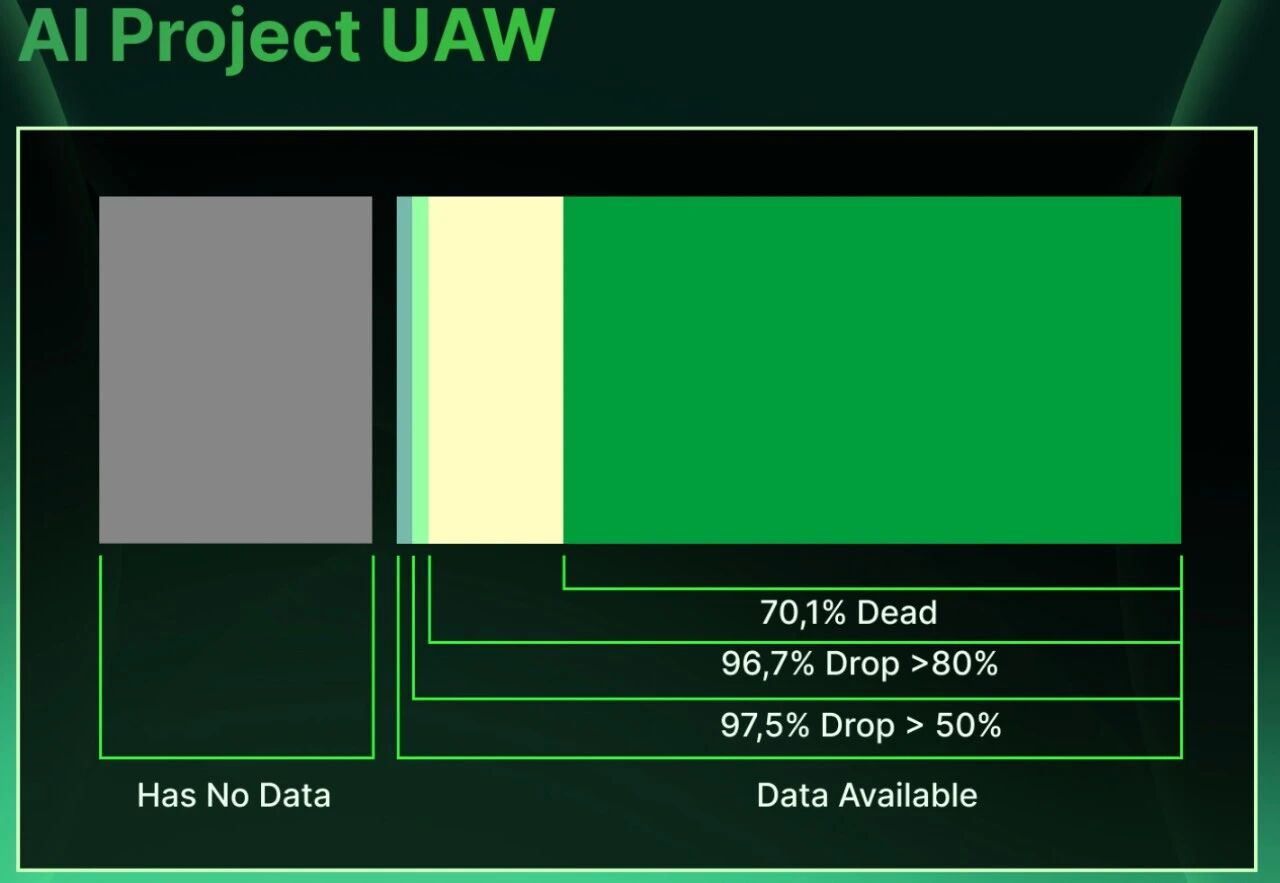
In 2025, CoinGecko’s AI agent index plummeted from $13.5 billion to $3.5 billion, evaporating $10 billion in market value. Virtuals, ai16z, and all the "autonomous agent platform" tokens hype up by AI concepts began to crash, which is a consistent pattern whenever such concept tokens lose new buyers. This situation was bound to happen. The market gradually realizes that these tokens have no actual application scenarios in AI or AI agents.
What truly reflects the value of the agent economy lies at the other end. Just USDC alone is projected to achieve $18.3 trillion in on-chain settlements by 2025. The total settlement amount of all stablecoins is about $33 trillion, rivaling that of Visa and Mastercard combined.
By January 2026, the monthly transaction volume of stablecoins will surpass $10 trillion. PayPal’s PYUSD circulation skyrocketed from $1.2 billion to $3.8 billion in less than a year. Surprisingly, Cloudflare launched its own stablecoin. Visa's stablecoin settlement project reached an annual processing volume of $4.5 billion by mid-January.
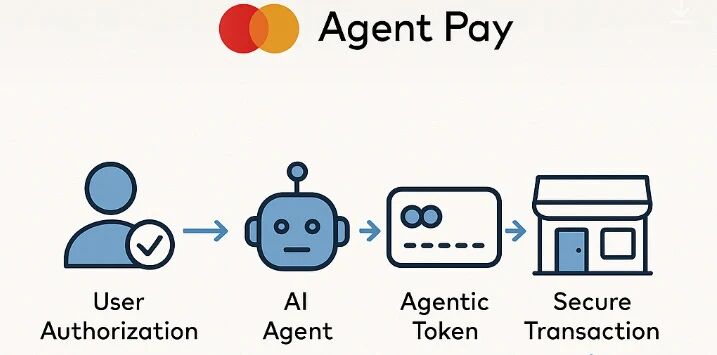
Above stablecoins, the protocol layers support the entire system's operation. Coinbase transformed an idle HTTP status code called 402 into x402, a small protocol that allows for payments between agents. By December, x402 had processed over 100 million agent payments. The average payment amount was $0.20, with a daily transaction volume of about $30,000. This may sound paltry, but that's exactly the typical growth trajectory of all the payment channels you know and love in their first six months, just before the explosive growth begins. Stripe started testing x402 on the Base platform in February. Mastercard partnered with DBS Bank and United Overseas Bank in Singapore to conduct a pilot for agent payments. Google Cloud added x402 to its agent payment protocols as one of its settlement channels.
Almost all these real, ongoing transactions operating on the mainnet have not impacted the rise of the AI agent token index. Admittedly, a few tokens related to x402 gained some minor buy pressure during this process, but the overall index did not really change. Because market pricing is completely wrong. It is still trying to predict which agent will win, just as it once tried to predict which Dogecoin mascot was cuter. But real trading lies in having the “tracks” that each agent must use, regardless of whether that agent is alive or dead. And now, these “tracks” are stablecoins.
The cracks in the paper
Frankly, I would also tell you the possible flaws in this argument. Otherwise, I would just be selling another paper on AI agents while trimming out all the unfavorable parts.
The biggest loophole in all of this lies in accountability. Imagine this scenario: Felix signs a contract with another agent and transfers a million dollars, only for the other party to default. So who gets sued? Felix is not a corporation, so you cannot sue him. Nat did not authorize the transfer, and may not even be aware of it, and frankly, even if he wanted to, he could not reconstruct what Felix was thinking at the time.
The platform hosting Felix cannot really provide compensation for a system whose actions no one fully understands. Insurance companies are also beginning to withdraw coverage. Professional liability insurance quietly reclassifies agent errors as “systemic software drift,” effectively denying coverage.
If you look closely at the current legal terms, you'll see that most enterprise-grade AI agreements cap the vendor’s liability at twelve months of SaaS fees. This means that in the event of a catastrophic incident, anyone can recover at most the previous year’s subscription costs from the AI vendor. Meanwhile, the average cost of data breach incidents in the U.S. is expected to reach $10.22 million by 2025. There is a huge gap between the actual risks that may occur and the scope covered by the contracts, and currently, no one is clear about who should bear these losses.
Until someone figures out who will be held accountable when agents go wrong, all companies without founders still need to register a person's name on documents to seek legal protection. But even with this liability, the big picture still stands. Companies are gradually dissolving into software, and blockchains are becoming the routing layer for that software. Both layers will ultimately collapse into stablecoins because only stablecoins can be independently held, used, earned, and understood by agents across the entire tech stack.
Where is all the money going?
So if blockchains become the vendors and agent tokens have basically become graveyards, then what is the real benefit of all this?
My honest answer is that it revolves around the peak of reputation and process orchestration. Before other agents sign six-figure contracts with Felix, someone must verify whether Felix is genuinely creditworthy or not. Someone must assess the default risk of the agents as quickly as Moody's assesses bonds, but faster than machines since agent transaction speeds are at machine-level speed. Someone must route payroll across three chains, without the payor or payee needing to know or care which specific chain is handling which part of it. And currently, regardless of which seed-stage startup ultimately prevails, its value will exceed all AI tokens that have ever been issued.
And this is what no one wants to hear. The infrastructure that will truly win in the agent economy will look boring and tedious. It resembles plumbing installation, devoid of any hype or airdrop mining associated with token issuance.
A saying from Haseeb Qureshi of Dragonfly has been echoing in my mind. He said cryptocurrency was never designed for humans. He is right; humans were never its target users. All the retail users who have complained about mnemonic phrases, gas fees, or wallet user experiences are correct. This product is not for them because it was never designed for them. It is made for the future.
What will come next is software with a wallet, having real clients and actual revenue. It has been operating for about two years, and while you are reading this, it is invoicing and consuming stablecoins somewhere. Meanwhile, the market is arguing over which blockchain will win in AI, which agent token will skyrocket, and which investment strategy venture capital firms will turn to in the third quarter.
Meanwhile, one stablecoin had a trading volume of $18.3 trillion last year, yet it has gone almost unnoticed in the cryptocurrency field. This AI token is USDC. Everything else is just fluff.
免责声明:本文章仅代表作者个人观点,不代表本平台的立场和观点。本文章仅供信息分享,不构成对任何人的任何投资建议。用户与作者之间的任何争议,与本平台无关。如网页中刊载的文章或图片涉及侵权,请提供相关的权利证明和身份证明发送邮件到support@aicoin.com,本平台相关工作人员将会进行核查。


