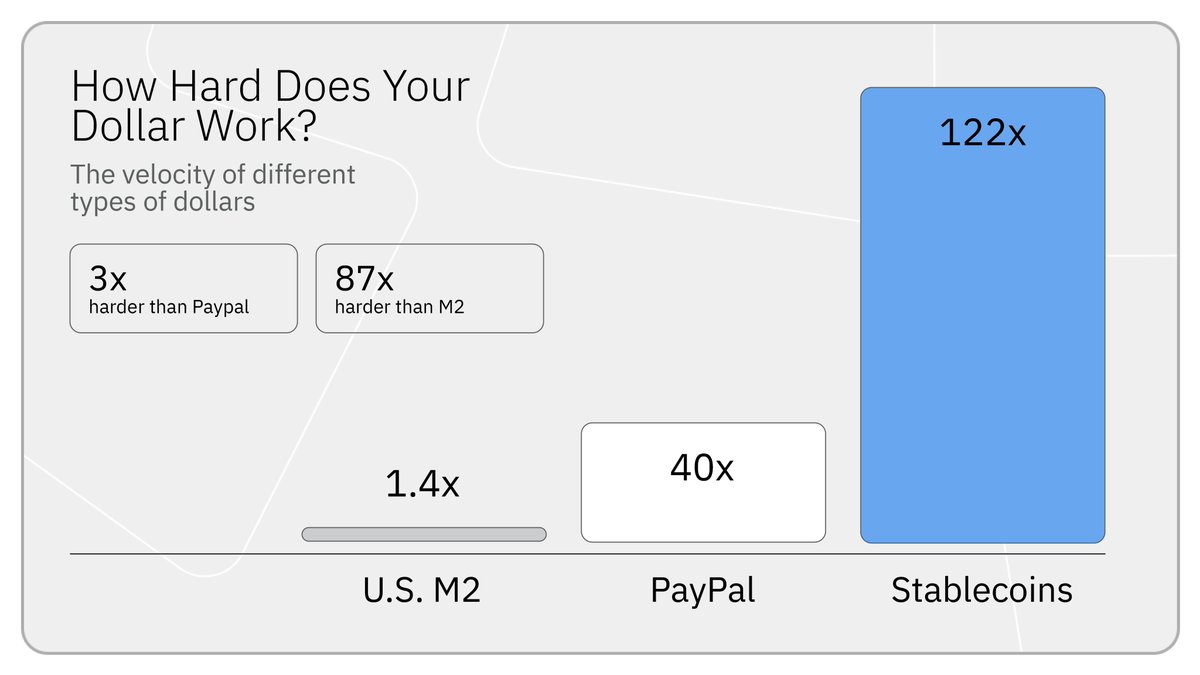
The efficiency of using 1 dollar on-chain is approximately 3 times that of PayPal and 87 times that of the US M2 money supply.
Written by: Jonah Burian, Investment Manager at Blockchain Capital
Translated by: Chopper, Foresight News
Software has taken over the world, and blockchain is absorbing massive capital.
The popularity of stablecoins and on-chain economic activities have formed a positive feedback loop, and this growth structure has become irreversible. The core logic that creates this irreversible trend has been significantly underestimated: Stablecoins flow on-chain → Developers create various applications to lock in funds → More stablecoins are continuously attracted to enter the market → This cycle repeats and strengthens.
Each cycle absorbs more capital. The capital that enters the chain can continually generate value, deeply integrating into the lending market, decentralized exchanges, and derivatives space. If this capital were to withdraw from the traditional financial system, all the on-chain utility must be sacrificed. Therefore, capital stays on-chain, and the flywheel effect continues to compound and amplify.
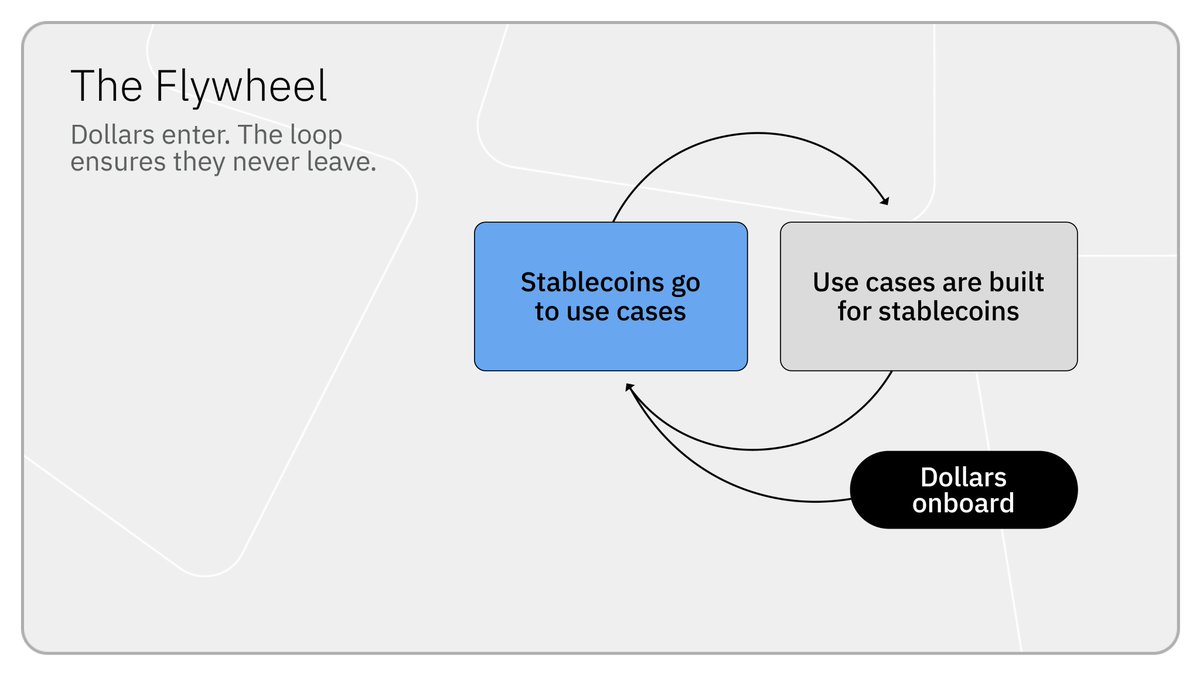
This cycle has given birth to an entirely new financial ecosystem, with annual revenue reaching tens of billions of dollars. Spencer Bogart and I believe that this same operating mechanism is beginning to continuously draw all global capital into the on-chain ecosystem.
Each rotation of the flywheel creates significant economic value
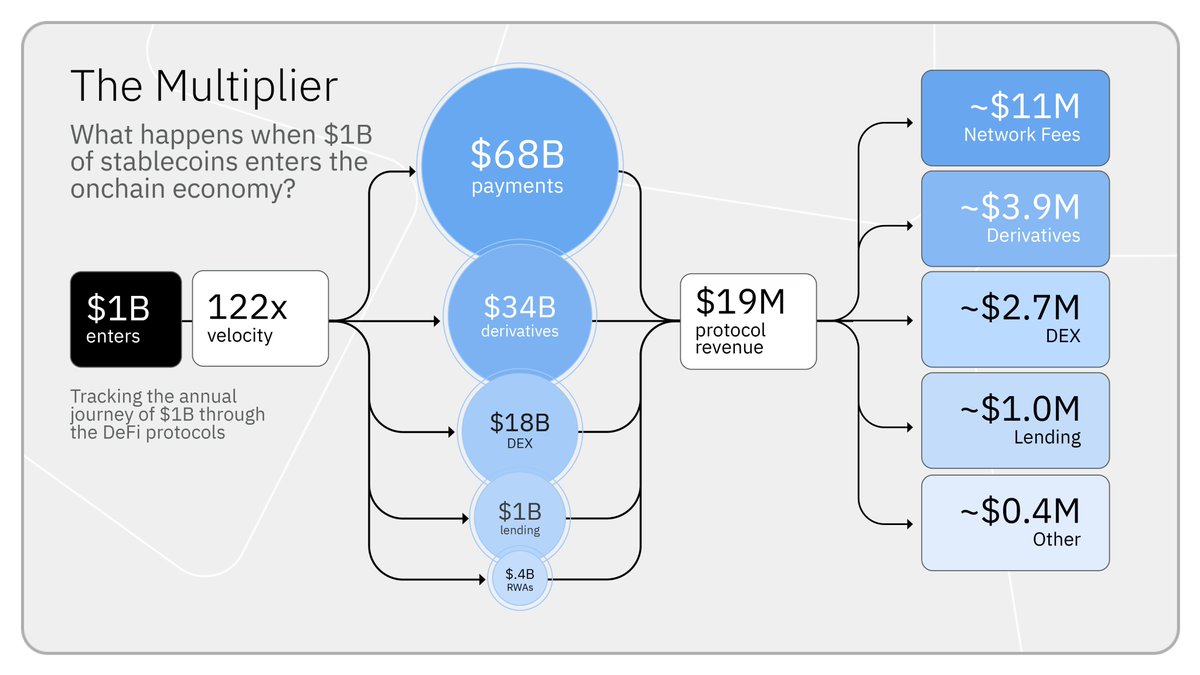
Whenever 1 billion dollars of new stablecoins are minted and enter the on-chain economy, this capital is dispersed across various positions in the financial system, reused more than a hundred times within a year, generating tens of millions of dollars in annual revenue.
Every 1 billion dollars of stablecoins can leverage approximately 122 billion dollars in annual economic activity, with a capital turnover rate of up to 122 times. In contrast, the annual turnover of PayPal dollars is about 40 times, and the circulation rate of the US broad money supply M2 is only 1.4 times. This means that the efficiency of using 1 dollar on-chain is about 3 times that of the PayPal system and 87 times that of the US M2 money supply. The reason for this lies in the fact that stablecoins can circulate infinitely in payment, exchange, lending scenarios, while traditional capital is constrained by T+1 and T+2 settlement systems, severely restricting turnover efficiency.
In the 122 billion annual economic activity created by the supply of 1 billion stablecoins, the breakdown is as follows:
- Payments and Transfers: Approximately 68 billion dollars
- Derivatives: Approximately 34 billion dollars
- Decentralized Exchanges: Approximately 18 billion dollars
- Lending Market: Approximately 1 billion dollars
- Real-World Assets (RWA): Approximately 400 million dollars
Each absorption of 1 billion dollars in on-chain stablecoins will generate approximately 19 million dollars in annual protocol revenue, providing funding for the development of next-generation products, thus attracting more stablecoins into the market.
It should be noted that the 19 million dollars only accounts for the direct revenue of the on-chain protocol layer and does not include the income earned annually by stablecoin issuers based on the stock of funds (calculated at a risk-free interest rate of 3.5%, with an annual yield of about 35 million dollars for every 10 billion in scale); as well as a large amount of derivative income from wallets, payment service providers, deposit and withdrawal channels, custodians, and compliance sectors.
Looking at the entire on-chain economy, by 2025, stablecoin issuers relying solely on the interest rate spread from existing funds will generate over 13 billion dollars (with Tether surpassing 10 billion dollars and Circle generating 2.7 billion dollars); total protocol income generated from decentralized exchanges, lending protocols, derivatives platforms, public chains, etc., will exceed 5 billion dollars.
Capital will not leave
Once capital enters the on-chain, it can continuously generate returns, further strengthening the cycle. Funds operate efficiently in lending, exchanges, and derivatives markets; in contrast, traditional finance is hindered by next-day settlements, bank operating hours fracture, and separate ledgers, which means that leaving the chain means sacrificing high liquidity and high reusability value. Therefore, capital tends to stay on-chain long-term, and the flywheel effect continues to strengthen itself.
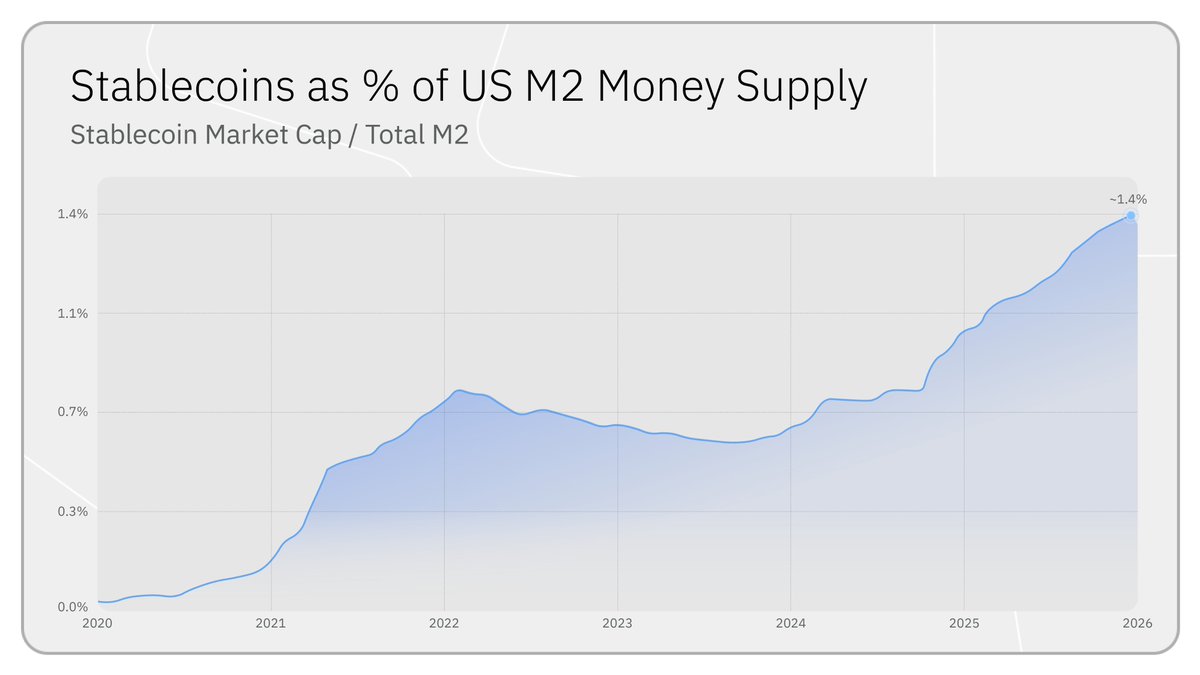
Since the beginning of 2020, the total supply of stablecoins has increased about 60 times, expanding from 5 billion dollars to 300 billion dollars, with the current scale accounting for approximately 1.4% of the total US M2 money supply. In 2025 alone, the newly minted stablecoin scale will exceed 120 billion dollars, the largest annual increase ever recorded. The total annual transaction volume of stablecoins reached 33 trillion dollars.
The flywheel is spinning faster
Previously, industry growth was mainly driven by retail capital and native cryptocurrency environments. However, in the next round of the flywheel's expansion, institutional capital will become the main force, achieving a leap in scale and influence.
Institutional funds are beginning to lay out on-chain on a large scale, compelling more asset issuers to promote asset tokenization and launch on-chain products to compete for incremental capital. BlackRock BUIDL products and Apollo's on-chain credit fund are both early typical cases, and such layouts will only increase. In two years, the scale of on-chain real asset tokenization has grown from 8 billion dollars to about 25 billion dollars; a single BlackRock BUIDL product alone has surpassed 2 billion dollars in scale.
The entry of institutional dollar funds will further attract the tokenization of treasury bills, private credit products, and structured financial products onto the chain. Wherever capital flows, financial products will be deployed. More on-chain financial products launching will encourage more institutions to transfer existing assets, forming a positive cycle.
Currently, the real asset track occupies the smallest share in the overall ecosystem, and its revenue scale is relatively low, yet it is the fastest-growing segment, acting as a crucial link connecting the on-chain economy with the multi-trillion dollar institutional capital market. The on-chain infrastructure built over the past five years from retail demand (decentralized exchanges, lending markets, payment channels) is now becoming the shared foundation for institutional entry.
The derivatives market is the best proof of this. Whenever traditional finance is closed for trading, or geopolitical risks break out, global risk trading demand floods into on-chain perpetual contracts on platforms like Hyperliquid. Each time traditional exchanges cease trading, on-chain trading volumes for oil, silver, gold, and other commodities surge significantly.
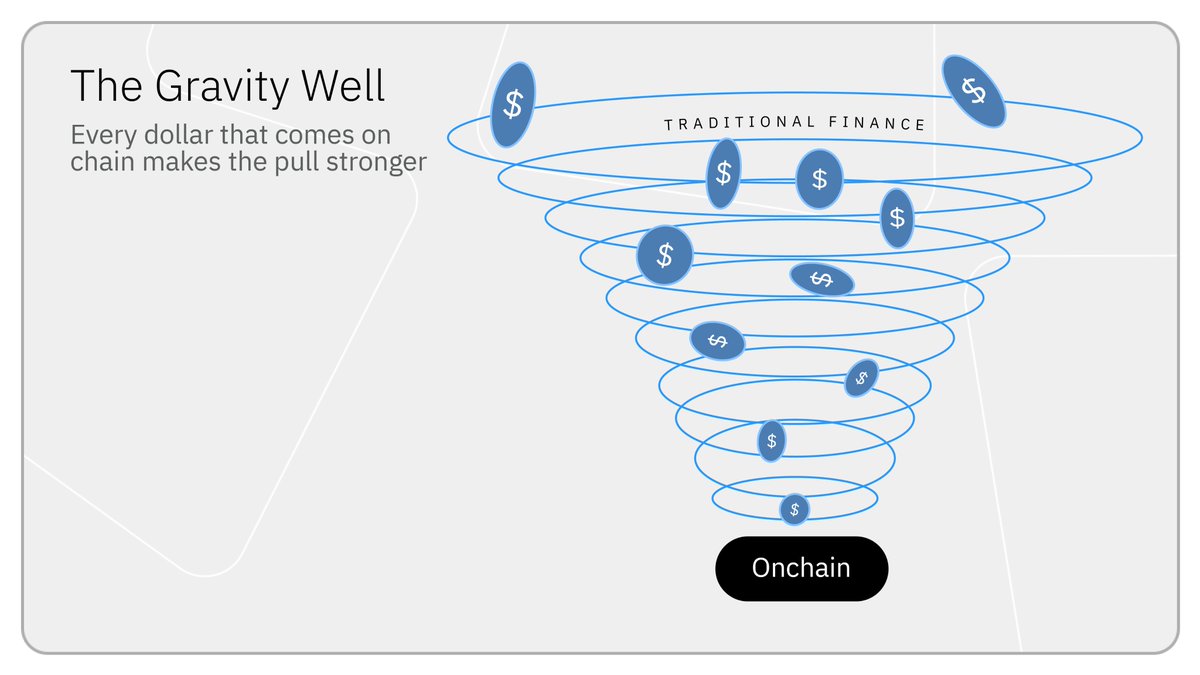
The great migration of capital
Stablecoins are the first large-scale on-chain real assets. Dollar funds migrate from bank accounts to the blockchain, relying on the flywheel effect for continuous accumulation and compound growth. Spencer Bogart and I believe that a great capital migration is underway: global capital is systematically shifting from traditional infrastructure to on-chain.
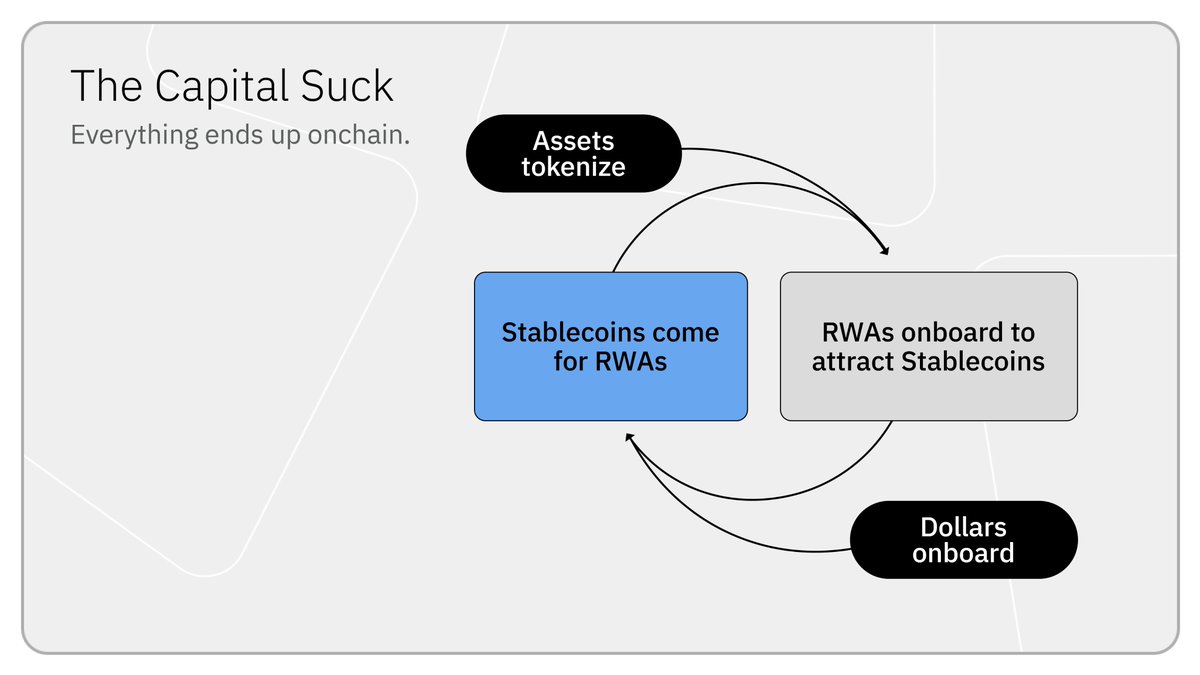
We have already seen this trend: issuers are tokenizing assets, institutional capital is flooding in, and more issuers are tokenizing products to compete for this capital, thereby attracting more capital onto the chain.
The flywheel that once only absorbed stablecoins has now begun to cover a full range of assets, including stocks, credit, treasury bonds, structured financial products, etc. The transformation is still in its early stages, but the invisible flywheel that has driven the stablecoin scale to soar 60 times in the past six years will ultimately drive all assets to complete their migration on-chain.
免责声明:本文章仅代表作者个人观点,不代表本平台的立场和观点。本文章仅供信息分享,不构成对任何人的任何投资建议。用户与作者之间的任何争议,与本平台无关。如网页中刊载的文章或图片涉及侵权,请提供相关的权利证明和身份证明发送邮件到support@aicoin.com,本平台相关工作人员将会进行核查。


