Author: nic_carter
Translation: Baihua Blockchain
Just two days ago, the biggest scandal broke: The U.S. Department of Justice charged Army Staff Sergeant Gannon Ken Van Dyke, accusing him of trading on confidential information related to the Maduro raid. He traded on Polymarket before executing the mission, making a profit of $400,000. He is not a junior soldier, but a senior Green Beret Special Forces member, taking on important planning and operational responsibilities in special operations missions.
By the way, although many are calling for leniency on his behalf, citing rampant (legal) insider trading activities in Congress, he still should be sentenced to prison. His actions posed a risk of leaking the impending raid to Venezuelans through trading activities, which is problematic both morally and legally. While the Venezuelans seem unaware, the government cannot accept a precedent where its elite operatives disclose details of upcoming operations through market activities. I sympathize with Van Dyke, but he indeed broke the law and violated his sworn duty to maintain secrecy for personal gain.
This is just the latest in a series of real or suspected insider trading scandals happening in prediction markets. Previously, Israel arrested two reservists, accusing them of trading on Polymarket using confidential military newsletters. Trades on markets concerning the start of the Iran war, ceasefire, killing of Khamenei, and Biden’s pardons have also been questioned, though no one has been arrested for that yet. Kalshi and Polymarket have also marked and frozen accounts trading on their own relevant markets, such as three incumbent members of Congress betting on their own campaign markets.
Now you might think that as more people realize that trading on confidential information is illegal in prediction markets (not just stock markets), these issues would fade away. But I believe that the root of the problem goes far beyond this.
The premise of prediction markets is that their informational efficiency is derived from the fact that they reward informed insiders.
In other words, prediction markets are considered “good” because they aggregate large numbers of ignorant noise traders, thus creating economic returns for insiders to convert private information into public signals. (The concept of noise traders creating participation incentives for informed insiders has been well established in financial literature, with a recent paper expanding it to prediction markets.) As a result, prediction markets can reliably promote themselves as having social value because they do provide better and timelier signals than other platforms (experts, polls, etc.) . Kalshi and Polymarket are fully aware of this but are reluctant to admit it explicitly. However, they do imply it in their marketing!
Kalshi's CEO Tarek Mansour explicitly stated on the Sourcery podcast: “There is no insider trading in the commodities space. In fact, it's all insider trading.” This… is an extremely creative interpretation of the law. He added:
I think there are a small number of confidential information [traders] that cannot utilize their trades, but I think our current restrictions are a bit too strict.
Kalshi uses promotional language like “Trade anything” and “Everyone is an expert in some field,” both implying that ordinary people with certain privileged information can monetize it on the platform.
Polymarket's CEO Shayne Coplan had this exchange with CBS last year:
Anderson Cooper:
But prediction markets do rely on some people having inside information.
Shayne Coplan:
Well. Yes. I think having an edge in the market is a good thing. Obviously, you need to manage that, and be very clear and strict about the boundaries and ethics, and we’ve put a lot of time into that. But it’s somewhat inevitable, and there are a lot of benefits to be gained from it. People will adapt.
Shayne also mentioned that prediction markets are “the most accurate tools humans have right now until someone invents some sort of super crystal ball.” And part of that accuracy comes precisely from insiders.
Vlad Tenev, CEO of Robinhood (a partner of Kalshi), previously stated:
Prediction markets can actually get you news faster, sometimes even before an event happens. I think this undoubtedly has great economic value.
Economist Robin Hanson, often seen as the father of prediction markets, directly acknowledged this point and defended insider trading in prediction markets. He stated in 2024:
If the focus of [prediction] markets is on obtaining accurate price information, then you absolutely want to allow insiders to trade, even if it might discourage others from betting because the prices become more accurate. That’s the primary goal.
I must point out that both Kalshi and Polymarket have anti-insider trading policies. Kalshi is regulated by the CFTC and consistently clearly prohibits trading using MNPI (material nonpublic information) and conducts market surveillance. When I wrote a blog post in February, I noted that Polymarket did not explicitly sanction insider trading, but in March they updated their rulebook and detailed the types of trading that are prohibited:
Trading on stolen confidential information (if you are a soldier, battle plans do not belong to you but to the government).
Trading on illegal information provided by insiders.
Trading in any contract where you can influence the outcome.
The focus of this section is not to accuse Kalshi, Polymarket, or their leadership regarding insider trading issues. I believe their policies (after being updated in March 2026) are clear enough. Instead, I am pointing out the fundamental contradiction that troubles these markets:
Prediction markets rely on informed traders to generate accurate prices, but at the same time also depend on uninformed traders to provide economic incentives for informed capital flows. This creates a conflict:
If insider trading is tolerated too much, uninformed traders may exit due to a perceived sense of unfairness.
If restrictions on insider trading are too stringent, the markets may shut out the most valuable sources of information.
The result is a trade-off between informational efficiency and perceived fairness.
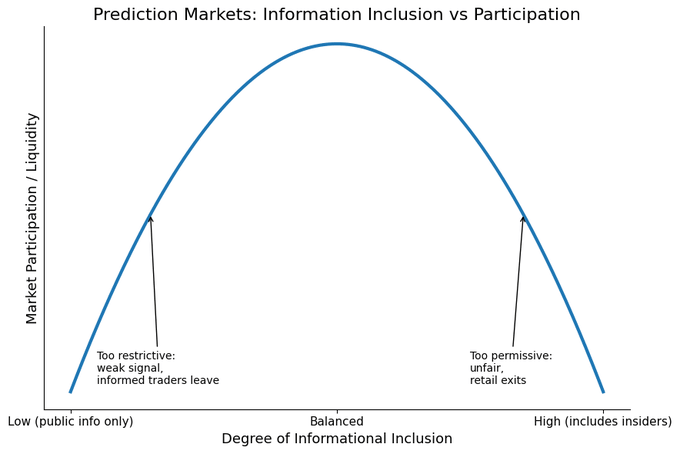
Thus, we ultimately face several different failure modes:
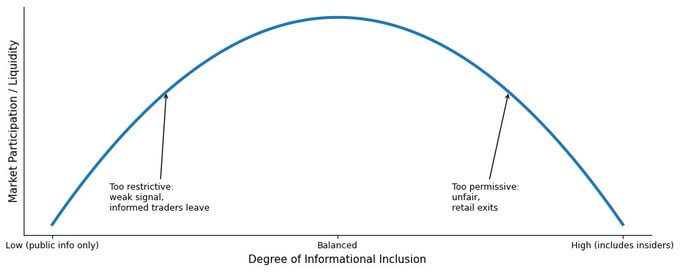
Too many sharks, eating all the small fish Insider trading standards are too lax, the market becomes extremely information-efficient, but noise traders generate a distinct feeling of being "manipulated" and that they are always betting against insiders. Consequently, noise traders leave, and the market ultimately lacks liquidity. This is the failure mode I mentioned earlier. We are at this stage now, but I believe we will rebound in another direction.
No sharks, no edge This is at the other end of the spectrum. The platforms enforce harsh crackdowns on insider trading through real-time market monitoring and strong regulatory reporting, leading to informed capital flowing out of the market. Thus, the social value information produced by these markets decreases, turning into mere sentiment aggregators, no longer able to generate “news before it happens.” Therefore, the platform cannot effectively market itself.
The core issue is whether there exists a happy medium that maximizes liquidity, makes noise traders feel the market is “fair enough,” while also rewarding informed capital for gathering information. The chart suggests that it is possible, but the reality is more complex.
My predictions from February still hold. As I stated then:
Insider trading scandals still pose serious risks that could create the impression among retail investors that the market is being manipulated, causing them to withdraw from the platforms. I predict that a series of insider trading events this year will force the platforms to significantly strengthen market surveillance and prompt Polymarket in particular to move away from anonymous models.
I expect Polymarket will completely eliminate the ability to trade without real-name registration (KYC) (which is already the case on its non-U.S. platform) and intensify its marking of suspicious trades on the platform. There will be numerous criminal cases regarding stolen insider information, but the temptation remains. While the platforms won't admit it, there does indeed exist a “social optimum” for insider trading volume. But can they achieve optimal calibration? Will regulators allow them to do so?
This article link: https://www.hellobtc.com/kp/du/04/6301.html
Source: https://x.com/nic_carter/status/2048123008200724599
免责声明:本文章仅代表作者个人观点,不代表本平台的立场和观点。本文章仅供信息分享,不构成对任何人的任何投资建议。用户与作者之间的任何争议,与本平台无关。如网页中刊载的文章或图片涉及侵权,请提供相关的权利证明和身份证明发送邮件到support@aicoin.com,本平台相关工作人员将会进行核查。


