The Nobitex, founded by two high-ranking officials' sons under alias, has become Iran's parallel financial world to bypass U.S. sanctions.
Written by: Gavin Finch, Reuters investigative reporter in London
Allison Martell, Reuters investigative reporter in Toronto
Denise Ajiri, Reuters investigative and data reporter in New York
James Pearson, Reuters investigative reporter in London
Translated by: Eric, Foresight News
The sons of a close aide to Iran's new supreme leader control the country’s largest cryptocurrency exchange, transforming it from a startup into a channel linking the global economy, serving both blacklisted state entities and ordinary citizens.
According to a Reuters investigation, since Nobitex was founded by two brothers using a family alias, the exchange has processed transactions ranging from tens of millions to hundreds of millions of dollars tied to sanctioned groups, including the Central Bank of Iran and the powerful Islamic Revolutionary Guard Corps.
The two are members of the Kharrazi family, one of the most influential families in the Islamic Republic of Iran. Business registration records show that at the inception of the exchange, the brothers used a surname rarely employed by family members.
The company quickly embedded itself into Iran's economic system. Nobitex claims to have 11 million users, over 10% of Iran's total population. Excluded from the international banking system, compounded by the devaluation of the rial and hyperinflation, ordinary Iranians have to use the exchange to buy and hold cryptocurrencies.
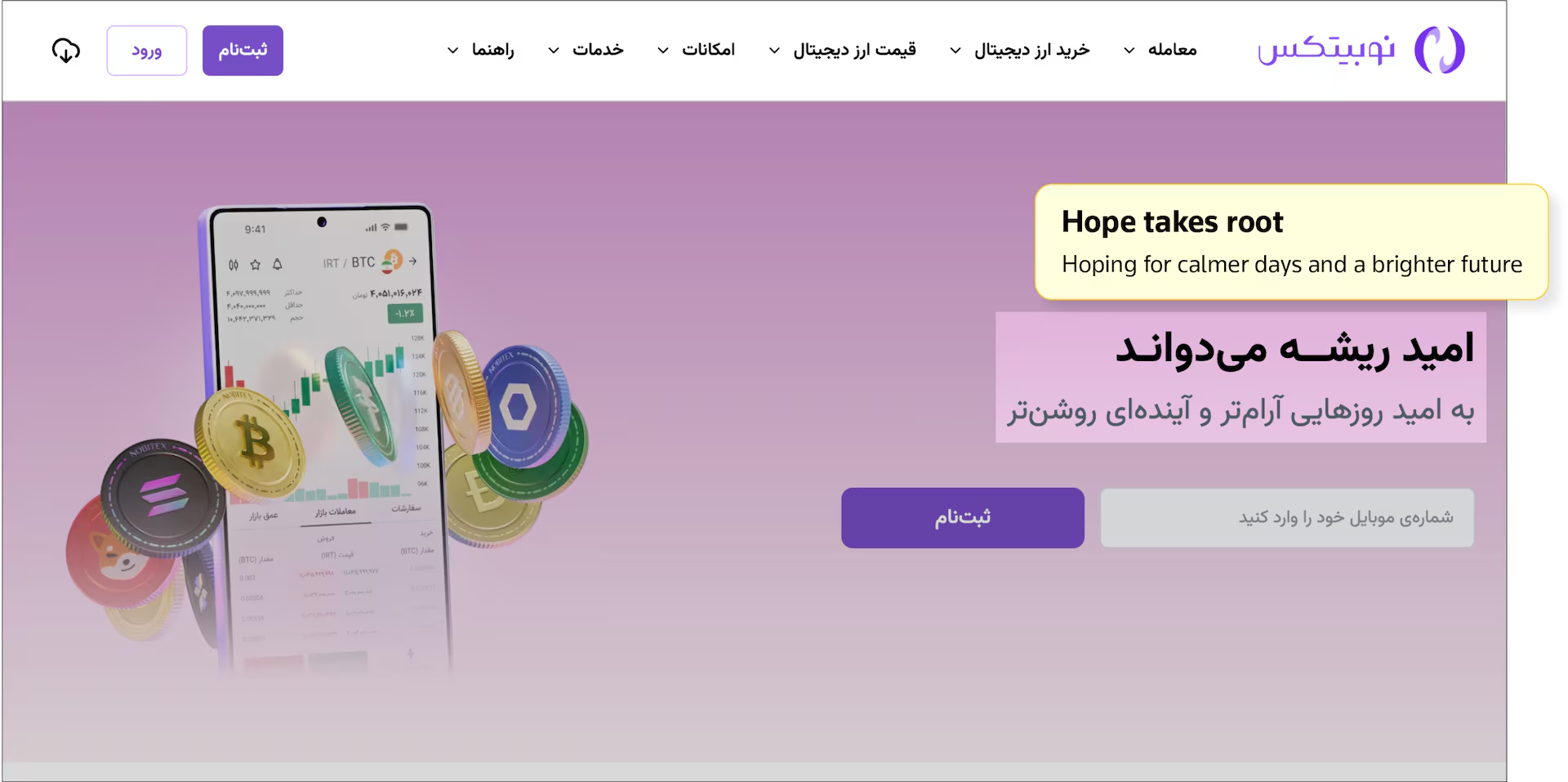
This is a screenshot of the Nobitex homepage on March 28, one month after the war broke out. Although the government imposed internet blockades during the war, the company continued to operate.
Despite Iran facing comprehensive economic sanctions from the West, the exchange has not been sanctioned by the U.S. or its allies so far. Reuters could not find any signs that Kharrazi family members had faced sanctions from Western governments, nor could it determine why Nobitex has managed to avoid the types of penalties imposed on other major Iranian economic entities.
As Reuters reveals the elite background of Nobitex's founders, it coincides with a critical moment for Iran, particularly for the Revolutionary Guards. Since the supreme leader Khamenei was killed in a bombardment at the beginning of February during the U.S. and Israel's war against Iran, the Revolutionary Guards have further consolidated their control over Iran's economy and security institutions.
The brothers are third-generation members of the Kharrazi family, sitting at the core of Iran's ruling elite. Kharrazi family members have served as advisers to supreme leaders and held key political, diplomatic, and religious positions. The family has marital ties to all three supreme leaders of the Islamic Republic of Iran: revolutionary founder Ayatollah Ruhollah Khomeini, the late Khamenei, and Khamenei’s son Mojtaba.
Brothers Ali Kharrazi and Mohammad Kharrazi (using the family surname Aghamir) have turned Nobitex into the country’s dominant cryptocurrency trading platform. It is estimated that the exchange handles about 70% of Iran's cryptocurrency transactions. It is not uncommon for Iranians to use aliases, but the brothers seem to be the only direct descendants in their family who have deliberately distanced themselves from their prominent lineage.
The Reuters investigation found that Nobitex acts both as a bridge connecting the global cryptocurrency market and as a core node in a parallel financial system used to transfer funds outside of Western sanctions. Analysis of on-chain data by cryptocurrency analytics firm Crystal Intelligence and interviews with four private financial investigators reveal that the Iranian government utilizes the exchange to funnel money to allies through routes outside the traditional banking system. Reuters also interviewed nine individuals who have worked at or collaborated with Nobitex, six of whom said they were aware of funds from sanctioned countries flowing through the exchange.
Nobitex denied any direct connection with the government or providing assistance to the state in an email statement to Reuters, stating that any illegal funds flowing through the exchange had not been authorized or known by management. The company claims that the brothers did not change their identities or use alternative identities.
The company also stated that any transaction amounts involving state entities were far below the estimated figures provided by investigators to Reuters.
Nobitex stated: "Nobitex is a private independent enterprise. It has never been a government branch and has never had any relationship, arrangement, agreement, or contract with the Central Bank of Iran, the Islamic Revolutionary Guard Corps, or any other government agency."
The Iranian government did not respond to requests for comments through its United Nations delegations in New York and Geneva.
A Trump administration official wrote in response to detailed questions from Reuters regarding the investigation's findings: "Under the strong leadership of President Trump, the U.S. is actively making economic lightning moves, using all available tools to maintain maximum pressure on Iran, systematically undermining Tehran's ability to earn, transfer, and repatriate funds." The official did not mention Nobitex.
According to three blockchain analysis companies tracking Nobitex and other exchanges, Nobitex continued to process transactions throughout the war, even during national internet blockades and massive power outages in Tehran.
According to Crystal Intelligence, during this period, Nobitex processed over $100 million in transactions, about 20% of its normal business volume. The company has been investigating the flow of Iranian cryptocurrency funds for over four years.
Crystal Intelligence Chief Intelligence Officer Nick Smart stated: "The problem with Nobitex is that, since a large amount of activity on the platform is from ordinary Iranians, it's hard to distinguish the regimes from the people using the platform."
U.S. Democratic Senator Elizabeth Warren expressed concerns over the revelations about Nobitex.
As a senior Democratic member of the Senate Banking Committee, Warren said in a statement to Reuters: "This latest report is a warning light: adversaries are using digital assets as alternatives to the American-led global financial system. Because too many services in the crypto ecosystem lack basic controls to prevent money laundering and evade sanctions, transferring billions has become effortless.
Founder Brothers
Nobitex's initial board of directors consisted of brothers Ali and Mohammad, along with Amir Hosein Rad. All three graduated from Tehran's elite Sharif University of Technology, which is comparable to the Massachusetts Institute of Technology.
Rad is not related to the brothers, yet he and Ali are the company's public representatives, with Rad serving as CEO and Mohammad as a blockchain technology expert.
In an interview conducted for Nobitex's promotional brochure, the brothers used the family surname Aghamir. Mohammad described his elder brother as "my life adviser, I always consult him when making decisions." Government and banking records reviewed by Reuters show that Ali was born in 1986 and Mohammad in 1992.
In the same promotional brochure, Ali described his feelings for the company, stating that the founders' love for Nobitex is like "for their own child," believing the company is under special care: "In any situation, I can always feel some supernatural power helping me."
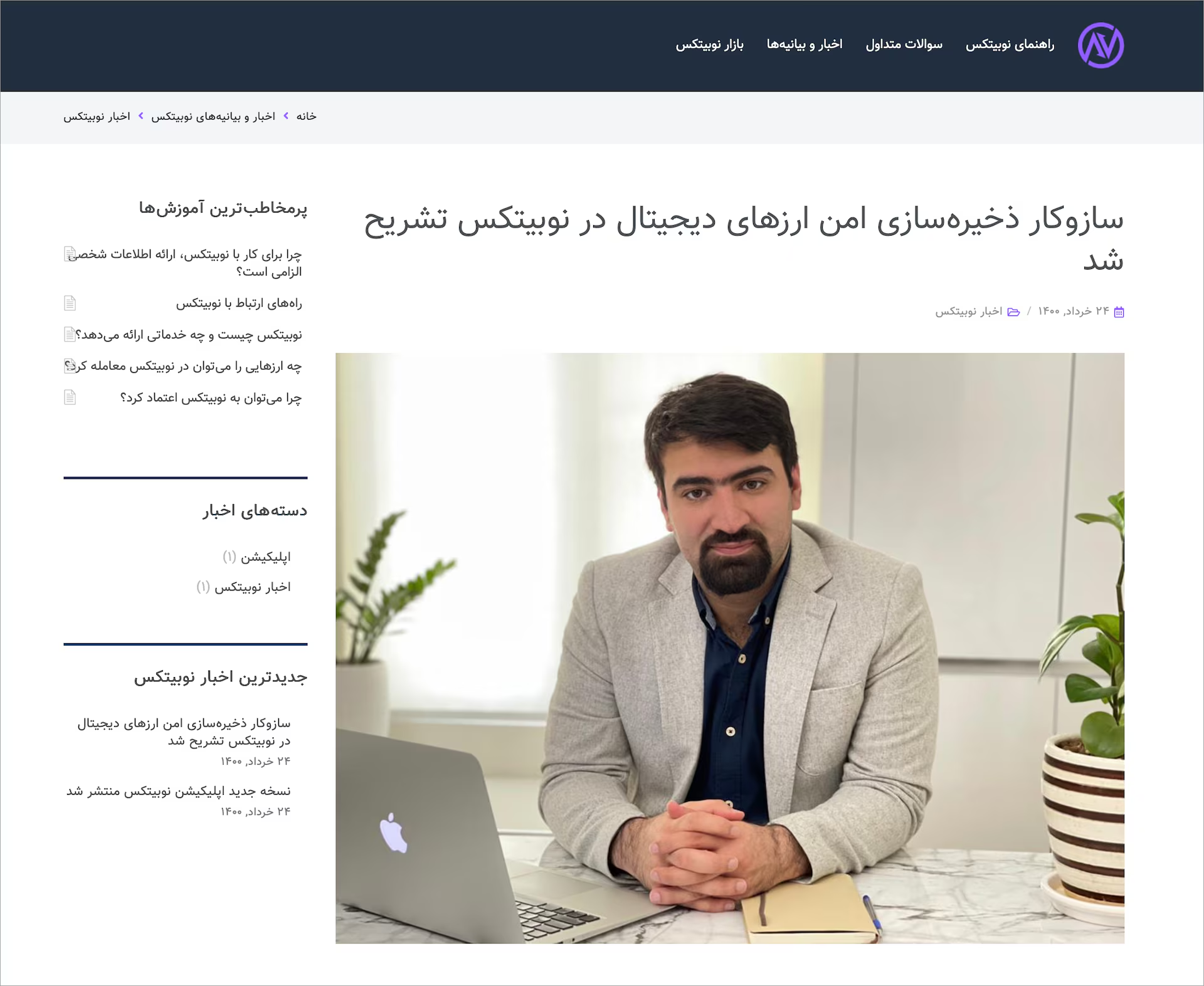
This is a screenshot from Nobitex's website, featuring Seyed Mohammad Ali Aghamir Mohammad Ali from the Kharrazi family, known as Ali, who is one of the public faces of Nobitex. He is explaining how to secure cryptocurrencies.
According to seven former employees and industry insiders interviewed by Reuters, within the company, the brothers even concealed the Kharrazi surname from their closest acquaintances. Some of these sources mentioned they had known the brothers since university days. Back then and now, they had never used the Kharrazi surname.
Reuters could not determine why the brothers chose to continue concealing their lineage.
Nobitex did not respond to inquiries about the brothers' relationship with the Kharrazi family, nor did their reply mention the family’s surname. However, a brief email signed by elder brother Ali came from an email address containing the Kharrazi surname.
Nobitex stated: "They come from the Aghamir Mohammad Ali family and use that name in their daily lives."
Of the nine former employees and industry insiders interviewed by Reuters, only one learned directly from the brothers about their family connection. Another said he discovered it through his own investigation. The most surprised was a former colleague who had known Mohammad for many years; he was shocked when Reuters revealed the brothers' relationship to the Kharrazi family.
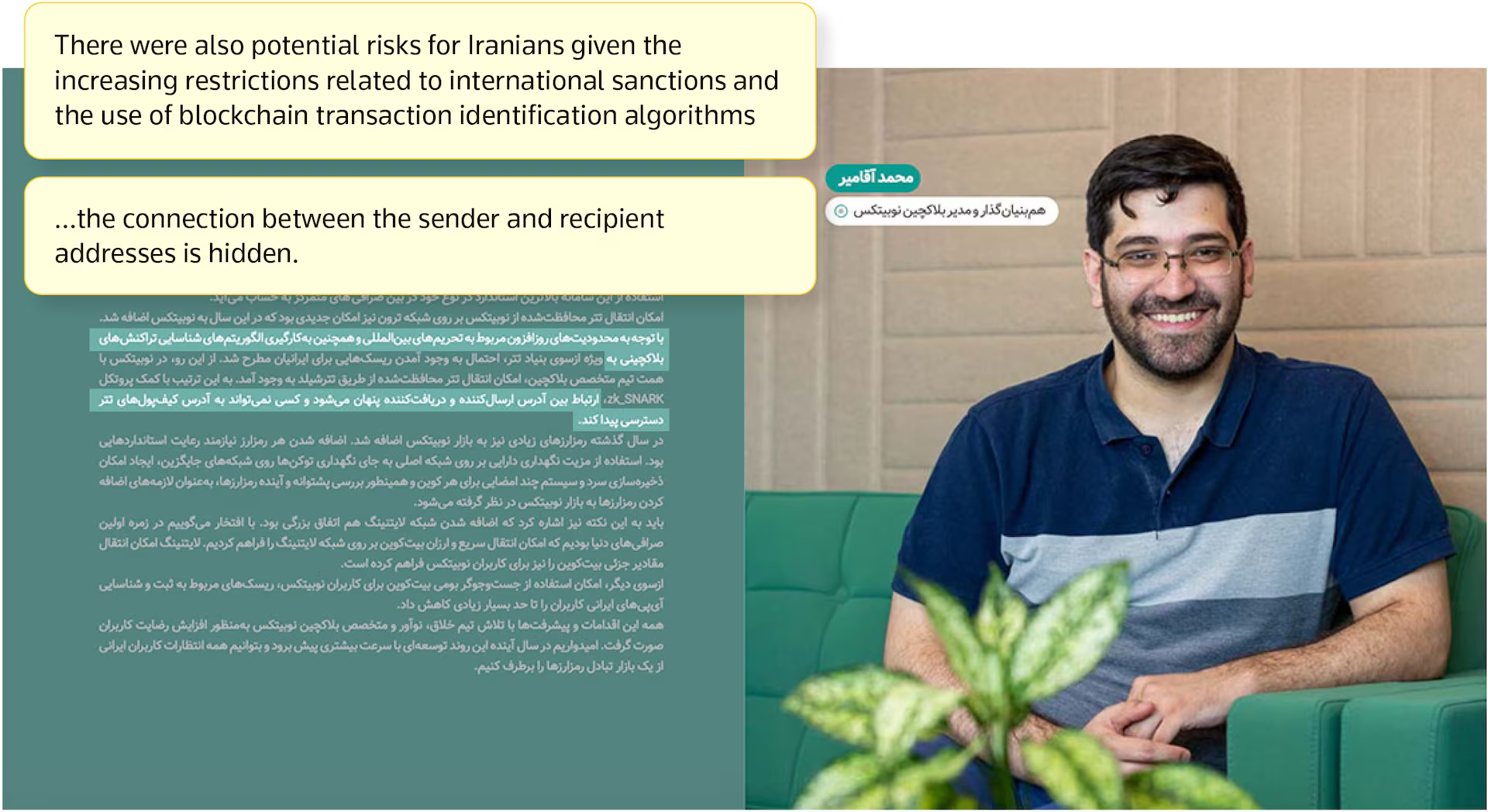
Brother Seyed Mohammad Aghamir Mohammad Ali from the Kharrazi family appears in Nobitex's 2021 annual report. He is referred to as Mohammad and is the company's blockchain expert.
Another former Nobitex employee stated: "I was quite open in my criticisms of the regime, and my colleagues were too." After discovering the brothers' surname, he said, "I became scared; I had made a lot of hateful comments against the regime and religion."
According to Iranian news reports, their grandfather was a religious scholar and Ayatollah (a title for high-ranking Shia clerics), who taught Iran's new supreme leader Khamenei. This person later joined the assembly responsible for electing the supreme leader of Iran. Mojtaba succeeded after his father Khamenei was assassinated.
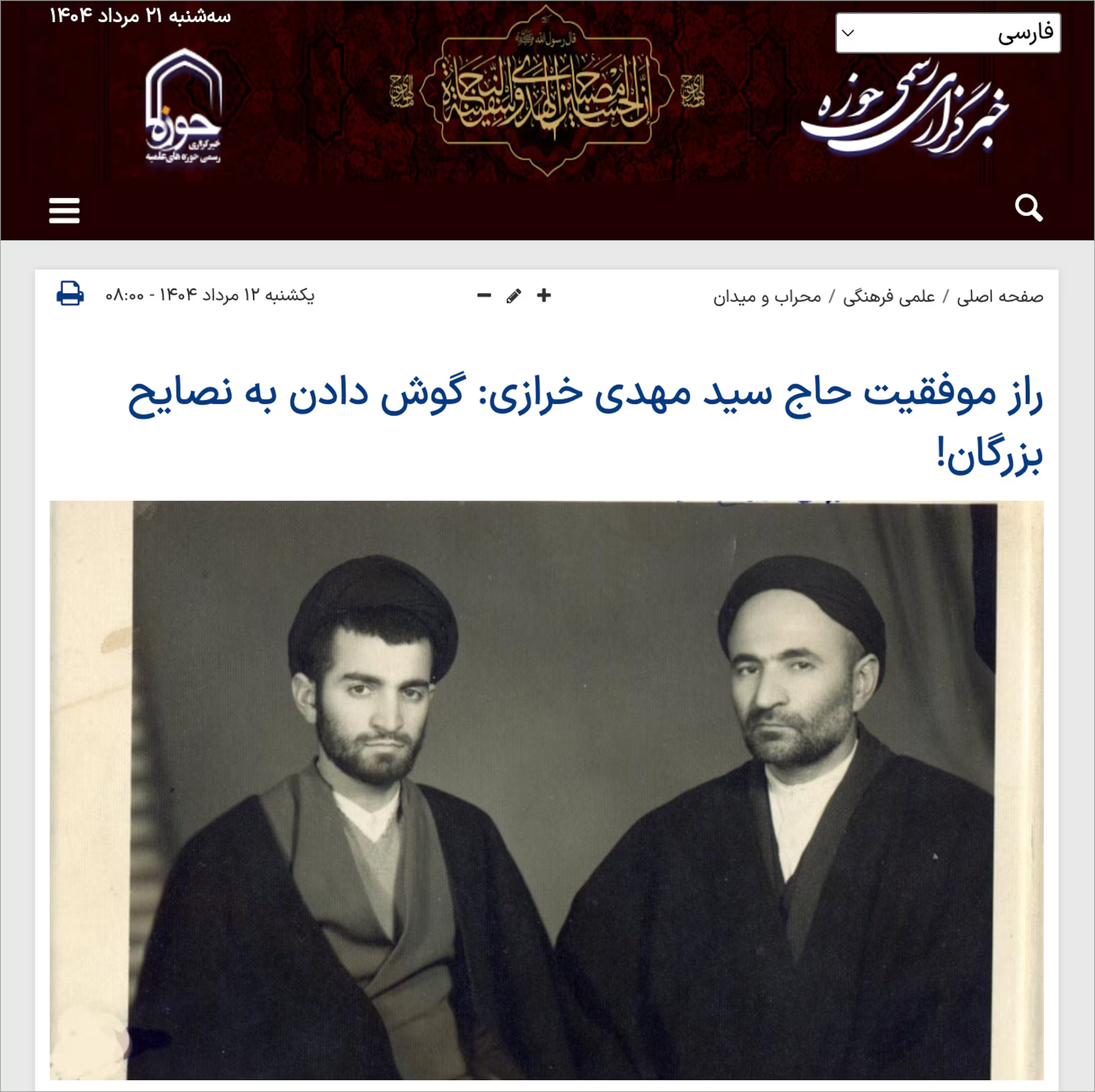
Mehdi Kharrazi, depicted on the right in the photo, is a businessman. His son Mohsen (on the left) is a member of Iran's Assembly of Experts. Mohsen Kharrazi is the grandfather of Nobitex's founders. The caption reads: "Hajj Seyed Mehdi Kharrazi's secret to success: listening to the advice of elders!"
One of their uncles served as a foreign minister and advisor to successive supreme leaders, including Mojtaba.
Their father Ayatollah Bagher Kharrazi was the founder of the Iranian Hezbollah, a political and religious organization that is not related to the more well-known Iranian proxy organization in Lebanon. Bagher participated in the 2013 presidential election and stated on his personal website that he was also involved in the staffing of the Revolutionary Guards after the 1979 Islamic Revolution. The brothers' aunt married the brother of the new supreme leader.
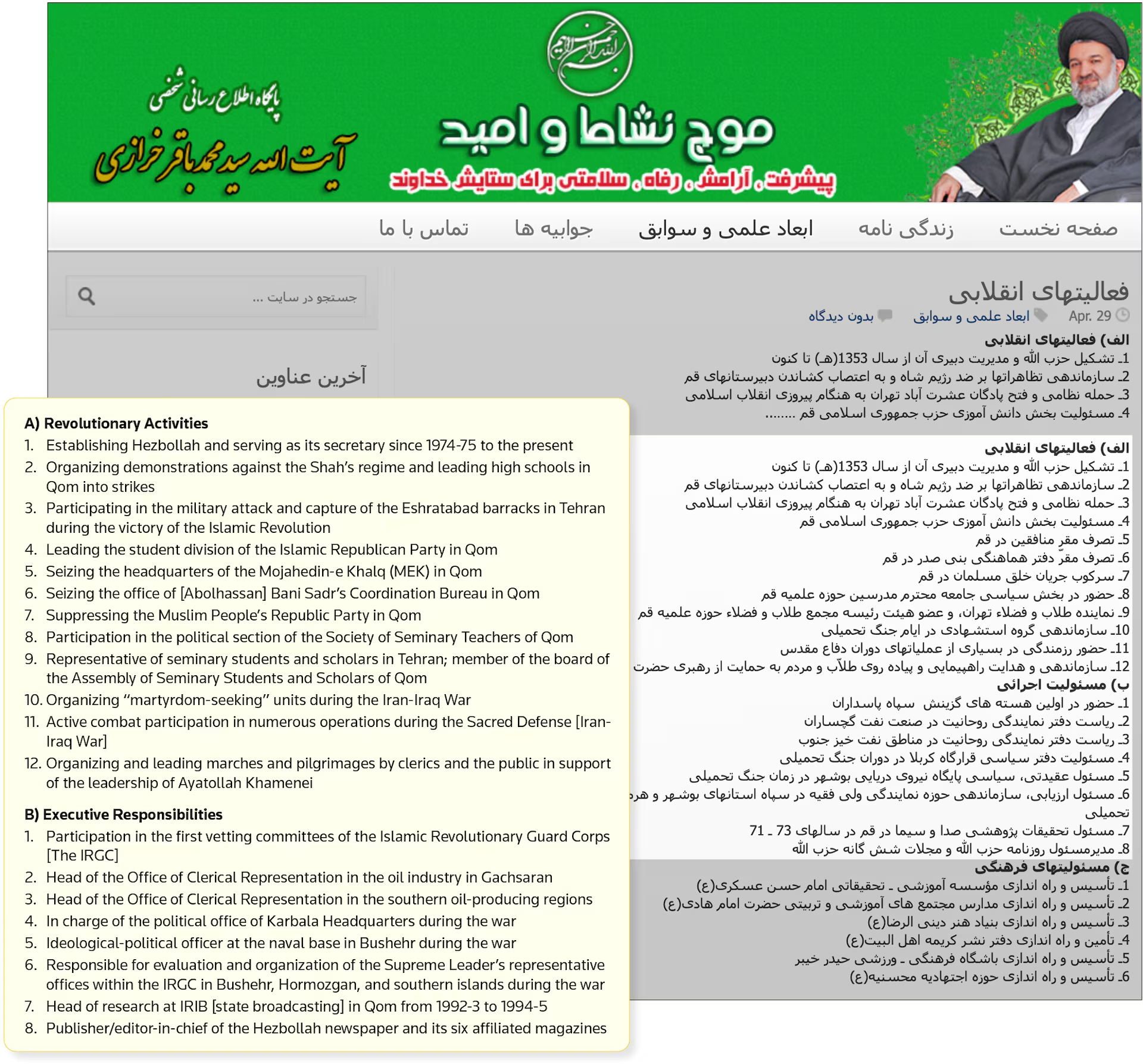
A screenshot of Bagher Kharrazi's personal website taken on August 13, 2016, listing his achievements. This Nobitex founder’s father also ran in the 2013 election for the presidency of Iran.
Journalist Fariborz Kalantari stated that there exists a "core circle and peripheral circle" within Iran's clerical system. He was sentenced to imprisonment and 74 lashes in 2021 for reporting on corruption in Iran and now resides abroad. Speaking of the Kharrazi family, he remarked: "These people are members of Khamenei's inner circle."
Kalantari noted that others, especially those related to the revolution, had developed a habit of using aliases long before 1979, when many anti-Shah activists were imprisoned alongside opposition guerrilla fighters.
Nobitex stated in its declaration that the two brothers "and their father have never held any government or military positions." The statement did not mention their father's name.
Despite their prominent background, according to four individuals who know them, the brothers led a modest life during their student and young entrepreneurial years. One person remarked that when Mohammad bought his first car, he chose one of the cheapest models in Iran, the SAIPA Pride.
The elder brother Ali's full name is Seyed Mohammad Ali Aghamir Mohammad Ali, while the younger brother Mohammad's full name is Seyed Mohammad Aghamir Mohammad Ali. Friends used to tease them about their lengthy and unusual names, but according to one person who knows them outside of work, the brothers have never explained this.
Rumors about their identity began circulating in 2024, when a Chinese blog reported that the brothers' father had become a principal shareholder of the cryptocurrency exchange through his son Mohammad (using the Aghamir surname).
When Seyed Mohammad Ali Aghamir Mohammad Ali registered the Nobitex domain in 2017, he used an email address containing the Kharrazi surname. This address was also employed to register a website for a religious charity chaired by his father. Business registration documents indicate that elder brother Ali was named vice-chairman of that charity. Messages from Ali received by Reuters were also sent from this email.
Public registration announcements of the same charity show that the founder's father had used two different surnames under the same national identification number. In most records, he used Kharrazi. However, in at least one 2011 record, he used Aghamir, which corresponds to the surname used by his sons when founding Nobitex.
Reuters tracked Nobitex's ties to the Kharrazi family through Iranian corporate, governmental, and banking records. Artificial intelligence tools were used to extract the names and identification numbers of Nobitex's board members and create a relational map. Confirmations of the father-son relationships among the three were verified through a leaked database cross-referenced with national identity numbers.
Other family members, including the brothers' aunt, uncle, and cousins, all publicly use the Kharrazi surname. The brothers' grandfather occasionally also used the name Aghamir.
Ambiguous "Address"
Nobitex has publicly claimed that its goal is to enable Iranians to invest in cryptocurrencies under "the shadow of sanctions" and to advise clients on how best to avoid having their transactions monitored or intercepted by Western governments.
Nobitex has conducted business with several giants in the global cryptocurrency field. Reuters reported in 2022 that the world's largest cryptocurrency exchange Binance helped Nobitex transfer $7.8 billion while circumventing U.S. sanctions against Iran. Binance's founder Changpeng Zhao was sentenced in 2024 for violating U.S. anti-money laundering laws and was pardoned by President Trump in 2025 .
Binance did not respond to questions about how it prevents sanctioned Iranian entities from entering the exchange.
To cover their tracks, Nobitex would change the wallet addresses used for fund transfers. As stated by the young Kharrazi brothers in Nobitex's 2021 annual report, due to "increasing restrictions related to international sanctions," the company had also developed encryption tools to further obscure the connections between relevant wallets. Furthermore, Nobitex advised clients to use multiple wallet addresses when trading to increase the difficulty for Western investigators to track.
Despite their elite connections, the founders had to navigate the competing demands of powerful state institutions from the outset, according to former employees.
The Central Bank of Iran has repeatedly banned exchanges, including Nobitex, from accessing the domestic banking system.
According to three former employees, shortly after Nobitex opened in 2018, the Islamic Revolutionary Guard Corps visited the company's office in Tehran and questioned then-CEO Rad. The two said that years later, the Revolutionary Guards conducted another raid, arresting Rad, seizing employees' laptops, and sealing the office. Two of the employees stated that there are currently no indications that Rad has been prosecuted.
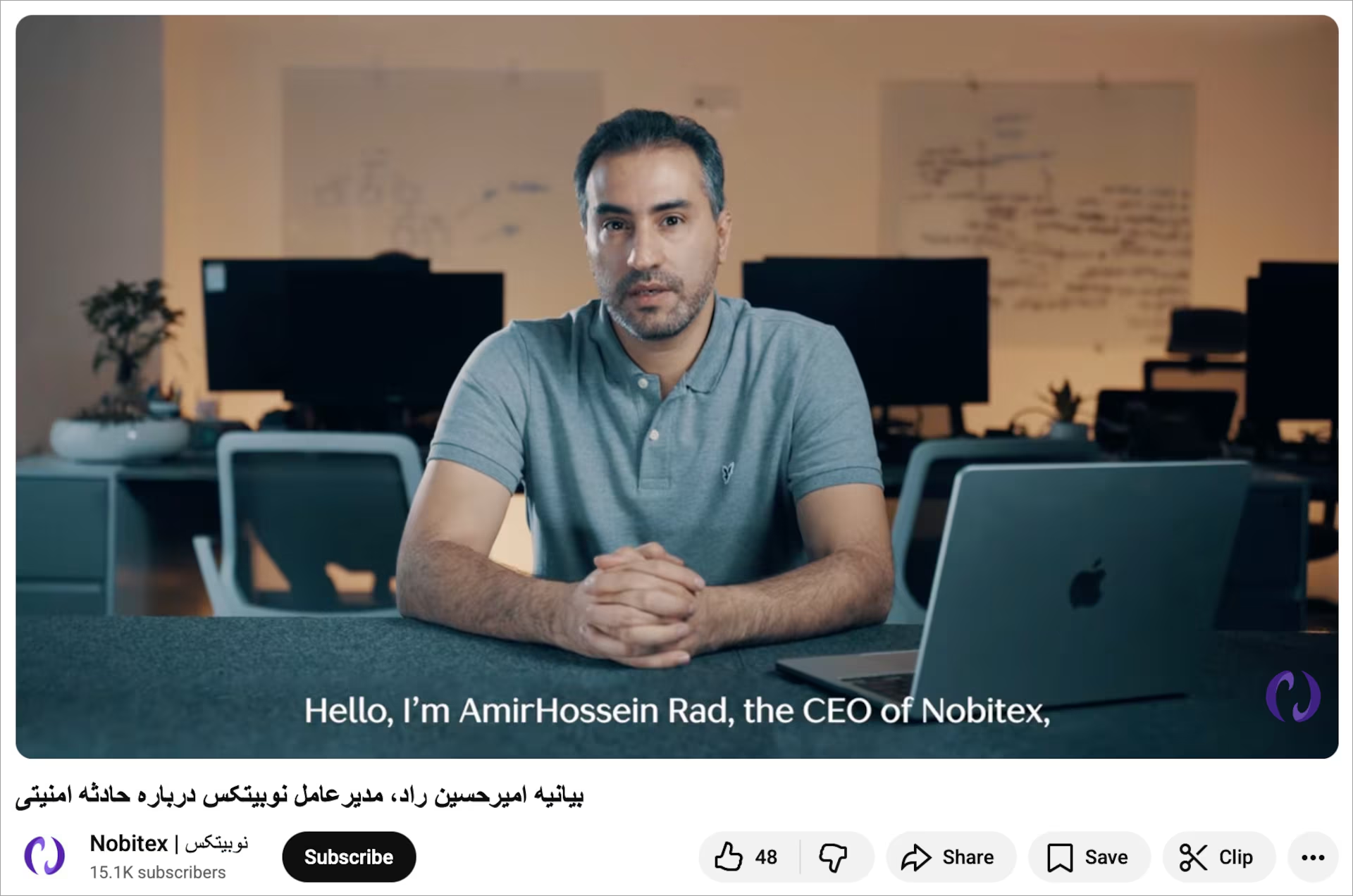
This is a screenshot of Amir Hosein Rad, one of the co-founders of Nobitex, from a video released on June 21, 2025. He has been questioned multiple times by the Iranian Islamic Revolutionary Guards.
Various explanations circulated within the office regarding the reasons for the Revolutionary Guards' multiple visits. One person stated it was retaliation for Nobitex's refusal to process funds related to sanctioned oil sales from the Revolutionary Guards. Two others claimed a jealous competitor had falsely reported Nobitex for defrauding users.
In December 2025, during an interview with an Iranian podcast host, Rad stated that his 2021 arrest involved a misunderstanding regarding Nobitex’s relationship with another company that had questionable business practices. Rad did not disclose the name of that company, describing the arrest as one of the side effects of starting a business in Iran: "I think few Iranian entrepreneurs have not experienced something similar."
Six former employees interviewed by Reuters acknowledged that Nobitex has been used by the Iranian government and its security agencies to circumvent strict Western financial sanctions. Nobitex, however, denies having entered into any agreements with any government entities, and none of the employees interviewed by Reuters were aware of such agreements.
Nobitex stated: "We face numerous operational restrictions from the Iranian government, including raids on offices, domain blockades, and closures of banking gateways. These actions completely contradict the notion that we receive any form of government support."
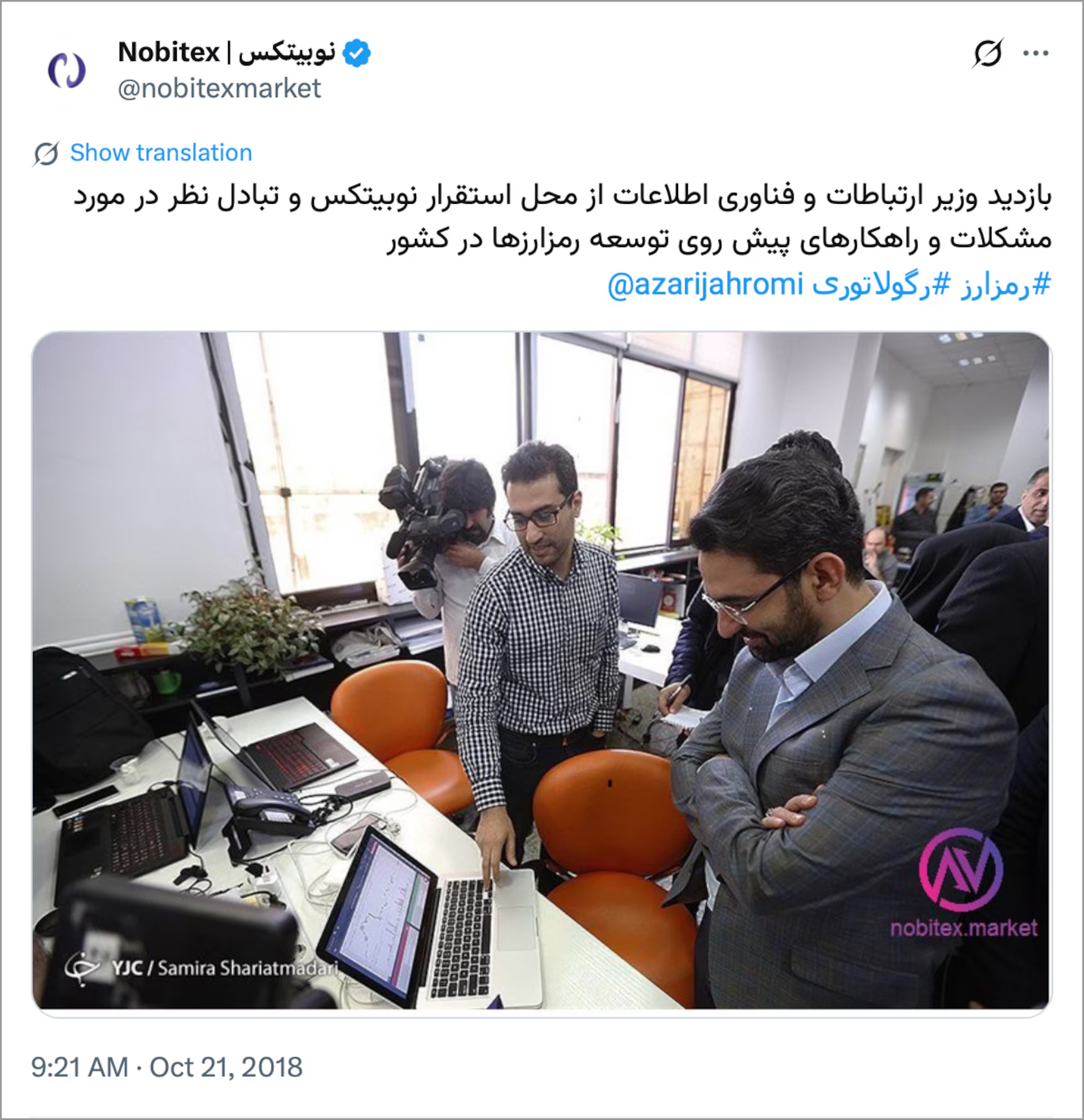
A screenshot from Nobitex's official Twitter account shows the Iranian Minister of Communications and Information Technology visited the Nobitex company in 2018. The company was founded that year.
Despite the pressures, Nobitex continues to thrive, with the Kharrazi brothers' wealth growing accordingly.
According to five former employees, the company moved to a luxurious new office in 2021, equipped with a lounge area where employees could play video games, watch movies, or enjoy panoramic views of the Alborz Mountains. Their descriptions matched the photos the company posted on LinkedIn. Female employees were not required to wear headscarves, and the office remained open during religious holidays.
A family address associated with Mohammad's national identification number is located in one of Tehran's wealthiest neighborhoods.
By the end of 2022, the exchange reported having 4.3 million users and 268 employees. The sanctions that exclude Iranians from the global financial system have instead boosted Nobitex’s appeal to its Iranian clients. Essentially, while Iranians are unable to legally open accounts on exchanges like Binance, they can open accounts on Nobitex, which allows them to access the global cryptocurrency market that is under incomplete international regulation.
In 2022, a young woman named Mahsa Amini died while in police custody for allegedly violating the headscarf law. The nationwide protests that followed brought a change in the company atmosphere.
A former employee stated: "Building security and morality police began to check female employees' headscarves and threatened to seal the office."
According to two former employees, the dress code enforcement in the office became stricter afterward.
A person who frequently visited the Nobitex office and was familiar with the founders stated: "Management became stricter regarding headscarves and security regulations. Before that, the company looked like a tech startup."
According to three former employees, following the company associated with one of Nobitex's main investors, Mohammad Bagher Nahvi, being sanctioned by the U.S. for supplying drones to Russia, employee concerns about their employer's relationship with the government deepened.
The U.S. Treasury stated in September 2022 that Safiran Airport Services was responsible for coordinating "flights between Iran and Russia, including those related to the transportation of Iranian drones, personnel, and related equipment." Safiran is a private company whose vice chairman Nahvi is a former chairman of Nobitex and one of the earliest and largest investors in the exchange.
In Nobitex's 2022 promotional brochure, Ali Kharrazi described Nahvi as an enthusiastic investor who was "actively involved from the first meeting." Nahvi did not respond to requests for comments from Reuters regarding his role in Nobitex.
In 2025, a hacker group called Predatory Sparrow launched an attack on Nobitex, transferring around $90 million worth of cryptocurrency to wallets that were inaccessible and bore profane names disparaging the Iranian Islamic Revolutionary Guard Corps. The company and its shareholders (including the two brothers) directly compensated the customers for the stolen funds, showcasing Nobitex's substantial financial capacity.
According to a former senior U.S. Treasury official who helped develop U.S. sanctions against Iran, the Islamic Revolutionary Guard Corps is involved in every important aspect of Iran's economy, and it is only natural that they would take a keen interest in companies like Nobitex that are crucial to the economy.
Miad Maleki, who worked at the U.S. Treasury from 2017 to 2025 and served as Deputy Director of the Office of Foreign Assets Control, stated: "Once a business starts making profits, you will see the government intervene and take a share. In Iran, it is impossible to own a successful business without being under the control of the regime." He is now a senior fellow at the Foundation for Defense of Democracies.
Complaints of Embezzlers
Evidence of how Nobitex fits into Iran's sanctions evasion scheme surfaced through an unexpected channel: Babak Zanjani, an Iranian billionaire convicted of fraud.
Zanjani has long been a key figure in Iran's sanctions evasion network. He was sentenced to death by Iranian authorities in 2016 for embezzlement but had his sentence commuted in 2024. However, Zanjani remains in a public dispute with the Central Bank of Iran, which accuses him of failing to return billions in embezzled funds.
In a fierce attack on the central bank in December 2024, Zanjani posted wallet addresses on social media, allowing external cryptocurrency analysts to unravel a complex sanctions evasion scheme, with Nobitex at its core.
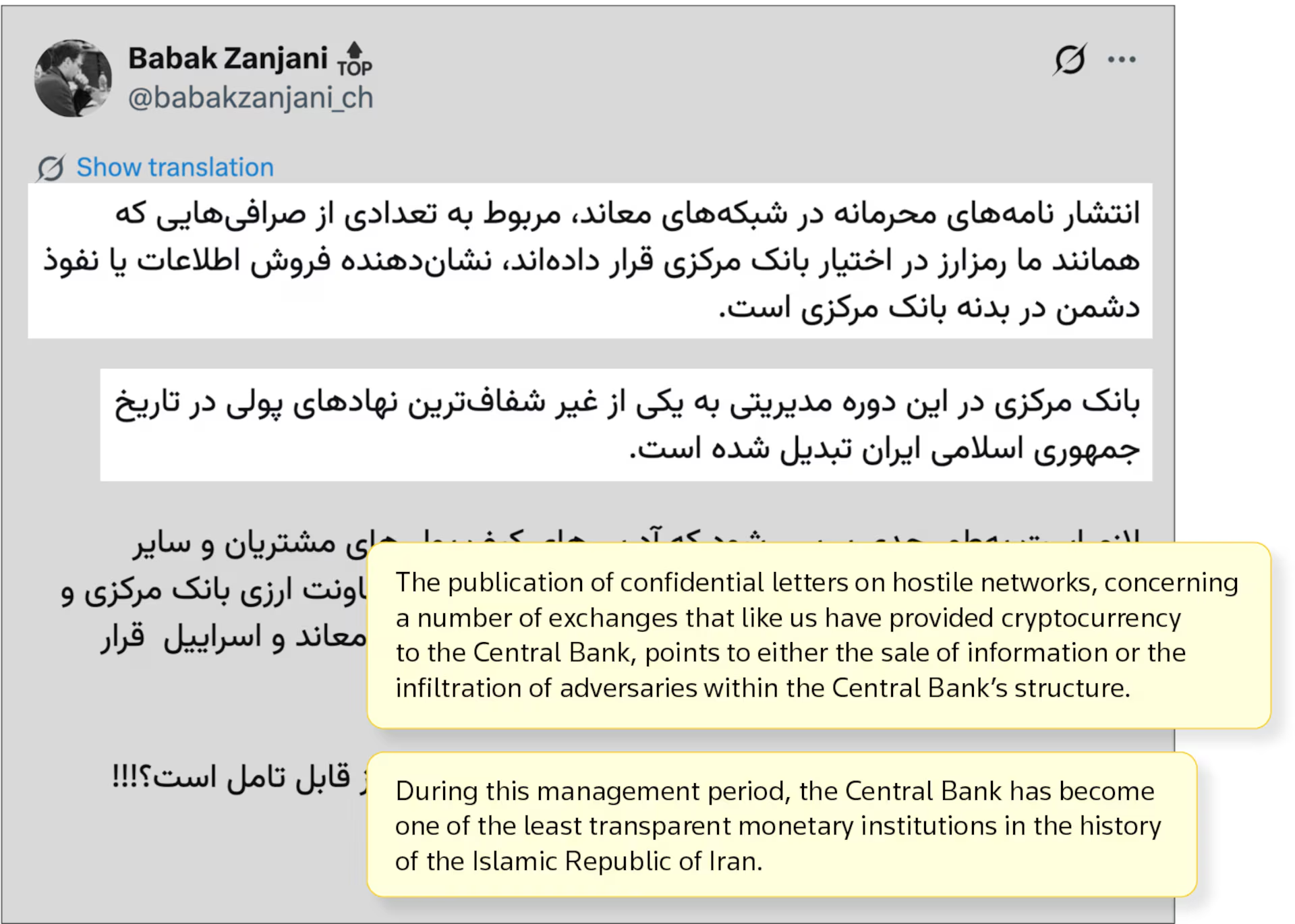
Iranian billionaire Babak Zanjani, convicted of fraud, posted on social media criticizing the Iranian Central Bank. Previously disclosed documents revealed cryptocurrency wallet information, which analysts used to uncover a sanctions evasion scheme involving Nobitex as a key channel.
According to Smart from Crystal Intelligence and another cryptocurrency analyst, part of the scheme involved transferring at least $20 million in sanctioned central bank funds to wallet addresses controlled by Nobitex.
Zanjani did not respond to requests for comments.
Blockchain analysis company Elliptic reported that these transactions are just part of a larger network of wallets controlled by the Central Bank of Iran, which purchased over $500 million in cryptocurrency between November 2024 and June 2025.
Elliptic stated that about $347 million was funneled from the sanctioned Central Bank of Iran into Nobitex in the first half of 2025.
Routing funds through Nobitex serves to obscure the origin of the funds.
Nobitex stated that any alleged illegal funds flowing through the exchange accounted for only "a tiny fraction of total transaction volume" and occurred without the company’s knowledge.
The company stated: "Once suspicious or irregular activities are detected, Nobitex's response is decisive, including permanently closing accounts." The statement did not define what constitutes "irregularities."
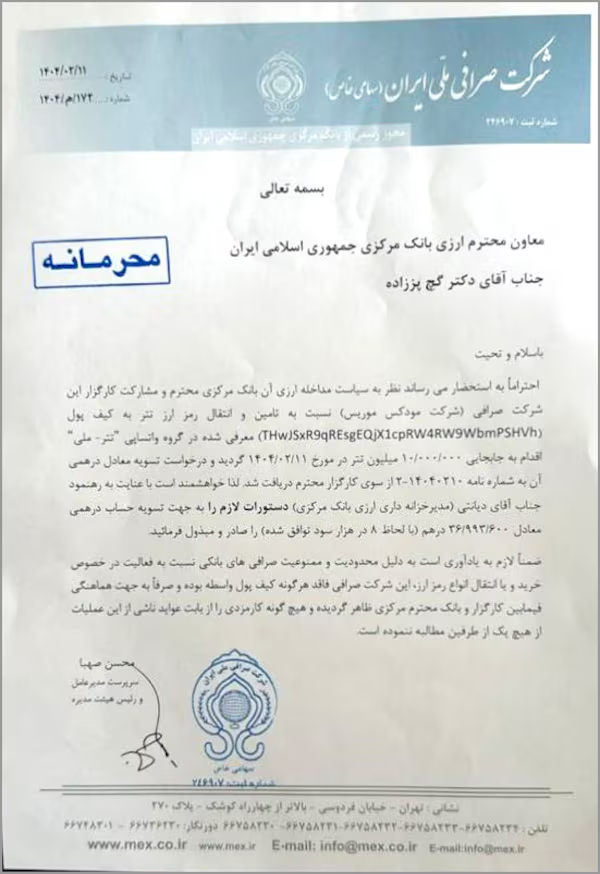
Babak Zanjani shared a letter dated April 30, 2025, from a bank manager to an official at the Iranian central bank detailing a cryptocurrency transaction. The letter provided a wallet address that helped analysts expose a sanctions evasion scheme involving Nobitex.
Estimates of the total volume of illegal transactions through Nobitex vary widely. These figures primarily stem from wallet addresses identified and sanctioned by various governments, including Israel and the U.S.
Elliptic has identified about $366 million flowing through the exchange. Chainalysis provided a number close to $68 million; Crystal Intelligence estimated direct transfers from sanctioned wallets at $22 million. Even the highest estimates account for only 3% of the $11 billion in cryptocurrency that Nobitex processed.
All companies caution that the real numbers could be much higher.
Among Iran's allies, at least two companies found Nobitex’s involvement in transactions related to accounts linked to the Houthis in Yemen. Houthi media outlets did not respond to requests for comments regarding transactions involving Nobitex.
The U.S. and Israeli governments have listed dozens of cryptocurrency wallets associated with the Central Bank of Iran and the Islamic Revolutionary Guard Corps for sanctions. Crystal Intelligence and other private investigators tracked how these wallets transferred funds through Nobitex and shared their conclusions and methodologies with Reuters.
Sanctioned Iranian entities also use other means to transfer funds, such as informal hawala money transfer systems and complex offshore banking networks. On April 28, the U.S. announced new sanctions against what it termed Iran's "shadow banking system." Nobitex was not included in this.
However, Nobitex's critical role in Iran's financial system was fully exposed during this year's war with Israel and the U.S.
Since February 28, due to government-imposed internet blockades to suppress dissent, most ordinary Iranians have been unable to access the internet. Nevertheless, Nobitex continues to operate. Nobitex did not respond to questions about how it maintained internet access during the blockades.
Internet monitoring company Netblocks stated that during this period, only individuals on a "nationally approved whitelist" (1% to 2% of the total population) could access the internet, as the government was cracking down on satellite links and VPNs.
Crystal Intelligence discovered that some individuals within this tiny elite group withdrew at least $54 million from the exchange during the war, with most flowing to overseas brokers who exchanged cryptocurrencies for cash with little inquiry.
On April 1, Nobitex issued a message aimed at reassuring clients, stating that "despite the instability of infrastructure and service systems," customer funds were safe and accessible.
The statement did not directly reference the war. However, the conflict that day had a direct impact on the Kharrazi brothers: a bombing targeted their uncle Kamal's apartment. Kamal had served as a foreign minister and was an advisor to the current supreme leader and his assassinated father.
According to state news reports, his wife died on the spot, and Kamal succumbed to his injuries days later.
The new supreme leader of Iran lost his wife and father on the first day of the war, mourning the Kharrazi family in state media and praying that God bless the "distinguished Kharrazi family."
免责声明:本文章仅代表作者个人观点,不代表本平台的立场和观点。本文章仅供信息分享,不构成对任何人的任何投资建议。用户与作者之间的任何争议,与本平台无关。如网页中刊载的文章或图片涉及侵权,请提供相关的权利证明和身份证明发送邮件到support@aicoin.com,本平台相关工作人员将会进行核查。


