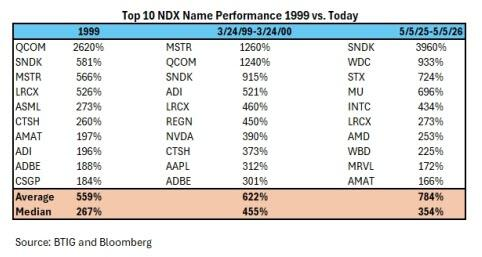
The top ten constituents of the Nasdaq 100 soared an average of 784% in the past year, with SanDisk surpassing Qualcomm’s record from the 2000 internet bubble period with a staggering 3960% increase. As the narrative of "this time is different" rings out again, will history repeat itself in the same rhyme?
Written by: BiyaMews
Looking at the average increase of 784% for the top ten stocks in the Nasdaq 100 index over the past year, what comes to mind are the wild days before the internet bubble burst in 2000. At that time, Qualcomm saw a 2600% increase in a year, and people said this time is different. Now, SanDisk has increased by 3960%, outpacing Qualcomm by 1300 percentage points, and once again, people say this time is different.
History never simply repeats itself, but the rhymes can send chills down your spine.
How exaggerated is this round of gains?
First, let’s take a look at a set of staggering data. According to the latest report from BTIG chief technical analyst Jonathan Krinsky, the top ten stocks in the Nasdaq 100 index had an average increase of as much as 784% in the past year. In comparison, this figure was 559% in 1999, and it was 622% in the year before the market peaked in March 2000.
Even more heartbreaking is that Qualcomm, which performed the best in 1999, had a 52-week gain of 2600%, and the best Strategy before the peak in 2000 had a gain of 1260%. Now, SanDisk has crushed these two records with its 3960% increase.
I remember bottoming out during the stock market circuit breaker in March 2020, thinking it was a once-in-a-decade opportunity. But to be honest, seeing these kinds of numbers, I feel more fear than excitement. The last time I saw this level of madness was in March 2000, after which the Nasdaq plummeted by 78%.
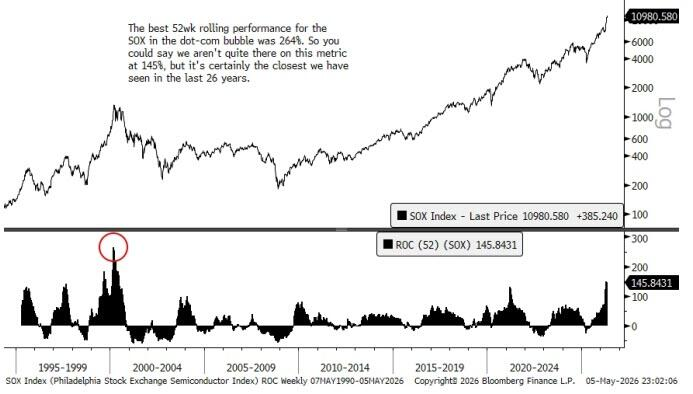
As the core engine behind this round of increases, the Philadelphia Semiconductor Index (SOX) is also nearing historical extremes. During the internet bubble, the best 52-week rolling return for this index was 264%, and now this number is 145%. While it hasn't broken a record yet, it is already the closest to an extreme level in the past 26 years.
Why is the market irrationally rising?
As I write this article, there are signs of easing in the Middle East situation, oil prices have plummeted, and U.S. Treasury yields have followed suit. The market's expectations for interest rate hikes by the Federal Reserve this year have basically disappeared, and chip giants like AMD have reported impressive earnings. All of this makes the stock market environment seem "perfect."
But the problem is, this "perfect" scenario reminds me of the situation in January 2018. At that time, everyone felt that the economy was strong, corporate profits were robust, and tax cuts were favorable, but then the market suddenly plunged in February, with the S&P 500 dropping 10% in one week.
Bloomberg macro strategist Cameron Crise is right; this perfect resonance at both macro and micro levels chills skeptical investors. This is because the stock market often peaks on good news, not on bad news.
What is different this time compared to 2000?
The biggest difference is the fundamentals. During the burst of the internet bubble in 2000, many companies were not profitable at all and relied solely on storytelling to support their valuations. Now, the performance of AI and semiconductor companies is solid. The financial reports from Nvidia and AMD are there, showing that both revenue and profits are growing.
But this is also what concerns me. Because when everyone uses "good fundamentals" to argue that the market won't drop, it often signals a precursor to a correction. I remember during the bull market in 2021, everyone said, "this time is different, there is fundamental support," and then in 2022, the Nasdaq dropped 33%.
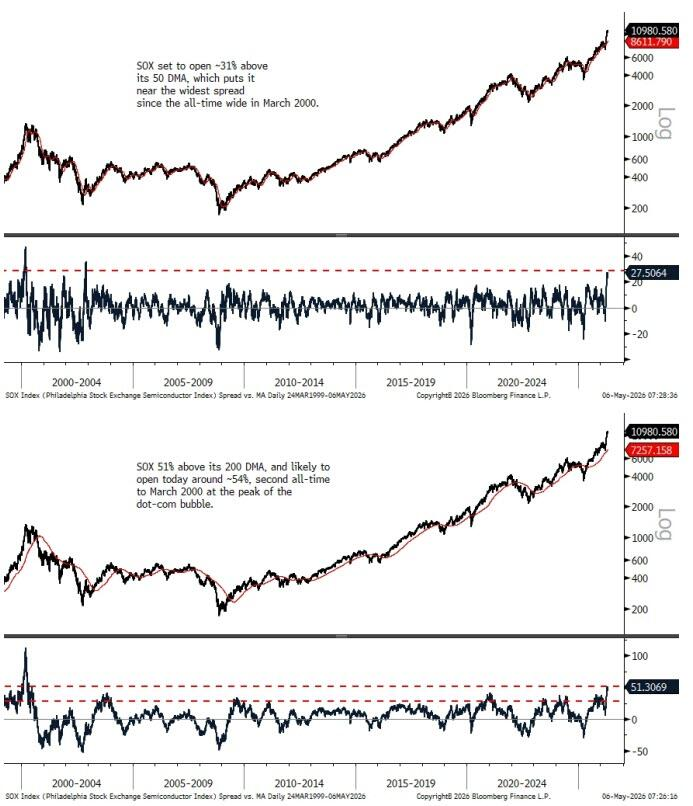
BTIG estimates that the semiconductor sector may see a correction of 25% to 30%, which would bring the Philadelphia Semiconductor Index down to its 50-day moving average. This judgment is in line with the technical indicators I have observed.
What should investors do?
To be honest, I cannot predict when the market will peak. But there are several signals worth paying attention to:
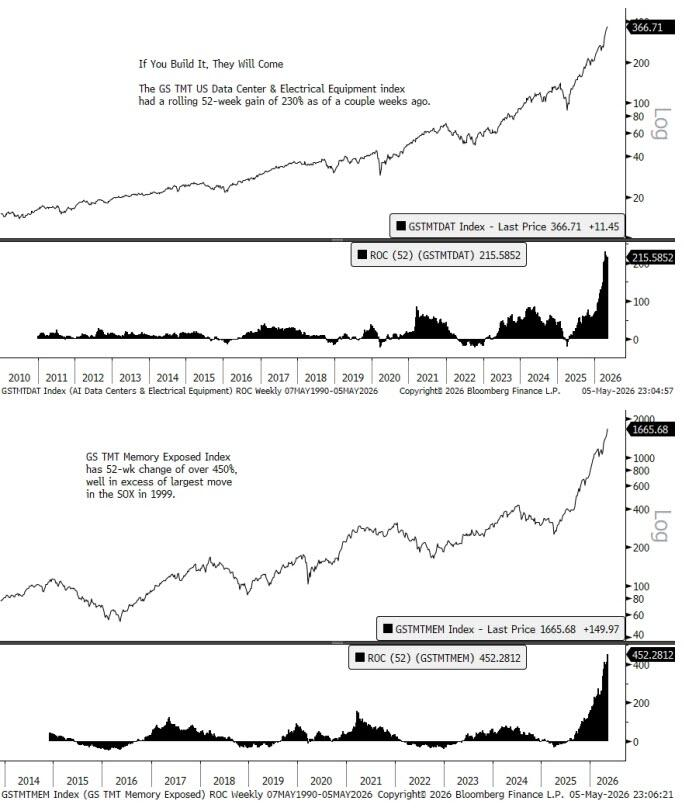
First, when everyone feels that "this time is different," it is often the most dangerous time. Second, when within the semiconductor sector, data center-related stocks have risen by 230%, and storage chip stocks have risen by over 450%, the pressure from profit-taking will increasingly grow.
Third, and most crucially, there is uncertainty around a shift in Fed policy. Although the market currently expects no interest rate hikes this year, if inflation data unexpectedly rises, everything could reverse in an instant.
My advice is this: if you have made a significant profit, consider gradually locking in those profits. If you are still debating whether to chase the highs, it may be wise to wait for a pullback. Because even if this time is truly different, the market will provide you with better buying opportunities.
Remember, before the burst of the 2000 internet bubble, many people also felt that "this time is different." And what happened? The Nasdaq dropped from 5048 points to 1114 points, taking a full two and a half years to hit bottom. Those stocks that performed the best that year often suffered the most significant declines.
Will this happen again? I do not know. But history tells us that when the gains surpass those of 1999, being cautious is never a bad thing.
免责声明:本文章仅代表作者个人观点,不代表本平台的立场和观点。本文章仅供信息分享,不构成对任何人的任何投资建议。用户与作者之间的任何争议,与本平台无关。如网页中刊载的文章或图片涉及侵权,请提供相关的权利证明和身份证明发送邮件到support@aicoin.com,本平台相关工作人员将会进行核查。


