
Author: Ba Jiuling, Wu Xiaobo Channel
“A plane carrying the ‘Jerusalem of the stock market’ is flying towards us.”
On the evening of May 13, the U.S. presidential delegation officially landed at Beijing Capital International Airport.
In the eyes of stockholders, what landed was the hottest AI bull market at present.
Accompanying Trump were 17 top executives from American companies. Their companies have a combined market value of over $10 trillion, accounting for more than one-fifth of the U.S. stock market, equivalent to moving half of the U.S.'s wealth.
Among them, familiar faces like Jensen Huang and Elon Musk need no introduction. This visit also included representatives from today’s hottest AI hardware companies on Wall Street.
For example, Sanjay Mehrotra, CEO of Micron Technology, saw Micron’s stock price rise over 320% in the past year, driven by demand for AI storage; likewise, Jim Anderson, whose company HighTie is a representative of the “light chasing (optical communication)” concept stock in the U.S. stock market, also doubled its stock price this year.

Jensen Huang and Elon Musk arrived in Beijing with Trump
In other words, standing in this group is not only Trump, the “king of candlesticks,” but also the “staunch bulls” of the entire U.S. AI industry.
U.S. stocks also boosted this trip. That night, both the Nasdaq and S&P 500 indexes reached all-time highs, with Tesla rising over 2%, and Nvidia and Apple rising over 1%, with the latter two hitting their previous market capitalization peaks as a result.
In less than a day, more good news emerged. Right after the A-share market closed that day, Reuters dropped a bombshell stating that the U.S. had allowed 10 Chinese companies including Alibaba, ByteDance, Tencent, and JD.com to purchase Nvidia H200 chips, causing Nvidia's stock price to hit a new all-time high when trading opened that evening.
Such a trend seems to further reinforce stockholders' obsession with a current market logic — “high cut high, account continuously reaching new highs; high cut low, levels continuously dropping.”
High Cut High, Account Continuously Reaching New Highs
Generally speaking, when the market is relatively stable, it tends to undergo rounds of sector rotation, shifting funds from over-inflated high-growth stocks to lower-growth stocks that have not risen, known as “high cut low.”
In stockholders’ experience, when tech stocks surge, profits are shifted to cyclical stocks, once those are exhausted, funds flow into dividend stocks, ultimately finishing in pharma and consumer sectors.
However, in the last month of global markets, funds have not flowed from high-position sectors to low-position assets but have continued to chase even stronger, hotter, and more crowded AI directions, known as “high cut high.”
The market resembles a snake biting its own tail, rolling solely from AI related back to AI related, ultimately flipping out one doubling stock after another.
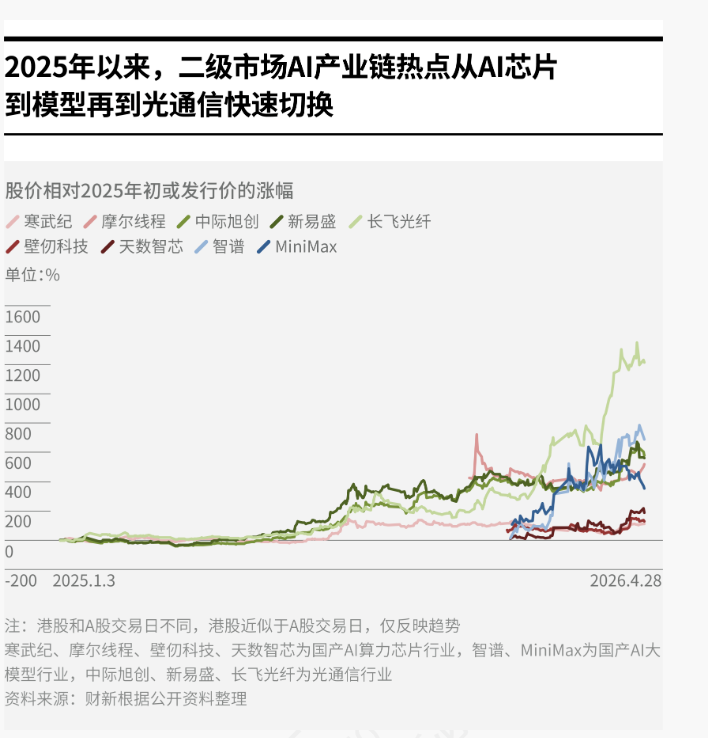
From early April to May 11th in the A-share market, funds flowed from upstream optical chips (represented by stock Yuanjie Technology, rising over 60%) to the midstream trio of optical modules “Yi Zhongtian”—New Yisheng (rising over 70%), Zhongji Xuchuang (rising over 55%), and Tianfu Communication (rising over 45%).
Then, funds flowed to PCB printed circuit boards (represented by stock Huadian Co., rising over 70%), and finally into downstream AI computing power (represented by stock Cambricon, rising over 90%), with nearly the entire AI infrastructure chain experiencing an uptick.
U.S. stocks have also been wandering in this vortex: after Nvidia rose (30%), it was Micron's (181%) and SanDisk’s (100%) turn, representing the storage sector.
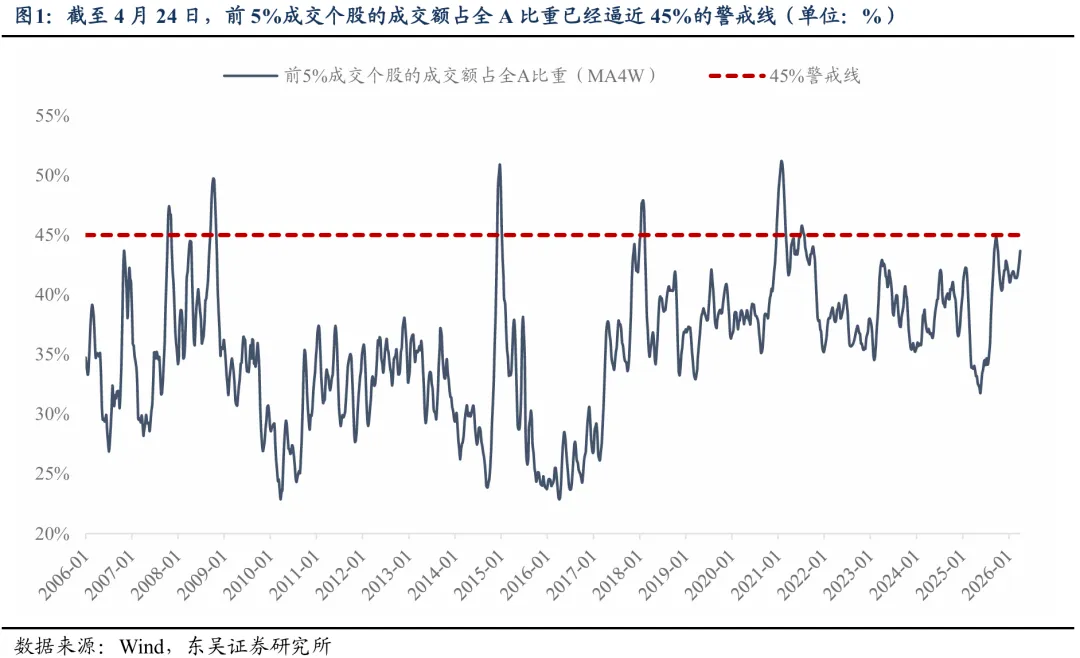
Data from Dongwu Securities indicates that as of April 24th, the trading volume of the top 5% of stocks reached 43.7% of total A-share volume, approaching the 45% crowding threshold.
“High cut high” has led to fierce short squeezing in the market, even giving rise to an extreme sentiment of “not wanting to buy anything but AI.”
This has also been the choice of mainstream funds.
In the first quarter of this year, among the top 50 heavily held stocks by funds in the A-share market, as many as 18 belonged to the information technology sector, with stock Zhongji Xuchuang heavily held by 1163 funds, and New Yisheng backed by around a thousand funds. Meanwhile, the net proportion of the semiconductor industry in current global hedge funds has jumped from 5.5% in the same period last year to 20% now.
“High cut high” naturally becomes the biggest victim for those holding other “non-AI stocks.”
A new world is accelerating into view, but not everyone can sit on that rocket.
Data from CITIC Securities indicates that in April, among stock indexes that rose more than 10%, the “information technology + communication services” sector contributed an average of 68.9% to the index's increase, even for weaker-performing indexes, the tech sector contributed as much as 54% to the index's growth.
By contrast, amidst the backdrop of the Shanghai Composite Index stabilizing above 4100 points and rising a total of 5.66%, the food and beverage sector (-1.1%), transportation (-0.7%), and banking sectors (-0.6%) in A-shares have underperformed, falling against the market.
AI Enjoys Prosperity Exclusively
However, while many indicators warn of the risks of being too tightly clustered, no one dares to say they will get off the ride.
The reason is that people would rather “high cut high,” not just out of fear of missing out, but due to certain pragmatic considerations.
Currently, AI has genuinely boosted the economy and corporate profits, to exaggerate, it has become the “hope of the whole village.”
Taking the U.S. as an example, in the first quarter of this year, the U.S. GDP increased by 2% (excluding inflation factors), and according to the Wall Street Journal, the AI economy grew by 31%, while the non-AI economy only grew by 0.1%.
Among them, personal consumption, the largest component of the U.S. GDP, only modestly grew by 1.6%; while investments in commercial buildings such as housing, office buildings, and factories, as well as transportation equipment such as trucks and planes, have declined, in contrast, investment in technology equipment surged by 43%, software investment rose by 23%, and data center construction investment grew by 22%.
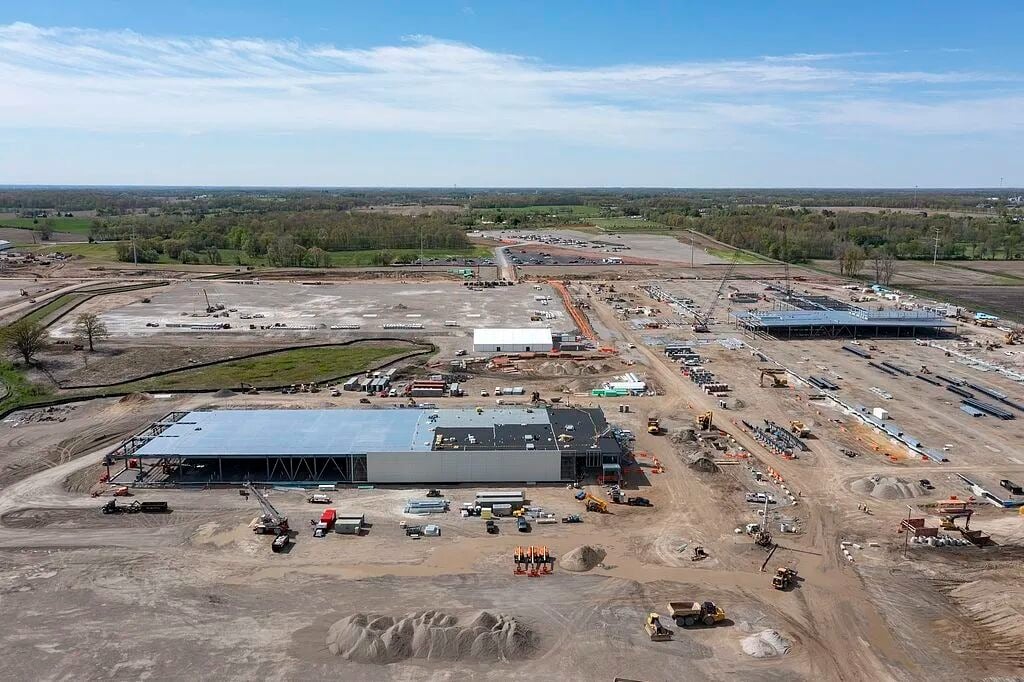
Data centers developed by Oracle and OpenAI
A similar situation is subtly emerging in the structure of China's economy.
In the first quarter of 2026, profits of high-tech manufacturing represented by computer communications and equipment manufacturing industries rose by 47.4% year-on-year, driving the profits of all industrial enterprises above the scale by 7.9 percentage points.
In terms of investment, the difference between the growth rate of investment in high-tech industries and that of overall fixed asset investment has further widened from 4.8 percentage points in 2024 to 5.7.
On the export front, the pull of the AI-related industrial chain is even more significant.
In the first quarter of this year, integrated circuit exports rose by 77.5% year-on-year, with the export of industrial robots capable of AI visual recognition and autonomous navigation growing by 42%, significantly surpassing the overall export growth rate.
By April, China's year-on-year export growth rate further rebounded to 14.1%. Among them, integrated circuit exports grew by 99.6%, and exports of automatic data processing equipment increased by 47.3%, becoming the core driving force for exports.
The import side is similarly so.
Driven by the demand for AI computing power, in the first quarter, China's integrated circuit imports increased by 45%, rising further to 54.7% in April.
Profits from capital markets are also concentrated in “AI.”
According to estimates, in the first quarter of this year, the information technology sector contributed to 80% of U.S. stock profit growth. For the S&P 500, overall profit increased by 15.1% year-on-year, but among the “seven sisters” of U.S. stocks, the increase was 61%, while the remaining 493 companies only saw a growth of 16%.
The A-share market exhibits similar characteristics.
In the first quarter of this year, sectors highly related to AI, represented by communications, electronics, and non-ferrous metals, saw their net profit TTM growth increase by 60.9% compared to the end of 2023; after excluding these three industries, net profits of other non-financial sectors in the same period fell 23.5%.
AI exclusively enjoys prosperity, which has also given investors the courage to cluster together.
New Stories vs. Old Narratives
However, even though the AI narrative is so strong, Trump's three-day, two-night visit to China has brought new variables to the market.
On May 14th, after the Shanghai Composite Index set a new peak of 4258 points that day, it turned downwards, closing below the 4200 point mark, with a large bearish candlestick of -1.52% amidst a sea of red candles; the Hong Kong Hang Seng Index also opened high and went low.
This is a sign of divergence.
Historically, May-June is typically a time when industry rotation speeds converge, indicating the market is likely to give birth to a new round of structural main lines.
Wall Street is also prepared for this; they do not expect a super reconciliation, but have higher expectations for “easing relations.”
After all, outside of AI, there are still many pressing problems in the real world waiting to be solved, and the keys to solving these problems are in the hands of these two superpowers.
According to a summary by various media, the topics potentially involved in this Sino-U.S. dialogue may include the U.S.-Iran war, tariffs, critical minerals, investments in the U.S., imports of agricultural products, and more, each likely to become a new reference point for market direction.
But this does not mean that the “high cut high” vortex of AI will stop.
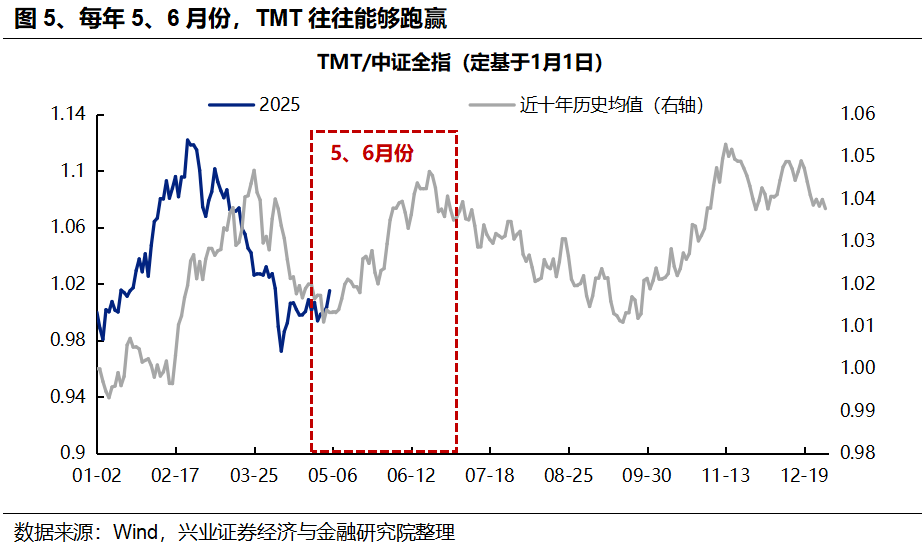
On one hand, according to the calendar effect, the technology industry in May-June tends to outperform the market, as this period is also dense with important meetings in the tech industry.
On the other hand, considering there are so many “AI bulls” in position, future news will naturally benefit the followers of “high cut high”, with Reuters’ news being a significant corroboration.
From their responses, the evolution of future market trends depends on the correlation of related assets with AI, as well as the extent of geopolitical influence.
Ironically, some views have begun to form a new logic: when AI becomes the only prosperity, more and more originally unrelated industries are also starting to depend on the wealth effect created by the AI bull market.
In other words, consumption, the housing market, risk assets, and even domestic demand recovery all need that rocket to continue ascending.
Perhaps it is just as Chuck Prince, the former CEO of Citigroup, said:
As long as the music is playing, you've got to get up and dance.
Interestingly, this quote was written on the eve of the subprime mortgage crisis.
May Wealth Survey Results Released
At the end of the article, we invited nine investors and financial experts to make predictions and judgments about the market for the next month.
The monthly wealth growth report has now reached its third issue since March, conducting a survey every month based on the market performance of the past month and inviting experts to make predictions.
This month's major asset categories involved are: CSI 300 Index (A-share large cap), Hang Seng Index (representing Hong Kong stocks), U.S. stocks (AI bubble direction indicator), U.S. dollar index (inflation expectations), gold prices (safe haven), first-tier city housing prices (confidence), oil prices (geopolitical), and CSI major consumption index (domestic demand expectations).
Survey results are shown in the figure:

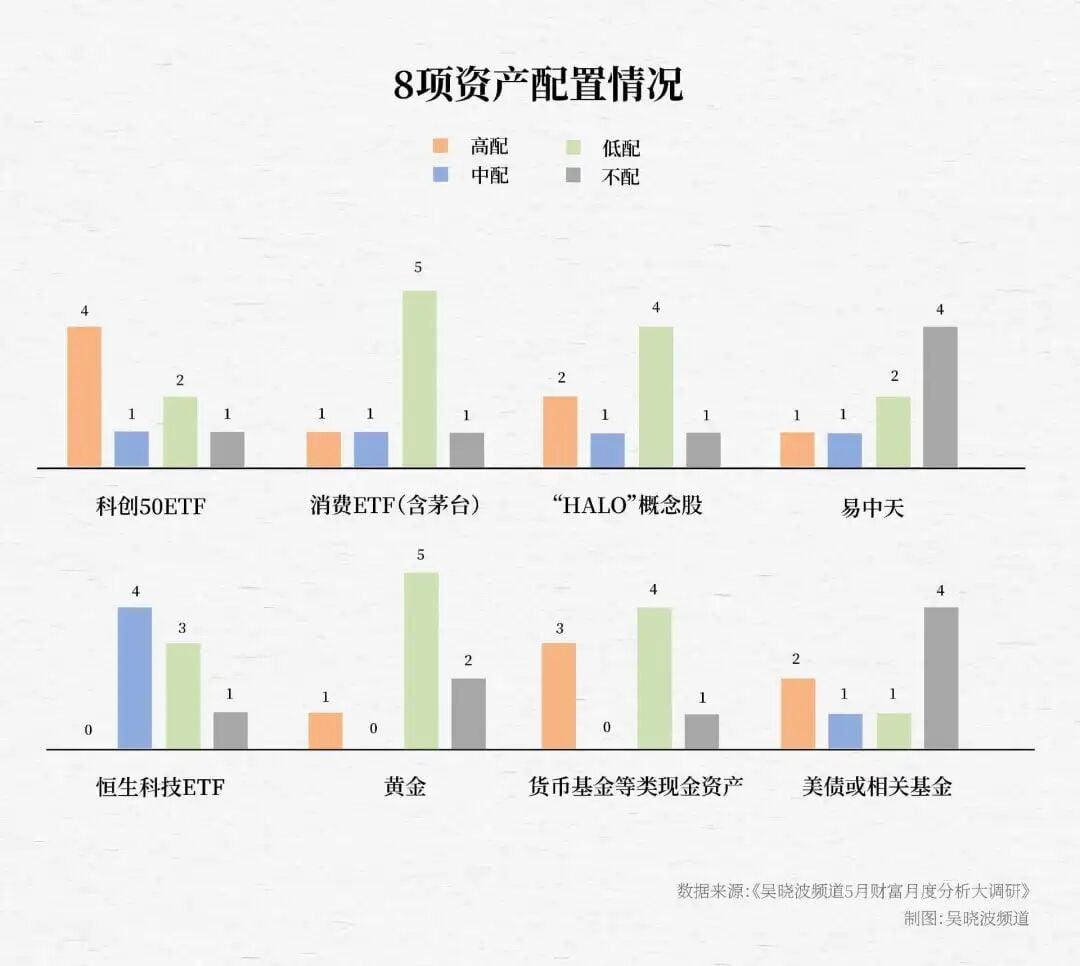
Additionally, once the experts completed their evaluations of bullish and bearish positions on assets, the next step involved real investment allocations. Based on the aforementioned eight categories of assets, we further selected eight corresponding investment targets and invited them to make allocation choices.
The results reveal that in priority rankings, the most frequently selected assets outline two clear main lines: tech growth and “HALO” assets.
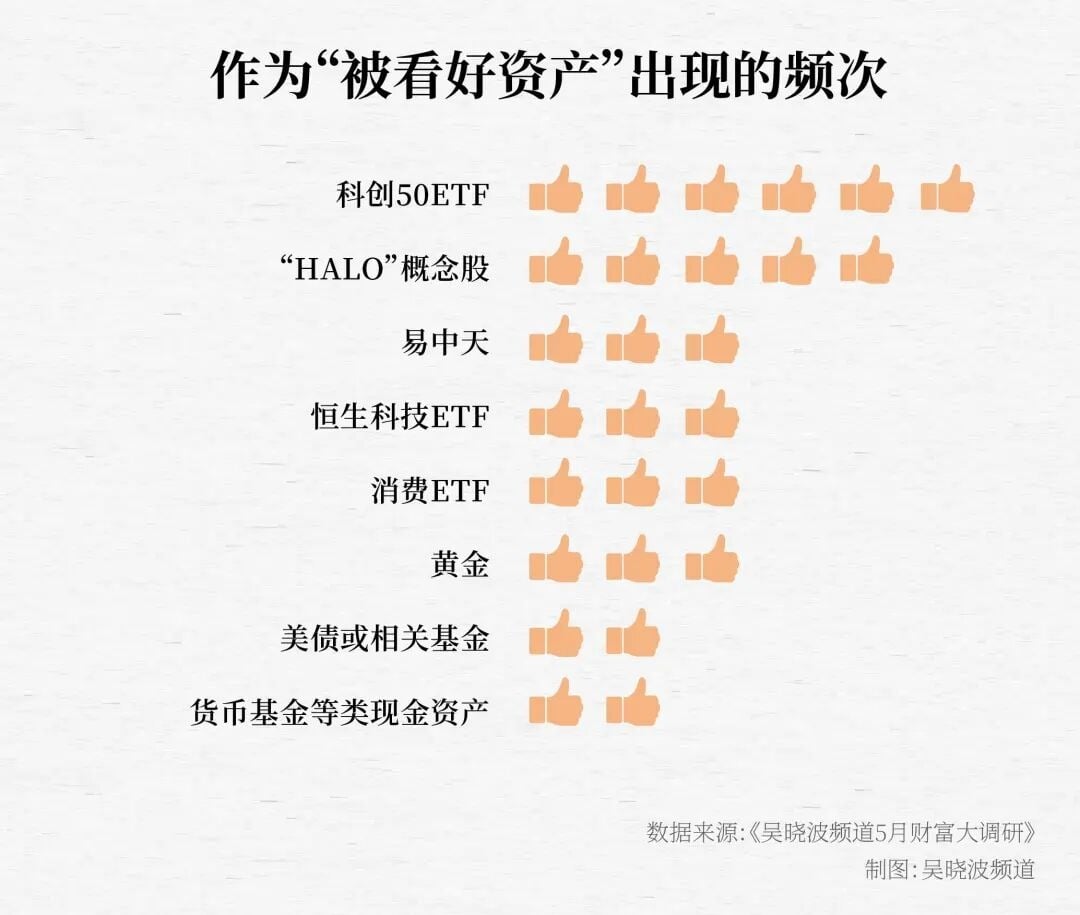
Specifically, the following five notable features emerged:
▶▷ First, the Sci-tech 50 ETF has been the most favored asset for the third consecutive month.
Experts who clearly favor and choose to overweight it provided three reasons:
◎ First, the ChiNext and Sci-Tech Board have shown strong profit effects.
◎ Second, this round of the bull market is essentially a “tech bull,” and the Sci-Tech Board is the main battlefield of new productivity, with strong support from the “14th Five-Year Plan.”
◎ Third, the Sci-Tech 50 Index has high certainty, better than specific stocks or sectors.
▶▷ Second, preference for allocating “HALO” assets has once again rebounded.
In the recent three months of surveys, experts’ optimism towards “HALO” concept stocks has undergone significant changes:
In March, “HALO” concept stocks were favored 6 times, but in April, this number dropped to 3 times, mainly due to market concerns of overheating. In May, the situation turned around as the enormous energy demand of AI infrastructure endowed “HALO” assets represented by non-ferrous metals, electricity, and energy with a new narrative, with the number of favorable times for “HALO” concept stocks increasing to 5, ranking second again.
▶▷ Third, most experts chose to avoid popular assets “Yi Zhongtian.”
The core reason lies in the drop in win rates. Over the past year, “Yi Zhongtian” rose 7-10 times, and the crowding in the optical module sector has reached its highest level in nearly a decade.
▶▷ Fourth, although experts remain cautious about the recovery of consumption, they generally recognize the value of allocation in consumption ETFs.
In terms of allocation proportions, few experts chose to overweight or highly allocate to consumption ETFs, with more than half selecting low allocation, but only 2 choosing no allocation.
Experts generally believe that the consumption sector has hardly benefited from the bull market’s rise and still has room for gains; in the context of crowded conditions already emerging in popular sectors, the cost performance becomes apparent. Therefore, the current stage of allocation is an option that is “losing time rather than money.”
▶▷ Fifth, preference for defensive assets continues to decline.
Over the past three months, the enthusiasm and overall allocation ratio for gold have continued to drop, with most experts holding a short-term bearish view on gold trends, only keeping it as a holding asset.
Views on money market funds and U.S. Treasury bonds have polarized: one group generally overweights tech growth assets while underweighting or not allocating cash products, reasoning that a slow bull market remains strong and the market will continue to push higher, thus preferring to shift funds toward high elasticity targets.
The other group, however, overweight cash products while underweighting or not allocating tech products. Their reason relates to risk control, “In allocating to relatively high positions of prosperous assets, it’s hard to find directions with cost performance, making it an unsuitable time to increase positions.”
免责声明:本文章仅代表作者个人观点,不代表本平台的立场和观点。本文章仅供信息分享,不构成对任何人的任何投资建议。用户与作者之间的任何争议,与本平台无关。如网页中刊载的文章或图片涉及侵权,请提供相关的权利证明和身份证明发送邮件到support@aicoin.com,本平台相关工作人员将会进行核查。


