Original author: Gracy Chen (X: @GracyBitget)
Last night, a college classmate working on Wall Street suddenly sent me two images: the contract trends for the AI chip company Cerebras (CBRS) on Bitget and Hyperliquid. 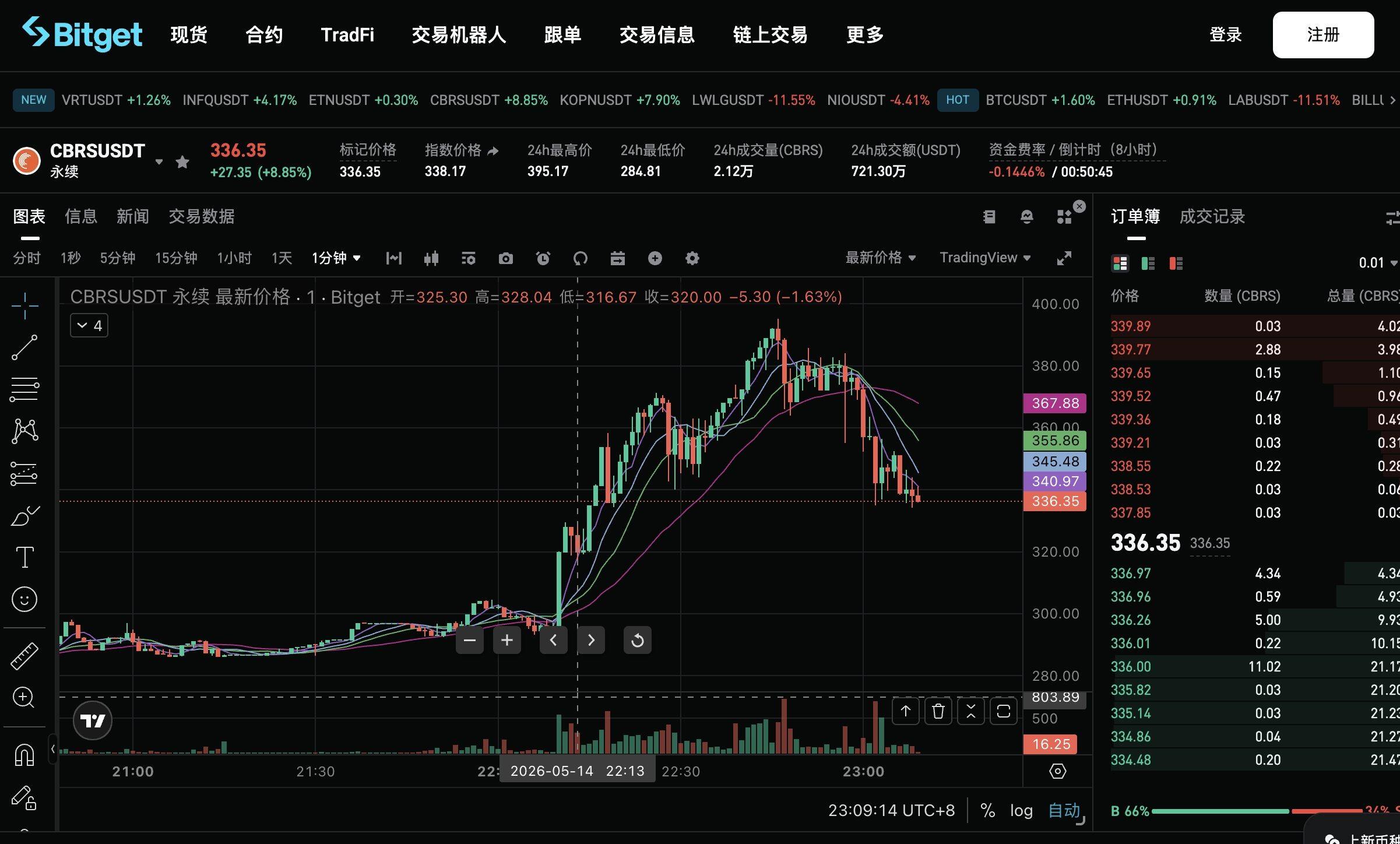
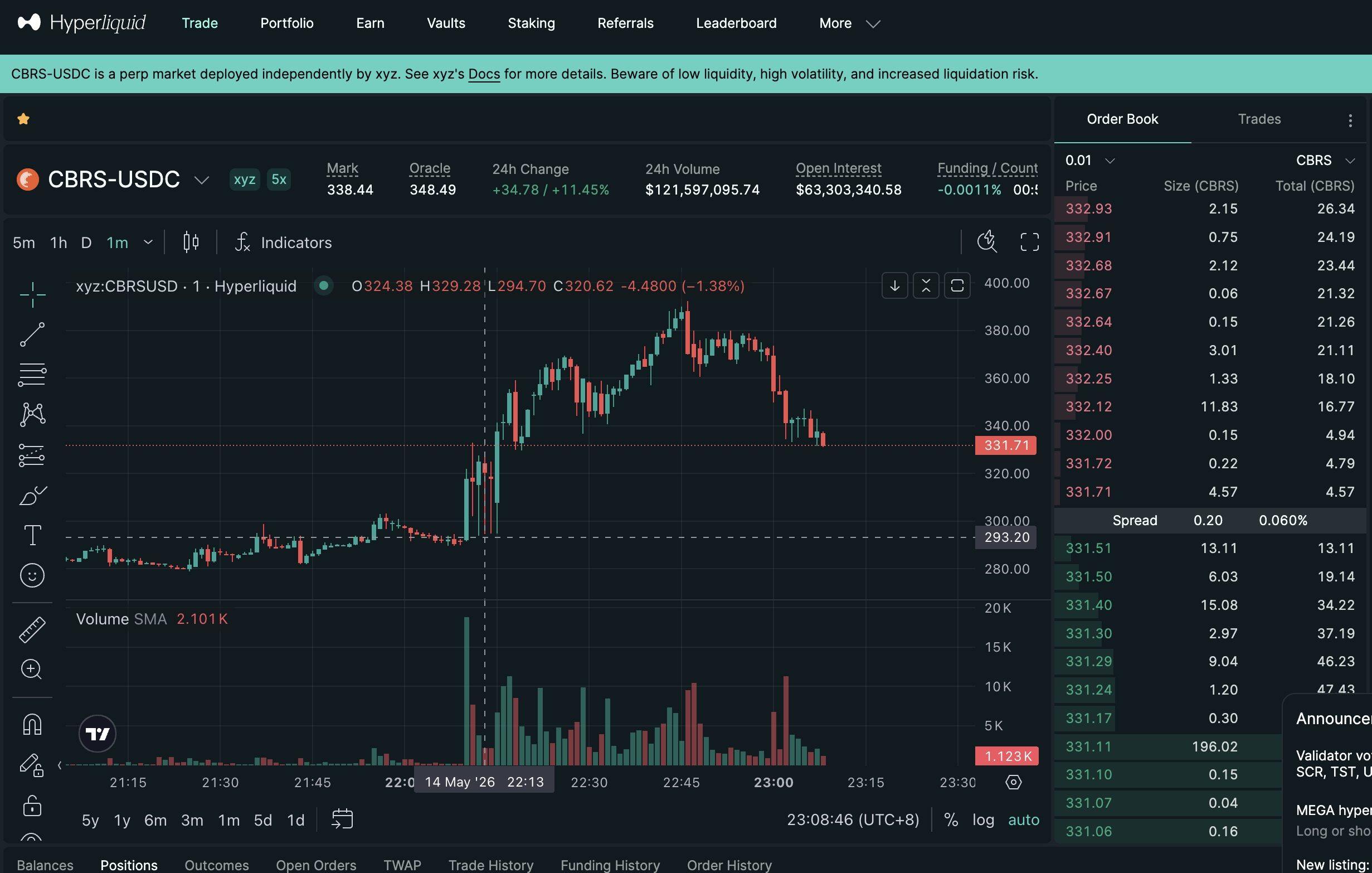
He said these two images appeared during their company’s internal meeting. The theme of the discussion was quite interesting:
The cryptocurrency industry is providing a unique value that Wall Street does not have — giving the opening price of IPO assets earlier than Wall Street.
Taking CBRS as an example, on the eve of its official listing on May 14 in Eastern Time, the entire Wall Street was waiting for its opening price. However, on platforms like Bitget and Hyperliquid, the market had already started moving ahead.
On that day around 10 AM Eastern Time (while Nasdaq was still conducting its opening match for new stocks), both platforms showed similar trends: the CBRS contract price quickly surged from about $290 to around $380.
Later that day, CBRS officially debuted on Nasdaq, with an opening price of about $350, peaking at $386 during trading.
In other words, in the case of CBRS, the cryptocurrency market completed a fairly accurate price discovery in advance.
This is quite exhilarating.
For a long time, the cryptocurrency industry has been waiting for Wall Street's recognition, for institutional participation, and for traditional finance to endorse us.
But now, the situation is reversing, and Wall Street is beginning to seriously look at the price signals from the cryptocurrency market.
This is not a coincidence but a manifestation of the mechanisms advantage of the cryptocurrency industry. For the price discovery of Pre-IPO contracts, several exchanges have adopted similar mechanisms, such as:
- Oracle-based internal pricing and smoothing mechanism: How does the system price during the “blind box” period before the US stock market opens, with no external price references? Our mechanism, in the absence of external price references, extracts the large transaction price differences from the order book through an endogenous oracle and adjusts prices at a frequency of once per second. However, the price is calculated using the exponentially smoothed moving average (EMA) of the prices in the past minute, allowing the current price to gradually approach the target price. Here’s a metaphor: the oracle captures large real-money transactions on the market like a radar, calculating the true target price. But to prevent price spikes from hurting retail investors, the system enters “slow-motion” mode — making tiny adjustments every second, smoothly approaching the target price, avoiding malicious liquidations due to momentary drastic fluctuations.
- A dynamic price cage mechanism balancing risk and flexibility: The system sets an initial price fluctuation range of ±5%, and once the price touches 90% of the boundary, it triggers an automatic re-anchoring, expanding the maximum price discovery space within the week to about ±25% without altering the risk model for market makers per transaction. This is somewhat like a retractable leash when walking a dog. The system initially defines a safe activity range for the price (for example, ±5%). If buying pressure is extremely strong and the price is about to break through the ceiling, the system does not rigidly lock the trades but automatically adjusts the “ceiling” upward (to ±25%). This controls single-instance price surges and dips while providing ample space for the market to find the true “opening price.”
The truly important thing behind this is: the cryptocurrency market is transitioning from a “follower” to a pioneer in the global asset pricing system.
Recently, in a CNBC interview, I mentioned a “10% vision”: by 2030, about 10% of global financial assets will exist in tokenized forms. We are truly accelerating towards this vision.
As I write this, I also remember taking my son to visit Wall Street and seeing the “Fearless Girl” standing in front of the New York Stock Exchange with her hands on her hips. She held her head high, stubbornly and firmly staring at the enormous, ancient, seemingly unshakable traditional financial empire ahead.
In its early years, Crypto was like this girl — standing outside the door of traditional giants, seen as a rebellious outlier and challenger.
In the previous cycle, we eagerly anticipated Wall Street to turn around and embrace crypto. In the next cycle, Wall Street will find that they must embrace crypto and tokenization.
Because the most cutting-edge market experiments, the fastest liquidity organization, and the most open price discovery are happening here. In this irreversible integration, the enormous capital of traditional finance is actively connecting to the superior underlying track of Web3.
Wall Street remains the largest container of global capital, but Crypto is becoming the “pricing hub” of this container.
Wall Street brings the scale, but Crypto dictates the future of price discovery.
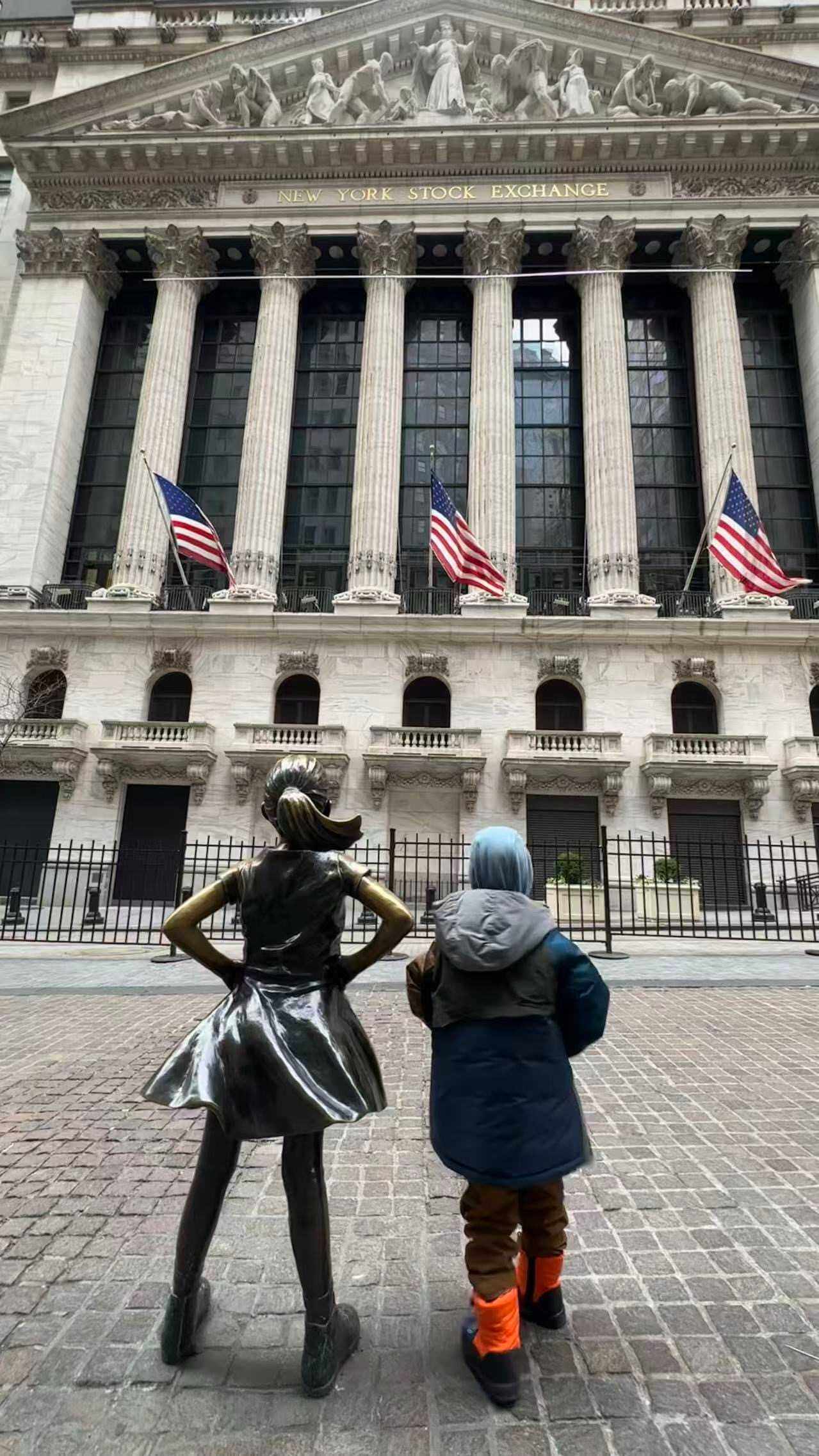
(The photo was taken by me in February 2023 @Wall Street)
免责声明:本文章仅代表作者个人观点,不代表本平台的立场和观点。本文章仅供信息分享,不构成对任何人的任何投资建议。用户与作者之间的任何争议,与本平台无关。如网页中刊载的文章或图片涉及侵权,请提供相关的权利证明和身份证明发送邮件到support@aicoin.com,本平台相关工作人员将会进行核查。


