
Author: Block Analytics Ltd, Merkle 3s Capital
An IPO that has been overly anticipated for half a year
On June 12, SpaceX will debut on NASDAQ with a valuation of $1.75 trillion, becoming the largest IPO in the history of human capital markets. This figure surpasses Walmart, JPMorgan, and all traditional energy giants combined. A space company still operating at a loss has a valuation that outperforms most of the S&P 500.
But what truly supports that $1.75 trillion is not the Starship, which keeps exploding in Texas, but the over 8,000 small satellites known as Starlink above. The rocket is merely an entry ticket; satellite internet is the cash machine. This is the contrast the market has taken a quarter to digest since SpaceX filed its prospectus.
More interesting is the related concept stocks. From the leak of the prospectus on March 25 to now, TSLA is up 10%, RKLB up 88%, FLY up 70%, QCOM up 56%, DXYZ up 79%—a funding frenzy surrounding SpaceX has already run a good distance. Are the retail investors joining in to catch the wave or to take over? Let’s break it down one by one.
Three faces in the prospectus
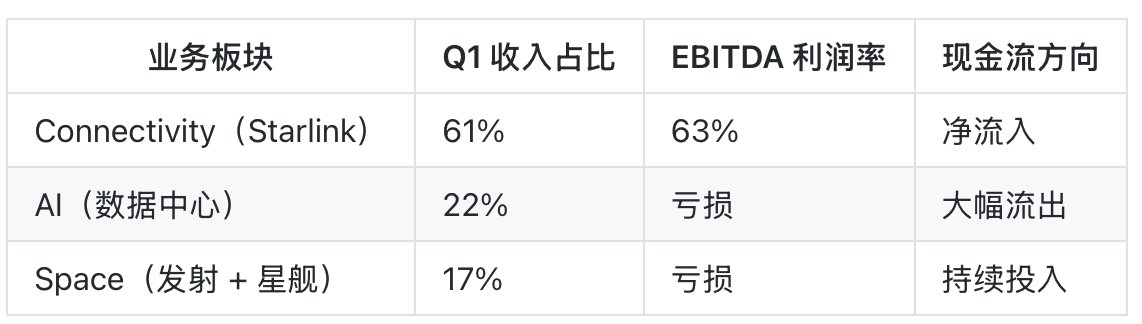
SpaceX has divided its business into three segments: Space (launch and spacecraft), Connectivity (Starlink), and AI (data centers and computing power). It sounds balanced, but financially it is a severely specialized machine.
Starlink is the true cash cow. As of Q1 2026, paying users have surpassed 10.3 million, contributing 61% of quarterly revenue for the entire group, with an EBITDA profit margin of 63%. This is a figure higher than most SaaS companies. Once the scale effect of satellite internet crosses the critical point, marginal costs are almost zero—SpaceX has crossed that point already.
The trend of ARPU is another side of this story that merits attention. In 2023, the average monthly fee for Starlink remains in the range of $110-130, dropping to $90-100 in 2024 as markets in developing countries expand, and by the second half of 2025, due to the dilution from Direct to Cell entry packages and long-tail enterprise users, it has dropped to the range of $75-85. Doubling the user base while cutting per-user revenue in half is a typical "volume compensates for price" story.
The upside is that TAM is opening up—markets in India, Southeast Asia, and Africa with low ARPU were not part of Starlink's early business model. The downside is that gross margins will be pressured, as the hardware subsidy ratio is higher in low-end markets, and the payback cycle per user will extend from 14 months to 22-28 months. We are more inclined to view Starlink as a "user growth takes precedence over ARPU" story before 2027, meaning we need not be overly sensitive to quarterly ARPU declines, but must be wary of the potential risk of "user growth + ARPU" slowing simultaneously.
The AI business is another extreme. Q1 capital expenditures burned $7.7 billion, mostly invested in Phase II of the data center in Memphis, Texas. The computing power contract signed with Anthropic has a monthly price of $1.25 billion, which sounds great, but the contract clearly states: can be unilaterally terminated in 90 days. This means the AI revenue on paper could evaporate at any time.
The Space segment continues to incur losses due to the development of Starship. The logic of this business is to make rockets cheap, then collect tolls using Starlink, and ultimately leverage the AI data center to consume all computing power. All three pieces are indispensable, but only Starlink is creating cash.
In terms of control, Musk holds 85.1% of the voting rights. This is a more absolute control structure than Zuckerberg during the Meta era, implying that the essence of retail investors buying in is "faith". SpaceX lists a TAM of $28.5 trillion in the prospectus, broken down as: satellite broadband $12 trillion, government defense launches $400 billion, AI computing power $12 trillion, deep space and lunar economy $9 trillion, and the rest is industrial space. Most of these figures won’t be validated until 2040.
TSLA: The "unseen key player" mentioned 87 times in the prospectus
If only one SpaceX concept stock can be chosen, the answer is not a rocket company, it is Tesla.
The SpaceX prospectus mentions Tesla 87 times, far exceeding any other entity. The two companies share chip design teams, share the computing architecture of Dojo, and share the production capacity of the Terafab chip factory in Texas. Musk's "Heart of the Galaxy" plan announced in early 2026 essentially connects SpaceX's computing power with Tesla's FSD training data pool—these are not two companies, but a technology empire deliberately divided in half.
The capital markets have been voting with their feet. Since the submission of the prospectus on March 25, TSLA has risen 10.24%. This increase seems less impressive than many small-cap concept stocks, but it is important to realize that Tesla’s market value base is in the trillions; a 10% increase means an additional entire Ford Motor Company’s market value. What is the market betting on? It is that SpaceX's indirect equity held by Tesla after the IPO will be revalued.
A more aggressive speculation is on a merger. There is indeed market expectation of "the two companies merging around 2027", but the probability of this depends on the tax structure and Musk's personal patience with the Tesla board. We prefer to see TSLA as a "high-certainty side pocket" of SpaceX’s IPO rather than a "merger lottery".
If you are optimistic about SpaceX's AI computing power story, then Tesla's Dojo is the closest version you can directly buy in the secondary market. If you are optimistic about SpaceX's cash flow story, then Tesla may not be the best choice—it is not directly linked to Starlink's business.
Three direct competitors: RKLB, ASTS, FLY
The most awkward aspect of SpaceX’s IPO is not itself, but these three companies. They benefit from the "aerospace stock sector premium" but also must prove "they won't be eaten by SpaceX".
Rocket Lab (RKLB): The small SpaceX, the only alternative
RKLB is the king of this round of increases, with an 88.85% rise since the end of March. The logic is very simple: if retail investors cannot buy SpaceX, they buy the one that looks most like SpaceX. Rocket Lab's Electron small rocket has achieved commercial stable launches, and the Neutron medium rocket currently in development aims to compete with Falcon 9, with a first launch expected by the end of 2026.
The timeline for Neutron is the most sensitive variable for RKLB at present. The company set a goal of a first launch by the end of 2025, adjusted to Q1 2026 mid-2025, and once again pushed back to Q4 2026 by the end of 2025. The shares fell 15-25% after each of these two delays, indicating a very high market focus on this point—any news about engine testing, joint training, or weather windows could trigger short-term volatility.
Engine-wise, Archimedes has completed long-range ignition testing, and the secondary recovery plan borrows from Falcon 9 but has simplified it, opting for a more conservative parachute recovery instead of grid fins. If Neutron successfully launches at the end of 2026, RKLB will gain a competitive ticket for NASA’s NSSL Phase 3 Lane 1 contract, which is a government order pool worth $5 billion over five years. Conversely, if the first launch gets delayed until 2027, the entire valuation anchor will loosen—the market’s patience for "alternatives" is limited.
However, RKLB's real moat isn't the rocket but its quiet transformation into a "space IDM"—building rockets, making satellite buses, providing launch services, and operating constellations. This vertical integration approach is the path SpaceX has traveled, and the market is willing to give it a valuation premium.
Risks are also quite apparent. If Neutron is delayed or its first launch fails, the entire "alternative" story will be revalued by the market. The SpaceX IPO itself acts as a valuation attractor—when the real SpaceX becomes available for purchase, how much is the alternative worth?
AST SpaceMobile (ASTS): The AT&T of space
ASTS has taken a different path: direct mobile phone connections to satellites. No special terminals are needed; regular iPhones and Android phones can connect to space-based stations. The breakthrough of this story is that itdirectly challenges the same TAM as Starlink Direct to Cell.
ASTS has signed partnerships with AT&T, Verizon, Vodafone, Rakuten, etc., and BlueWalker 3 has achieved an on-orbit testing rate of 14Mbps. However, its satellite deployment progress lags far behind Starlink, and complete constellation operations will take 18-30 months.
High volatility is the norm for ASTS—daily fluctuations of 10% are common. If your risk tolerance for positions is low, this stock is not suitable as a core holding. But if you are betting that "operators do not want Starlink to be the sole player", then ASTS is the sharpest tool under this logic.
Firefly Aerospace (FLY): The formidable underdog
FLY is one of the most severely undervalued candidates in this round, with a rise of 70.38% seeming significant, but its fundamental strength may be stronger than RKLB. The Alpha rocket has completed multiple commercial launches, and the Blue Ghost lunar lander is one of the core contractors for NASA's Commercial Lunar Payload Services (CLPS).
FLY's core narrative is the "Earth-Moon ecology"—full-stack ability from low Earth orbit to the lunar surface. When SpaceX's Starship turns the lunar economy from science fiction into reality, FLY will be one of the direct beneficiaries. It may not have as loud a brand as RKLB, but its capacity to secure NASA contracts could be the strongest among these three.
The common risk for all three is that after SpaceX’s IPO, the "alternative funds" that had previously stagnated could withdraw, shifting to the actual SpaceX. This is a typical "shoe dropping" risk, suggesting that adjustments should occur before and not after a surge.
Partnership ecosystem: SATS, PL, AMZN, TMUS, QCOM, FLYX
SpaceX's IPO acts as a "shot in the arm" for its partners—proving this ecosystem can create value, all upstream and downstream will be revalued.
EchoStar (SATS): Spectrum big seller
SATS is one of the biggest winners in this ecological game. By the end of 2025, it sold S-band and part of the AWS-4 spectrum to SpaceX for $8.5 billion in cash + $8.5 billion in SpaceX stock. This deal transformed SATS overnight from a struggling satellite TV company into an important shareholder of SpaceX.
Since the end of March, SATS has increased by 23.81%, which seems moderate, but this increase does not fully reflect the release of value in SpaceX stock after the IPO. If SpaceX maintains a valuation of $1.75 trillion after its IPO, the actual value of SATS's $8.5 billion stock will be significantly higher than the book value.
Planet Labs (PL): The most loyal passenger
PL is a frequent customer of SpaceX carpool launches, with over 90% of satellites sent up by Falcon 9. Since the end of March, it has risen 30.76%. This company is a leader in the field of earth observation, conducting a scan of the entire surface of the Earth every day and selling data products to governments, agriculture, insurance, and hedge funds.
PL and SpaceX have a true symbiotic relationship. The SpaceX IPO will not change PL's fundamentals, but it will prompt the market to reassess the ceiling of the "earth observation" sector. If you believe in the logic of "data as an asset," PL is the cleanest option in this line.
Amazon (AMZN): The dramatic turn from rival to partner
Amazon’s Kuiper constellation was originally the biggest potential challenger to Starlink. However, in the second half of 2025, AMZN unexpectedly awarded part of the Kuiper satellite launch contracts to SpaceX—reasoning that ULA and Blue Origin could not keep up with capacity.
This is a classic example of commercial logic overpowering positions. For AMZN, the SpaceX IPO means a benchmark valuation for the Kuiper project arises, and the synergistic value of Amazon Web Services (AWS) + Kuiper may be rediscovered by the market. However, AMZN's scale is too large; the SpaceX IPO appears more as a "marginal positive" and not a core driver for it.
T-Mobile (TMUS): Direct to Cell's primary ally
TMUS is the exclusive operating partner for Starlink's mobile direct connection service in the U.S. Starting in 2025, T-Mobile users can send and receive messages via Starlink satellites where there is no signal, expanding to voice and data in 2026. This is a revolutionary story that allows operators to bypass traditional base station construction.
The response of TMUS's stock price has been relatively moderate, but it locks in a 10-year collaboration framework. If the user penetration rate of Starlink Direct to Cell exceeds expectations, TMUS will be the most robust beneficiary of cash flow in this line.
Qualcomm (QCOM): The underlying enabler
QCOM is up 56.59%, an increase surprising many. The logic lies in the deep cooperation with Qualcomm regarding the satellite baseband chips for Starlink, mobile modems for Direct to Cell, and some communication chips for SpaceX's data centers.
QCOM is the most "underlying" shovel seller in SpaceX's ecosystem; it does not bet on any single application, but every application that explodes allows it to partake. This logic aligns perfectly with its position during the smartphone era.
flyExclusive (FLYX): The satellite chain aviation dealer
FLYX is a private jet charter service provider and one of the core dealers for Starlink Aviation in the private aviation sector. The company is small and flexible, but the ceiling of its story is also clear— the entire private aviation market is limited.
If you want flexibility, FLYX offers it; if you want certainty, FLYX is not the answer. This is a典型的"小盘 beta"标的.
Premium channels: GOOGL, BAC, DXYZ, XOVR, VCX
This group is characterized by "indirectly holding SpaceX equity." Before SpaceX's IPO, they were the only channel through which retail investors could buy into SpaceX; after going public, the value of that channel will undergo fundamental changes.
GOOGL and BAC: The giants winning by lying down
Google holds about 7% of SpaceX shares, a legacy from that round of investment in 2015. Calculating at a $1.75 trillion valuation, the book value of this equity is approximately $120 billion. For GOOGL, this is an asset that won't change fundamentals but will add a significant revaluation figure to financials as a "sleeping asset."
BAC is one of the lead underwriters for SpaceX's IPO, with an expected underwriting fee share in the $500 million to $800 million range. For a bank of BAC's size, this sum won't change valuation but will be a "star transaction" for this quarter. The capital markets favor star transactions.
DXYZ, XOVR, VCX: The last window for retail to buy SpaceX
These three entities are essentially "closed-end funds packaging SpaceX equity." DXYZ is Destiny Tech100, XOVR is ERShares Private-Public Crossover ETF, VCX is Vinia Capital. They hold a considerable proportion of SpaceX stock through secondary markets or private placements.
Since the end of March, DXYZ has risen 79.56%, with the market price relative to NAV showing a premium that once exceeded 200%. This is a very dangerous signal. The existence of this premium assumes that “retail has no other channels to buy SpaceX.” When SpaceX officially goes public and retail can directly purchase the underlying stock, this premium has no reason to exist.
Historically, there has been a completely consistent script. GBTC maintained a premium of over 30% before the Bitcoin ETF was listed in 2021, which immediately flipped to a negative discount of over 20% after the ETF was made available. DXYZ, XOVR, VCX are likely to replicate this process, and due to higher underlying premiums, the declines may be even more significant.
If you currently hold these funds, you need to think carefully: are you benefiting from SpaceX's valuation increase or the scarcity premium of "no channels for retail"? If the latter, June 12 is the day this scarcity will reach zero.
RDW Redwire: Another way of being the space shovel seller
Redwire is not included in the media's concept stock list, but we believe it deserves its own chapter—because its investment logic differs from all the previous companies.
Rocket companies earn transportation fees, satellite companies earn bandwidth fees, while Redwire makes money from "the parts cost for building satellites". Solar arrays, deployable structures, camera payloads, space 3D printing equipment—all required hardware components for spacecraft, Redwire is one of the invisible champions in this niche market.
By the end of 2025, RDW acquired Edge Autonomy, a company specializing in military drones and military space payloads. This acquisition transformed Redwire from a purely commercial aerospace company into a "dual-use" defense contractor. In the current structure of the U.S. defense budget, dual-use targets will receive significantly higher valuation multiples than purely commercial companies.
More interesting is their microgravity drug development line. Redwire’s PIL-BOX microgravity cultivation device has completed multiple protein crystal growth experiments on the International Space Station. Certain drugs produced in microgravity environments have much higher purity than those on the ground, representing a still-early but potentially billion-dollar TAM.
In terms of product lines, PIL-BOX's current clients include top-tier pharmaceutical companies like Bristol Myers Squibb and Eli Lilly, focusing on optimizing the crystal forms of monoclonal antibodies. Ground cultivation can only consistently yield one crystal form, while microgravity environments can sift through multiple crystal forms, corresponding to different solubility, stability, and half-lives of drugs. The commercial value lies not in "manufacturing drugs in space," but in "using space data to guide ground processes"—representing a typical high-value data business, with single experiments priced between $2-5 million.
Further applications include stem cell culture and tissue engineering. Cell 3D cultures in microgravity can bypass sedimentation issues encountered in ground cultures, theoretically creating true three-dimensional organ-like structures. This pathway is still in preclinical stages, with the earliest data entering IND expected by 2028, but once successful, Redwire will hold not just aerospace concept stock but also biotech concept stock—a completely different valuation logic, with corresponding PS multiples shifting from 3-5 times aerospace stocks to 15-25 times biotech.
RDW is currently undervalued for three reasons: SPAC historical labeling, continuous losses, and relatively obscure income scale compared to rocket companies. These three reasons do not affect the quality of its core asset but do impact retail attention.
On the catalyst front, the "Iron Dome" defense system plan proposed by the Trump administration has direct demand for Redwire’s low-orbit satellites and Edge Autonomy’s payloads. This represents a government order pool potentially reaching hundreds of billions of dollars.
The specific technology path for Iron Dome is still being evaluated, but a basic direction has been established around "low-orbit multi-layer detection + high-orbit warning + end interception," comparable to an upgraded version of the Israeli original Iron Dome plus the U.S. SDI legacy. Redwire's low-orbit satellite bus, Edge Autonomy's tactical drones and high-altitude payloads, and PIL-BOX's space materials and sensor testing can all be integrated into different sub-contracts for Iron Dome. The rarity of a single small- or mid-cap company concurrently holding these three types of assets is the most easily overlooked point in Redwire’s valuation story.
As for the timeline, the Pentagon plans to release the first batch of tenders in the second half of 2026, start significant procurements in 2027, and complete the initial deployment before 2030. This means RDW's current undervaluation window may only last 12-18 months—once orders start materializing, the market will quickly reclassify it from "commercial aerospace stock" to "defense contractor stock," leading to a structural increase in valuation multiples, similar to the 2023 revaluation when Palantir shifted from tech stock to defense stock.
We are not saying Redwire will definitely become the next RKLB, but its investment logic features a dual attribute of "infrastructure + shovel seller," making it more stable than purely betting on whether a specific rocket company can succeed. If your portfolio already has high-exposure elastic positions like RKLB or ASTS, then RDW is a reasonably cost-effective hedging option.
Risks and outlook: A story already priced by the market
After reviewing all 17 companies, we need to return to the most fundamental question—has all this been priced in?
More than 60 days have passed since the submission of the prospectus, and almost all concept stocks have seen double-digit or even triple-digit increases. This indicates that the market has already priced in most of the positive aspects of the SpaceX IPO. On the actual listing day of June 12, it is more likely to see "profit-taking" than a new round of widespread increases.
Historical patterns also support this judgment. From Alibaba to Facebook, from Saudi Aramco to Saudi Aramco, all mega IPOs with market values exceeding $500 billion tend to underperform the market in the first year after listing. The liquidity siphoning effect is real, and the valuation anchoring effect is also authentic.
The fundamental risks of SpaceX itself cannot be overlooked. Starship is still in the testing phase; the most recent test flight did not complete the full mission profile; Starlink ARPU continues to decline, from an early $130/month to currently below $80/month; although the AI segment is burning cash, its growth rate is far slower than similarly cash-burning businesses like xAI, OpenAI, and Anthropic.
Our judgment is: SpaceX is a great company, but $1.75 trillion is a valuation that requires perfect execution over the next three years to sustain. Any misstep could lead to a 20-40% pullback in valuation. In terms of concept stocks, differentiation may be more severe than widespread increases—true friends (TSLA, QCOM, SATS, RDW) will be quickly distinguished from "stock buyers" (DXYZ, XOVR, VCX) within three months post-IPO.
Tail risks are also worth mentioning separately. Companies of SpaceX's scale typically experience conventional valuation fluctuations of 20-40%; however, the real threats to structural funding withdrawal involve several low-probability but high-destructive events: a catastrophic incident occurring with Starship before a manned mission, a personal health or legal black swan involving Musk, U.S. government interference with SpaceX's equity structure under the guise of national security, or an escalation in space militarization leading to asset destruction.
While each event on its own may not have a high probability of occurrence, the impact of any such event would affect not just SpaceX's valuation but the liquidity discount across the entire 17 concept stock sector. Historical events such as Tesla's 2018 privatization fiasco or the leverage contagion triggered by the 2022 Twitter acquisition illustrate that assets heavily tied to Musk carry tail risks that are not independent. We are more inclined to keep the total position of the SpaceX ecosystem within 10-15% of the portfolio, instead of being seduced by short-term gains to heavily invest in the space theme—tail risks are hedged through position management rather than stock selection.
When rockets are launched, everyone looks up, but the moment real profits are made is often when the rocket lands back and is recovered.
免责声明:本文章仅代表作者个人观点,不代表本平台的立场和观点。本文章仅供信息分享,不构成对任何人的任何投资建议。用户与作者之间的任何争议,与本平台无关。如网页中刊载的文章或图片涉及侵权,请提供相关的权利证明和身份证明发送邮件到support@aicoin.com,本平台相关工作人员将会进行核查。


